Articles | Volume 19, issue 21
https://doi.org/10.5194/gmd-19-10533-2026
© Author(s) 2026. This work is distributed under
the Creative Commons Attribution 4.0 License.
https://doi.org/10.5194/gmd-19-10533-2026
© Author(s) 2026. This work is distributed under
the Creative Commons Attribution 4.0 License.
A deep-atmosphere extension in a nonhydrostatic dynamical core: formulation and idealized tests

Qitao Cui
National Key Laboratory of Earth System Numerical Modelling and Application, Institute of Atmospheric Physics, Chinese Academy of Sciences, Beijing 100029, China
College of Earth and Planetary Sciences, University of Chinese Academy of Sciences, Beijing 100049, China
Li Dong
CORRESPONDING AUTHOR
National Key Laboratory of Earth System Numerical Modelling and Application, Institute of Atmospheric Physics, Chinese Academy of Sciences, Beijing 100029, China
College of Marine Sciences, University of Chinese Academy of Sciences, Qingdao 266400, China
Bin Wang
National Key Laboratory of Earth System Numerical Modelling and Application, Institute of Atmospheric Physics, Chinese Academy of Sciences, Beijing 100029, China
College of Marine Sciences, University of Chinese Academy of Sciences, Qingdao 266400, China
Related authors
No articles found.
Gudongze Li, Chun Zhao, Yinhua Xia, Li Dong, Yibo Xue, Xiao-Xiao Zhang, Jun Gu, Jiawang Feng, and Zihan Xia
EGUsphere, https://doi.org/10.5194/egusphere-2026-2532, https://doi.org/10.5194/egusphere-2026-2532, 2026
Short summary
Short summary
Simulating how chemical species are advected by air flow is essential for air quality and climate research, but becomes prohibitively slow when hundreds of species are tracked at high resolution. We developed a new transport method that removes the most costly step in current approaches. Tests show it matches existing accuracy while achieving nearly 4-fold computational speedup. The design is transferable to other models, offering a pathway toward faster high-resolution atmospheric simulations.
Pengfei Shi, L. Ruby Leung, and Bin Wang
Geosci. Model Dev., 18, 2443–2460, https://doi.org/10.5194/gmd-18-2443-2025, https://doi.org/10.5194/gmd-18-2443-2025, 2025
Short summary
Short summary
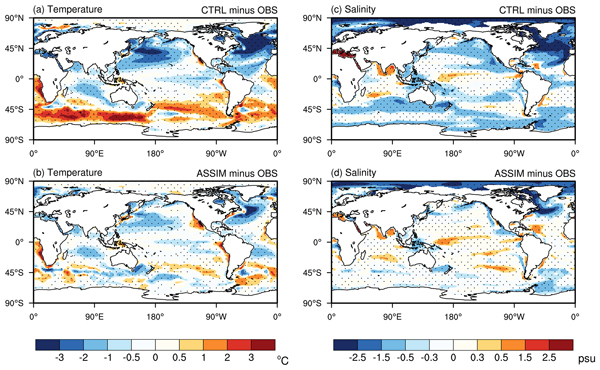
Improving climate predictions has significant socio-economic impacts. In this study, we develop and apply a new weakly coupled ocean data assimilation (WCODA) system to a coupled climate model. The WCODA system improves simulations of ocean temperature and salinity across many global regions. This system is meant to advance our understanding of the ocean's role in climate predictability.
Pengfei Shi, L. Ruby Leung, Bin Wang, Kai Zhang, Samson M. Hagos, and Shixuan Zhang
Geosci. Model Dev., 17, 3025–3040, https://doi.org/10.5194/gmd-17-3025-2024, https://doi.org/10.5194/gmd-17-3025-2024, 2024
Short summary
Short summary
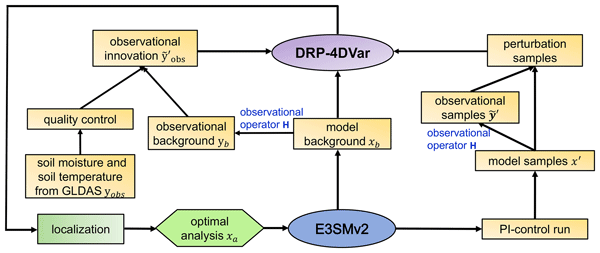
Improving climate predictions have profound socio-economic impacts. This study introduces a new weakly coupled land data assimilation (WCLDA) system for a coupled climate model. We demonstrate improved simulation of soil moisture and temperature in many global regions and throughout the soil layers. Furthermore, significant improvements are also found in reproducing the time evolution of the 2012 US Midwest drought. The WCLDA system provides the groundwork for future predictability studies.
Li Liu, Chao Sun, Xinzhu Yu, Hao Yu, Qingu Jiang, Xingliang Li, Ruizhe Li, Bin Wang, Xueshun Shen, and Guangwen Yang
Geosci. Model Dev., 16, 2833–2850, https://doi.org/10.5194/gmd-16-2833-2023, https://doi.org/10.5194/gmd-16-2833-2023, 2023
Short summary
Short summary
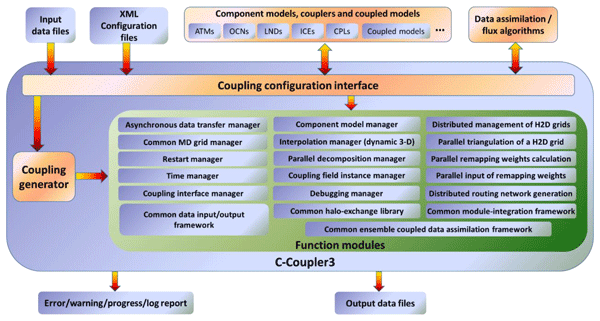
C-Coupler3.0 is an integrated coupler infrastructure with new features, i.e. a series of parallel-optimization technologies, a common halo-exchange library, a common module-integration framework, a common framework for conveniently developing a weakly coupled ensemble data assimilation system, and a common framework for flexibly inputting and outputting fields in parallel. It is able to handle coupling under much finer resolutions (e.g. more than 100 million horizontal grid cells).
Ming Yin, Yilun Han, Yong Wang, Wenqi Sun, Jianbo Deng, Daoming Wei, Ying Kong, and Bin Wang
Geosci. Model Dev., 16, 135–156, https://doi.org/10.5194/gmd-16-135-2023, https://doi.org/10.5194/gmd-16-135-2023, 2023
Short summary
Short summary
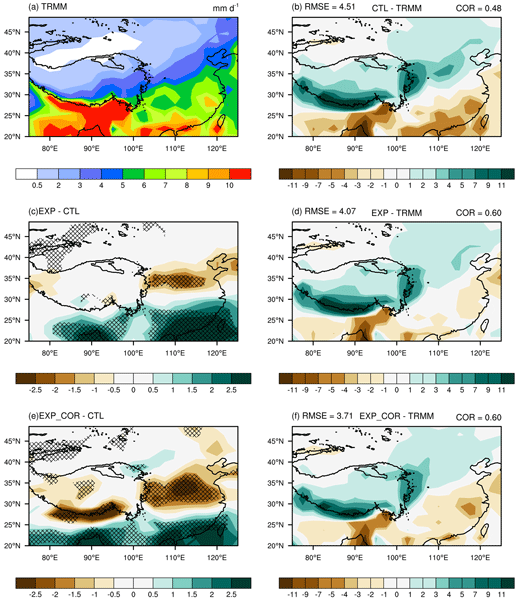
All global climate models (GCMs) use the grid-averaged surface heat fluxes to drive the atmosphere, and thus their horizontal variations within the grid cell are averaged out. In this regard, a novel scheme considering the variation and partitioning of the surface heat fluxes within the grid cell is developed. The scheme reduces the long-standing rainfall biases on the southern and eastern margins of the Tibetan Plateau. The performance of key variables at the global scale is also evaluated.
Cited articles
Adcroft, A., Hill, C., and Marshall, J.: Representation of Topography by Shaved Cells in a Height Coordinate Ocean Model, Mon. Weather Rev., 125, 2293–2315, https://doi.org/10.1175/1520-0493(1997)125<2293:ROTBSC>2.0.CO;2, 1997.
Akmaev, R. A.: WHOLE ATMOSPHERE MODELING: CONNECTING TERRESTRIAL AND SPACE WEATHER, Rev. Geophys., 49, 2011RG000364, https://doi.org/10.1029/2011RG000364, 2011.
Arakawa, A. and Lamb, V. R.: Computational Design of the Basic Dynamical Processes of the UCLA General Circulation Model, in: Methods in Computational Physics: Advances in Research and Applications, Vol. 17, Elsevier, 173–265, https://doi.org/10.1016/B978-0-12-460817-7.50009-4, 1977.
Baldwin, M. P. and Dunkerton, T. J.: Stratospheric Harbingers of Anomalous Weather Regimes, Science, 294, 581–584, https://doi.org/10.1126/science.1063315, 2001.
Becker, E. and Vadas, S. L.: Explicit Global Simulation of Gravity Waves in the Thermosphere, J. Geophys. Res.-Space, 125, e2020JA028034, https://doi.org/10.1029/2020JA028034, 2020.
Bendall, T. M. and Kent, J.: SWIFT: A Monotonic, Flux-Form Semi-Lagrangian Tracer Transport Scheme for Flow with Large Courant Numbers, Mon. Weather Rev., 153, 565–587, https://doi.org/10.1175/MWR-D-24-0110.1, 2025.
Borchert, S., Zhou, G., Baldauf, M., Schmidt, H., Zängl, G., and Reinert, D.: The upper-atmosphere extension of the ICON general circulation model (version: ua-icon-1.0), Geosci. Model Dev., 12, 3541–3569, https://doi.org/10.5194/gmd-12-3541-2019, 2019.
Chew, R., Schlutow, M., and Klein, R.: An unstable mode of the stratified atmosphere under the non-traditional Coriolis acceleration, J. Fluid Mech., 967, A21, https://doi.org/10.1017/jfm.2023.474, 2023.
Cui, Q., Dong, L., and Wang, B.: A deep-atmosphere extension in a nonhydrostatic dynamical core: formulation and idealized tests, Zenodo [code, data set], https://doi.org/10.5281/zenodo.19705647, 2026.
De Verdière, A. C. and Schopp, R.: Flows in a rotating spherical shell: the equatorial case, J. Fluid Mech., 276, 233–260, https://doi.org/10.1017/S0022112094002545, 1994.
Dong, L., Pu, Y., Li, Y., Liu, H., Liu, J., Deng, S., Huang, Y., Liu, M., Liu, S., and Wang, B.: A new global open planetary atmospheric model for Mars: GoPlanet-Mars V1, Chinese Sci. Bull., https://doi.org/10.1360/TB-2023-0699, 2024.
Dörffel, T., Papke, A., Klein, R., Ernst, N., and Smolarkiewicz, P. K.: Dynamics of tilted atmospheric vortices under asymmetric diabatic heating, Theor. Comp. Fluid Dyn., 35, 831–873, https://doi.org/10.1007/s00162-021-00591-x, 2021.
Fritts, D. C. and Alexander, M. J.: Gravity wave dynamics and effects in the middle atmosphere, Rev. Geophys., 41, 2001RG000106, https://doi.org/10.1029/2001RG000106, 2003.
Gassmann, A.: A global hexagonal C-grid non-hydrostatic dynamical core (ICON-IAP) designed for energetic consistency, Q. J. Roy. Meteor. Soc., 139, 152–175, https://doi.org/10.1002/qj.1960, 2013.
Gassmann, A. and Herzog, H.: Towards a consistent numerical compressible non-hydrostatic model using generalized Hamiltonian tools, Q. J. Roy. Meteor. Soc., 134, 1597–1613, https://doi.org/10.1002/qj.297, 2008.
Gerkema, T., Zimmerman, J. T. F., Maas, L. R. M., and Van Haren, H.: Geophysical and astrophysical fluid dynamics beyond the traditional approximation, Rev. Geophys., 46, 2006RG000220, https://doi.org/10.1029/2006RG000220, 2008.
Gettelman, A., Mills, M. J., Kinnison, D. E., Garcia, R. R., Smith, A. K., Marsh, D. R., Tilmes, S., Vitt, F., Bardeen, C. G., McInerny, J., Liu, H.-L., Solomon, S. C., Polvani, L. M., Emmons, L. K., Lamarque, J.-F., Richter, J. H., Glanville, A. S., Bacmeister, J. T., Phillips, A. S., Neale, R. B., Simpson, I. R., DuVivier, A. K., Hodzic, A., and Randel, W. J.: The Whole Atmosphere Community Climate Model Version 6 (WACCM6), J. Geophys. Res.-Atmos., 124, 12380–12403, https://doi.org/10.1029/2019JD030943, 2019.
Hollingsworth, A., Kållberg, P., Renner, V., and Burridge, D. M.: An internal symmetric computational instability, Q. J Roy. Meteor. Soc., 109, 417–428, https://doi.org/10.1002/qj.49710946012, 1983.
Igel, M. R. and Biello, J. A.: The Nontraditional Coriolis Terms and Tropical Convective Clouds, J. Atmos. Sci., 77, 3985–3998, https://doi.org/10.1175/JAS-D-20-0024.1, 2020.
Jablonowski, C. and Williamson, D. L.: A baroclinic instability test case for atmospheric model dynamical cores, Q. J. Roy. Meteor. Soc., 132, 2943–2975, https://doi.org/10.1256/qj.06.12, 2006.
Kasahara, A.: Various Vertical Coordinate Systems Used for Numerical Weather Prediction, Mon. Weather Rev., 102, 509–522, https://doi.org/10.1175/1520-0493(1974)102<0509:VVCSUF>2.0.CO;2, 1974.
Kelly, J. F., Alves, F. A. V. D. B., Eckermann, S. D., Giraldo, F. X., Reinecke, P. A., and Emmert, J. T.: A nonhydrostatic mass-conserving dynamical core for deep atmospheres of variable composition, J. Comput. Phys., 552, 114683, https://doi.org/10.1016/j.jcp.2026.114683, 2026.
Kim, Y., Eckermann, S. D., and Chun, H.: An overview of the past, present and future of gravity-wave drag parametrization for numerical climate and weather prediction models, Atmos.-Ocean, 41, 65–98, https://doi.org/10.3137/ao.410105, 2003.
Laprise, R.: The Euler Equations of Motion with Hydrostatic Pressure as an Independent Variable, Mon. Weather Rev., 120, 197–207, https://doi.org/10.1175/1520-0493(1992)120<0197:TEEOMW>2.0.CO;2, 1992.
Lauritzen, P., Jablonowski, C., Taylor, M., and Nair, R. (Eds.): Numerical Techniques for Global Atmospheric Models, Springer Berlin Heidelberg, Berlin, Heidelberg, https://doi.org/10.1007/978-3-642-11640-7, 2011.
Lauritzen, P. H., Nair, R. D., Herrington, A. R., Callaghan, P., Goldhaber, S., Dennis, J. M., Bacmeister, J. T., Eaton, B. E., Zarzycki, C. M., Taylor, M. A., Ullrich, P. A., Dubos, T., Gettelman, A., Neale, R. B., Dobbins, B., Reed, K. A., Hannay, C., Medeiros, B., Benedict, J. J., and Tribbia, J. J.: NCAR Release of CAM-SE in CESM2.0: A Reformulation of the Spectral Element Dynamical Core in Dry-Mass Vertical Coordinates With Comprehensive Treatment of Condensates and Energy, J. Adv. Model. Earth Sy., 10, 1537–1570, https://doi.org/10.1029/2017MS001257, 2018.
Li, J. and Dong, L.: A Long-Time-Step-Permitting Tracer Transport Model on the Regular Latitude–Longitude Grid, Adv. Atmos. Sci., 41, 493–508, https://doi.org/10.1007/s00376-023-2270-z, 2024.
Li, J., Wang, B., and Dong, L.: Analysis of and Solution to the Polar Numerical Noise Within the Shallow-Water Model on the Latitude-Longitude Grid, J. Adv. Model. Earth Sy., 12, e2020MS002047, https://doi.org/10.1029/2020MS002047, 2020.
Liang, X. and Chan, J. C. L.: The Effects of the Full Coriolis Force on the Structure and Motion of a Tropical Cyclone. Part I: Effects due to Vertical Motion, J. Atmos. Sci., 62, 3825–3830, https://doi.org/10.1175/JAS3545.1, 2005.
Lima, G. S.: A Global C-Staggered Composite Model for Shallow Water Equations with Latitude–Longitude Grid and Reductions in the Polar Regions, Int. J. Comput. Meth., 21, 2450029, https://doi.org/10.1142/S0219876224500294, 2024.
Lin, S.-J. and Rood, R. B.: Multidimensional Flux-Form Semi-Lagrangian Transport Schemes, Mon. Weather Rev., 124, 2046–2070, https://doi.org/10.1175/1520-0493(1996)124<2046:MFFSLT>2.0.CO;2, 1996.
Liu, H., Bardeen, C. G., Foster, B. T., Lauritzen, P., Liu, J., Lu, G., Marsh, D. R., Maute, A., McInerney, J. M., Pedatella, N. M., Qian, L., Richmond, A. D., Roble, R. G., Solomon, S. C., Vitt, F. M., and Wang, W.: Development and Validation of the Whole Atmosphere Community Climate Model With Thermosphere and Ionosphere Extension (WACCM-X 2.0), J. Adv. Model. Earth Sy., 10, 381–402, https://doi.org/10.1002/2017MS001232, 2018.
Liu, S., Dong, L., Xi, X., Cheng, X., Liu, J., Pu, Y., Li, Y., Liu, H., Liu, M., Xue, W., Cao, J., and Wang, B.: The Fully Interactive Martian Dust Cycle Simulations by the GoMars Model, Adv. Atmos. Sci., 43, 461–476, https://doi.org/10.1007/s00376-025-5190-2, 2026.
Marshall, J., Hill, C., Perelman, L., and Adcroft, A.: Hydrostatic, quasi-hydrostatic, and nonhydrostatic ocean modeling, J. Geophys. Res., 102, 5733–5752, https://doi.org/10.1029/96JC02776, 1997.
Nolan, D. S., Montgomery, M. T., and Grasso, L. D.: The Wavenumber-One Instability and Trochoidal Motion of Hurricane-like Vortices, J. Atmos. Sci., 58, 3243–3270, https://doi.org/10.1175/1520-0469(2001)058<3243:TWOIAT>2.0.CO;2, 2001.
Ong, H. and Roundy, P. E.: Linear effects of nontraditional Coriolis terms on intertropical convergence zone forced large-scale flow, Q. J. Roy. Meteor. Soc., 145, 2445–2453, https://doi.org/10.1002/qj.3572, 2019.
Päschke, E., Marschalik, P., Owinoh, A. Z., and Klein, R.: Motion and structure of atmospheric mesoscale baroclinic vortices: dry air and weak environmental shear, TU Berlin, https://doi.org/10.14279/DEPOSITONCE-6371, 2012.
Phillips, N. A.: The Equations of Motion for a Shallow Rotating Atmosphere and the “Traditional Approximation”, J. Atmos. Sci., 23, 626–628, https://doi.org/10.1175/1520-0469(1966)023<0626:TEOMFA>2.0.CO;2, 1966.
Polvani, L. M.: Two-layer geostrophic vortex dynamics. Part 2. Alignment and two-layer V-states, J. Fluid Mech., 225, 241–270, https://doi.org/10.1017/S0022112091002045, 1991.
Reasor, P. D. and Montgomery, M. T.: Three-Dimensional Alignment and Corotation of Weak, TC-like Vortices via Linear Vortex Rossby Waves, J. Atmos. Sci., 58, 2306–2330, https://doi.org/10.1175/1520-0469(2001)058<2306:TDAACO>2.0.CO;2, 2001.
Reed, K. A. and Jablonowski, C.: An Analytic Vortex Initialization Technique for Idealized Tropical Cyclone Studies in AGCMs, Mon. Weather Rev., 139, 689–710, https://doi.org/10.1175/2010MWR3488.1, 2011.
Ringler, T. D., Thuburn, J., Klemp, J. B., and Skamarock, W. C.: A unified approach to energy conservation and potential vorticity dynamics for arbitrarily-structured C-grids, J. Comput. Phys., 229, 3065–3090, https://doi.org/10.1016/j.jcp.2009.12.007, 2010.
Satoh, M., Matsuno, T., Tomita, H., Miura, H., Nasuno, T., and Iga, S.: Nonhydrostatic icosahedral atmospheric model (NICAM) for global cloud resolving simulations, J. Comput. Phys., 227, 3486–3514, https://doi.org/10.1016/j.jcp.2007.02.006, 2008.
Schecter, D. A., Montgomery, M. T., and Reasor, P. D.: A Theory for the Vertical Alignment of a Quasigeostrophic Vortex, J. Atmos. Sci., 59, 150–168, https://doi.org/10.1175/1520-0469(2002)059<0150:ATFTVA>2.0.CO;2, 2002.
Simmons, A. J. and Burridge, D. M.: An Energy and Angular-Momentum Conserving Vertical Finite-Difference Scheme and Hybrid Vertical Coordinates, Mon. Weather Rev., 109, 758–766, https://doi.org/10.1175/1520-0493(1981)109<0758:AEAAMC>2.0.CO;2, 1981.
Skamarock, W. C., Klemp, J. B., Duda, M. G., Fowler, L. D., Park, S.-H., and Ringler, T. D.: A Multiscale Nonhydrostatic Atmospheric Model Using Centroidal Voronoi Tesselations and C-Grid Staggering, Mon. Weather Rev., 140, 3090–3105, https://doi.org/10.1175/MWR-D-11-00215.1, 2012.
Skamarock, W. C., Ong, H., and Klemp, J. B.: A Fully Compressible Nonhydrostatic Deep-Atmosphere Equations Solver for MPAS, Mon. Weather Rev., 149, 571–583, https://doi.org/10.1175/MWR-D-20-0286.1, 2021.
Staniforth, A. and Thuburn, J.: Horizontal grids for global weather and climate prediction models: a review, Q. J Roy. Meteor. Soc., 138, 1–26, https://doi.org/10.1002/qj.958, 2012.
Staniforth, A. and White, A. A.: Further non-separable exact solutions of the deep- and shallow-atmosphere equations, Atmos. Sci. Lett., 12, 356–361, https://doi.org/10.1002/asl.349, 2011.
Thuburn, J., Wood, N., and Staniforth, A.: Normal modes of deep atmospheres. I: Spherical geometry, Q. J. Roy. Meteor. Soc., 128, 1771–1792, https://doi.org/10.1256/003590002320603403, 2002.
Ullrich, P. A., Melvin, T., Jablonowski, C., and Staniforth, A.: A proposed baroclinic wave test case for deep- and shallow-atmosphere dynamical cores, Q. J. Roy. Meteor. Soc., 140, 1590–1602, https://doi.org/10.1002/qj.2241, 2014.
Vallis, G. K.: Atmospheric and Oceanic Fluid Dynamics: Fundamentals and Large-Scale Circulation, 2nd edn., Cambridge University Press, https://doi.org/10.1017/9781107588417, 2017.
White, A. A. and Bromley, R. A.: Dynamically consistent, quasi-hydrostatic equations for global models with a complete representation of the Coriolis force, Q. J. Roy. Meteor. Soc., 121, 399–418, https://doi.org/10.1002/qj.49712152208, 1995.
White, A. A., Hoskins, B. J., Roulstone, I., and Staniforth, A.: Consistent approximate models of the global atmosphere: shallow, deep, hydrostatic, quasi-hydrostatic and non-hydrostatic, Q. J. Roy. Meteor. Soc., 131, 2081–2107, https://doi.org/10.1256/qj.04.49, 2005.
Wicker, L. J. and Skamarock, W. C.: Time-Splitting Methods for Elastic Models Using Forward Time Schemes, Mon. Weather Rev., 130, 2088–2097, https://doi.org/10.1175/1520-0493(2002)130<2088:TSMFEM>2.0.CO;2, 2002.
Williamson, D. L.: The Evolution of Dynamical Cores for Global Atmospheric Models, J. Meteorol. Soc. Jpn., 85B, 241–269, https://doi.org/10.2151/jmsj.85B.241, 2007.
Williamson, D. L., Drake, J. B., Hack, J. J., Jakob, R., and Swarztrauber, P. N.: A standard test set for numerical approximations to the shallow water equations in spherical geometry, J. Comput. Phys., 102, 211–224, https://doi.org/10.1016/S0021-9991(05)80016-6, 1992.
Wood, N. and Staniforth, A.: The deep-atmosphere Euler equations with a mass-based vertical coordinate, Q. J. Roy. Meteor. Soc., 129, 1289–1300, https://doi.org/10.1256/qj.02.153, 2003.
Wood, N., Staniforth, A., White, A., Allen, T., Diamantakis, M., Gross, M., Melvin, T., Smith, C., Vosper, S., Zerroukat, M., and Thuburn, J.: An inherently mass-conserving semi-implicit semi-Lagrangian discretization of the deep-atmosphere global non-hydrostatic equations, Q. J. Roy. Meteor. Soc., 140, 1505–1520, https://doi.org/10.1002/qj.2235, 2014.
Yatunin, D., Byrne, S., Kawczynski, C., Kandala, S., Bozzola, G., Sridhar, A., Shen, Z., Jaruga, A., Sloan, J., He, J., Huang, D. Z., Barra, V., Chew, R., Boral, A., Chen, Y., Knoth, O., Ullrich, P., Mbengue, C., and Schneider, T.: The Climate Modeling Alliance Atmosphere Dynamical Core: Concepts, Numerics, and Scaling, J. Adv. Model. Earth Sy., 18, e2025MS005014, https://doi.org/10.1029/2025MS005014, 2026.
Zängl, G., Reinert, D., Rípodas, P., and Baldauf, M.: The ICON (ICOsahedral Non-hydrostatic) modelling framework of DWD and MPI-M: Description of the non-hydrostatic dynamical core, Q. J. Roy. Meteor. Soc., 141, 563–579, https://doi.org/10.1002/qj.2378, 2015.
Zhang, Y., Li, J., Yu, R., Zhang, S., Liu, Z., Huang, J., and Zhou, Y.: A Layer-Averaged Nonhydrostatic Dynamical Framework on an Unstructured Mesh for Global and Regional Atmospheric Modeling: Model Description, Baseline Evaluation, and Sensitivity Exploration, J. Adv. Model. Earth Sy., 11, 1685–1714, https://doi.org/10.1029/2018MS001539, 2019.
Short summary
Many atmospheric models use shallow approximation that work well when the model top is low. As models top now reach higher layers, these approximation need to be relaxed. We develop a deep atmosphere dynamical core(GMCORE), including full deep atmosphere dynamics, and spherical geometry. The tests case with idealized baroclinic waves and tropical cyclones show that the new model reproduces known results and can alter storm trajectory, suggesting value for future high-top and tropical studies.
Many atmospheric models use shallow approximation that work well when the model top is low. As...
Altmetrics
Final-revised paper
Preprint