Articles | Volume 19, issue 21
https://doi.org/10.5194/gmd-19-10447-2026
Development and technical paper
 | 
04 Nov 2026
Development and technical paper |  | 04 Nov 2026

Hybrid implicit–explicit XFEM simulation of injection-induced seismicity: resolving multi-scale rupture nucleation and dynamics

Mohammad Sabah, Mauro Cacace, Inga Berre, Iman R. Kivi, and Hannes Hofmann

Related authors

PyMeshIt: An open-source geological solid modeling and tetrahedral meshing engine integrated in PZero
Waqas Hussain, Mauro Cacace, Andrea Bistacchi, and Riccardo Monti
EGUsphere, https://doi.org/10.5194/egusphere-2026-4815,https://doi.org/10.5194/egusphere-2026-4815, 2026
This preprint is open for discussion and under review for Solid Earth (SE).
Short summary
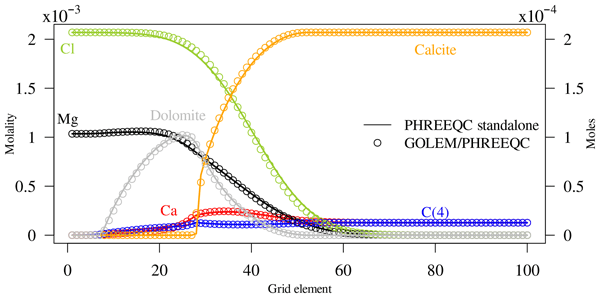
Towards fully coupled Thermo-Hydro-Mechanical-Chemical (THMC) modelling in advanced reservoir engineering: GOLEM-PHREEQC
Marco De Lucia, Samuele Frigo, Max Lübke, Mauro Cacace, Elena Petrova, Hannes Hofmann, Magdalena Scheck-Wenderoth, and Guido Blöcher
Adv. Geosci., 67, 117–127, https://doi.org/10.5194/adgeo-67-117-2026,https://doi.org/10.5194/adgeo-67-117-2026, 2026
Short summary
Exploiting physics-based machine learning to quantify geodynamic effects – insights from the Alpine region
Denise Degen, Ajay Kumar, Magdalena Scheck-Wenderoth, and Mauro Cacace
Geosci. Model Dev., 18, 9219–9236, https://doi.org/10.5194/gmd-18-9219-2025,https://doi.org/10.5194/gmd-18-9219-2025, 2025
Short summary
Large-scale reservoir modeling of the Vendenheim geothermal site (France)
Javier Abreu-Torres, Gergő Hutka, Guido Blöcher, Mauro Cacace, Vincent Magnenet, and Jean Schmittbuhl
Adv. Geosci., 65, 117–125, https://doi.org/10.5194/adgeo-65-117-2025,https://doi.org/10.5194/adgeo-65-117-2025, 2025
Short summary
Physics-based numerical evaluation of High-Temperature Aquifer Thermal Energy Storage (HT-ATES) in the Upper Jurassic reservoir of the German Molasse Basin
Kalliopi Tzoufka, Guido Blöcher, Mauro Cacace, Daniela Pfrang, and Kai Zosseder
Adv. Geosci., 65, 103–111, https://doi.org/10.5194/adgeo-65-103-2024,https://doi.org/10.5194/adgeo-65-103-2024, 2024
Short summary

Cited articles

Alkhimenkov, Y., Khakimova, L., and Podladchikov, Y.: Stability of discrete schemes of Biot's poroelastic equations, Geophys. J. Int., 225, 354–377, 2021. 
Bandis, S. C., Lumsden, A. C., and Barton, N. R.: Fundamentals of rock joint deformation, Int. J. Rock Mech. Min., 20, 249–268, https://doi.org/10.1016/0148-9062(83)90595-8, 1983. 
Biot, M. A.: Theory of propagation of elastic waves in a fluid-saturated porous solid. II. Higher frequency range, J. Acoust. Soc. Am., 28, 179–191, 1956. 
Bommer, J. J.: Earthquake hazard and risk analysis for natural and induced seismicity: towards objective assessments in the face of uncertainty, B. Earthq. Eng., 20, 2825–3069, 2022. 
Boyet, A., De Simone, S., Ge, S., and Vilarrasa, V.: Poroelastic stress relaxation, slip stress transfer and friction weakening controlled post-injection seismicity at the Basel Enhanced Geothermal System, Commun. Earth Environ., 4, 104, https://doi.org/10.1038/s43247-023-00764-y, 2023. 
Download
Short summary

Injecting fluids underground for energy projects can trigger earthquakes. Predicting these events is difficult because underground pressure changes slowly, while faults can move in a fraction of a second. We developed a computer method that switches between two ways of calculating these processes. In our test, it reduced computing time by 62 % while giving similar estimates of earthquake size and total fault movement. Differences in the fastest movements show that further testing is needed.

Share
Altmetrics
Final-revised paper
Preprint