Articles | Volume 19, issue 20
https://doi.org/10.5194/gmd-19-10243-2026
Development and technical paper
 | 
28 Oct 2026
Development and technical paper |  | 28 Oct 2026

Calibration guidelines and a runoff-isotope module for lake proxy system modeling (PRYSM v2.0)

Rebecca G. Topness, Elizabeth K. Thomas, Michaela Fendrock, and Gerard A. Otiniano

Related authors

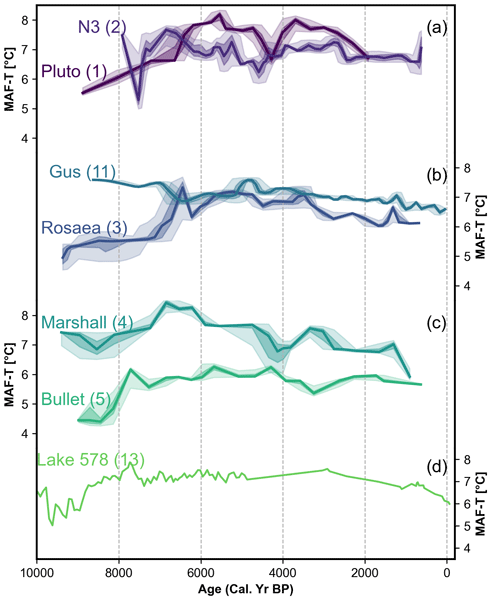
Coherent regional expressions of Holocene summer temperature on Greenland
Gerard A. Otiniano, Elizabeth K. Thomas, Olivia J. Truax, Eric J. Steig, Anne de Vernal, Sudip Acharya, Jason P. Briner, Joshua K. Cuzzone, Sam Z. Mark, and Greg Hakim
EGUsphere, https://doi.org/10.5194/egusphere-2026-5983,https://doi.org/10.5194/egusphere-2026-5983, 2026
This preprint is open for discussion and under review for Climate of the Past (CP).
Short summary
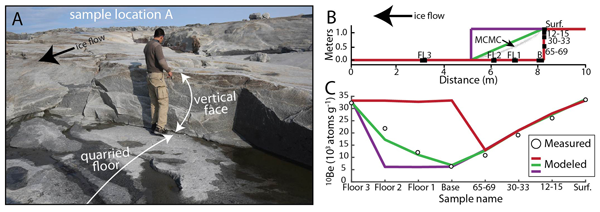
Holocene-like summer climate during Marine Isotope Stage 11 in northwestern Greenland
John Michael N. Aguilar, Elizabeth K. Thomas, Diana S. Aga, Paul R. Bierman, Jason P. Briner, Isla S. Castañeda, and Andrew J. Christ
Clim. Past, 22, 1757–1779, https://doi.org/10.5194/cp-22-1757-2026,https://doi.org/10.5194/cp-22-1757-2026, 2026
Short summary
Holocene temperatures in southwestern Greenland controlled by topography, ice sheet proximity, and oceanic conditions
Sudip Acharya, Allison A. Cluett, Amy L. Grogan, Jason P. Briner, Isla S. Castañeda, and Elizabeth K. Thomas
Clim. Past, 22, 1401–1421, https://doi.org/10.5194/cp-22-1401-2026,https://doi.org/10.5194/cp-22-1401-2026, 2026
Short summary
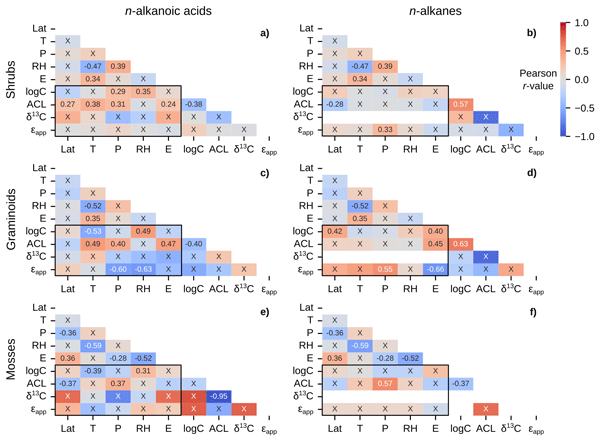
Ecological and environmental controls on plant wax production and stable isotope fractionation in modern terrestrial Arctic vegetation
Kurt R. Lindberg, Elizabeth K. Thomas, Martha K. Raynolds, Helga Bültmann, and Jonathan H. Raberg
Biogeosciences, 23, 2503–2523, https://doi.org/10.5194/bg-23-2503-2026,https://doi.org/10.5194/bg-23-2503-2026, 2026
Short summary
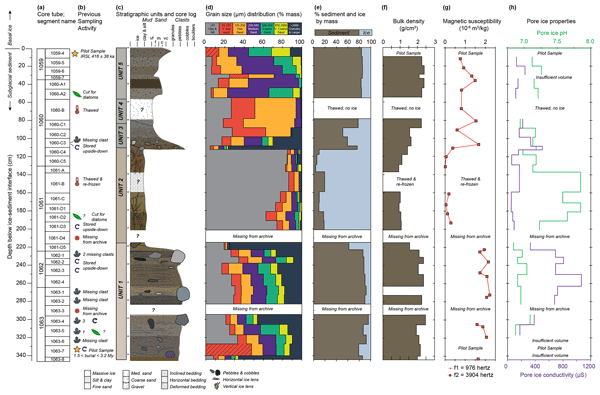
Scientific history, sampling approach, and physical characterization of the Camp Century subglacial material, a rare archive from beneath the Greenland Ice Sheet
Paul R. Bierman, Andrew J. Christ, Catherine M. Collins, Halley M. Mastro, Juliana Souza, Pierre-Henri Blard, Stefanie Brachfeld, Zoe R. Courville, Tammy M. Rittenour, Elizabeth K. Thomas, Jean-Louis Tison, and François Fripiat
The Cryosphere, 18, 4029–4052, https://doi.org/10.5194/tc-18-4029-2024,https://doi.org/10.5194/tc-18-4029-2024, 2024
Short summary

Cited articles

Acharya, S., Cluett, A. A., Grogan, A. L., Briner, J. P., Castañeda, I. S., and Thomas, E. K.: Holocene temperatures in southwestern Greenland controlled by topography, ice sheet proximity, and oceanic conditions, Clim. Past, 22, 1401–1421, https://doi.org/10.5194/cp-22-1401-2026, 2026. 
Almeida, M. C., Shevchuk, Y., Kirillin, G., Soares, P. M. M., Cardoso, R. M., Matos, J. P., Rebelo, R. M., Rodrigues, A. C., and Coelho, P. S.: Modeling reservoir surface temperatures for regional and global climate models: a multi-model study on the inflow and level variation effects, Geosci. Model Dev., 15, 173–197, https://doi.org/10.5194/gmd-15-173-2022, 2022. 
Arp, C. D., Jones, B. M., Whitman, M., Larsen, A., and Urban, F. E.: Lake Temperature and Ice Cover Regimes in the Alaskan Subarctic and Arctic: Integrated Monitoring, Remote Sensing, and Modeling1, J. Am. Water Resour. As., 46, 777–791, https://doi.org/10.1111/j.1752-1688.2010.00451.x, 2010. 
Bigham Stephens, D. L., Carlson, R. E., Horsburgh, C. A., Hoyer, M. V., Bachmann, R. W., and Canfield, D. E.: Regional distribution of Secchi disk transparency in waters of the United States, Lake Reserv. Manage., 31, 55–63, https://doi.org/10.1080/10402381.2014.1001539, 2015. 
Birkel, C., Miller, J., Watson, A., Anh Trinh, D., Durán-Quesada, A. M., Sánchez-Murillo, R., Soulsby, C., Terzer-Wassmuth, S., Tetzlaff, D., Uhlenbrook, S., Vystavna, Y., and Yoshimura, K.: Demystifying the art of isotope-enabled hydrological and climate modelling, Sci. Total Environ., 959, 178242, https://doi.org/10.1016/j.scitotenv.2024.178242, 2025. 
Download
Short summary
Lake models are powerful tools for disentangling complex past climate data preserved in sediments. These models can be hard to set-up for lakes that are not well-observed. We improve an existing model with code to simulate water runoff and establish guidelines for setting-up the model when data are scarce. Using our workflow, more scientists can apply this tool to more lakes and gain a better understanding of the climate histories stored in their sediments.
Share
Altmetrics
Final-revised paper
Preprint