Articles | Volume 18, issue 23
https://doi.org/10.5194/gmd-18-9897-2025
© Author(s) 2025. This work is distributed under
the Creative Commons Attribution 4.0 License.
https://doi.org/10.5194/gmd-18-9897-2025
© Author(s) 2025. This work is distributed under
the Creative Commons Attribution 4.0 License.
Validation of climate mitigation pathways

Pascal Weigmann
CORRESPONDING AUTHOR
Potsdam Institute for Climate Impact Research (PIK), Member of the Leibniz Association, Potsdam, Germany
Rahel Mandaroux
CORRESPONDING AUTHOR
Potsdam Institute for Climate Impact Research (PIK), Member of the Leibniz Association, Potsdam, Germany
Fabrice Lécuyer
Potsdam Institute for Climate Impact Research (PIK), Member of the Leibniz Association, Potsdam, Germany
Anne Merfort
Potsdam Institute for Climate Impact Research (PIK), Member of the Leibniz Association, Potsdam, Germany
Tabea Dorndorf
Potsdam Institute for Climate Impact Research (PIK), Member of the Leibniz Association, Potsdam, Germany
Johanna Hoppe
Potsdam Institute for Climate Impact Research (PIK), Member of the Leibniz Association, Potsdam, Germany
Jarusch Muessel
Potsdam Institute for Climate Impact Research (PIK), Member of the Leibniz Association, Potsdam, Germany
Robert Pietzcker
Potsdam Institute for Climate Impact Research (PIK), Member of the Leibniz Association, Potsdam, Germany
Oliver Richters
Potsdam Institute for Climate Impact Research (PIK), Member of the Leibniz Association, Potsdam, Germany
Lavinia Baumstark
Potsdam Institute for Climate Impact Research (PIK), Member of the Leibniz Association, Potsdam, Germany
Elmar Kriegler
Potsdam Institute for Climate Impact Research (PIK), Member of the Leibniz Association, Potsdam, Germany
Nico Bauer
Potsdam Institute for Climate Impact Research (PIK), Member of the Leibniz Association, Potsdam, Germany
Falk Benke
Potsdam Institute for Climate Impact Research (PIK), Member of the Leibniz Association, Potsdam, Germany
Chen Chris Gong
Potsdam Institute for Climate Impact Research (PIK), Member of the Leibniz Association, Potsdam, Germany
Gunnar Luderer
Potsdam Institute for Climate Impact Research (PIK), Member of the Leibniz Association, Potsdam, Germany
Related authors
No articles found.
Detlef van Vuuren, Brian O'Neill, Claudia Tebaldi, Louise Chini, Pierre Friedlingstein, Tomoko Hasegawa, Keywan Riahi, Benjamin Sanderson, Bala Govindasamy, Nico Bauer, Veronika Eyring, Cheikh Fall, Katja Frieler, Matthew Gidden, Laila Gohar, Andrew Jones, Andrew King, Reto Knutti, Elmar Kriegler, Peter Lawrence, Chris Lennard, Jason Lowe, Camila Mathison, Shahbaz Mehmood, Luciana Prado, Qiang Zhang, Steven Rose, Alexander Ruane, Carl-Friederich Schleussner, Roland Seferian, Jana Sillmann, Chris Smith, Anna Sörensson, Swapna Panickal, Kaoru Tachiiri, Naomi Vaughan, Saritha Vishwanathan, Tokuta Yokohata, and Tilo Ziehn
EGUsphere, https://doi.org/10.5194/egusphere-2024-3765, https://doi.org/10.5194/egusphere-2024-3765, 2025
Short summary
Short summary
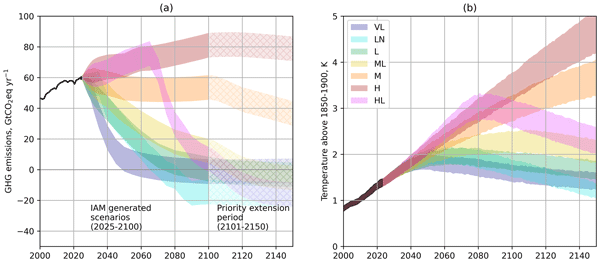
We propose a set of six plausible 21st century emission scenarios, and their multi-century extensions, that will be used by the international community of climate modeling centers to produce the next generation of climate projections. These projections will support climate, impact and mitigation researchers, provide information to practitioners to address future risks from climate change, and contribute to policymakers’ considerations of the trade-offs among various levels of mitigation.
Chen Chris Gong, Falko Ueckerdt, Robert Pietzcker, Adrian Odenweller, Wolf-Peter Schill, Martin Kittel, and Gunnar Luderer
Geosci. Model Dev., 16, 4977–5033, https://doi.org/10.5194/gmd-16-4977-2023, https://doi.org/10.5194/gmd-16-4977-2023, 2023
Short summary
Short summary
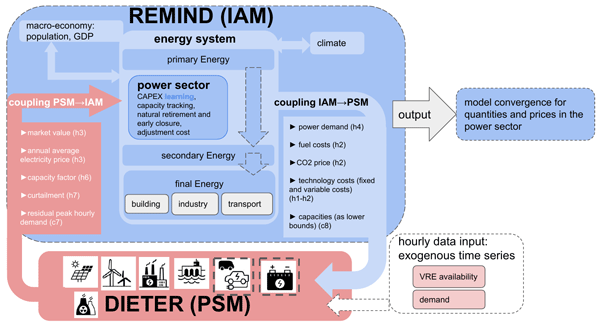
To mitigate climate change, the global economy must drastically reduce its greenhouse gas emissions, for which the power sector plays a key role. Until now, long-term models which simulate this transformation cannot always accurately depict the power sector due to a lack of resolution. Our work bridges this gap by linking a long-term model to an hourly model. The result is an almost full harmonization of the models in generating a power sector mix until 2100 with hourly resolution.
Jarmo S. Kikstra, Zebedee R. J. Nicholls, Christopher J. Smith, Jared Lewis, Robin D. Lamboll, Edward Byers, Marit Sandstad, Malte Meinshausen, Matthew J. Gidden, Joeri Rogelj, Elmar Kriegler, Glen P. Peters, Jan S. Fuglestvedt, Ragnhild B. Skeie, Bjørn H. Samset, Laura Wienpahl, Detlef P. van Vuuren, Kaj-Ivar van der Wijst, Alaa Al Khourdajie, Piers M. Forster, Andy Reisinger, Roberto Schaeffer, and Keywan Riahi
Geosci. Model Dev., 15, 9075–9109, https://doi.org/10.5194/gmd-15-9075-2022, https://doi.org/10.5194/gmd-15-9075-2022, 2022
Short summary
Short summary
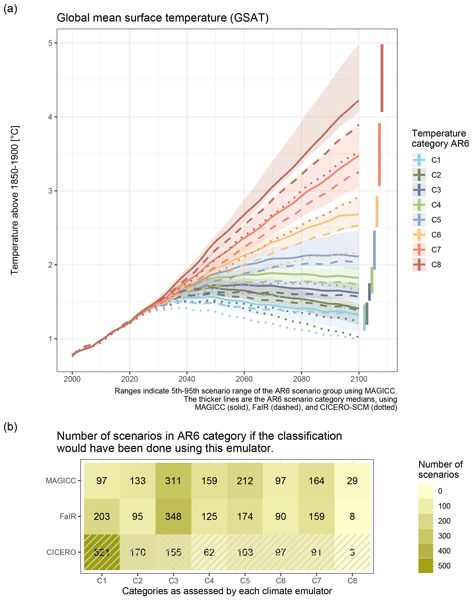
Assessing hundreds or thousands of emission scenarios in terms of their global mean temperature implications requires standardised procedures of infilling, harmonisation, and probabilistic temperature assessments. We here present the open-source
climate-assessmentworkflow that was used in the IPCC AR6 Working Group III report. The paper provides key insight for anyone wishing to understand the assessment of climate outcomes of mitigation pathways in the context of the Paris Agreement.
Lavinia Baumstark, Nico Bauer, Falk Benke, Christoph Bertram, Stephen Bi, Chen Chris Gong, Jan Philipp Dietrich, Alois Dirnaichner, Anastasis Giannousakis, Jérôme Hilaire, David Klein, Johannes Koch, Marian Leimbach, Antoine Levesque, Silvia Madeddu, Aman Malik, Anne Merfort, Leon Merfort, Adrian Odenweller, Michaja Pehl, Robert C. Pietzcker, Franziska Piontek, Sebastian Rauner, Renato Rodrigues, Marianna Rottoli, Felix Schreyer, Anselm Schultes, Bjoern Soergel, Dominika Soergel, Jessica Strefler, Falko Ueckerdt, Elmar Kriegler, and Gunnar Luderer
Geosci. Model Dev., 14, 6571–6603, https://doi.org/10.5194/gmd-14-6571-2021, https://doi.org/10.5194/gmd-14-6571-2021, 2021
Short summary
Short summary
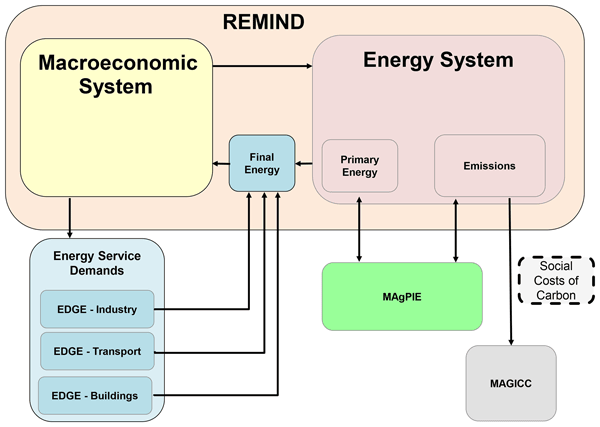
This paper presents the new and open-source version 2.1 of the REgional Model of INvestments and Development (REMIND) with the aim of improving code documentation and transparency. REMIND is an integrated assessment model (IAM) of the energy-economic system. By answering questions like
Can the world keep global warming below 2 °C?and, if so,
Under what socio-economic conditions and applying what technological options?, it is the goal of REMIND to explore consistent transformation pathways.
Claudia Tebaldi, Kevin Debeire, Veronika Eyring, Erich Fischer, John Fyfe, Pierre Friedlingstein, Reto Knutti, Jason Lowe, Brian O'Neill, Benjamin Sanderson, Detlef van Vuuren, Keywan Riahi, Malte Meinshausen, Zebedee Nicholls, Katarzyna B. Tokarska, George Hurtt, Elmar Kriegler, Jean-Francois Lamarque, Gerald Meehl, Richard Moss, Susanne E. Bauer, Olivier Boucher, Victor Brovkin, Young-Hwa Byun, Martin Dix, Silvio Gualdi, Huan Guo, Jasmin G. John, Slava Kharin, YoungHo Kim, Tsuyoshi Koshiro, Libin Ma, Dirk Olivié, Swapna Panickal, Fangli Qiao, Xinyao Rong, Nan Rosenbloom, Martin Schupfner, Roland Séférian, Alistair Sellar, Tido Semmler, Xiaoying Shi, Zhenya Song, Christian Steger, Ronald Stouffer, Neil Swart, Kaoru Tachiiri, Qi Tang, Hiroaki Tatebe, Aurore Voldoire, Evgeny Volodin, Klaus Wyser, Xiaoge Xin, Shuting Yang, Yongqiang Yu, and Tilo Ziehn
Earth Syst. Dynam., 12, 253–293, https://doi.org/10.5194/esd-12-253-2021, https://doi.org/10.5194/esd-12-253-2021, 2021
Short summary
Short summary
We present an overview of CMIP6 ScenarioMIP outcomes from up to 38 participating ESMs according to the new SSP-based scenarios. Average temperature and precipitation projections according to a wide range of forcings, spanning a wider range than the CMIP5 projections, are documented as global averages and geographic patterns. Times of crossing various warming levels are computed, together with benefits of mitigation for selected pairs of scenarios. Comparisons with CMIP5 are also discussed.
Cited articles
Anderson, K.: Wrong tool for the job: Debating the bedrock of climate-change mitigation scenarios, Nature, 573, 348–348, 2019. a
Baumstark, L., Bauer, N., Benke, F., Bertram, C., Bi, S., Gong, C. C., Dietrich, J. P., Dirnaichner, A., Giannousakis, A., Hilaire, J., Klein, D., Koch, J., Leimbach, M., Levesque, A., Madeddu, S., Malik, A., Merfort, A., Merfort, L., Odenweller, A., Pehl, M., Pietzcker, R. C., Piontek, F., Rauner, S., Rodrigues, R., Rottoli, M., Schreyer, F., Schultes, A., Soergel, B., Soergel, D., Strefler, J., Ueckerdt, F., Kriegler, E., and Luderer, G.: REMIND2.1: transformation and innovation dynamics of the energy-economic system within climate and sustainability limits, Geosci. Model Dev., 14, 6571–6603, https://doi.org/10.5194/gmd-14-6571-2021, 2021. a, b
Beck, S. and Oomen, J.: Imagining the corridor of climate mitigation – What is at stake in IPCC's politics of anticipation?, Environmental Science & Policy, 123, 169–178, 2021. a
Bellona: Norway's Longship CCS project, https://network.bellona.org/content/uploads/sites/3/2020/10/Longship-Briefing_Bellona-1.pdf (last access: 5 December 2025), 2022. a
Bertram, C., Brutschin, E., Drouet, L., Luderer, G., van Ruijven, B., Aleluia Reis, L., Baptista, L. B., de Boer, H.-S., Cui, R., Daioglou, V., Fosse, F., Fragkiadakis, D., Fricko, O., Fujimori, S., Hultman, N., Iyer, G., Keramidas, K., Krey, V., Kriegler, E., Lamboll, R. D., Mandaroux, R., Rochedo, P., Rogelj, J., Schaeffer, R., Silva, D., Tagomori, I., van Vuuren, D., Vrontisi, Z., and Riahi, K.: Feasibility of peak temperature targets in light of institutional constraints, Nature Climate Change, 14, 954–960, 2024. a
Brutschin, E., Pianta, S., Tavoni, M., Riahi, K., Bosetti, V., Marangoni, G., and Van Ruijven, B. J.: A multidimensional feasibility evaluation of low-carbon scenarios, Environmental Research Letters, 16, 064069, https://doi.org/10.1088/1748-9326/abf0ce, 2021. a
Bui, M., Adjiman, C. S., Bardow, A., Anthony, E. J., Boston, A., Brown, S., Fennell, P. S., Fuss, S., Galindo, A., Hackett, L. A., Hallett, J. P., Herzog, H. J., Jackson, G., Kemper, J., Krevor, S., Maitland, G. C., Matuszewski, M., Metcalfe, I. S., Petit, C., Puxty, G., Reimer, J., Reiner, D. M., Rubin, E. S., Scott, S. A., Shah, N., Smit, B., Trusler, J. P. M., Webley, P., Wilcox, J., and Mac Dowell, N.: Carbon capture and storage (CCS): the way forward, Energy & Environmental Science, 11, 1062–1176, 2018. a
Carbon Brief: Just 15 countries account for 98 % of new coal-power development, https://www.carbonbrief.org/guest-post-just-15-countries-account-for-98-of-new-coal-power-development/ (last access: 10 October 2024), 2024. a
Cointe, B., Cassen, C., and Nadaï, A.: Organising policy-relevant knowledge for climate action: integrated assessment modelling, the IPCC, and the emergence of a collective expertise on socioeconomic emission scenarios, Science & Technology Studies, https://doi.org/10.23987/sts.65031, 2019. a
Creutzig, F., Hilaire, J., Nemet, G., Müller-Hansen, F., and Minx, J. C.: Technological innovation enables low cost climate change mitigation, Energy Research & Social Science, 105, 103276, https://doi.org/10.1016/j.erss.2023.103276, 2023. a
Edenhofer, O. and Minx, J.: Mapmakers and navigators, facts and values, Science, 345, 37–38, 2014. a
Giannousakis, A., Hilaire, J., Nemet, G. F., Luderer, G., Pietzcker, R. C., Rodrigues, R., Baumstark, L., and Kriegler, E.: How uncertainty in technology costs and carbon dioxide removal availability affect climate mitigation pathways, Energy, 216, 119253, https://doi.org/10.1016/j.energy.2020.119253, 2021. a
IEA: Global EV Outlook 2024, licence: CC BY 4.0, https://www.iea.org/reports/global-ev-outlook-2024 (last access: 5 December 2025), 2024. a
IOGP: Creating a sustainable business case for CCS value chains – the needed funding and de-risking mechanisms, https://iogpeurope.org/wp-content/uploads/2023/11/Creating-a-Business-Case-for-CCS-Value-Chains-IOGP-Europe.pdf (last access: 5 December 2025), 2023. a
IPCC: IPCC fifth assessment report – synthesis report, IPPC Rome, Italy, https://www.ipcc.ch/site/assets/uploads/2018/02/SYR_AR5_FINAL_full.pdf last access: 5 December 2025, 2014. a
IRENA: Renewable energy highlights, https://www.irena.org/-/media/Files/IRENA/Agency/Publication/2023/Jul/Renewable_energy_highlights_July_2023.pdf (last access: 10 October 2024), 2024a. a
IRENA: Renewable capacity statistics, Tech. rep., International Renewable Energy Agency, https://www.irena.org/-/media/Files/IRENA/Agency/Publication/2024/Mar/IRENA_RE_Capacity_Statistics_2024.pdf (last access: 5 December 2025), 2024b. a
Jakobsen, J., Roussanaly, S., and Anantharaman, R.: A techno-economic case study of CO2 capture, transport and storage chain from a cement plant in Norway, Journal of cleaner production, 144, 523–539, 2017. a
Keppo, I., Butnar, I., Bauer, N., Caspani, M., Edelenbosch, O., Emmerling, J., Fragkos, P., Guivarch, C., Harmsen, M., Lefèvre, J., Le Gallic, T., Leimbach, M., McDowall, W., Mercure, J.-F., Schaeffer, R., Trutnevyte, E., and Wagner, F.: Exploring the possibility space: Taking stock of the diverse capabilities and gaps in integrated assessment models, Environmental Research Letters, 16, 053006, https://doi.org/10.1088/1748-9326/abe5d8, 2021. a, b
Krey, V., Guo, F., Kolp, P., Zhou, W., Schaeffer, R., Awasthy, A., Bertram, C., de Boer, H.-S., Fragkos, P., Fujimori, S., He, C., Iyer, G., Keramidas, K., Köberle, A. C., Oshiro, K., Reis, L. A., Shoai-Tehrani, B., Vishwanathan, S., Capros, P., Drouet, L., Edmonds, J. E., Garg, A., Gernaat, D. E., Jiang, K., Kannavou, M., Kitous, A., Kriegler, E., Luderer, G., Mathur, R., Muratori, M., Sano, F., and van Vuuren, D. P.: Looking under the hood: a comparison of techno-economic assumptions across national and global integrated assessment models, Energy, 172, 1254–1267, 2019. a, b
Luderer, G., Madeddu, S., Merfort, L., Ueckerdt, F., Pehl, M., Pietzcker, R., Rottoli, M., Schreyer, F., Bauer, N., Baumstark, L., Bertram, C., Dirnaichner, A., Humpenöder, F., Levesque, A., Popp, A., Rodrigues, R., Strefler, J., and Kriegler, E.: Impact of declining renewable energy costs on electrification in low-emission scenarios, Nature Energy, 7, 32–42, 2022. a
Luderer, G., Bauer, N., Baumstark, L., Bertram, C., Leimbach, M., Pietzcker, R., Strefler, J., Aboumahboub, T., Abrahão, G., Auer, C., Benke, F., Bi, S., Dietrich, J., Dirnaichner, A., Fuchs, S., Führlich, P., Giannousakis, A., Gong, C. C., Haller, M., Hasse, R., Hilaire, J., Hoppe, J., Klein, D., Koch, J., Körner, A., Kowalczyk, K., Kriegler, E., Levesque, A., Lorenz, A., Ludig, S., Lüken, M., Malik, A., Mandaroux, R., Manger, S., Merfort, A., Merfort, L., Moreno-Leiva, S., Mouratiadou, I., Odenweller, A., Pehl, M., Pflüger, M., Piontek, F., Popin, L., Rauner, S., Richters, O., Rodrigues, R., Roming, N., Rottoli, M., Schmidt, E., Schötz, C., Schreyer, F., Schultes, A., Sörgel, B., Ueckerdt, F., Verpoort, P., and Weigmann, P.: REMIND – REgional Model of INvestments and Development 3.2.0, Zenodo [code], https://doi.org/10.5281/zenodo.7852740, 2023. a, b
Luderer, G., Bauer, N., Baumstark, L., Bertram, C., Leimbach, M., Pietzcker, R., Strefler, J., Aboumahboub, T., Abrahão, G., Auer, C., Bantje, D., Beier, F., Benke, F., Bi, S., Dietrich, J. P., Dirnaichner, A., Dorndorf, T., Duerrwaechter, J., Fuchs, S., Führlich, P., Giannousakis, A., Gong, C. C., Hagen, A., Haller, M., Hasse, R., Hayez, L., Hilaire, J., Hofbauer, V., Hoppe, J., Klein, D., Koch, J., Köhler-Schindler, L., Körner, A., Kowalczyk, K., Kriegler, E., Lécuyer, F., Levesque, A., Lorenz, A., Ludig, S., Lüken, M., Malik, A., Mandaroux, R., Manger, S., Merfort, A., Merfort, L., Moreno-Leiva, S., Mouratiadou, I., Müßel, J., Odenweller, A., Pehl, M., Pflüger, M., Piontek, F., Popin, L., Rauner, S., Richters, O., Rodrigues, R., Roming, N., Rosemann, R., Rottoli, M., Rüter, T., Salzwedel, R., Sauer, P., Schmidt, E., Schötz, C., Schreyer, F., Schultes, A., Sitarz, J., Sörgel, B., Ueckerdt, F., Verpoort, P., Weigmann, P., and Weiss, B.: REMIND – REgional Model of INvestments and Development 3.5.0, Zenodo [code], https://doi.org/10.5281/zenodo.15147820, 2025. a, b
Richters, O., Kriegler, E., Bertram, C., Cui, R., Edmonds, J., Fawcett, A., Fuhrman, J., George, M., Hackstock, P., Hurst, I., Ju, Y., Kotz, M., Liadze, I., Min, J., Piontek, F., Sanchez Juanino, P., Sferra, F., Stevanovic, M., van Ruijven, B., Weigmann, P., Wenz, L., Westphal, M. I., Zwerling, M., Abrahão, G., Baumstark, L., Bresch, D. N., Chen, D. M.-C., Dietrich, J. P., Durga, S., Fricko, O., Hasse, R., Hoppe, J., Humpenöder, F., Iyer, G., Javaid, A., Joshi, S., Kikstra, J., Kishimoto, P., Klein, D., Koch, J., Krey, V., Kropf, C. M., Lewis, J., Lochner, E., Luderer, G., Maczek, F., Mandaroux, R., Mastrucci, A., Meinshausen, M., Meng, M., Merfort, A., Nicholls, Z., Patel, P., Pehl, M., Pelz, S., Popp, A., Rüter, T., Sauer, I., Schreyer, F., Ünlü, G., von Jeetze, P., Zhao, A., and Zhao, X.: NGFS climate scenarios data set, Zenodo [data set], https://doi.org/10.5281/zenodo.13989530, 2024. a
Robertson, S.: Transparency, trust, and integrated assessment models: An ethical consideration for the Intergovernmental Panel on Climate Change, Wiley Interdisciplinary Reviews: Climate Change, 12, e679, https://doi.org/10.1002/wcc.679, 2021. a
Rottoli, M., Dirnaichner, A., Kyle, P., Baumstark, L., Pietzcker, R., and Luderer, G.: Coupling a detailed transport model to the integrated assessment model REMIND, Environmental Modeling & Assessment, 26, 891–909, 2021. a
Stanton, E. A., Ackerman, F., and Kartha, S.: Inside the integrated assessment models: Four issues in climate economics, Climate and Development, 1, 166–184, 2009. a
Van Beek, L., Hajer, M., Pelzer, P., van Vuuren, D., and Cassen, C.: Anticipating futures through models: the rise of Integrated Assessment Modelling in the climate science-policy interface since 1970, Global Environmental Change, 65, 102191, https://doi.org/10.1016/j.gloenvcha.2020.102191, 2020. a
Weigmann, P., Richters, O., Lécuyer, F., and Koch, J.: piamValidation: Validation Tools for PIK-PIAM, Zenodo [code], https://doi.org/10.5281/zenodo.17661999, 2025. a
Short summary
We present the Potsdam Integrated Assessment Modeling validation tool, piamValidation, an open-source R package for validating climate scenarios. The tool enables comparison of model outputs with historical data, feasibility constraints and alternative scenarios. Designed as a community resource, validation configuration files can serve as a knowledge-sharing platform. The main objective is to improve the credibility of Integrated Assessment Models by promoting standardized validation practices.
We present the Potsdam Integrated Assessment Modeling validation tool, piamValidation, an...