
Articles | Volume 18, issue 22
https://doi.org/10.5194/gmd-18-8723-2025
© Author(s) 2025. This work is distributed under
the Creative Commons Attribution 4.0 License.
the Creative Commons Attribution 4.0 License.
https://doi.org/10.5194/gmd-18-8723-2025
© Author(s) 2025. This work is distributed under
the Creative Commons Attribution 4.0 License.
the Creative Commons Attribution 4.0 License.
Methods for assessment of models
| 
20 Nov 2025
Methods for assessment of models |
| 20 Nov 2025
| 20 Nov 2025
On the proper use of screen-level temperature measurements in weather forecasting models over mountains
Danaé Préaux
CORRESPONDING AUTHOR

Météo-France, CNRS, Univ. Toulouse, CNRM, Toulouse, France
Ingrid Dombrowski-Etchevers
Météo-France, CNRS, Univ. Toulouse, CNRM, Toulouse, France
Isabelle Gouttevin
Météo-France, CNRS, Univ. Grenoble Alpes, Univ. Toulouse, CNRM, Centre d’Études de la Neige, 38000 Grenoble, France
Yann Seity
Météo-France, DIRSO/CMP, Foix, France
Related authors
No articles found.
Nora Helbig, Florian Hammer, Gert-Jan Duine, Leila M. V. Carvalho, Charles Jones, Hugo Merzisen, Isabelle Gouttevin, and Sarah Barber
EGUsphere, https://doi.org/10.5194/egusphere-2026-5871, https://doi.org/10.5194/egusphere-2026-5871, 2026
This preprint is open for discussion and under review for Nonlinear Processes in Geophysics (NPG).
Short summary
Short summary
We enhanced DEVINE, a deep-learning wind downscaling model trained on atmospheric model simulations over synthetic topographies. Introducing wind direction-dependent input features enabled rotational data augmentation. We assess performance across unseen terrain, wind regimes and driving model data with station observations and atmospheric model simulations. DEVINE generalizes well when flow is primarily terrain-forced, but performance degrades under complex atmosphere-terrain interactions.
Thomas Pauze, Axel Bouchet, Isabelle Gouttevin, Aaron Boone, Mathieu Fructus, Matthieu Lafaysse, Erwan Le Gac, Agnès Rivière, and Yves Lejeune
EGUsphere, https://doi.org/10.5194/egusphere-2026-4137, https://doi.org/10.5194/egusphere-2026-4137, 2026
This preprint is open for discussion and under review for Geoscientific Model Development (GMD).
Short summary
Short summary
In mid-altitude mountainous areas, snow acts as a water reservoir and is impacted by forest: to represent it we use a model called MEB/Crocus. It has been developed in boreal forests. Its results at a mid-altitude alpine site (the Col de Porte) were not convincing. We modify parametrizations that govern the behavior of intercepted snow to have a more realistic representation. We improve results of simulated snowpack under forest at Col de Porte and do not change performance in boreal sites.
Olivier Champagne, Flora Branger, Anthony Lemoine, Jordi Bolibar, Louise Mimeau, Gilles Delaygue, Isabelle Gouttevin, Sophie Cauvy-Fraunié, and Thomas Condom
EGUsphere, https://doi.org/10.5194/egusphere-2026-3523, https://doi.org/10.5194/egusphere-2026-3523, 2026
This preprint is open for discussion and under review for Hydrology and Earth System Sciences (HESS).
Short summary
Short summary
This study using a hydrological model shows the projections of icemelt contribution to streamflow until the end of the century in many rivers in the Rhône basin. The results show a streamflow decrease in summer, due to the decrease of precipitations, snowmelt, and glacier melt. In many catchments, icemelt will completely disappear by the end of the century. In the Arve and highly glaciated catchments of the upper Rhône, icemelt will remains sufficiently large to sustain streamflow in summer.
Giulia Mazzotti, Félix Vaccaro, Antoine Courteaud, Mathieu Fructus, Jan Magnusson, Isabelle Gouttevin, Jari-Pekka Nousu, and Matthieu Lafaysse
EGUsphere, https://doi.org/10.5194/egusphere-2026-1464, https://doi.org/10.5194/egusphere-2026-1464, 2026
Short summary
Short summary
This study evaluates spatial simulations with the new snow model MEB-Crocus over mountainous, forested terrain. In lack of forest snow observations over large areas, simulations are assessed against simulations with the state-of-the art model FSM2oshd. Results show that the data characterizing the vegetation is as important for model performance as the mathematical description of physical processes. These insights inform future improvements of MEB-Crocus for its application to alpine regions.

Oriol Pomarol Moya, Madlene Nussbaum, Siamak Mehrkanoon, Philip D. A. Kraaijenbrink, Isabelle Gouttevin, Derek Karssenberg, and Walter W. Immerzeel
The Cryosphere, 20, 1427–1444, https://doi.org/10.5194/tc-20-1427-2026, https://doi.org/10.5194/tc-20-1427-2026, 2026
Short summary
Short summary
Two hybrid Machine Learning (ML) approaches predicting daily Snow Water Equivalent (SWE) were evaluated across ten Northern Hemisphere sites. By integrating meteorological data with Crocus snow model simulations, these hybrid models outperformed both standalone Crocus and traditional ML models. Notably, augmenting measured SWE data with Crocus simulations significantly improved performance at unseen locations, offering a promising new approach to long-term SWE prediction.
Louis Le Toumelin, Isabelle Gouttevin, Clovis Galiez, and Nora Helbig
Nonlin. Processes Geophys., 31, 75–97, https://doi.org/10.5194/npg-31-75-2024, https://doi.org/10.5194/npg-31-75-2024, 2024
Short summary
Short summary
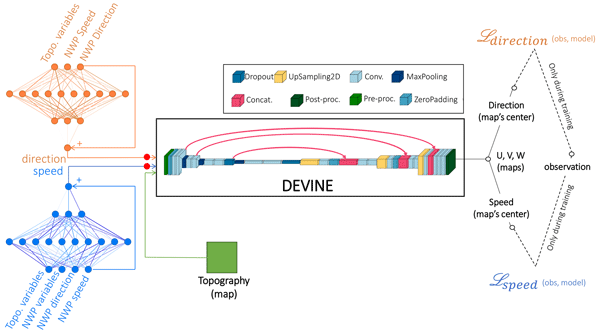
Forecasting wind fields over mountains is of high importance for several applications and particularly for understanding how wind erodes and disperses snow. Forecasters rely on operational wind forecasts over mountains, which are currently only available on kilometric scales. These forecasts can also be affected by errors of diverse origins. Here we introduce a new strategy based on artificial intelligence to correct large-scale wind forecasts in mountains and increase their spatial resolution.
Jean Emmanuel Sicart, Victor Ramseyer, Ghislain Picard, Laurent Arnaud, Catherine Coulaud, Guilhem Freche, Damien Soubeyrand, Yves Lejeune, Marie Dumont, Isabelle Gouttevin, Erwan Le Gac, Frédéric Berger, Jean-Matthieu Monnet, Laurent Borgniet, Éric Mermin, Nick Rutter, Clare Webster, and Richard Essery
Earth Syst. Sci. Data, 15, 5121–5133, https://doi.org/10.5194/essd-15-5121-2023, https://doi.org/10.5194/essd-15-5121-2023, 2023
Short summary
Short summary
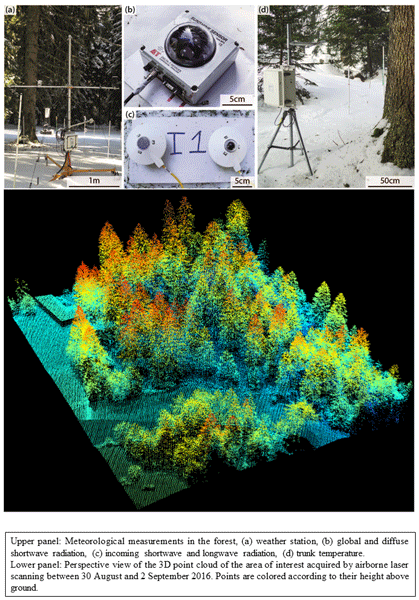
Forests strongly modify the accumulation, metamorphism and melting of snow in midlatitude and high-latitude regions. Two field campaigns during the winters 2016–17 and 2017–18 were conducted in a coniferous forest in the French Alps to study interactions between snow and vegetation. This paper presents the field site, instrumentation and collection methods. The observations include forest characteristics, meteorology, snow cover and snow interception by the canopy during precipitation events.
Marie Dumont, Simon Gascoin, Marion Réveillet, Didier Voisin, François Tuzet, Laurent Arnaud, Mylène Bonnefoy, Montse Bacardit Peñarroya, Carlo Carmagnola, Alexandre Deguine, Aurélie Diacre, Lukas Dürr, Olivier Evrard, Firmin Fontaine, Amaury Frankl, Mathieu Fructus, Laure Gandois, Isabelle Gouttevin, Abdelfateh Gherab, Pascal Hagenmuller, Sophia Hansson, Hervé Herbin, Béatrice Josse, Bruno Jourdain, Irene Lefevre, Gaël Le Roux, Quentin Libois, Lucie Liger, Samuel Morin, Denis Petitprez, Alvaro Robledano, Martin Schneebeli, Pascal Salze, Delphine Six, Emmanuel Thibert, Jürg Trachsel, Matthieu Vernay, Léo Viallon-Galinier, and Céline Voiron
Earth Syst. Sci. Data, 15, 3075–3094, https://doi.org/10.5194/essd-15-3075-2023, https://doi.org/10.5194/essd-15-3075-2023, 2023
Short summary
Short summary
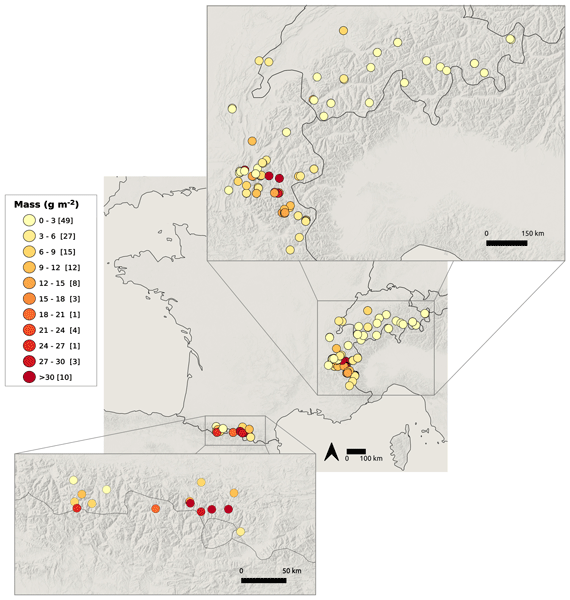
Saharan dust outbreaks have profound effects on ecosystems, climate, health, and the cryosphere, but the spatial deposition pattern of Saharan dust is poorly known. Following the extreme dust deposition event of February 2021 across Europe, a citizen science campaign was launched to sample dust on snow over the Pyrenees and the European Alps. This campaign triggered wide interest and over 100 samples. The samples revealed the high variability of the dust properties within a single event.
Alistair Bell, Pauline Martinet, Olivier Caumont, Frédéric Burnet, Julien Delanoë, Susana Jorquera, Yann Seity, and Vinciane Unger
Atmos. Meas. Tech., 15, 5415–5438, https://doi.org/10.5194/amt-15-5415-2022, https://doi.org/10.5194/amt-15-5415-2022, 2022
Short summary
Short summary
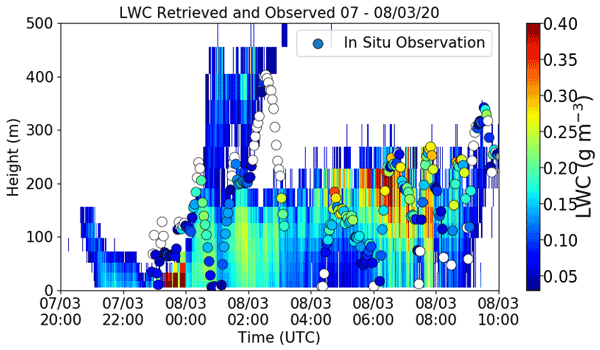
Cloud radars and microwave radiometers offer the potential to improve fog forecasts when assimilated into a high-resolution model. As this process can be complex, a retrieval of model variables is sometimes made as a first step. In this work, results from a 1D-Var algorithm for the retrieval of temperature, humidity and cloud liquid water content are presented. The algorithm is applied first to a synthetic dataset and then to a dataset of real measurements from a recent field campaign.
Cited articles
Antoine, S., Honnert, R., Seity, Y., Vié, B., Burnet, F., and Martinet, P.: Evaluation of an improved AROME configuration for fog forecasts during the SOFOG3D campaign, Weather and Forecasting, 38, 1605–1620, https://doi.org/10.1175/WAF-D-22-0215.1, 2023. a
Arduini, G.: Processus de la couche limite atmosphérique stable hivernale en vallée alpine, phdthesis, 2017. a
Arnould, G. and Préaux, D.: Study of AROME Temperature in mountain regions, ACCORD Newsletter, https://www.umr-cnrm.fr/accord/IMG/pdf/accord-nl1.pdf (last access: 27 October 2025), 2021. a
Arnould, G., Dombrowski-Etchevers, I., Gouttevin, I., and Seity, Y.: Améliorer la prévision de température en montagne par des descentes d’échelle, La Météorology, 115, 37–44, https://doi.org/10.37053/lameteorologie-2021-0091, 2021. a, b
Atlaskin, E. and Vihma, T.: Evaluation of NWP results for wintertime nocturnal boundary-layer temperatures over Europe and Finland, Quarterly Journal of the Royal Meteorological Society, 138, 1440–1451, 2012. a
Aymoz, G., Jaffrezo, J. L., Chapuis, D., Cozic, J., and Maenhaut, W.: Seasonal variation of PM10 main constituents in two valleys of the French Alps. I: EC/OC fractions, Atmos. Chem. Phys., 7, 661–675, https://doi.org/10.5194/acp-7-661-2007, 2007. a
Becken, S.: The importance of climate and weather for tourism: literature review, Lincoln University, LEaP, https://researcharchive.lincoln.ac.nz/entities/publication/72cdf0e5-5933-44cb-906b-3575c7125129 (last access: 27 October 2025), 2010. a
Blein, S.: Observation et modélisation de couche limite atmosphérique stable en relief complexe: le processus turbulent d'écoulement catabatique, PhD thesis, Université Grenoble Alpes, https://theses.hal.science/tel-01622676 (last access: 27 October 2025), 2016. a
Boone, A. and Etchevers, P.: An Intercomparison of Three Snow Schemes of Varying Complexity Coupled to the Same Land Surface Model: Local-Scale Evaluation at an Alpine Site, Journal of Hydrometeorology, 2, 374–394, 2001. a
Brousseau, P., Seity, Y., Ricard, D., and Léger, J.: Improvement of the forecast of convective activity from the AROME-France system, Q. J. Roy. Meteor. Soc., 142, 2231–2243, https://doi.org/10.1002/qj.2822, 2016. a, b, c, d
Brousseau, P., Vogt, V., Arbogast, E., Martet, M., Thomas, G., and Berre, L.: The operational 3DEnVar data assimilation scheme for the Météo-France convective scale model AROME-France, EGUsphere [preprint], https://doi.org/10.5194/egusphere-2025-2642, 2025. a
Bubnová, R., Hello, G., Bénard, P., and Geleyn, J.-F.: Integration of the fully elastic equations cast in the hydrostatic pressure terrain-following coordinate in the framework of the ARPEGE/Aladin NWP system, Mon. Weather Review, 123, 515–535, https://doi.org/10.1175/1520-0493(1995)123<0515:IOTFEE>2.0.CO;2, 1995. a, b
Chow, F. K., De Wekker, S. F., and Snyder, B. J.: Mountain weather research and forecasting: recent progress and current challenges, vol. 750, Springer, ISBN 9789400740976, 2013. a
Courtier, P. and Geleyn, J.-F.: A global numerical weather prediction model with variable resolution: Application to the shallow-water equations, Quarterly Journal of the Royal Meteorological Society, 114, 1321–1346, 1988. a
Demortier, A., Mandement, M., Pourret, V., and Caumont, O.: Assimilation of surface pressure observations from personal weather stations in AROME-France, Nat. Hazards Earth Syst. Sci., 24, 907–-927, https://doi.org/10.5194/nhess-24-907-2024, 2024. a, b
Deng, X. and Stull, R.: Assimilation of surface observations in complex terrain, in: Ninth Symposium on Integrated Observing and Assimilation Systems for the Atmosphere, Oceans, and Land Surface, San Diego, 9–14 January 2025, https://ams.confex.com/ams/Annual2005/techprogram/paper_86561.htm (last access: 27 October 2025), 2005. a
Dian, M. and Masek, J.: Improving the Computation of Screen Level Fields (Temperature, Moisture), Report of LACE Stay at CHMI in Prague 11–29 April 2015, 2015, Prague, https://www.rclace.eu/File/Physics/2016/dian_screeninter_pragueApr2016.pdf (last access: 27 October 2025), 2016. a
Douville, H., Royer, J. F., and Mahfouf, J. F.: A new snow parameterization for the Météo-France climate model: Part I: validation in stand-alone experiments, Clim. Dynam., 12, 21–35, https://doi.org/10.1007/BF00208760, 1995. a, b
Dozier, J. and Warren, S. G.: Effect of viewing angle on the infrared brightness temperature of snow, Water Resources Research, 18, 1424–1434, 1982. a
Durand, Y., Brun, E., Merindol, L., Guyomarc'h, G., Lesaffre, B., and Martin, E.: A meteorological estimation of relevant parameters for snow models, Annals of Glaciology, 18, 65–71, 1993. a
Etchevers, P.: Modélisation du cycle continental de l'eau à l'échelle régionale. Impact de la modélisation de la neige sur l'hydrologie du Rhône, PhD thesis, https://theses.hal.science/tel-00466802 (last access: 27 October 2025), 2000. a
Fischer, C., Bouyssel, F., Brousseau, P., El Khatib, R., Pottier, P., Seity, Y., Wattrelot, E., and Joly, A.: Les modèles opérationnels de prévision numérique à aire limitée de Météo-France, La Météorologie, 2018, 18–28, https://doi.org/10.4267/2042/65139, 2018. a
Giard, D. and Bazile, E.: Implementation of a new assimilation scheme for soil and surface variables in a global NWP model, Monthly Weather Review, 128, 997–1015, https://doi.org/10.1175/1520-0493(2000)128<0997:IOANAS>2.0.CO;2, 2000. a, b
GLACIOCLIM_CDP: Col de Porte: a meterological and snow observatory, OSUG [data set], https://doi.osug.fr/public/CRYOBSCLIM_CDP/ (last access: 30 July 2024), 2023. a
GLACIOCLIM-CLB: Col du Lac Blanc: a meteorological and blowing snow observatory, OSUG [data set], https://doi.osug.fr/public/CRYOBSCLIM_CLB/ (last access: 18 July 2024), 2024. a
GLACIOCLIM-CLB: Col du Lac Blanc: additional data, Zenodo [data set], https://doi.org/10.5281/zenodo.14989735, 2025. a
Gouttevin, I., Langer, M., Löwe, H., Boike, J., Proksch, M., and Schneebeli, M.: Observation and modelling of snow at a polygonal tundra permafrost site: spatial variability and thermal implications, The Cryosphere, 12, 3693–3717, https://doi.org/10.5194/tc-12-3693-2018, 2018. a
Gouttevin, I., Vionnet, V., Seity, Y., Boone, A., Lafaysse, M., Deliot, Y., and Merzisen, H.: To the origin of a wintertime screen-level temperature bias at high altitude in a kilometric NWP model, Journal of Hydrometeorology, 24, 53–71, https://doi.org/10.1175/JHM-D-21-0200.1, 2023. a, b, c, d, e, f, g, h, i
Guillet, O.: Modélisation des corélations spatiales d'erreurs d'observation en assimilation de données variationnelle: étude sur des maillages non structurés, PhD thesis, Institut National Polytechnique de Toulouse-INPT, https://theses.hal.science/tel-04160718v1 (last access: 27 October 2025), 2019. a, b
Gustafsson, N., Janjić, T., Schraff, C., Leuenberger, D., Weissmann, M., Reich, H., Brousseau, P., Montmerle, T., Wattrelot, E., Bučánek, A., Mile, M., Hamdi, R., Lindskog, M., Barkmeijer, J., Dahlbom, M., Macpherson, B., Ballard, S., Inverarity, G., Carley, J., Alexander, C., Dowell, D., Liu, S., Ikuta, Y., and Fujita, T.: Survey of data assimilation methods for convective-scalenumerical weather prediction at operational centres, Q. J. Roy. Meteor. Soc., 144, 1218–1256, https://doi.org/10.1002/qj.3179, 2018. a, b
Guyomarc'h, G., Bellot, H., Vionnet, V., Naaim-Bouvet, F., Déliot, Y., Fontaine, F., Puglièse, P., Nishimura, K., Durand, Y., and Naaim, M.: A meteorological and blowing snow data set (2000–2016) from a high-elevation alpine site (Col du Lac Blanc, France, 2720 m a.s.l.), Earth Syst. Sci. Data, 11, 57–69, https://doi.org/10.5194/essd-11-57-2019, 2019. a, b, c
Ingleby, B., Arduini, G., Balsamo, G., Boussetta, S., Ochi, K., Pinnington, E., and de Rosnay, P.: Improved two-metre temperature forecasts in the 2024 upgrade, ECMWF Newsletter, https://www.ecmwf.int/en/newsletter/178/earth-system-science/improved-two-metre-temperature-forecasts-2024-upgrade (last access: 27 October 2025), 2024. a, b
Jörg-Hess, S., Griessinger, N., and Zappa, M.: Probabilistic forecasts of snow water equivalent and runoff in mountainous areas, Journal of Hydrometeorology, 16, 2169–2186, https://doi.org/10.1175/JHM-D-14-0193.1, 2015. a
Kotlarski, S., Lüthi, D., and Schär, C.: The elevation dependency of 21st century European climate change: an RCM ensemble perspective, International Journal of Climatology, 35, https://doi.org/10.1002/joc.4254, 2015. a
Lac, C., Chaboureau, J.-P., Masson, V., Pinty, J.-P., Tulet, P., Escobar, J., Leriche, M., Barthe, C., Aouizerats, B., Augros, C., Aumond, P., Auguste, F., Bechtold, P., Berthet, S., Bielli, S., Bosseur, F., Caumont, O., Cohard, J.-M., Colin, J., Couvreux, F., Cuxart, J., Delautier, G., Dauhut, T., Ducrocq, V., Filippi, J.-B., Gazen, D., Geoffroy, O., Gheusi, F., Honnert, R., Lafore, J.-P., Lebeaupin Brossier, C., Libois, Q., Lunet, T., Mari, C., Maric, T., Mascart, P., Mogé, M., Molinié, G., Nuissier, O., Pantillon, F., Peyrillé, P., Pergaud, J., Perraud, E., Pianezze, J., Redelsperger, J.-L., Ricard, D., Richard, E., Riette, S., Rodier, Q., Schoetter, R., Seyfried, L., Stein, J., Suhre, K., Taufour, M., Thouron, O., Turner, S., Verrelle, A., Vié, B., Visentin, F., Vionnet, V., and Wautelet, P.: Overview of the Meso-NH model version 5.4 and its applications, Geosci. Model Dev., 11, 1929–1969, https://doi.org/10.5194/gmd-11-1929-2018, 2018. a
Lafore, J. P., Stein, J., Asencio, N., Bougeault, P., Ducrocq, V., Duron, J., Fischer, C., Héreil, P., Mascart, P., Masson, V., Pinty, J. P., Redelsperger, J. L., Richard, E., and Vilà-Guerau de Arellano, J.: The Meso-NH Atmospheric Simulation System. Part I: adiabatic formulation and control simulations, Annales Geophysicae, 16, 90–109, 1998. a
Lalande, M., Ménégoz, M., Krinner, G., Ottlé, C., and Cheruy, F.: Improving climate model skill over High Mountain Asia by adapting snow cover parameterization to complex-topography areas, The Cryosphere, 17, 5095–5130, https://doi.org/10.5194/tc-17-5095-2023, 2023. a, b
Lejeune, Y., Dumont, M., Panel, J.-M., Lafaysse, M., Lapalus, P., Le Gac, E., Lesaffre, B., and Morin, S.: 57 years (1960–2017) of snow and meteorological observations from a mid-altitude mountain site (Col de Porte, France, 1325 m of altitude), Earth Syst. Sci. Data, 11, 71–88, https://doi.org/10.5194/essd-11-71-2019, 2019. a
Leuenberger, D., Merker, C., Chandramouli, K., Crezee, B., and Arpagaus, M.: Benefit and challenges in assimilating near-surface temperature and humidity observations in complex terrain. in: 8th WMO workshop on the Impacts of Various Observing Systems on Numerical Weather Prediction and Earth System Prediction, 27–30 May 2024, Norrköping, Sweden, https://cgms-info.org/wp-content/uploads/2024/12/8th-Impact_Workshop-Final_Report.pdf (last access: 27 October 2025), 2024. a
Liu, C., Ikeda, K., Rasmussen, R., Barlage, M., Newman, A. J., Prein, A. F., Chen, F., Chen, L., Clark, M., Dai, A., Dudhia, J., Eidhammer, T., Gochis, D., Gutmann, E., Kurkute, S., Li, Y., Thompson, G., and Yates, D.: Continental-scale convection-permitting modeling of the current and future climate of North America, Climate Dynamics, 49, 71–95, 2017. a
Mahfouf, J.-F., Brasnett, B., and Gagnon, S.: A Canadian precipitation analysis (CaPA) project: Description and preliminary results, Atmosphere-Ocean, 45, 1–17, 2007. a
Masson, V. and Seity, Y.: Including Atmospheric Layers in Vegetation and Urban Offline Surface Schemes, Journal of Applied Meteorology and Climatology, 48, 1377–1397, https://doi.org/10.1175/2009JAMC1866.1, 2009. a, b
Masson, V., Le Moigne, P., Martin, E., Faroux, S., Alias, A., Alkama, R., Belamari, S., Barbu, A., Boone, A., Bouyssel, F., Brousseau, P., Brun, E., Calvet, J.-C., Carrer, D., Decharme, B., Delire, C., Donier, S., Essaouini, K., Gibelin, A.-L., Giordani, H., Habets, F., Jidane, M., Kerdraon, G., Kourzeneva, E., Lafaysse, M., Lafont, S., Lebeaupin Brossier, C., Lemonsu, A., Mahfouf, J.-F., Marguinaud, P., Mokhtari, M., Morin, S., Pigeon, G., Salgado, R., Seity, Y., Taillefer, F., Tanguy, G., Tulet, P., Vincendon, B., Vionnet, V., and Voldoire, A.: The SURFEXv7.2 land and ocean surface platform for coupled or offline simulation of earth surface variables and fluxes, Geosci. Model Dev., 6, 929–960, https://doi.org/10.5194/gmd-6-929-2013, 2013. a
McCandless, T., Gagne, D. J., Kosović, B., Haupt, S. E., Yang, B., Becker, C., and Schreck, J.: Machine learning for improving surface-layer-flux estimates, Boundary-Layer Meteorology, 185, 199–228, 2022. a
Meier, F., Wastl, C., Weidle, F., and Wittmann, C.: Adapting the screening level diagnostics to improve AROME temperature forecasts in Alpine areas, ACCORD Newsletter, https://www.umr-cnrm.fr/accord/IMG/pdf/accord-nl1.pdf (last access: 27 October 2025), 2021. a
Merker, C., Leuenberger, D., Anlauf, H., Potthast, R., and Arpagaus, M.: Additive covariance inflation in KENDA: Towards a climatological error covariance matrix from COSMO, in: 20th COSMO GM, edited by: MeteoSwiss, St. Petersburg, Russia, https://www.cosmo-model.org/content/consortium/generalMeetings/general2018/parallel/additiveInflation_merker.pdf (last access: 27 October 2025), 2018. a
Monteiro, D., Caillaud, C., Lafaysse, M., Napoly, A., Fructus, M., Alias, A., and Morin, S.: Improvements in the land surface configuration to better simulate seasonal snow cover in the European Alps with the CNRM-AROME (cycle 46) convection-permitting regional climate model, Geosci. Model Dev., 17, 7645–7677, https://doi.org/10.5194/gmd-17-7645-2024, 2024. a, b
Morin, S., Lejeune, Y., Lesaffre, B., Panel, J.-M., Poncet, D., David, P., and Sudul, M.: An 18-yr long (1993–2011) snow and meteorological dataset from a mid-altitude mountain site (Col de Porte, France, 1325 m alt.) for driving and evaluating snowpack models, Earth Syst. Sci. Data, 4, 13–21, https://doi.org/10.5194/essd-4-13-2012, 2012. a, b
Morin, S., Horton, S., Techel, F., Bavay, M., Coléou, C., Fierz, C., Gobiet, A., Hagenmuller, P., Lafaysse, M., Ližar, M., Mitterer, C., Monti, F., Müller, K., Olefs, M., Snook, J.S., van Herwijnen, A., and Vionnet, V.: Application of physical snowpack models in support of operational avalanche hazard forecasting: A status report on current implementations and prospects for the future, Cold Regions Science and Technology, 170, 102910, https://doi.org/10.1016/j.coldregions.2019.102910, 2020. a
Météo-France: Météo France data, https://portail-api.meteofrance.fr/web/en/ (last access: 18 July 2024), 2025. a
Naaim-Bouvet, F. and Truche, M.: Guide technique “Ouvrages à vent en zone de montagne”, in: International Snow Science Workshop (ISSW), Irstea, ANENA, Meteo France, 134 pp., https://hal.science/hal-00949755/document (last access: 27 October 2025), 2013. a
Noilhan, J. and Planton, S.: A simple parameterization of land surface processes for meteorological models, Mon. Weather Rev., 117, 536–549, https://doi.org/10.1175/1520-0493(1989)117<0536:ASPOLS>2.0.CO;2, 1989. a
Paci, A., Staquet, C., Allard, J., Barral, H., Canut, G., Cohard, J.-M., Jaffrezo, J.-L., Martinet, P., Sabatier, T., Troude, F., Arduini, G., Burnet, F., Brun, C., Chemel, C., Dabas, A., Donier, J.-M., Garrouste, O., Guillot, R., Largeron, Y., Legain, D., Maurel, W., Tzanos, D., Barrau, S., Barret, M., Barrie, J., Belleudy, A., Bouhours, G., Bourrianne, T., Chevrier, F., Douffet, T., Etcheberry, J.-M., Gustave, L., Mazoyer, M., Mercier, S., Moulin, E., Pellan, Y., Piguet, B., Rodier, Q., and Zin, I.: La campagne Passy-2015: dynamique atmosphérique et qualité de l’air dans la vallée de l’Arve, American Institute of Physics Melville, NY, https://doi.org/10.4267/pollution-atmospherique.5903, 2016. a, b, c
Peixóto, J. P. and Oort, A. H.: Physics of climate, Reviews of Modern Physics, 56, 365, https://doi.org/10.1103/RevModPhys.56.365, 1984. a
Pepin, N. and Kidd, D.: Spatial temperature variation in the Eastern Pyrenees, Weather, 61, 300–310, https://doi.org/10.1256/wea.106.06, 2006. a
Pichelli, E., Coppola, E., Sobolowski, S., Ban, N., Giorgi, F., Stocchi, P., Alias, A., Belušić, D., Berthou, S., Caillaud, C., Cardoso, R. M., Chan, S., Christensen, O. B., Dobler, A., de Vries, H., Goergen, K., Kendon, E. J., Keuler, K., Lenderink, G., Lorenz, T., Mishra, A. N., Panitz, H-J., Schär, C., Soares, P. M. M., Truhetz, H., and Vergara-Temprado, J.: The first multi-model ensemble of regional climate simulations at kilometer-scale resolution part 2: historical and future simulations of precipitation, Climate Dynamics, 56, 3581–3602, 2021. a
Préaux, D.: codes and dataset of numerical assimilation experiments, Zenodo [code and data set], https://doi.org/10.5281/zenodo.16570743, 2025. a, b
Quéno, L., Vionnet, V., Dombrowski-Etchevers, I., Lafaysse, M., Dumont, M., and Karbou, F.: Snowpack modelling in the Pyrenees driven by kilometric-resolution meteorological forecasts, The Cryosphere, 10, 1571–1589, https://doi.org/10.5194/tc-10-1571-2016, 2016. a, b, c
Rotach, M. W., Serafin, S., Ward, H. C., Arpagaus, M., Colfescu, I., Cuxart, J., De Wekker, S. F., Grubišic, V., Kalthoff, N., Karl, T., Kirshbaum, D. J., Lehner, M., Mobbs, S., Paci, A., Palazzi, E., Bailey, A., Schmidli, J., Wittmann, C., Wohlfahrt, G., and Zardi, D.: A collaborative effort to better understand, measure, and model atmospheric exchange processes over mountains, Bulletin of the American Meteorological Society, 103, E1282–E1295, 2022. a
Rudisill, W., Rhoades, A., Xu, Z., and Feldman, D. R.: Are atmospheric models too cold in the mountains? The state of science and insights from the SAIL field campaign, Bulletin of the American Meteorological Society, 105, E1237–E1264, https://doi.org/10.1175/BAMS-D-23-0082.1, 2024. a, b, c, d, e, f, g, h, i, j
Scherrer, S., Ceppi, P., Croci-Maspoli, M., and Appenzeller, C.: Snow-albedo feedback and Swiss spring temperature trends, Theoretical and Applied Climatology, 110, 509–516, 2012. a
Seity, Y., Brousseau, P., Malardel, S., Hello, G., Bénard, P., Bouttier, F., Lac, C., and Masson, V.: The AROME-France Convective-Scale Operational Model, Mon. Weather Rev., 139, 976–991, https://doi.org/10.1175/2010MWR3425.1, 2011. a
Serafin, S., Adler, B., Cuxart, J., De Wekker, S. F. J., Gohm, A., Grisogono, B., Kalthoff, N., Kirshbaum, D. J., Rotach, M. W., Schmidli, J., Stiperski, I., Večenaj, Z., and Zardi, D.: Exchange Processes in the Atmospheric Boundary Layer Over Mountainous Terrain, Atmosphere, 9, https://doi.org/10.3390/atmos9030102, 2018. a
Sheridan, P., Vosper, S., and Smith, S.: A Physically Based Algorithm for Downscaling Temperature in Complex Terrain, Journal of Applied Meteorology and Climatology, 57, 1907–1929, https://doi.org/10.1175/JAMC-D-17-0140.1, 2018. a
Spandre, P., François, H., George-Marcelpoil, E., and Morin, S.: Panel based assessment of snow management operations in French ski resorts, Journal of Outdoor Recreation and Tourism, 16, 24–36, https://doi.org/10.1016/j.jort.2016.09.002, 2016. a
Stiperski, I. and Calaf, M.: Generalizing Monin-Obukhov similarity theory (1954) for complex atmospheric turbulence, Physical Review Letters, 130, 124001, https://doi.org/10.1103/PhysRevLett.130.124001, 2023. a
Stiperski, I., Calaf, M., and Rotach, M. W.: Scaling, anisotropy, and complexity in near-surface atmospheric turbulence, Journal of Geophysical Research: Atmospheres, 124, 1428–1448, 2019. a
Sturm, M. and Liston, G. E.: Revisiting the global seasonal snow classification: An updated dataset for earth system applications, Journal of Hydrometeorology, 22, 2917–2938, 2021. a
Taillefer, F.: CANARI Some technical features, in: NetFAM working days, edited by: Météo-France, Oslo, Sweden, https://netfam.fmi.fi/OBS09/Taillefer_1.pdf (last access: 27 October 2025), 2009. a
Thornton, J. M., Pepin, N., Shahgedanova, M., and Adler, C.: Coverage of in situ climatological observations in the world's mountains, Frontiers in Climate, 4, 814181, https://doi.org/10.3389/fclim.2022.814181, 2022. a
Torma, C., Giorgi, F., and Coppola, E.: Added value of regional climate modeling over areas characterized by complex terrain – Precipitation over the Alps, Journal of Geophysical Research: Atmospheres, 120, 3957–3972, 2015. a
Van Hyfte, S.: Mise en oeuvre et évaluation d'un nouveau système de réanalyses météorologiques des paramètres de surface à haute résolution, PhD thesis, Institut National Polyetchnique de Toulouse – INPT, https://theses.hal.science/tel-04186752 (last access: 27 October 2025), 2021. a
Vernay, M., Lafaysse, M., Monteiro, D., Hagenmuller, P., Nheili, R., Samacoïts, R., Verfaillie, D., and Morin, S.: The S2M meteorological and snow cover reanalysis over the French mountainous areas: description and evaluation (1958–2021), Earth Syst. Sci. Data, 14, 1707–1733, https://doi.org/10.5194/essd-14-1707-2022, 2022. a
Vionnet, V., Guyomarc’h, G., Bouvet, F. N., Martin, E., Durand, Y., Bellot, H., Bel, C., and Puglièse, P.: Occurrence of blowing snow events at an alpine site over a 10-year period: Observations and modelling, Advances in Water Resources, 55, 53–63, 2013. a
Vionnet, V., Dombrowski-Etchevers, I., Lafaysse, M., Quéno, L., Seity, Y., and Bazile, E.: Numerical Weather Forecasts at Kilometer Scale in the French Alps: Evaluation and Application for Snowpack Modeling, Journal of Hydrometeorology, 17, 2591–2614, https://doi.org/10.1175/JHM-D-15-0241.1, 2016. a, b, c, d, e, f, g, h, i, j, k, l, m, n, o, p
Vionnet, V., Fortin, V., Gaborit, E., Roy, G., Abrahamowicz, M., Gasset, N., and Pomeroy, J. W.: Assessing the factors governing the ability to predict late-spring flooding in cold-region mountain basins, Hydrol. Earth Syst. Sci., 24, 2141–2165, https://doi.org/10.5194/hess-24-2141-2020, 2020. a
Whiteman, C. D.: Mountain meteorology: fundamentals and applications, Oxford University Press, https://doi.org/10.1093/oso/9780195132717.001.0001, 2000. a
Winstral, A., Jonas, T., and Helbig, N.: Statistical downscaling of gridded wind speed data using local topography, Journal of Hydrometeorology, 18, 335–348, https://doi.org/10.1175/JHM-D-16-0054.1, 2017. a
Winter, K. J. P. M., Kotlarski, S., Scherrer, S. C., and Schär, C.: The Alpine snow-albedo feedback in regional climate models, Climate Dynamics, 48, 1109–1124, 2017. a
Short summary
Air temperature is usually measured around 2 m above the ground following meteorological standards. However, in mountain regions, temperature sensors are often placed higher up to avoid being buried in snow in winter. We show that the measurement height is of high importance when quantifying the errors made by weather prediction models. Also, it should be accounted for when these observations are used to correct the models in real time, as doing otherwise degrades their forecasts at high altitudes.
Air temperature is usually measured around 2 m above the ground following meteorological...


