
Articles | Volume 18, issue 20
https://doi.org/10.5194/gmd-18-7987-2025
© Author(s) 2025. This work is distributed under
the Creative Commons Attribution 4.0 License.
the Creative Commons Attribution 4.0 License.
https://doi.org/10.5194/gmd-18-7987-2025
© Author(s) 2025. This work is distributed under
the Creative Commons Attribution 4.0 License.
the Creative Commons Attribution 4.0 License.
Development and technical paper
| 
29 Oct 2025
Development and technical paper |
| 29 Oct 2025
| 29 Oct 2025
Development of the global hydro-economic model (ECHO-Global version 1.0) for assessing the performance of water management options

Water Security Research Group, International Institute for Applied Systems Analysis (IIASA), Laxenburg, Austria
United Nations University Institute for Water, Environment and Health (UNU-INWEH), Hamilton, ON, Canada
Safa Baccour
Research Institute of Water Engineering and Environment (IIAMA), Polytechnic University of Valencia, Spain
Julian Joseph
Water Security Research Group, International Institute for Applied Systems Analysis (IIASA), Laxenburg, Austria
Reetik Sahu
Water Security Research Group, International Institute for Applied Systems Analysis (IIASA), Laxenburg, Austria
Peter Burek
Water Security Research Group, International Institute for Applied Systems Analysis (IIASA), Laxenburg, Austria
Jia Yi Ng
Water Security Research Group, International Institute for Applied Systems Analysis (IIASA), Laxenburg, Austria
College of Environmental Sciences and Engineering, Peking University, Beijing, China
Samar Asad
Water Security Research Group, International Institute for Applied Systems Analysis (IIASA), Laxenburg, Austria
Dor Fridman
Water Security Research Group, International Institute for Applied Systems Analysis (IIASA), Laxenburg, Austria
Jose Albiac
Water Security Research Group, International Institute for Applied Systems Analysis (IIASA), Laxenburg, Austria
Department of Economic Analysis, University of Zaragoza, Zaragoza, Spain
Frank A. Ward
Department of Agricultural Economics and Agricultural Business, Water Science and Management Program, New Mexico State University, Las Cruces, United States
Yoshihide Wada
Biological and Environmental Science and Engineering Division, King Abdullah University of Science and Technology, Thuwal, Saudi Arabia
Related authors
Dor Fridman, Mikhail Smilovic, Peter Burek, Sylvia Tramberend, and Taher Kahil
Geosci. Model Dev., 18, 3735–3754, https://doi.org/10.5194/gmd-18-3735-2025, https://doi.org/10.5194/gmd-18-3735-2025, 2025
Short summary
Short summary
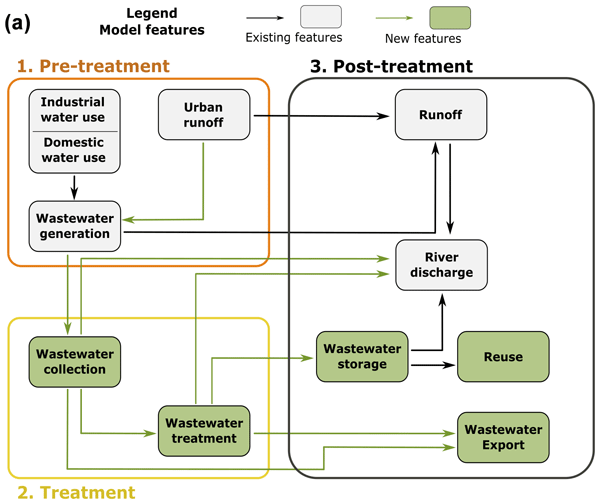
Global hydrological models are applied at high spatial resolutions to quantify water availability and evaluate water scarcity mitigation options. Yet, they mainly oversee critical local processes. This paper presents and demonstrates the inclusion of wastewater treatment and reuse into a global hydrological model. As a result, model performance improves, and models consider treated wastewater as an alternative water source.

Luca Guillaumot, Mikhail Smilovic, Peter Burek, Jens de Bruijn, Peter Greve, Taher Kahil, and Yoshihide Wada
Geosci. Model Dev., 15, 7099–7120, https://doi.org/10.5194/gmd-15-7099-2022, https://doi.org/10.5194/gmd-15-7099-2022, 2022
Short summary
Short summary
We develop and test the first large-scale hydrological model at regional scale with a very high spatial resolution that includes a water management and groundwater flow model. This study infers the impact of surface and groundwater-based irrigation on groundwater recharge and on evapotranspiration in both irrigated and non-irrigated areas. We argue that water table recorded in boreholes can be used as validation data if water management is well implemented and spatial resolution is ≤ 100 m.
Amr Al-Zu'bi and Yoshihide Wada
EGUsphere, https://doi.org/10.5194/egusphere-2026-3475, https://doi.org/10.5194/egusphere-2026-3475, 2026
This preprint is open for discussion and under review for Geoscientific Model Development (GMD).
Short summary
Short summary
We developed a new high-resolution water resources model to estimate household and industrial water use across Gulf Cooperation Council countries and Jordan. It integrates economic, demographic, climate, and infrastructure data to capture detailed sectoral differences often missing in traditional approaches. It provides more accurate and spatially consistent water use estimates. Results reveal hidden patterns of water use and support planning for sustainable water supply.
Emmanuel Okiria, Naota Hanasaki, Simon N. Gosling, Emmanuel Nyenah, Peter Burek, Yusuke Satoh, Sebastian Ostberg, Kedar Otta, and Luca Guillaumot
EGUsphere, https://doi.org/10.5194/egusphere-2026-2043, https://doi.org/10.5194/egusphere-2026-2043, 2026
Short summary
Short summary
We investigated why global hydrological models struggle to simulate reservoir storage. By comparing five models against satellite data from 424 dams, we found they often exaggerate seasonal storage fluctuations due to simple one-size-fits-all global rules. Customising these settings significantly improved accuracy. This proves generic rules are a major flaw. Future models must combine traditional physics with real satellite observations to better predict global water resources.
Peter Greve, Amelie U. Schmitt, Sina Jasmin Schreiber, Augustin Clédat, and Peter Burek
EGUsphere, https://doi.org/10.5194/egusphere-2026-2366, https://doi.org/10.5194/egusphere-2026-2366, 2026
Short summary
Short summary
We introduce a new water resources and river flow model to improve our understanding of interactions between human water management and the Earth system. Many Earth system models oversimplify water management and its influence on processes at the interface between the land surface and the atmosphere. Our model can establish a link between these processes and enable faster, more realistic studies of climate change impacts on water availability and human decision-making.
Robert Reinecke, Tanjila Akhter, Annemarie Bäthge, Ricarda Dietrich, Sebastian Gnann, Simon N. Gosling, Danielle Grogan, Andreas Hartmann, Stefan Kollet, Rohini Kumar, Richard Lammers, Sida Liu, Yan Liu, Nils Moosdorf, Bibi Naz, Sara Nazari, Chibuike Orazulike, Yadu Pokhrel, Jacob Schewe, Mikhail Smilovic, Maryna Strokal, Wim Thiery, Yoshihide Wada, Shan Zuidema, and Inge de Graaf
Geosci. Model Dev., 19, 523–542, https://doi.org/10.5194/gmd-19-523-2026, https://doi.org/10.5194/gmd-19-523-2026, 2026
Short summary
Short summary
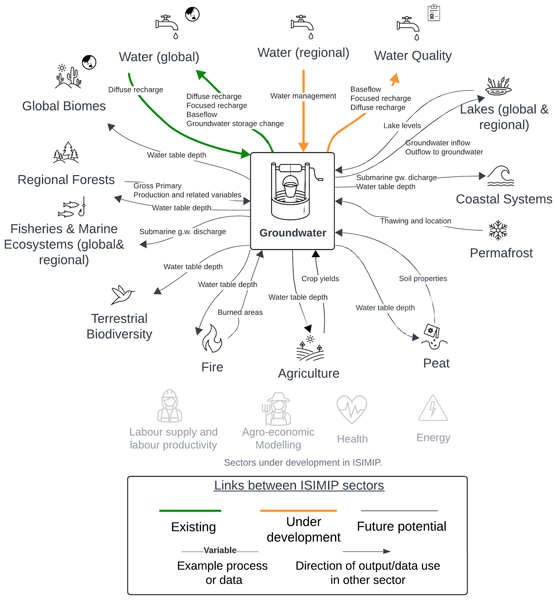
Here we describe a collaborative effort to improve predictions of how climate change will affect groundwater. The ISIMIP (The Inter-Sectoral Impact Model Intercomparison Project) groundwater sector combines multiple global groundwater models to capture a range of possible outcomes and reduce uncertainty. Initial comparisons reveal significant differences between models in key metrics like water table depth and recharge rates, highlighting the need for structured model intercomparisons.
Xuetong Wang, Raied S. Alharbi, Oscar M. Baez-Villanueva, Amy Green, Matthew F. McCabe, Yoshihide Wada, Albert I. J. M. Van Dijk, Muhammad A. Abid, and Hylke E. Beck
Hydrol. Earth Syst. Sci., 29, 4983–5003, https://doi.org/10.5194/hess-29-4983-2025, https://doi.org/10.5194/hess-29-4983-2025, 2025
Short summary
Short summary
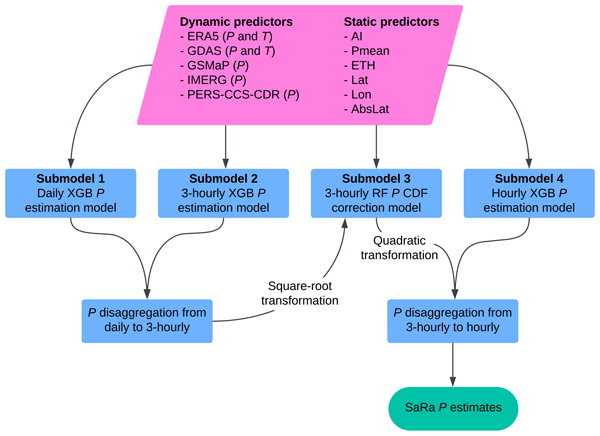
Our paper introduces Saudi Rainfall (SaRa), a high-resolution, near-real-time rainfall product for the Arabian Peninsula. Using machine learning, SaRa combines multiple satellite and (re)analysis datasets with static predictors, outperforming existing products in the region. With the fast development and continuing growth in water demand over this region, SaRa could help to address water challenges and support resource management.
Mateo Barco Largo, Meshal Alarifi, Sami D. Almalki, Shauna K. Rees, Benjamin P. Y.-H. Lee, Ahmed H. Mohamed, Abdalsamad Aldabaa, Kaoru Kakinuma, and Yoshihide Wada
Int. Arch. Photogramm. Remote Sens. Spatial Inf. Sci., XLVIII-G-2025, 183–188, https://doi.org/10.5194/isprs-archives-XLVIII-G-2025-183-2025, https://doi.org/10.5194/isprs-archives-XLVIII-G-2025-183-2025, 2025
Dor Fridman, Mikhail Smilovic, Peter Burek, Sylvia Tramberend, and Taher Kahil
Geosci. Model Dev., 18, 3735–3754, https://doi.org/10.5194/gmd-18-3735-2025, https://doi.org/10.5194/gmd-18-3735-2025, 2025
Short summary
Short summary
Global hydrological models are applied at high spatial resolutions to quantify water availability and evaluate water scarcity mitigation options. Yet, they mainly oversee critical local processes. This paper presents and demonstrates the inclusion of wastewater treatment and reuse into a global hydrological model. As a result, model performance improves, and models consider treated wastewater as an alternative water source.
Hannes Müller Schmied, Simon Newland Gosling, Marlo Garnsworthy, Laura Müller, Camelia-Eliza Telteu, Atiq Kainan Ahmed, Lauren Seaby Andersen, Julien Boulange, Peter Burek, Jinfeng Chang, He Chen, Lukas Gudmundsson, Manolis Grillakis, Luca Guillaumot, Naota Hanasaki, Aristeidis Koutroulis, Rohini Kumar, Guoyong Leng, Junguo Liu, Xingcai Liu, Inga Menke, Vimal Mishra, Yadu Pokhrel, Oldrich Rakovec, Luis Samaniego, Yusuke Satoh, Harsh Lovekumar Shah, Mikhail Smilovic, Tobias Stacke, Edwin Sutanudjaja, Wim Thiery, Athanasios Tsilimigkras, Yoshihide Wada, Niko Wanders, and Tokuta Yokohata
Geosci. Model Dev., 18, 2409–2425, https://doi.org/10.5194/gmd-18-2409-2025, https://doi.org/10.5194/gmd-18-2409-2025, 2025
Short summary
Short summary
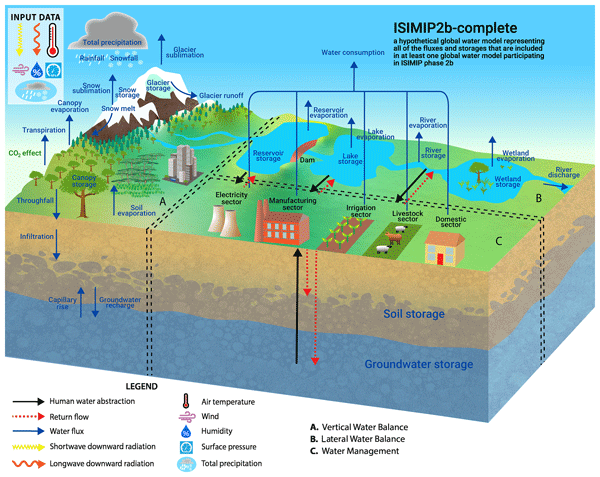
Global water models contribute to the evaluation of important natural and societal issues but are – as all models – simplified representation of reality. So, there are many ways to calculate the water fluxes and storages. This paper presents a visualization of 16 global water models using a standardized visualization and the pathway towards this common understanding. Next to academic education purposes, we envisage that these diagrams will help researchers, model developers, and data users.
Dapeng Feng, Hylke Beck, Jens de Bruijn, Reetik Kumar Sahu, Yusuke Satoh, Yoshihide Wada, Jiangtao Liu, Ming Pan, Kathryn Lawson, and Chaopeng Shen
Geosci. Model Dev., 17, 7181–7198, https://doi.org/10.5194/gmd-17-7181-2024, https://doi.org/10.5194/gmd-17-7181-2024, 2024
Short summary
Short summary
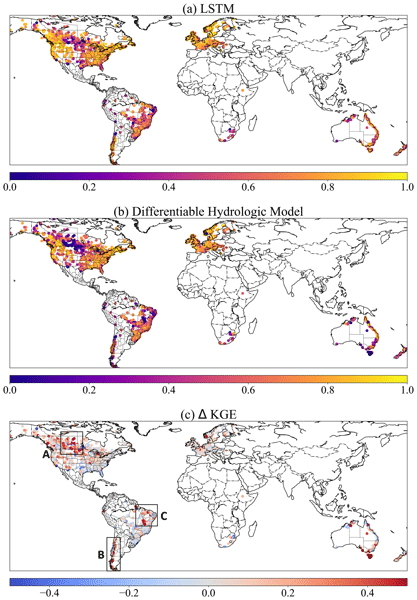
Accurate hydrologic modeling is vital to characterizing water cycle responses to climate change. For the first time at this scale, we use differentiable physics-informed machine learning hydrologic models to simulate rainfall–runoff processes for 3753 basins around the world and compare them with purely data-driven and traditional modeling approaches. This sets a benchmark for hydrologic estimates around the world and builds foundations for improving global hydrologic simulations.
Sarah Hanus, Lilian Schuster, Peter Burek, Fabien Maussion, Yoshihide Wada, and Daniel Viviroli
Geosci. Model Dev., 17, 5123–5144, https://doi.org/10.5194/gmd-17-5123-2024, https://doi.org/10.5194/gmd-17-5123-2024, 2024
Short summary
Short summary
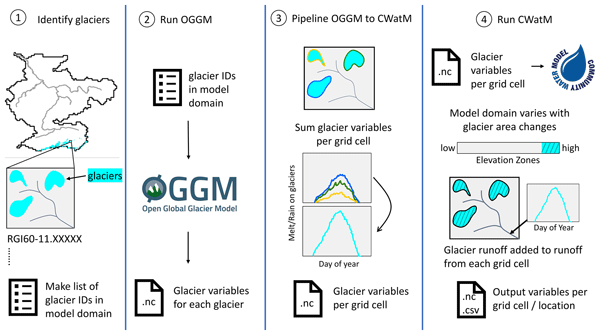
This study presents a coupling of the large-scale glacier model OGGM and the hydrological model CWatM. Projected future increase in discharge is less strong while future decrease in discharge is stronger when glacier runoff is explicitly included in the large-scale hydrological model. This is because glacier runoff is projected to decrease in nearly all basins. We conclude that an improved glacier representation can prevent underestimating future discharge changes in large river basins.
Muhammad Awais, Adriano Vinca, Edward Byers, Stefan Frank, Oliver Fricko, Esther Boere, Peter Burek, Miguel Poblete Cazenave, Paul Natsuo Kishimoto, Alessio Mastrucci, Yusuke Satoh, Amanda Palazzo, Madeleine McPherson, Keywan Riahi, and Volker Krey
Geosci. Model Dev., 17, 2447–2469, https://doi.org/10.5194/gmd-17-2447-2024, https://doi.org/10.5194/gmd-17-2447-2024, 2024
Short summary
Short summary
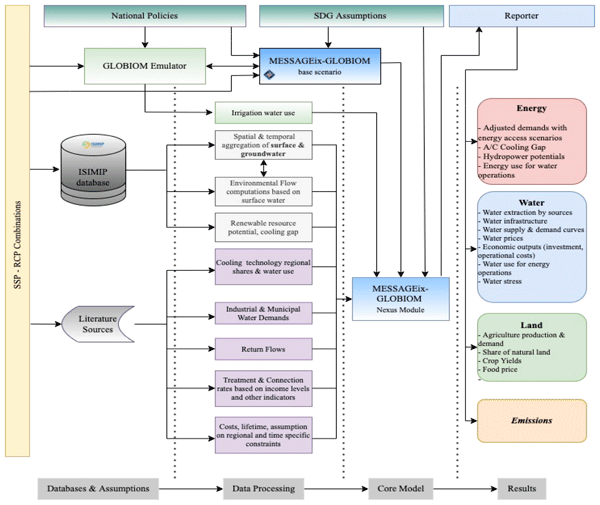
Climate change, population growth, and depletion of natural resources all pose complex and interconnected challenges. Our research offers a novel model that can help in understanding the interplay of these aspects, providing policymakers with a more robust tool for making informed future decisions. The study highlights the significance of incorporating climate impacts within large-scale global integrated assessments, which can help us in generating more climate-resilient scenarios.
Peter Burek and Mikhail Smilovic
Earth Syst. Sci. Data, 15, 5617–5629, https://doi.org/10.5194/essd-15-5617-2023, https://doi.org/10.5194/essd-15-5617-2023, 2023
Short summary
Short summary
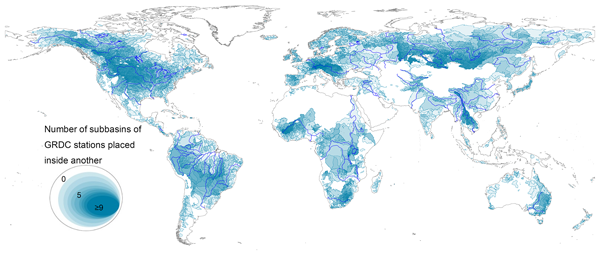
We address an annoying problem every grid-based hydrological model must solve to compare simulated and observed river discharge. First, station locations do not fit the high-resolution river network. We update the database with stations based on a new high-resolution network. Second, station locations do not work with a coarser grid-based network. We use a new basin shape similarity concept for station locations on a coarser grid, reducing the error of assigning stations to the wrong basin.
Jens A. de Bruijn, Mikhail Smilovic, Peter Burek, Luca Guillaumot, Yoshihide Wada, and Jeroen C. J. H. Aerts
Geosci. Model Dev., 16, 2437–2454, https://doi.org/10.5194/gmd-16-2437-2023, https://doi.org/10.5194/gmd-16-2437-2023, 2023
Short summary
Short summary
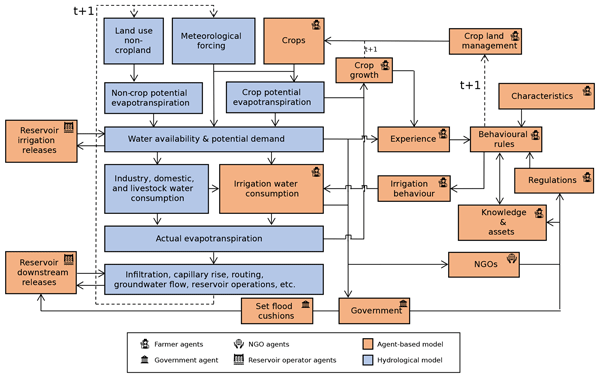
We present a computer simulation model of the hydrological system and human system, which can simulate the behaviour of individual farmers and their interactions with the water system at basin scale to assess how the systems have evolved and are projected to evolve in the future. For example, we can simulate the effect of subsidies provided on investment in adaptation measures and subsequent effects in the hydrological system, such as a lowering of the groundwater table or reservoir level.
Luca Guillaumot, Mikhail Smilovic, Peter Burek, Jens de Bruijn, Peter Greve, Taher Kahil, and Yoshihide Wada
Geosci. Model Dev., 15, 7099–7120, https://doi.org/10.5194/gmd-15-7099-2022, https://doi.org/10.5194/gmd-15-7099-2022, 2022
Short summary
Short summary
We develop and test the first large-scale hydrological model at regional scale with a very high spatial resolution that includes a water management and groundwater flow model. This study infers the impact of surface and groundwater-based irrigation on groundwater recharge and on evapotranspiration in both irrigated and non-irrigated areas. We argue that water table recorded in boreholes can be used as validation data if water management is well implemented and spatial resolution is ≤ 100 m.
Thomas Lees, Steven Reece, Frederik Kratzert, Daniel Klotz, Martin Gauch, Jens De Bruijn, Reetik Kumar Sahu, Peter Greve, Louise Slater, and Simon J. Dadson
Hydrol. Earth Syst. Sci., 26, 3079–3101, https://doi.org/10.5194/hess-26-3079-2022, https://doi.org/10.5194/hess-26-3079-2022, 2022
Short summary
Short summary
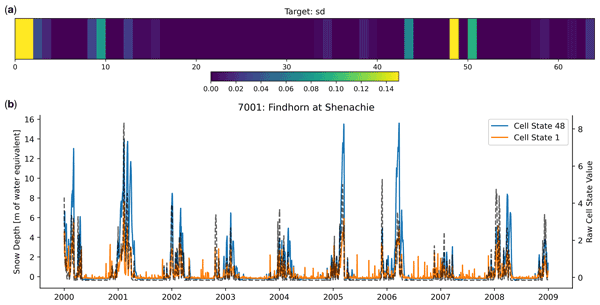
Despite the accuracy of deep learning rainfall-runoff models, we are currently uncertain of what these models have learned. In this study we explore the internals of one deep learning architecture and demonstrate that the model learns about intermediate hydrological stores of soil moisture and snow water, despite never having seen data about these processes during training. Therefore, we find evidence that the deep learning approach learns a physically realistic mapping from inputs to outputs.
Cited articles
Allen, R. G., Pereira, L. S., Raes, D., and Smith, M.: Crop evapotranspiration-Guidelines for computing crop water requirements-FAO Irrigation and drainage paper 56, Fao, Rome, 300, D05109, ISBN 92-5-104219-5, 1998.
Almazán-Gómez, M. A., Kahil, T., Duarte, R., and Sánchez-Chóliz, J.: A multiregional input–output hydro-economic modeling framework: An application to the Ebro River basin, Water Economics and Policy, 2140002, https://doi.org/10.1142/S2382624X21400026, 2021.
Awais, M., Vinca, A., Byers, E., Frank, S., Fricko, O., Boere, E., Burek, P., Poblete Cazenave, M., Kishimoto, P. N., Mastrucci, A., Satoh, Y., Palazzo, A., McPherson, M., Riahi, K., and Krey, V.: MESSAGEix-GLOBIOM nexus module: integrating water sector and climate impacts, Geosci. Model Dev., 17, 2447–2469, https://doi.org/10.5194/gmd-17-2447-2024, 2024.
Baccour, S., Ward, F. A., and Albiac, J.: Climate adaptation guidance: New roles for hydroeconomic analysis, Science of The Total Environment, 835, 155518, https://doi.org/10.1016/j.scitotenv.2022.155518, 2022.
Baccour, S., Goelema, G., Kahil, T., Albiac, J., Van Vliet, M. T. H., Zhu, X., and Strokal, M.: Water quality management could halve future water scarcity cost-effectively in the Pearl River Basin, Nat. Commun., 15, 5669, https://doi.org/10.1038/s41467-024-49929-z, 2024.
Baker, J. S., Van Houtven, G., Cai, Y., Moreda, F., Wade, C., Henry, C., Redmon, J. H., and Kondash, A. J.: A Hydro-Economic Methodology for the Food-Energy-Water Nexus: Valuation and Optimization of Water Resources, RTI Press, https://doi.org/10.3768/rtipress.2021.mr.0044.2105, 2021.
Bierkens, M. F. P., Reinhard, S., De Bruijn, J. A., Veninga, W., and Wada, Y.: The Shadow Price of Irrigation Water in Major Groundwater-Depleting Countries, Water Resources Research, 55, 4266–4287, https://doi.org/10.1029/2018WR023086, 2019.
Brooke, A., Kendrick, D., and Meeraus, A.: GAMS: A user's guide, The Scientific Press, New York, 1988.
Burek, P., Satoh, Y., Kahil, T., Tang, T., Greve, P., Smilovic, M., Guillaumot, L., Zhao, F., and Wada, Y.: Development of the Community Water Model (CWatM v1.04) – a high-resolution hydrological model for global and regional assessment of integrated water resources management, Geosci. Model Dev., 13, 3267–3298, https://doi.org/10.5194/gmd-13-3267-2020, 2020.
Dagnino, M. and Ward, F. A.: Economics of Agricultural Water Conservation: Empirical Analysis and Policy Implications, International Journal of Water Resources Development, 28, 577–600, https://doi.org/10.1080/07900627.2012.665801, 2012.
Dolan, F., Lamontagne, J., Link, R., Hejazi, M., Reed, P., and Edmonds, J.: Evaluating the economic impact of water scarcity in a changing world, Nat. Commun., 12, 1915, https://doi.org/10.1038/s41467-021-22194-0, 2021.
Fischer, G., Tubiello, F. N., van Velthuizen, H., and Wiberg, D. A.: Climate change impacts on irrigation water requirements: Effects of mitigation, 1990–2080, Technological Forecasting and Social Change, 74, 1083–1107, https://doi.org/10.1016/j.techfore.2006.05.021, 2007.
Fricko, O., Havlik, P., Rogelj, J., Klimont, Z., Gusti, M., Johnson, N., Kolp, P., Strubegger, M., Valin, H., Amann, M., Ermolieva, T., Forsell, N., Herrero, M., Heyes, C., Kindermann, G., Krey, V., McCollum, D. L., Obersteiner, M., Pachauri, S., Rao, S., and Riahi, K.: The marker quantification of the Shared Socioeconomic Pathway 2: A middle-of-the-road scenario for the 21st century, Global Environmental Change, 42, 251–267, https://doi.org/10.1016/j.gloenvcha.2016.06.004, 2017.
Gao, Y., Dong, K., and Yue, Y.: Projecting global fertilizer consumption under shared socioeconomic pathway (SSP) scenarios using an approach of ensemble machine learning, Science of The Total Environment, 912, 169130, https://doi.org/10.1016/j.scitotenv.2023.169130, 2024.
Global Commission on the Economics of Water: The economics of water: Valuing the hydrological cycle as a global common good, Global Commission on the Economics of Water, Paris, https://economicsofwater.watercommission.org/report/economics-of-water.pdf (last access: 23 October 2025), 2024.
Gerten, D., Heck, V., Jägermeyr, J., Bodirsky, B. L., Fetzer, I., Jalava, M., Kummu, M., Lucht, W., Rockström, J., Schaphoff, S., and Schellnhuber, H. J.: Feeding ten billion people is possible within four terrestrial planetary boundaries, Nature Sustainability, 3, 200–208, https://doi.org/10.1038/s41893-019-0465-1, 2020.
Gracia-de-Rentería, P. and Barberán, R.: Economic Determinants of Industrial Water Demand: A Review of the Applied Research Literature, Water, 13, 1684, https://doi.org/10.3390/w13121684, 2021.
Greve, P., Kahil, T., Mochizuki, J., Schinko, T., Satoh, Y., Burek, P., Fischer, G., Tramberend, S., Burtscher, R., Langan, S., and Wada, Y.: Global assessment of water challenges under uncertainty in water scarcity projections, Nat. Sustain., 1, 486–494, https://doi.org/10.1038/s41893-018-0134-9, 2018.
Griffin, R. C.: Water resource economics: The analysis of scarcity, policies, and projects, MIT Press, ISBN 9780262034043, 2016.
Hanasaki, N., Yoshikawa, S., Kakinuma, K., and Kanae, S.: A seawater desalination scheme for global hydrological models, Hydrol. Earth Syst. Sci., 20, 4143–4157, https://doi.org/10.5194/hess-20-4143-2016, 2016.
Haqiqi, I., Bowling, L., Jame, S., Baldos, U., Liu, J., and Hertel, T.: Global drivers of local water stresses and global responses to local water policies in the United States, Environ. Res. Lett., 18, 065007, https://doi.org/10.1088/1748-9326/acd269, 2023.
He, C., Liu, Z., Wu, J., Pan, X., Fang, Z., Li, J., and Bryan, B. A.: Future global urban water scarcity and potential solutions, Nat. Commun., 12, 4667, https://doi.org/10.1038/s41467-021-25026-3, 2021.
Howitt, R. E.: Positive Mathematical Programming, Am. J. Agric. Econ., 77, 329–342, https://doi.org/10.2307/1243543, 1995.
Howitt, R. E., Medellín-Azuara, J., MacEwan, D., and Lund, J. R.: Calibrating disaggregate economic models of agricultural production and water management, Environmental Modelling & Software, 38, 244–258, https://doi.org/10.1016/j.envsoft.2012.06.013, 2012.
Huang, Z., Yuan, X., and Liu, X.: The key drivers for the changes in global water scarcity: Water withdrawal versus water availability, Journal of Hydrology, 601, 126658, https://doi.org/10.1016/j.jhydrol.2021.126658, 2021.
Jones, E. R., van Vliet, M. T. H., Qadir, M., and Bierkens, M. F. P.: Country-level and gridded estimates of wastewater production, collection, treatment and reuse, Earth Syst. Sci. Data, 13, 237–254, https://doi.org/10.5194/essd-13-237-2021, 2021.
Kahil, T.: ECHO-Global version 1.0, Zenodo [code and data set], https://doi.org/10.5281/zenodo.14391182, 2024.
Kahil, T., Parkinson, S., Satoh, Y., Greve, P., Burek, P., Veldkamp, T. I. E., Burtscher, R., Byers, E., Djilali, N., Fischer, G., Krey, V., Langan, S., Riahi, K., Tramberend, S., and Wada, Y.: A Continental-Scale Hydroeconomic Model for Integrating Water-Energy-Land Nexus Solutions, Water Resources Research, 54, 7511–7533, https://doi.org/10.1029/2017WR022478, 2018.
Kim, S.H., Hejazi, M., Liu, L., Calvin, K., Clarke, L., Edmonds, J., Kyle, P., Patel, P., Wise, M., and Davies, E.: Balancing global water availability and use at basin scale in an integrated assessment model, Climatic Change, 136, 217–231, https://doi.org/10.1007/s10584-016-1604-6, 2016.
Kirshen, P.: Adaptation Options and Cost in Water Supply, UNFCCC Secretariat, Bonn, Germany, https://unfccc.int/files/cooperation_and_support/financial_mechanism/application/pdf/kirshen.pdf (last access: 23 October 2025), 2007.
Ledvina, K., Winchester, N., Strzepek, K., and Reilly, J. M.: New data for representing irrigated agriculture in economy-wide models, Journal of Global Economic Analysis, 3, 122–155, 2018.
Lehner, B., Liermann, C. R., Revenga, C., Vörösmarty, C., Fekete, B., Crouzet, P., Döll, P., Endejan, M., Frenken, K., Magome, J., Nilsson, C., Robertson, J. C., Rodel, R., Sindorf, N., and Wisser, D.: High-resolution mapping of the world’s reservoirs and dams for sustainable river-flow management, Front. Ecol. Environ., 9, 494–502, https://doi.org/10.1890/100125, 2011.
Levintal, E., Kniffin, M. L., Ganot, Y., Marwaha, N., Murphy, N. P., and Dahlke, H. E.: Agricultural managed aquifer recharge (Ag-MAR) – a method for sustainable groundwater management: A review, Critical Reviews in Environmental Science and Technology, 53, 291–314, https://doi.org/10.1080/10643389.2022.2050160, 2023.
Liu, L., Parkinson, S., Gidden, M., Byers, E., Satoh, Y., Riahi, K., and Forman, B.: Quantifying the potential for reservoirs to secure future surface water yields in the world's largest river basins, Environ. Res. Lett., 13, 044026, https://doi.org/10.1088/1748-9326/aab2b5, 2018.
Niazi, H., Wild, T. B., Turner, S. W. D., Graham, N. T., Hejazi, M., Msangi, S., Kim, S., Lamontagne, J. R., and Zhao, M.: Global peak water limit of future groundwater withdrawals, Nat. Sustain., 7, 413–422, https://doi.org/10.1038/s41893-024-01306-w, 2024.
Niazi, H., Ferencz, S. B., Graham, N. T., Yoon, J., Wild, T. B., Hejazi, M., Watson, D. J., and Vernon, C. R.: Long-term hydro-economic analysis tool for evaluating global groundwater cost and supply: Superwell v1.1, Geosci. Model Dev., 18, 1737–1767, https://doi.org/10.5194/gmd-18-1737-2025, 2025.
Ortiz-Partida, J. P., Fernandez-Bou, A. S., Maskey, M., Rodríguez-Flores, J. M., Medellín-Azuara, J., Sandoval-Solis, S., Ermolieva, T., Kanavas, Z., Sahu, R. K., Wada, Y., and Kahil, T.: Hydro-Economic Modeling of Water Resources Management Challenges: Current Applications and Future Directions, Water Econs. Policy, 9, 2340003, https://doi.org/10.1142/S2382624X23400039, 2023.
Palazzo, A., Kahil, T., Willaarts, B. A., Burek, P., van Dijk, M., Tang, T., Magnuszewski, P., Havlík, P., Langan, S., and Wada, Y.: Assessing sustainable development pathways for water, food, and energy security in a transboundary river basin, Environmental Development, 51, 101030, https://doi.org/10.1016/j.envdev.2024.101030, 2024.
Parkinson, S., Krey, V., Huppmann, D., Kahil, T., McCollum, D., Fricko, O., Byers, E., Gidden, M. J., Mayor, B., Khan, Z., Raptis, C., Rao, N. D., Johnson, N., Wada, Y., Djilali, N., and Riahi, K.: Balancing clean water-climate change mitigation trade-offs, Environ. Res. Lett., 14, 014009, https://doi.org/10.1088/1748-9326/aaf2a3, 2019.
Pastor, A. V., Ludwig, F., Biemans, H., Hoff, H., and Kabat, P.: Accounting for environmental flow requirements in global water assessments, Hydrol. Earth Syst. Sci., 18, 5041–5059, https://doi.org/10.5194/hess-18-5041-2014, 2014.
Popp, A., Calvin, K., Fujimori, S., Havlik, P., Humpenöder, F., Stehfest, E., Bodirsky, B. L., Dietrich, J. P., Doelmann, J. C., Gusti, M., Hasegawa, T., Kyle, P., Obersteiner, M., Tabeau, A., Takahashi, K., Valin, H., Waldhoff, S., Weindl, I., Wise, M., Kriegler, E., and van Vuuren, D. P.: Land-use futures in the shared socio-economic pathways, Global Environmental Change, 42, 331–345, https://doi.org/10.1016/j.gloenvcha.2016.10.002, 2017.
Portmann, F. T., Siebert, S., and Döll, P.: MIRCA2000 – Global monthly irrigated and rainfed crop areas around the year 2000: A new high-resolution data set for agricultural and hydrological modeling, Global Biogeochemical Cycles, 24, https://doi.org/10.1029/2008GB003435, 2010.
Reynaud, A. and Romano, G.: Advances in the Economic Analysis of Residential Water Use: An Introduction, Water, 10, 1162, https://doi.org/10.3390/w10091162, 2018.
Rodell, M., Famiglietti, J. S., Wiese, D. N., Reager, J. T., Beaudoing, H. K., Landerer, F. W., and Lo, M.-H.: Emerging trends in global freshwater availability, Nature, 557, 651–659, https://doi.org/10.1038/s41586-018-0123-1, 2018.
Rosa, L., Rulli, M. C., Davis, K. F., Chiarelli D. D., Passera, C., and D'Odorico, P.: Closing the yield gap while ensuring water sustainability, Environ. Res. Lett., 13, 104002, https://doi.org/10.1088/1748-9326/aadeef, 2018.
Sauer, T., Havlík, P., Schneider, U. A., Schmid, E., Kindermann, G., and Obersteiner, M.: Agriculture and resource availability in a changing world: The role of irrigation, Water Resources Research, 46, https://doi.org/10.1029/2009WR007729, 2010.
Scanlon, B. R., Fakhreddine, S., Rateb, A., de Graaf, I., Famiglietti, J., Gleeson, T., Grafton, R. Q., Jobbagy, E., Kebede, S., Kolusu, S. R., Konikow, L. F., Long, D., Mekonnen, M., Schmied, H. M., Mukherjee, A., MacDonald, A., Reedy, R. C., Shamsudduha, M., Simmons, C. T., Sun, A., Taylor, R. G., Villholth, K. G., Vörösmarty, C. J., and Zheng, C.: Global water resources and the role of groundwater in a resilient water future, Nat. Rev. Earth Environ., 4, 87–101, https://doi.org/10.1038/s43017-022-00378-6, 2023.
Schmidt-Traub, G.: Investment needs to achieve the Sustainable Development Goals: Understanding the Billions and Trillions, SDSN Working Paper Version 2, https://files.unsdsn.org/151112-SDG-Financing-Needs-Summary-for-Policymakers.pdf (last access: 23 October 2025), 2015.
Shrestha, P. K., Samaniego, L., Rakovec, O., Kumar, R., Mi, C., Rinke, K., and Thober, S.: Toward improved simulations of disruptive reservoirs in global hydrological modeling, Water Resources Research, 60, e2023WR035433, https://doi.org/10.1029/2023WR035433, 2024.
Straatsma, M., Droogers, P., Hunink, J., Berendrecht, W., Buitink, J., Buytaert, W., Karssenberg, D., Schmitz, O., Sutanudjaja, E. H., Van Beek, L. P. H., Vitolo, C., and Bierkens, M. F. P.: Global to regional scale evaluation of adaptation measures to reduce the future water gap, Environmental Modelling & Software, 124, 104578, https://doi.org/10.1016/j.envsoft.2019.104578, 2020.
Strong, C., Kuzma, S., Vionnet, S., and Reig, P.: Achieving abundance: Understanding the cost of a sustainable water future, Working Paper, World Resources Institute, Washington D.C., https://www.wri.org/research/achieving-abundance-understanding-cost-sustainable-water-future (last access: 23 October 2025), 2020.
USDA ERS – Commodity Costs and Returns: https://www.ers.usda.gov/data-products/commodity-costs-and-returns/, last access: 20 November 2024.
Valle-García, A., Montilla-Lopez, N. M., Parrado, R., Berbel, J., Martínez-Dalmau, J., Kahil, T., and Gutierrez-Martín, C.: Integrated assessment of resilience to drought by coupling hydro-economic and macroeconomic models, Journal of Hydrology, 661, 133549, https://doi.org/10.1016/j.jhydrol.2025.133549, 2025.
Vittis, Y., Folberth, C., Bundle, S.-C., and Obersteiner, M.: Restoring Nature at Lower Food Production Costs, Front. Environ. Sci., 9, https://doi.org/10.3389/fenvs.2021.672663, 2021.
Wada, Y. and Bierkens, M. F. P.: Sustainability of global water use: past reconstruction and future projections, Environ. Res. Lett., 9, 104003, https://doi.org/10.1088/1748-9326/9/10/104003, 2014.
Wada, Y., Wisser, D., and Bierkens, M. F. P.: Global modeling of withdrawal, allocation and consumptive use of surface water and groundwater resources, Earth Syst. Dynam., 5, 15–40, https://doi.org/10.5194/esd-5-15-2014, 2014.
Wada, Y., Flörke, M., Hanasaki, N., Eisner, S., Fischer, G., Tramberend, S., Satoh, Y., van Vliet, M. T. H., Yillia, P., Ringler, C., Burek, P., and Wiberg, D.: Modeling global water use for the 21st century: the Water Futures and Solutions (WFaS) initiative and its approaches, Geosci. Model Dev., 9, 175–222, https://doi.org/10.5194/gmd-9-175-2016, 2016.
Ward, P. J., Strzepek, K. M., Pauw, W. P., Brander, L. M., Hughes, G. A., and Aerts, J. C. J. H.: Partial costs of global climate change adaptation for the supply of raw industrial and municipal water: a methodology and application, Environ. Res. Lett., 5, 044011, https://doi.org/10.1088/1748-9326/5/4/044011, 2010.
Woetzel, J., Garemo, N., Mischke, J., Kamra, P., and Palter, R.: Bridging infrastructure gaps: Has the world made progress, McKinsey & Company, 12 pp., https://www.mckinsey.com/~/media/mckinsey/business functions/operations/our insights/bridging infrastructure gaps how has the world made progress v2/mgi-bridging-infrastructure-gaps-discussion-paper.pdf (last access: 23 October 2025), 2017.
Yigzaw, W., Li, H.-Y., Demissie, Y., Hejazi, M. I., Leung, L. R., Voisin, N., and Payn, R.: A New Global Storage-Area-Depth Data Set for Modeling Reservoirs in Land Surface and Earth System Models, Water Resources Research, 54, 10372–10386, https://doi.org/10.1029/2017WR022040, 2018.
Yoon, J., Voisin, N., Klassert, C., Thurber, T., and Xu, W.: Representing farmer irrigated crop area adaptation in a large-scale hydrological model, Hydrol. Earth Syst. Sci., 28, 899–916, https://doi.org/10.5194/hess-28-899-2024, 2024.
Young, R. A. and Loomis, J. B.: Determining the Economic Value of Water: Concepts and Methods, 2nd edn., Routledge, New York, 358 pp., https://doi.org/10.4324/9780203784112, 2014.
Yu, Q., You, L., Wood-Sichra, U., Ru, Y., Joglekar, A. K. B., Fritz, S., Xiong, W., Lu, M., Wu, W., and Yang, P.: A cultivated planet in 2010 – Part 2: The global gridded agricultural-production maps, Earth Syst. Sci. Data, 12, 3545–3572, https://doi.org/10.5194/essd-12-3545-2020, 2020.
Zhao, M., Wild, T. B., Graham, N. T., Kim, S. H., Binsted, M., Chowdhury, A. F. M. K., Msangi, S., Patel, P. L., Vernon, C. R., Niazi, H., Li, H.-Y., and Abeshu, G. W.: GCAM–GLORY v1.0: representing global reservoir water storage in a multi-sector human–Earth system model, Geosci. Model Dev., 17, 5587–5617, https://doi.org/10.5194/gmd-17-5587-2024, 2024.
Short summary
This study presents the development of the global version of the ECHO hydro-economic model for assessing the economic and environmental performance of water management options. This improved version covers a large number of basins worldwide, includes a detailed representation of irrigated agriculture, and accounts for economic benefits and costs of water use. Results of this study demonstrates the capacity of ECHO-Global to address emerging water-related research and practical questions.
This study presents the development of the global version of the ECHO hydro-economic model for...


