Articles | Volume 19, issue 2
https://doi.org/10.5194/gmd-19-989-2026
© Author(s) 2026. This work is distributed under
the Creative Commons Attribution 4.0 License.
https://doi.org/10.5194/gmd-19-989-2026
© Author(s) 2026. This work is distributed under
the Creative Commons Attribution 4.0 License.
Coastal-Cosmo-Model (CCMv1): a cosmogenic nuclide model for rocky coastlines

Richard S. Jones
CORRESPONDING AUTHOR
School of Earth Atmosphere and Environment, Monash University, Clayton, 3800 Victoria, Australia
Related authors
Cari Rand, Richard S. Jones, Andrew N. Mackintosh, Brent Goehring, and Kat Lilly
The Cryosphere, 19, 3681–3691, https://doi.org/10.5194/tc-19-3681-2025, https://doi.org/10.5194/tc-19-3681-2025, 2025
Short summary
Short summary
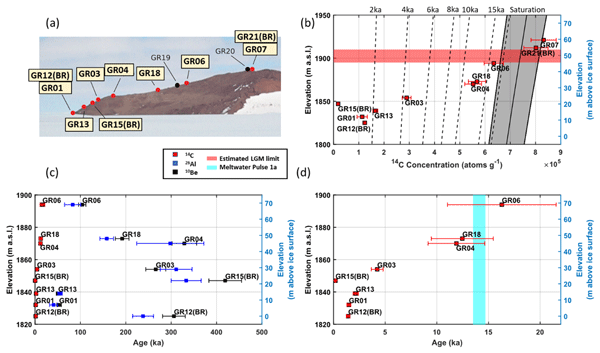
In this study, we determine how recently samples from a mountain in East Antarctica were last covered by the East Antarctic Ice Sheet. By examining concentrations of 14C in rock samples, we determined that all but the summit of the mountain was buried under glacial ice within the last 15 kyr. Other methods of estimating past ice thicknesses are not sensitive enough to capture ice cover this recent, so we were previously unaware that ice at this site was thicker at this time.
Lawrence A. Bird, Vitaliy Ogarko, Laurent Ailleres, Lachlan Grose, Jérémie Giraud, Felicity S. McCormack, David E. Gwyther, Jason L. Roberts, Richard S. Jones, and Andrew N. Mackintosh
The Cryosphere, 19, 3355–3380, https://doi.org/10.5194/tc-19-3355-2025, https://doi.org/10.5194/tc-19-3355-2025, 2025
Short summary
Short summary
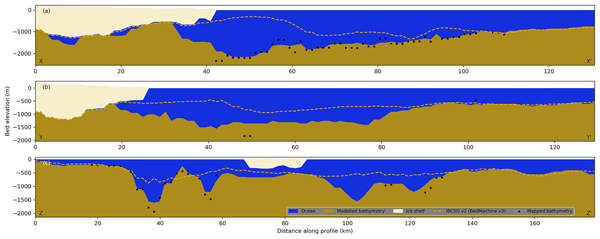
The terrain of the seafloor has important controls on the access of warm water below floating ice shelves around Antarctica. Here, we present an open-source method to infer what the seafloor looks like around the Antarctic continent and within these ice shelf cavities, using measurements of the Earth's gravitational field. We present an improved seafloor map for the Vincennes Bay region in East Antarctica and assess its impact on ice melt rates.
Lawrence A. Bird, Felicity S. McCormack, Johanna Beckmann, Richard S. Jones, and Andrew N. Mackintosh
The Cryosphere, 19, 955–973, https://doi.org/10.5194/tc-19-955-2025, https://doi.org/10.5194/tc-19-955-2025, 2025
Short summary
Short summary
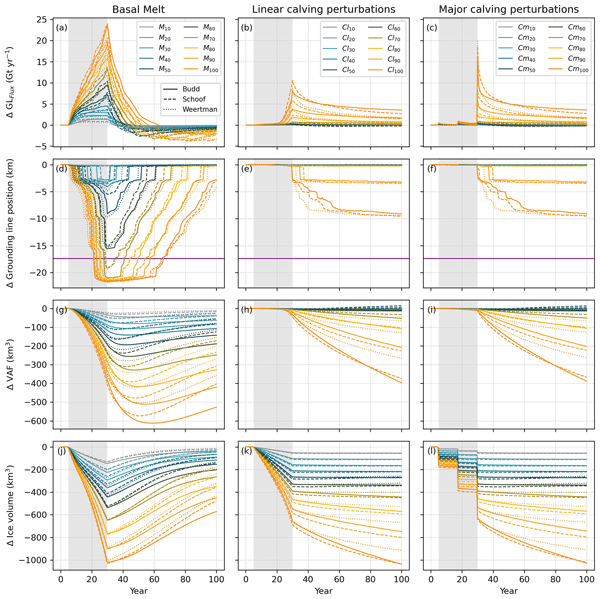
Vanderford Glacier is the fastest-retreating glacier in East Antarctica and may have important implications for future ice loss from the Aurora Subglacial Basin. Our ice sheet model simulations suggest that grounding line retreat is driven by sub-ice-shelf basal melting, in which warm ocean waters melt ice close to the grounding line. We show that current estimates of basal melt are likely too low, highlighting the need for improved estimates and direct measurements of basal melt in the region.
Felicity S. McCormack, Jason L. Roberts, Bernd Kulessa, Alan Aitken, Christine F. Dow, Lawrence Bird, Benjamin K. Galton-Fenzi, Katharina Hochmuth, Richard S. Jones, Andrew N. Mackintosh, and Koi McArthur
The Cryosphere, 17, 4549–4569, https://doi.org/10.5194/tc-17-4549-2023, https://doi.org/10.5194/tc-17-4549-2023, 2023
Short summary
Short summary
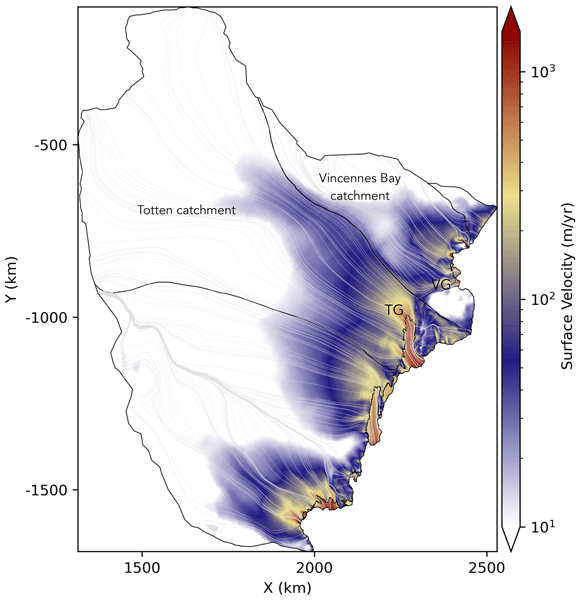
Changes in Antarctic surface elevation can cause changes in ice and basal water flow, impacting how much ice enters the ocean. We find that ice and basal water flow could divert from the Totten to the Vanderford Glacier, East Antarctica, under only small changes in the surface elevation, with implications for estimates of ice loss from this region. Further studies are needed to determine when this could occur and if similar diversions could occur elsewhere in Antarctica due to climate change.
James A. Smith, Louise Callard, Michael J. Bentley, Stewart S. R. Jamieson, Maria Luisa Sánchez-Montes, Timothy P. Lane, Jeremy M. Lloyd, Erin L. McClymont, Christopher M. Darvill, Brice R. Rea, Colm O'Cofaigh, Pauline Gulliver, Werner Ehrmann, Richard S. Jones, and David H. Roberts
The Cryosphere, 17, 1247–1270, https://doi.org/10.5194/tc-17-1247-2023, https://doi.org/10.5194/tc-17-1247-2023, 2023
Short summary
Short summary
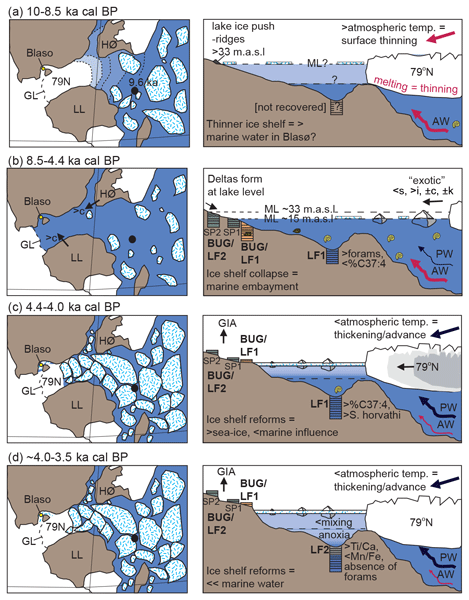
The Greenland Ice Sheet is melting at an accelerating rate. To understand the significance of these changes we reconstruct the history of one of its fringing ice shelves, known as 79° N ice shelf. We show that the ice shelf disappeared 8500 years ago, following a period of enhanced warming. An important implication of our study is that 79° N ice shelf is susceptible to collapse when atmospheric and ocean temperatures are ~2°C warmer than present, which could occur by the middle of this century.
Dominic Saunderson, Andrew Mackintosh, Felicity McCormack, Richard Selwyn Jones, and Ghislain Picard
The Cryosphere, 16, 4553–4569, https://doi.org/10.5194/tc-16-4553-2022, https://doi.org/10.5194/tc-16-4553-2022, 2022
Short summary
Short summary
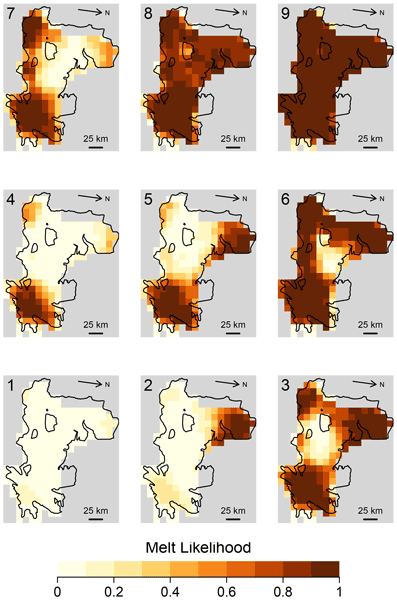
We investigate the variability in surface melt on the Shackleton Ice Shelf in East Antarctica over the last 2 decades (2003–2021). Using daily satellite observations and the machine learning approach of a self-organising map, we identify nine distinct spatial patterns of melt. These patterns allow comparisons of melt within and across melt seasons and highlight the importance of both air temperatures and local controls such as topography, katabatic winds, and albedo in driving surface melt.
Jamey Stutz, Andrew Mackintosh, Kevin Norton, Ross Whitmore, Carlo Baroni, Stewart S. R. Jamieson, Richard S. Jones, Greg Balco, Maria Cristina Salvatore, Stefano Casale, Jae Il Lee, Yeong Bae Seong, Robert McKay, Lauren J. Vargo, Daniel Lowry, Perry Spector, Marcus Christl, Susan Ivy Ochs, Luigia Di Nicola, Maria Iarossi, Finlay Stuart, and Tom Woodruff
The Cryosphere, 15, 5447–5471, https://doi.org/10.5194/tc-15-5447-2021, https://doi.org/10.5194/tc-15-5447-2021, 2021
Short summary
Short summary
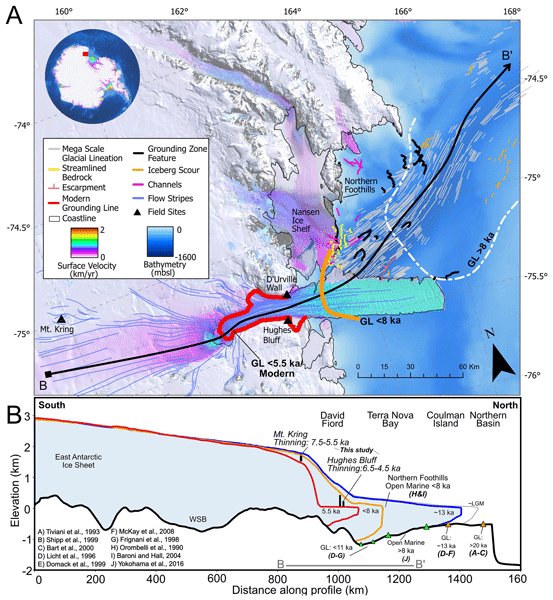
Understanding the long-term behaviour of ice sheets is essential to projecting future changes due to climate change. In this study, we use rocks deposited along the margin of the David Glacier, one of the largest glacier systems in the world, to reveal a rapid thinning event initiated over 7000 years ago and endured for ~ 2000 years. Using physical models, we show that subglacial topography and ocean heat are important drivers for change along this sector of the Antarctic Ice Sheet.
Rachel K. Smedley, David Small, Richard S. Jones, Stephen Brough, Jennifer Bradley, and Geraint T. H. Jenkins
Geochronology, 3, 525–543, https://doi.org/10.5194/gchron-3-525-2021, https://doi.org/10.5194/gchron-3-525-2021, 2021
Short summary
Short summary
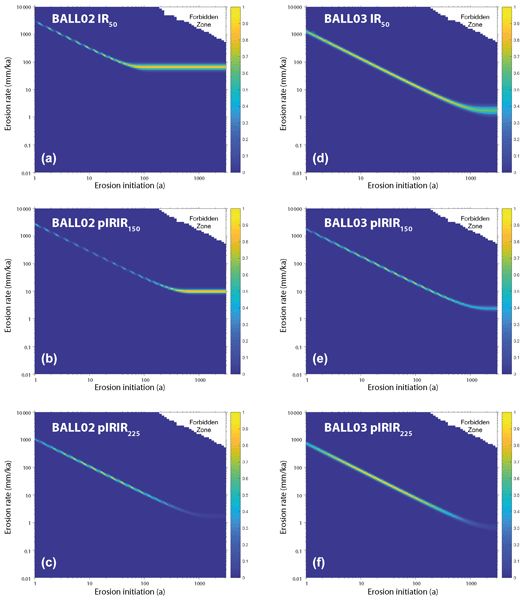
We apply new rock luminescence techniques to a well-constrained scenario of the Beinn Alligin rock avalanche, NW Scotland. We measure accurate erosion rates consistent with independently derived rates and reveal a transient state of erosion over the last ~4000 years in the wet, temperate climate of NW Scotland. This study shows that the new luminescence erosion-meter has huge potential for inferring erosion rates on sub-millennial scales, which is currently impossible with existing techniques.
Martim Mas e Braga, Richard Selwyn Jones, Jennifer C. H. Newall, Irina Rogozhina, Jane L. Andersen, Nathaniel A. Lifton, and Arjen P. Stroeven
The Cryosphere, 15, 4929–4947, https://doi.org/10.5194/tc-15-4929-2021, https://doi.org/10.5194/tc-15-4929-2021, 2021
Short summary
Short summary
Mountains higher than the ice surface are sampled to know when the ice reached the sampled elevation, which can be used to guide numerical models. This is important to understand how much ice will be lost by ice sheets in the future. We use a simple model to understand how ice flow around mountains affects the ice surface topography and show how much this influences results from field samples. We also show that models need a finer resolution over mountainous areas to better match field samples.
Cari Rand, Richard S. Jones, Andrew N. Mackintosh, Brent Goehring, and Kat Lilly
The Cryosphere, 19, 3681–3691, https://doi.org/10.5194/tc-19-3681-2025, https://doi.org/10.5194/tc-19-3681-2025, 2025
Short summary
Short summary
In this study, we determine how recently samples from a mountain in East Antarctica were last covered by the East Antarctic Ice Sheet. By examining concentrations of 14C in rock samples, we determined that all but the summit of the mountain was buried under glacial ice within the last 15 kyr. Other methods of estimating past ice thicknesses are not sensitive enough to capture ice cover this recent, so we were previously unaware that ice at this site was thicker at this time.
Lawrence A. Bird, Vitaliy Ogarko, Laurent Ailleres, Lachlan Grose, Jérémie Giraud, Felicity S. McCormack, David E. Gwyther, Jason L. Roberts, Richard S. Jones, and Andrew N. Mackintosh
The Cryosphere, 19, 3355–3380, https://doi.org/10.5194/tc-19-3355-2025, https://doi.org/10.5194/tc-19-3355-2025, 2025
Short summary
Short summary
The terrain of the seafloor has important controls on the access of warm water below floating ice shelves around Antarctica. Here, we present an open-source method to infer what the seafloor looks like around the Antarctic continent and within these ice shelf cavities, using measurements of the Earth's gravitational field. We present an improved seafloor map for the Vincennes Bay region in East Antarctica and assess its impact on ice melt rates.
Lawrence A. Bird, Felicity S. McCormack, Johanna Beckmann, Richard S. Jones, and Andrew N. Mackintosh
The Cryosphere, 19, 955–973, https://doi.org/10.5194/tc-19-955-2025, https://doi.org/10.5194/tc-19-955-2025, 2025
Short summary
Short summary
Vanderford Glacier is the fastest-retreating glacier in East Antarctica and may have important implications for future ice loss from the Aurora Subglacial Basin. Our ice sheet model simulations suggest that grounding line retreat is driven by sub-ice-shelf basal melting, in which warm ocean waters melt ice close to the grounding line. We show that current estimates of basal melt are likely too low, highlighting the need for improved estimates and direct measurements of basal melt in the region.
Felicity S. McCormack, Jason L. Roberts, Bernd Kulessa, Alan Aitken, Christine F. Dow, Lawrence Bird, Benjamin K. Galton-Fenzi, Katharina Hochmuth, Richard S. Jones, Andrew N. Mackintosh, and Koi McArthur
The Cryosphere, 17, 4549–4569, https://doi.org/10.5194/tc-17-4549-2023, https://doi.org/10.5194/tc-17-4549-2023, 2023
Short summary
Short summary
Changes in Antarctic surface elevation can cause changes in ice and basal water flow, impacting how much ice enters the ocean. We find that ice and basal water flow could divert from the Totten to the Vanderford Glacier, East Antarctica, under only small changes in the surface elevation, with implications for estimates of ice loss from this region. Further studies are needed to determine when this could occur and if similar diversions could occur elsewhere in Antarctica due to climate change.
James A. Smith, Louise Callard, Michael J. Bentley, Stewart S. R. Jamieson, Maria Luisa Sánchez-Montes, Timothy P. Lane, Jeremy M. Lloyd, Erin L. McClymont, Christopher M. Darvill, Brice R. Rea, Colm O'Cofaigh, Pauline Gulliver, Werner Ehrmann, Richard S. Jones, and David H. Roberts
The Cryosphere, 17, 1247–1270, https://doi.org/10.5194/tc-17-1247-2023, https://doi.org/10.5194/tc-17-1247-2023, 2023
Short summary
Short summary
The Greenland Ice Sheet is melting at an accelerating rate. To understand the significance of these changes we reconstruct the history of one of its fringing ice shelves, known as 79° N ice shelf. We show that the ice shelf disappeared 8500 years ago, following a period of enhanced warming. An important implication of our study is that 79° N ice shelf is susceptible to collapse when atmospheric and ocean temperatures are ~2°C warmer than present, which could occur by the middle of this century.
Dominic Saunderson, Andrew Mackintosh, Felicity McCormack, Richard Selwyn Jones, and Ghislain Picard
The Cryosphere, 16, 4553–4569, https://doi.org/10.5194/tc-16-4553-2022, https://doi.org/10.5194/tc-16-4553-2022, 2022
Short summary
Short summary
We investigate the variability in surface melt on the Shackleton Ice Shelf in East Antarctica over the last 2 decades (2003–2021). Using daily satellite observations and the machine learning approach of a self-organising map, we identify nine distinct spatial patterns of melt. These patterns allow comparisons of melt within and across melt seasons and highlight the importance of both air temperatures and local controls such as topography, katabatic winds, and albedo in driving surface melt.
Jamey Stutz, Andrew Mackintosh, Kevin Norton, Ross Whitmore, Carlo Baroni, Stewart S. R. Jamieson, Richard S. Jones, Greg Balco, Maria Cristina Salvatore, Stefano Casale, Jae Il Lee, Yeong Bae Seong, Robert McKay, Lauren J. Vargo, Daniel Lowry, Perry Spector, Marcus Christl, Susan Ivy Ochs, Luigia Di Nicola, Maria Iarossi, Finlay Stuart, and Tom Woodruff
The Cryosphere, 15, 5447–5471, https://doi.org/10.5194/tc-15-5447-2021, https://doi.org/10.5194/tc-15-5447-2021, 2021
Short summary
Short summary
Understanding the long-term behaviour of ice sheets is essential to projecting future changes due to climate change. In this study, we use rocks deposited along the margin of the David Glacier, one of the largest glacier systems in the world, to reveal a rapid thinning event initiated over 7000 years ago and endured for ~ 2000 years. Using physical models, we show that subglacial topography and ocean heat are important drivers for change along this sector of the Antarctic Ice Sheet.
Rachel K. Smedley, David Small, Richard S. Jones, Stephen Brough, Jennifer Bradley, and Geraint T. H. Jenkins
Geochronology, 3, 525–543, https://doi.org/10.5194/gchron-3-525-2021, https://doi.org/10.5194/gchron-3-525-2021, 2021
Short summary
Short summary
We apply new rock luminescence techniques to a well-constrained scenario of the Beinn Alligin rock avalanche, NW Scotland. We measure accurate erosion rates consistent with independently derived rates and reveal a transient state of erosion over the last ~4000 years in the wet, temperate climate of NW Scotland. This study shows that the new luminescence erosion-meter has huge potential for inferring erosion rates on sub-millennial scales, which is currently impossible with existing techniques.
Martim Mas e Braga, Richard Selwyn Jones, Jennifer C. H. Newall, Irina Rogozhina, Jane L. Andersen, Nathaniel A. Lifton, and Arjen P. Stroeven
The Cryosphere, 15, 4929–4947, https://doi.org/10.5194/tc-15-4929-2021, https://doi.org/10.5194/tc-15-4929-2021, 2021
Short summary
Short summary
Mountains higher than the ice surface are sampled to know when the ice reached the sampled elevation, which can be used to guide numerical models. This is important to understand how much ice will be lost by ice sheets in the future. We use a simple model to understand how ice flow around mountains affects the ice surface topography and show how much this influences results from field samples. We also show that models need a finer resolution over mountainous areas to better match field samples.
Cited articles
Balco, G., Stone, J. O., Lifton, N. A., and Dunai, T. J.: A complete and easily accessible means of calculating surface exposure ages or erosion rates from 10Be and 26Al measurements, Quaternary Geochronology, 3, 174–195, https://doi.org/10.1016/j.quageo.2007.12.001, 2008.
Bierman, P. R., Rood, D. H., Shakun, J. D., Portenga, E. W., and Corbett, L. B.: Directly dating postglacial Greenlandic land-surface emergence at high resolution using in situ 10Be, Quaternary Research, 90, 110–126, https://doi.org/10.1017/qua.2018.6, 2018.
Borchers, B., Marrero, S., Balco, G., Caffee, M., Goehring, B., Lifton, N., Nishiizumi, K., Phillips, F., Schaefer, J., and Stone, J.: Geological calibration of spallation production rates in the CRONUS-Earth project, Quaternary Geochronology, 31, 188–198, https://doi.org/10.1016/j.quageo.2015.01.009, 2016.
Chmeleff, J., von Blanckenburg, F., Kossert, K., and Jakob, D.: Determination of the 10Be half-life by multicollector ICP-MS and liquid scintillation counting, Nuclear Instruments and Methods in Physics Research Section B: Beam Interactions with Materials and Atoms, 268, 192–199, https://doi.org/10.1016/j.nimb.2009.09.012, 2010.
Choi, K. H., Seong, Y. B., Jung, P. M., and Lee, S. Y.: Using Cosmogenic 10Be Dating to Unravel the Antiquity of a Rocky Shore Platform on the West Coast of Korea, Journal of Coastal Research, 28, 641–657, https://doi.org/10.2112/JCOASTRES-D-11-00087.1, 2012.
Delunel, R., Bourlès, D. L., van der Beek, P. A., Schlunegger, F., Leya, I., Masarik, J., and Paquet, E.: Snow shielding factors for cosmogenic nuclide dating inferred from long-term neutron detector monitoring, Quaternary Geochronology, 24, 16–26, https://doi.org/10.1016/j.quageo.2014.07.003, 2014.
Dunai, T., Binnie, S., Hein, A., and Paling, S.: The effects of a hydrogen-rich ground cover on cosmogenic thermal neutrons: Implications for exposure dating, Quaternary Geochronology, 22, 183–191, 2014.
Dunne, J., Elmore, D., and Muzikar, P.: Scaling factors for the rates of production of cosmogenic nuclides for geometric shielding and attenuation at depth on sloped surfaces, Geomorphology, 27, 3–11, 1999.
Gosse, J. C. and Phillips, F. M.: Terrestrial in situ cosmogenic nuclides: theory and application, Quaternary Science Reviews, 20, 1475–1560, 2001.
Hippe, K.: Constraining processes of landscape change with combined in situ cosmogenic 14C-10Be analysis, Quaternary Science Reviews, 173, 1–19, https://doi.org/10.1016/j.quascirev.2017.07.020, 2017.
Hurst, M. D., Rood, D. H., Ellis, M. A., Anderson, R. S., and Dornbusch, U.: Recent acceleration in coastal cliff retreat rates on the south coast of Great Britain, Proceedings of the National Academy of Sciences, 113, 13336–13341, https://doi.org/10.1073/pnas.1613044113, 2016.
Hurst, M. D., Rood, D. H., and Ellis, M. A.: Controls on the distribution of cosmogenic 10Be across shore platforms, Earth Surf. Dynam., 5, 67–84, https://doi.org/10.5194/esurf-5-67-2017, 2017.
Jonas, T., Marty, C., and Magnusson, J.: Estimating the snow water equivalent from snow depth measurements in the Swiss Alps, Journal of Hydrology, 378, 161–167, 2009.
Jones, R., Small, D., Cahill, N., Bentley, M., and Whitehouse, P.: iceTEA: Tools for plotting and analysing cosmogenic-nuclide surface-exposure data from former ice margins, Quaternary Geochronology, 51, 72–86, 2019.
Jones, R. S.: Coastal-Cosmo-Model: a cosmogenic nuclide model for coastal erosion of rocky shore platforms, Zenodo [code], https://doi.org/10.5281/zenodo.15454613, 2025.
Korschinek, G., Bergmaier, A., Faestermann, T., Gerstmann, U. C., Knie, K., Rugel, G., Wallner, A., Dillmann, I., Dollinger, G., von Gostomski, C. L., Kossert, K., Maiti, M., Poutivtsev, M., and Remmert, A.: A new value for the half-life of 10Be by Heavy-Ion Elastic Recoil Detection and liquid scintillation counting, Nuclear Instruments and Methods in Physics Research Section B: Beam Interactions with Materials and Atoms, 268, 187–191, https://doi.org/10.1016/j.nimb.2009.09.020, 2010.
Korte, M. and Constable, C. G.: The geomagnetic dipole moment over the last 7000 years – new results from a global model, Earth and Planetary Science Letters, 236, 348–358, https://doi.org/10.1016/j.epsl.2004.12.031, 2005.
Korte, M. and Constable, C.: Improving geomagnetic field reconstructions for 0–3 ka, Physics of the Earth and Planetary Interiors, 188, 247–259, 2011.
Korte, M., Donadini, F., and Constable, C.: Geomagnetic field for 0–3 ka: 2. A new series of time-varying global models, Geochemistry, Geophysics, Geosystems, 10, Q06008, https://doi.org/10.1029/2008GC002297, 2009.
Lagarias, J. C., Reeds, J. A., Wright, M. H., and Wright, P. E.: Convergence Properties of the Nelder–Mead Simplex Method in Low Dimensions, SIAM J. Optim., 9, 112–147, https://doi.org/10.1137/S1052623496303470, 1998.
Laj, C., Kissel, C., and Beer, J.: High resolution global paleointensity stack since 75 kyr (GLOPIS-75) calibrated to absolute values, Timescales of the Paleomagnetic Field, in: Geophysical Monograph Series, Timescales of the Paleomagnetic Field, Vol. 145, edited by: Channell, J. E. T., Kent, D. V., Lowrie, W., and Meert, J. G., American Geophysical Union, 255–265, https://doi.org/10.1029/145GM19, 2004.
Lifton, N., Sato, T., and Dunai, T. J.: Scaling in situ cosmogenic nuclide production rates using analytical approximations to atmospheric cosmic-ray fluxes, Earth and Planetary Science Letters, 386, 149–160, https://doi.org/10.1016/j.epsl.2013.10.052, 2014.
Marrero, S. M., Phillips, F. M., Borchers, B., Lifton, N., Aumer, R., and Balco, G.: Cosmogenic nuclide systematics and the CRONUScalc program, Quaternary Geochronology, 31, 160–187, https://doi.org/10.1016/j.quageo.2015.09.005, 2016.
Mudd, S. M., Harel, M.-A., Hurst, M. D., Grieve, S. W. D., and Marrero, S. M.: The CAIRN method: automated, reproducible calculation of catchment-averaged denudation rates from cosmogenic nuclide concentrations, Earth Surf. Dynam., 4, 655–674, https://doi.org/10.5194/esurf-4-655-2016, 2016.
Nishiizumi, K., Winterer, E., Kohl, C., Klein, J., Middleton, R., Lal, D., and Arnold, J.: Cosmic ray production rates of 10Be and 26Al in quartz from glacially polished rocks, Journal of Geophysical Research: Solid Earth (1978–2012), 94, 17907–17915, 1989.
Radok, U., Allison, I., and Wendler, G.: Atmospheric surface pressure over the interior of Antarctica, Antarctic Science, 8, 209–217, 1996.
Regard, V., Dewez, T., Bourlès, D. L., Anderson, R. S., Duperret, A., Costa, S., Leanni, L., Lasseur, E., Pedoja, K., and Maillet, G. M.: Late Holocene seacliff retreat recorded by 10Be profiles across a coastal platform: Theory and example from the English Channel, Quaternary Geochronology, 11, 87–97, https://doi.org/10.1016/j.quageo.2012.02.027, 2012.
Sato, T., Yasuda, H., Niita, K., Endo, A., and Sihver, L.: Development of PARMA: PHITS-based analytical radiation model in the atmosphere, Radiation Research, 170, 244–259, 2008.
Schaefer, J. M., Finkel, R. C., Balco, G., Alley, R. B., Caffee, M. W., Briner, J. P., Young, N. E., Gow, A. J., and Schwartz, R.: Greenland was nearly ice-free for extended periods during the Pleistocene, Nature, 540, 252–255, 2016.
Shadrick, J. R., Hurst, M. D., Piggott, M. D., Hebditch, B. G., Seal, A. J., Wilcken, K. M., and Rood, D. H.: Multi-objective optimisation of a rock coast evolution model with cosmogenic 10Be analysis for the quantification of long-term cliff retreat rates, Earth Surf. Dynam., 9, 1505–1529, https://doi.org/10.5194/esurf-9-1505-2021, 2021.
Stone, J. O.: Air pressure and cosmogenic isotope production, Journal of Geophysical Research: Solid Earth (1978–2012), 105, 23753–23759, 2000.
Swirad, Z. M., Rosser, N. J., Brain, M. J., Rood, D. H., Hurst, M. D., Wilcken, K. M., and Barlow, J.: Cosmogenic exposure dating reveals limited long-term variability in erosion of a rocky coastline, Nat. Commun., 11, 3804, https://doi.org/10.1038/s41467-020-17611-9, 2020.
Trenhaile, A. S.: Shore platform erosion and evolution: Implications for cosmogenic nuclide analysis, Marine Geology, 403, 80–92, https://doi.org/10.1016/j.margeo.2018.05.005, 2018.
Uppala, S. M., Kållberg, P., Simmons, A., Andrae, U., Bechtold, V. D., Fiorino, M., Gibson, J., Haseler, J., Hernandez, A., and Kelly, G.: The ERA-40 re-analysis, Quarterly Journal of the Royal Meteorological Society, 131, 2961–3012, 2005.
Ziegler, L. B., Constable, C. G., Johnson, C. L., and Tauxe, L.: PADM2M: a penalized maximum likelihood model of the 0–2 Ma palaeomagnetic axial dipole moment, Geophysical Journal International, 184, 1069–1089, https://doi.org/10.1111/j.1365-246X.2010.04905.x, 2011.
Zweck, C., Zreda, M., and Desilets, D.: Snow shielding factors for cosmogenic nuclide dating inferred from Monte Carlo neutron transport simulations, Earth and Planetary Science Letters, 379, 64–71, https://doi.org/10.1016/j.epsl.2013.07.023, 2013.
Short summary
This paper presents a new modelling framework that reconstructs the history of rocky shores using cosmogenic nuclide data. The model can be applied to both eroding and stable coasts, and allows users to test how factors like cliff retreat, down-wearing and sea-level change have shaped coastal landscapes. It provides a flexible tool for exploring long-term coastal evolution across diverse environments.
This paper presents a new modelling framework that reconstructs the history of rocky shores...