
Articles | Volume 19, issue 2
https://doi.org/10.5194/gmd-19-827-2026
© Author(s) 2026. This work is distributed under
the Creative Commons Attribution 4.0 License.
the Creative Commons Attribution 4.0 License.
https://doi.org/10.5194/gmd-19-827-2026
© Author(s) 2026. This work is distributed under
the Creative Commons Attribution 4.0 License.
the Creative Commons Attribution 4.0 License.
Model evaluation paper
| 
26 Jan 2026
Model evaluation paper |
| 26 Jan 2026
| 26 Jan 2026
Modeling Indian Ocean circulation to study marine debris dispersion: insights into high-resolution and wave forcing effects with Symphonie 3.6.6

Université de Toulouse, LEGOS (IRD, CNRS, CNES, UT3), OMP, F31400, Toulouse, France
Université de Brest, LOPS (IRD, CNRS, Ifremer), IUEM, F29280, Plouzané, France
Marine Herrmann
Université de Toulouse, LEGOS (IRD, CNRS, CNES, UT3), OMP, F31400, Toulouse, France
Patrick Marsaleix
Université de Toulouse, LEGOS (IRD, CNRS, CNES, UT3), OMP, F31400, Toulouse, France
Matthieu Bompoil
Université de Brest, LOPS (IRD, CNRS, Ifremer), IUEM, F29280, Plouzané, France
Christophe Maes
Université de Brest, LOPS (IRD, CNRS, Ifremer), IUEM, F29280, Plouzané, France
Related authors
Jean-Michel Brankart, Damien Héron, Lisa Weiss, Thierry Penduff, and Pierre Brasseur
EGUsphere, https://doi.org/10.5194/egusphere-2026-3237, https://doi.org/10.5194/egusphere-2026-3237, 2026
Short summary
Short summary
In this paper, a method is proposed to estimate directly the low-frequency component of the ocean variability from native observations using statistics from a prior long-term ensemble simulation. The approach is illustrated by the reconstruction of the low-frequency variability of the Mediterranean sea level. The resulting ensemble estimate is assessed against independent observations, showing good reliability.
Jean-Michel Brankart, Damien Héron, Lisa Weiss, Thierry Penduff, and Pierre Brasseur
EGUsphere, https://doi.org/10.5194/egusphere-2026-3237, https://doi.org/10.5194/egusphere-2026-3237, 2026
Short summary
Short summary
In this paper, a method is proposed to estimate directly the low-frequency component of the ocean variability from native observations using statistics from a prior long-term ensemble simulation. The approach is illustrated by the reconstruction of the low-frequency variability of the Mediterranean sea level. The resulting ensemble estimate is assessed against independent observations, showing good reliability.
Quentin Desmet, Marine Herrmann, and Thanh Ngo-Duc
Geosci. Model Dev., 18, 8855–8886, https://doi.org/10.5194/gmd-18-8855-2025, https://doi.org/10.5194/gmd-18-8855-2025, 2025
Short summary
Short summary
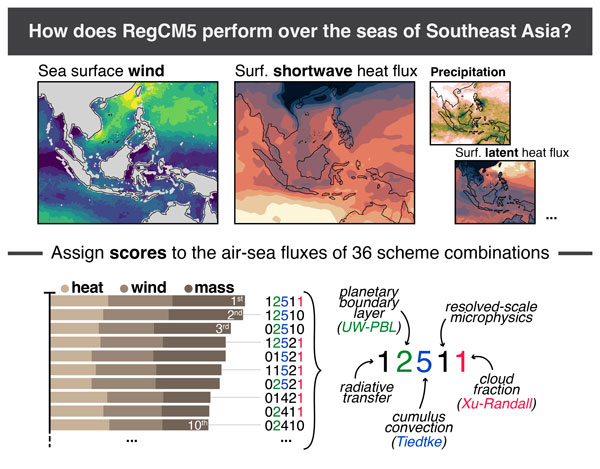
Climate model performance at the air–sea interface has long been overlooked across the Southeast Asian seas. We thus assess various regional model physics configurations in this regard. Finding one optimal configuration is challenging: reliable rainfall rarely coincides with correct radiative heating. Simulations of rainfall however yield more dissensus, suggesting that this variable should be prioritized, for which the best results are obtained with the cumulus convection scheme of Tiedtke.
Thanh Huyen Tran, Alexei Sentchev, Thai To Duy, Marine Herrmann, Sylvain Ouillon, and Kim Cuong Nguyen
Ocean Sci., 21, 1–18, https://doi.org/10.5194/os-21-1-2025, https://doi.org/10.5194/os-21-1-2025, 2025
Short summary
Short summary
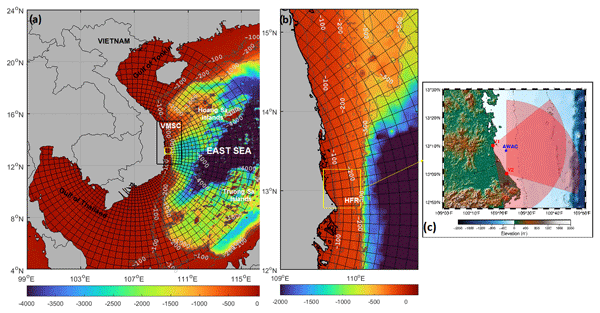
For the first time, high-resolution surface current data from high-frequency radar have been obtained along the central and southern coasts of Vietnam, and combined with a modelling approach, this is helping scientists to understand coastal processes. The research showed that the surface circulation is driven not only by winds, but also by other factors. This can enrich public knowledge of the coastal dynamics that govern other environmental impacts along the coasts.
Adrien Garinet, Marine Herrmann, Patrick Marsaleix, and Juliette Pénicaud
Geosci. Model Dev., 17, 6967–6986, https://doi.org/10.5194/gmd-17-6967-2024, https://doi.org/10.5194/gmd-17-6967-2024, 2024
Short summary
Short summary
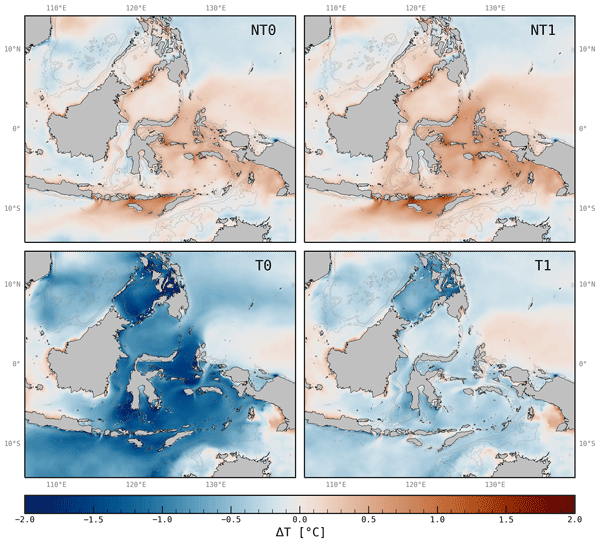
Mixing is a crucial aspect of the ocean, but its accurate representation in computer simulations is made challenging by errors that result in unwanted mixing, compromising simulation realism. Here we illustrate the spurious effect that tides can have on simulations of south-east Asia. Although they play an important role in determining the state of the ocean, they can increase numerical errors and make simulation outputs less realistic. We also provide insights into how to reduce these errors.
Marine Herrmann, Thai To Duy, and Patrick Marsaleix
Ocean Sci., 20, 1013–1033, https://doi.org/10.5194/os-20-1013-2024, https://doi.org/10.5194/os-20-1013-2024, 2024
Short summary
Short summary
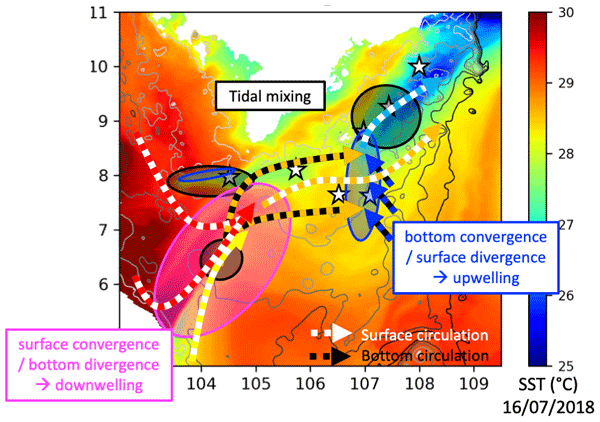
In summer, deep, cold waters rise to the surface along and off the Vietnamese coast. This upwelling of water lifts nutrients, inducing biological activity that is important for fishery resources. Strong tides occur on the shelf off the Mekong Delta. By increasing the mixing of ocean waters and modifying currents, they are a major factor in the development of upwelling on the shelf, accounting for ~75 % of its average summer intensity.
Ngoc B. Trinh, Marine Herrmann, Caroline Ulses, Patrick Marsaleix, Thomas Duhaut, Thai To Duy, Claude Estournel, and R. Kipp Shearman
Geosci. Model Dev., 17, 1831–1867, https://doi.org/10.5194/gmd-17-1831-2024, https://doi.org/10.5194/gmd-17-1831-2024, 2024
Short summary
Short summary
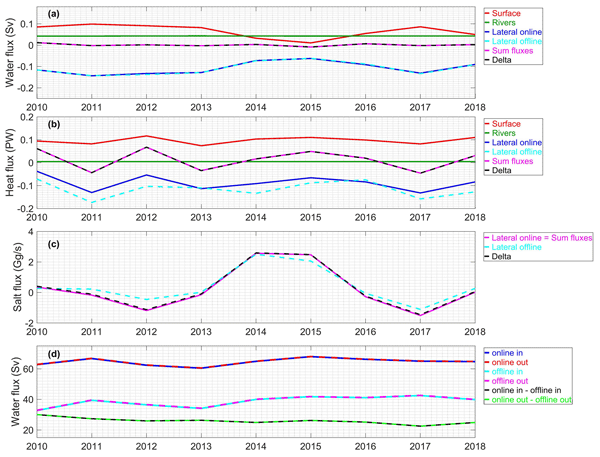
A high-resolution model was built to study the South China Sea (SCS) water, heat, and salt budgets. Model performance is demonstrated by comparison with observations and simulations. Important discards are observed if calculating offline, instead of online, lateral inflows and outflows of water, heat, and salt. The SCS mainly receives water from the Luzon Strait and releases it through the Mindoro, Taiwan, and Karimata straits. SCS surface interocean water exchanges are driven by monsoon winds.

Marine Herrmann, Thai To Duy, and Claude Estournel
Ocean Sci., 19, 453–467, https://doi.org/10.5194/os-19-453-2023, https://doi.org/10.5194/os-19-453-2023, 2023
Short summary
Short summary
The South Vietnam upwelling develops in summer along and off the Vietnamese coast. It brings cold and nutrient-rich waters to the surface, allowing photosynthesis essential to marine ecosystems and fishing resources. We show here that its daily variations are mainly due to the wind, thus predictable, in the southern shelf and coastal regions. However, they are more chaotic in the offshore area, and especially in the northern area, due to the influence of eddies of a highly chaotic nature.
Thai To Duy, Marine Herrmann, Claude Estournel, Patrick Marsaleix, Thomas Duhaut, Long Bui Hong, and Ngoc Trinh Bich
Ocean Sci., 18, 1131–1161, https://doi.org/10.5194/os-18-1131-2022, https://doi.org/10.5194/os-18-1131-2022, 2022
Short summary
Short summary
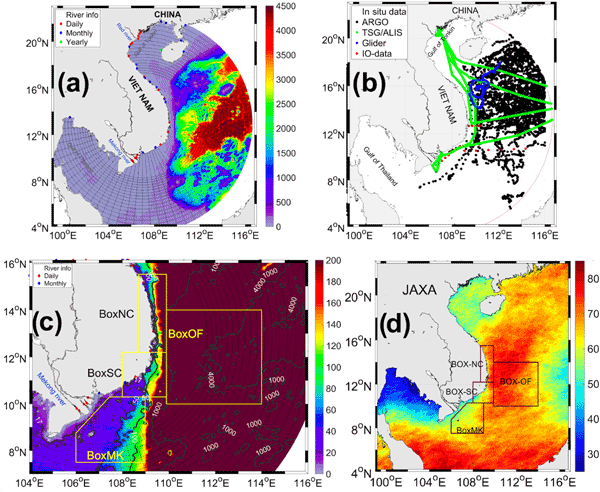
The South Vietnam Upwelling develops in the coastal and offshore regions of the southwestern South China Sea under the influence of summer monsoon winds. Cold, nutrient-rich waters rise to the surface, where photosynthesis occurs and is essential for fishing activity. We have developed a very high-resolution model to better understand the factors that drive the variability of this upwelling at different scales: daily chronology to summer mean of wind and mesoscale to regional circulation.
Cited articles
Alfieri, L., Lorini, V., Hirpa, F. A., Harrigan, S., Zsoter, E., Prudhomme, C., and Salamon, P.: A global streamflow reanalysis for 1980–2018, Journal of Hydrology X, 6, 100049, https://doi.org/10.1016/j.hydroa.2019.100049, 2020. a, b
Bajon, R., Huck, T., Grima, N., Maes, C., Blanke, B., Richon, C., and Couvelard, X.: Influence of waves on the three-dimensional distribution of plastic in the ocean, Marine Pollution Bulletin, 187, 114533, https://doi.org/10.1016/j.marpolbul.2022.114533, 2023. a
Bentsen, M., Evensen, G., Drange, H., and Jenkins, A. D.: Coordinate Transformation on a Sphere Using Conformal Mapping, Monthly Weather Review, 127, 2733–2740, https://doi.org/10.1175/1520-0493(1999)127<2733:ctoasu>2.0.co;2, 1999. a
Boutin, J., Vergely, J.-L., Reul, N., Catany, R., Koehler, J., Martin, A., Rouffi, F., Arias, M., Chakroun, M., Corato, G., Estella-Perez, V., Guimbard, S., Hasson, A., Josey, S., Khvorostyanov, D., Kolodziejczyk, N., Mignot, J., Olivier, L., Reverdin, G., Stammer, D., Supply, A., Thouvenin-Masson, C., Turiel, A., Vialard, J., Cipollini, P., and Donlon, C.: ESA Sea Surface Salinity Climate Change Initiative (Sea_Surface_Salinity_cci): weekly and monthly sea surface salinity products, v03.21, for 2010 to 2020, NERC EDS Centre for Environmental Data Analysis, https://doi.org/10.5285/5920A2C77E3C45339477ACD31CE62C3C, 2021. a
Chassignet, E. P., Xu, X., and Zavala-Romero, O.: Tracking Marine Litter With a Global Ocean Model: Where Does It Go? Where Does It Come From?, Frontiers in Marine Science, 8, https://doi.org/10.3389/fmars.2021.667591, 2021. a
Cheng, X., McCreary, J. P., Qiu, B., Qi, Y., Du, Y., and Chen, X.: Dynamics of Eddy Generation in the Central Bay of Bengal, J. Geophys. Res.-Oceans, 123, 6861–6875, https://doi.org/10.1029/2018jc014100, 2018. a
Choi, J., Bracco, A., Barkan, R., Shchepetkin, A. F., McWilliams, J. C., and Molemaker, J. M.: Submesoscale Dynamics in the Northern Gulf of Mexico. Part III: Lagrangian Implications, Journal of Physical Oceanography, 47, 2361–2376, https://doi.org/10.1175/jpo-d-17-0036.1, 2017. a
Couvelard, X., Lemarié, F., Samson, G., Redelsperger, J.-L., Ardhuin, F., Benshila, R., and Madec, G.: Development of a two-way-coupled ocean–wave model: assessment on a global NEMO(v3.6)–WW3(v6.02) coupled configuration, Geosci. Model Dev., 13, 3067–3090, https://doi.org/10.5194/gmd-13-3067-2020, 2020. a, b
Cucchi, M., Weedon, G. P., Amici, A., Bellouin, N., Lange, S., Müller Schmied, H., Hersbach, H., and Buontempo, C.: WFDE5: bias-adjusted ERA5 reanalysis data for impact studies, Earth Syst. Sci. Data, 12, 2097–2120, https://doi.org/10.5194/essd-12-2097-2020, 2020. a, b
Cummings, J. A. and Smedstad, O. M.: Variational Data Assimilation for the Global Ocean, Springer Berlin Heidelberg, 303–343, ISBN 9783642350887, https://doi.org/10.1007/978-3-642-35088-7_13, 2013. a
Cunningham, H. J., Higgins, C., and van den Bremer, T. S.: The Role of the Unsteady Surface Wave‐Driven Ekman–Stokes Flow in the Accumulation of Floating Marine Litter, J. Geophys. Res.-Oceans, 127, https://doi.org/10.1029/2021jc018106, 2022. a
Dai, A.: Dai and Trenberth Global River Flow and Continental Discharge Dataset, NSF National Center for Atmospheric Research [data set], https://doi.org/10.5065/D6V69H1T, 2017. a
D'Asaro, E. A., Shcherbina, A. Y., Klymak, J. M., Molemaker, J., Novelli, G., Guigand, C. M., Haza, A. C., Haus, B. K., Ryan, E. H., Jacobs, G. A., Huntley, H. S., Laxague, N. J. M., Chen, S., Judt, F., McWilliams, J. C., Barkan, R., Kirwan, A. D., Poje, A. C., and Özgökmen, T. M.: Ocean convergence and the dispersion of flotsam, Proceedings of the National Academy of Sciences, 115, 1162–1167, https://doi.org/10.1073/pnas.1718453115, 2018. a, b, c
Dobler, D., Huck, T., Maes, C., Grima, N., Blanke, B., Martinez, E., and Ardhuin, F.: Large impact of Stokes drift on the fate of surface floating debris in the South Indian Basin, Marine Pollution Bulletin, 148, 202–209, https://doi.org/10.1016/j.marpolbul.2019.07.057, 2019. a
Estournel, C., Marsaleix, P., and Ulses, C.: A new assessment of the circulation of Atlantic and Intermediate Waters in the Eastern Mediterranean, Progress in Oceanography, 198, 102673, https://doi.org/10.1016/j.pocean.2021.102673, 2021. a
Estournel, C., Mikolajczak, G., Ulses, C., Bourrin, F., Canals, M., Charmasson, S., Doxaran, D., Duhaut, T., de Madron, X. D., Marsaleix, P., Palanques, A., Puig, P., Radakovitch, O., Sanchez-Vidal, A., and Verney, R.: Sediment dynamics in the Gulf of Lion (NW Mediterranean Sea) during two autumn–winter periods with contrasting meteorological conditions, Progress in Oceanography, 210, 102942, https://doi.org/10.1016/j.pocean.2022.102942, 2023. a
E.U. Copernicus Marine Service Information (CMEMS): Global Ocean OSTIA Sea Surface Temperature and Sea Ice Reprocessed, Marine Data Store (MDS) [data set], https://doi.org/10.48670/MOI-00168, 2015. a
E.U. Copernicus Marine Service Information (CMEMS): Global Ocean Physics Reanalysis, Marine Data Store (MDS) [data set], https://doi.org/10.48670/MOI-00021, 2018. a
E.U. Copernicus Marine Service Information (CMEMS): Global Ocean Waves Reanalysis, Marine Data Store (MDS) [data set], https://doi.org/10.48670/MOI-00022, 2019. a, b
E.U. Copernicus Marine Service Information (CMEMS): Global Ocean Gridded L4 Sea Surface Heights And Derived Variables Reprocessed (1993–Ongoing), Marine Data Store (MDS) [data set], https://doi.org/10.48670/MOI-00148, 2021. a
Fischer, A. S., Weller, R. A., Rudnick, D. L., Eriksen, C. C., Lee, C. M., Brink, K. H., Fox, C. A., and Leben, R. R.: Mesoscale eddies, coastal upwelling, and the upper-ocean heat budget in the Arabian Sea, Deep Sea Research Part II: Topical Studies in Oceanography, 49, 2231–2264, https://doi.org/10.1016/s0967-0645(02)00036-x, 2002. a, b
Fischer, R., Lobelle, D., Kooi, M., Koelmans, A., Onink, V., Laufkötter, C., Amaral-Zettler, L., Yool, A., and van Sebille, E.: Modelling submerged biofouled microplastics and their vertical trajectories, Biogeosciences, 19, 2211–2234, https://doi.org/10.5194/bg-19-2211-2022, 2022. a
Forget, G., Campin, J.-M., Heimbach, P., Hill, C. N., Ponte, R. M., and Wunsch, C.: ECCO version 4: an integrated framework for non-linear inverse modeling and global ocean state estimation, Geosci. Model Dev., 8, 3071–3104, https://doi.org/10.5194/gmd-8-3071-2015, 2015. a
Fournier, S. and Lee, T.: Seasonal and Interannual Variability of Sea Surface Salinity Near Major River Mouths of the World Ocean Inferred from Gridded Satellite and In-Situ Salinity Products, Remote Sensing, 13, 728, https://doi.org/10.3390/rs13040728, 2021. a
Gamoyo, M., Obura, D., and Reason, C. J.: Estimating Connectivity Through Larval Dispersal in the Western Indian Ocean, J. Geophys. Res.-Biogeo., 124, 2446–2459, https://doi.org/10.1029/2019JG005128, 2019. a
Garinet, A., Herrmann, M., Marsaleix, P., and Pénicaud, J.: Spurious numerical mixing under strong tidal forcing: a case study in the south-east Asian seas using the Symphonie model (v3.1.2), Geosci. Model Dev., 17, 6967–6986, https://doi.org/10.5194/gmd-17-6967-2024, 2024. a
Gasparin, F., Greiner, E., Lellouche, J. M., Legalloudec, O., Garric, G., Drillet, Y., Bourdallé-Badie, R., Traon, P. Y. L., Rémy, E., and Drévillon, M.: A large-scale view of oceanic variability from 2007 to 2015 in the global high resolution monitoring and forecasting system at Mercator Océan, Journal of Marine Systems, 187, 260–276, https://doi.org/10.1016/j.jmarsys.2018.06.015, 2018. a
Guizien, K., Belharet, M., Marsaleix, P., and Guarini, J. M.: Using larval dispersal simulations for marine protected area design: Application to the Gulf of Lions (northwest Mediterranean), Limnol. Oceanogr., 57, 1099–1112, https://doi.org/10.4319/lo.2012.57.4.1099, 2012. a, b
Gula, J., Molemaker, M. J., and McWilliams, J. C.: Submesoscale Dynamics of a Gulf Stream Frontal Eddy in the South Atlantic Bight, Journal of Physical Oceanography, 46, 305–325, https://doi.org/10.1175/jpo-d-14-0258.1, 2016. a, b
Habib, J., Ulses, C., Estournel, C., Fakhri, M., Marsaleix, P., Pujo-Pay, M., Fourrier, M., Coppola, L., Mignot, A., Mortier, L., and Conan, P.: Seasonal and interannual variability of the pelagic ecosystem and of the organic carbon budget in the Rhodes Gyre (eastern Mediterranean): influence of winter mixing, Biogeosciences, 20, 3203–3228, https://doi.org/10.5194/bg-20-3203-2023, 2023. a
Halo, I., Backeberg, B., Penven, P., Ansorge, I., Reason, C., and Ullgren, J.: Eddy properties in the Mozambique Channel: A comparison between observations and two numerical ocean circulation models, Deep Sea Research Part II: Topical Studies in Oceanography, 100, 38–53, https://doi.org/10.1016/j.dsr2.2013.10.015, 2014. a
Hassler, B. and Lauer, A.: Comparison of Reanalysis and Observational Precipitation Datasets Including ERA5 and WFDE5, Atmosphere, 12, 1462, https://doi.org/10.3390/atmos12111462, 2021. a, b
Herrmann, M., Somot, S., Sevault, F., Estournel, C., and Déqué, M.: Modeling the deep convection in the northwestern Mediterranean Sea using an eddy‐permitting and an eddy‐resolving model: Case study of winter 1986–1987, J. Geophys. Res.-Oceans, 113, https://doi.org/10.1029/2006jc003991, 2008. a
Herrmann, M., To Duy, T., and Estournel, C.: Intraseasonal variability of the South Vietnam upwelling, South China Sea: influence of atmospheric forcing and ocean intrinsic variability, Ocean Sci., 19, 453–467, https://doi.org/10.5194/os-19-453-2023, 2023. a
Herrmann, M., To Duy, T., and Marsaleix, P.: Mechanisms and intraseasonal variability in the South Vietnam Upwelling, South China Sea: the role of circulation, tides, and rivers, Ocean Sci., 20, 1013–1033, https://doi.org/10.5194/os-20-1013-2024, 2024. a
Hossain, S., Cloke, H. L., Ficchì, A., Gupta, H., Speight, L., Hassan, A., and Stephens, E. M.: A decision‐led evaluation approach for flood forecasting system developments: An application to the Global Flood Awareness System in Bangladesh, Journal of Flood Risk Management, https://doi.org/10.1111/jfr3.12959, 2023. a
Jordà, G., Bolaños, R., Espino, M., and Sánchez-Arcilla, A.: Assessment of the importance of the current-wave coupling in the shelf ocean forecasts, Ocean Sci., 3, 345–362, https://doi.org/10.5194/os-3-345-2007, 2007. a
Kersalé, M., Volkov, D. L., Pujiana, K., and Zhang, H.: Interannual variability of sea level in the southern Indian Ocean: local vs. remote forcing mechanisms, Ocean Sci., 18, 193–212, https://doi.org/10.5194/os-18-193-2022, 2022. a, b
Klein, P., Lapeyre, G., Siegelman, L., Qiu, B., Fu, L., Torres, H., Su, Z., Menemenlis, D., and Le Gentil, S.: Ocean‐Scale Interactions From Space, Earth and Space Science, 6, 795–817, https://doi.org/10.1029/2018ea000492, 2019. a, b
Kuizenga, B., van Emmerik, T., Waldschläger, K., and Kooi, M.: Will it Float? Rising and Settling Velocities of Common Macroplastic Foils, ACS ES&T Water, 2, 975–981, https://doi.org/10.1021/acsestwater.1c00467, 2022. a
Large, W. and Yeager, S.: Diurnal to decadal global forcing for ocean and sea-ice models: The data sets and flux climatologies, Tech. rep., University Corporation for Atmospheric Research, https://doi.org/10.5065/D6KK98Q6, 2004. a
Laverre, M., Kerhervé, P., Constant, M., Weiss, L., Charrière, B., Stetzler, M., González-Fernández, D., and Ludwig, W.: Heavy rains control the floating macroplastic inputs into the sea from coastal Mediterranean rivers: A case study on the Têt River (NW Mediterranean Sea), Science of The Total Environment, 877, 162733, https://doi.org/10.1016/j.scitotenv.2023.162733, 2023. a
Lellouche, J.-M., Greiner, E., Bourdallé Badie, R., Garric, G., Melet, A., Drévillon, M., Bricaud, C., Hamon, M., Le Galloudec, O., Regnier, C., Candela, T., Testut, C.-E., Gasparin, F., Ruggiero, G., Benkiran, M., Drillet, Y., and Le Traon, P.-Y.: The Copernicus Global
Linke, S., Lehner, B., Ouellet Dallaire, C., Ariwi, J., Grill, G., Anand, M., Beames, P., Burchard-Levine, V., Maxwell, S., Moidu, H., Tan, F., and Thieme, M.: Global hydro-environmental sub-basin and river reach characteristics at high spatial resolution, Scientific Data, 6, https://doi.org/10.1038/s41597-019-0300-6, 2019. a, b
Lodise, J., Özgökmen, T., Gonçalves, R. C., Iskandarani, M., Lund, B., Horstmann, J., Poulain, P.-M., Klymak, J., Ryan, E. H., and Guigand, C.: Investigating the Formation of Submesoscale Structures along Mesoscale Fronts and Estimating Kinematic Quantities Using Lagrangian Drifters, Fluids, 5, 159, https://doi.org/10.3390/fluids5030159, 2020. a, b
Lyard, F. H., Allain, D. J., Cancet, M., Carrère, L., and Picot, N.: FES2014 global ocean tide atlas: design and performance, Ocean Sci., 17, 615–649, https://doi.org/10.5194/os-17-615-2021, 2021. a
Maes, C., Grima, N., Blanke, B., Martinez, E., Paviet‐Salomon, T., and Huck, T.: A Surface “Superconvergence” Pathway Connecting the South Indian Ocean to the Subtropical South Pacific Gyre, Geophysical Research Letters, 45, 1915–1922, https://doi.org/10.1002/2017gl076366, 2018. a
Marsaleix, P., Auclair, F., Floor, J. W., Herrmann, M. J., Estournel, C., Pairaud, I., and Ulses, C.: Energy conservation issues in sigma-coordinate free-surface ocean models, Ocean Modelling, 20, 61–89, https://doi.org/10.1016/j.ocemod.2007.07.005, 2008. a
Marsaleix, P., Michaud, H., and Estournel, C.: 3D phase-resolved wave modelling with a non-hydrostatic ocean circulation model, Ocean Modelling, 136, 28–50, https://doi.org/10.1016/j.ocemod.2019.02.002, 2019. a
McPhaden, M. J., Meyers, G., Ando, K., Masumoto, Y., Murty, V. S. N., Ravichandran, M., Syamsudin, F., Vialard, J., Yu, L., and Yu, W.: RAMA: The Research Moored Array for African–Asian–Australian Monsoon Analysis and Prediction, Bulletin of the American Meteorological Society, 90, 459–480, https://doi.org/10.1175/2008bams2608.1, 2009. a
McWilliams, J. C.: Submesoscale currents in the ocean, Proceedings of the Royal Society A: Mathematical, Physical and Engineering Sciences, 472, 20160117, https://doi.org/10.1098/rspa.2016.0117, 2016. a
McWilliams, J. C. and Restrepo, J. M.: The Wave-Driven Ocean Circulation, Journal of Physical Oceanography, 29, 2523–2540, https://doi.org/10.1175/1520-0485(1999)029<2523:twdoc>2.0.co;2, 1999. a
Nguyen-Duy, T., Ayoub, N. K., Marsaleix, P., Toublanc, F., De Mey-Frémaux, P., Piton, V., Herrmann, M., Duhaut, T., Tran, M. C., and Ngo-Duc, T.: Variability of the Red River Plume in the Gulf of Tonkin as Revealed by Numerical Modeling and Clustering Analysis, Frontiers in Marine Science, 8, 1–25, https://doi.org/10.3389/fmars.2021.772139, 2021. a
Onink, V., Wichmann, D., Delandmeter, P., and van Sebille, E.: The Role of Ekman Currents, Geostrophy, and Stokes Drift in the Accumulation of Floating Microplastic, J. Geophys. Res.-Oceans, 124, 1474–1490, https://doi.org/10.1029/2018jc014547, 2019. a
Pairaud, I., Lyard, F., Auclair, F., Letellier, T., and Marsaleix, P.: Dynamics of the semi-diurnal and quarter-diurnal internal tides in the Bay of Biscay. Part 1: Barotropic tides, Continental Shelf Research, 28, 1294–1315, https://doi.org/10.1016/j.csr.2008.03.004, 2008. a
Pairaud, I. L., Auclair, F., Marsaleix, P., Lyard, F., and Pichon, A.: Dynamics of the semi-diurnal and quarter-diurnal internal tides in the Bay of Biscay. Part 2: Baroclinic tides, Continental Shelf Research, 30, 253–269, https://doi.org/10.1016/j.csr.2009.10.008, 2010. a
Pattiaratchi, C., van der Mheen, M., Schlundt, C., Narayanaswamy, B. E., Sura, A., Hajbane, S., White, R., Kumar, N., Fernandes, M., and Wijeratne, S.: Plastics in the Indian Ocean – sources, transport, distribution, and impacts, Ocean Sci., 18, 1–28, https://doi.org/10.5194/os-18-1-2022, 2022. a, b
Phillips, H. E., Tandon, A., Furue, R., Hood, R., Ummenhofer, C. C., Benthuysen, J. A., Menezes, V., Hu, S., Webber, B., Sanchez-Franks, A., Cherian, D., Shroyer, E., Feng, M., Wijesekera, H., Chatterjee, A., Yu, L., Hermes, J., Murtugudde, R., Tozuka, T., Su, D., Singh, A., Centurioni, L., Prakash, S., and Wiggert, J.: Progress in understanding of Indian Ocean circulation, variability, air–sea exchange, and impacts on biogeochemistry, Ocean Sci., 17, 1677–1751, https://doi.org/10.5194/os-17-1677-2021, 2021. a
Pottapinjara, V. and Joseph, S.: Evaluation of mixing schemes in the HYbrid Coordinate Ocean Model (HYCOM) in the tropical Indian Ocean, Ocean Dynamics, 72, 341–359, https://doi.org/10.1007/s10236-022-01510-2, 2022. a
Qu, T., Fukumori, I., and Fine, R. A.: Spin-Up of the Southern Hemisphere Super Gyre, J. Geophys. Res.-Oceans, 124, 154–170, https://doi.org/10.1029/2018JC014391, 2019. a
Renault, L., McWilliams, J. C., and Penven, P.: Modulation of the Agulhas Current retroflection and leakage by oceanic current interaction with the atmosphere in coupled simulations, Journal of Physical Oceanography, 47, 2077–2100, https://doi.org/10.1175/JPO-D-16-0168.1, 2017. a, b
Rio, M., Mulet, S., and Picot, N.: Beyond GOCE for the ocean circulation estimate: Synergetic use of altimetry, gravimetry, and in situ data provides new insight into geostrophic and Ekman currents, Geophysical Research Letters, 41, 8918–8925, https://doi.org/10.1002/2014gl061773, 2014. a
Rocha, C. B., Chereskin, T. K., Gille, S. T., and Menemenlis, D.: Mesoscale to Submesoscale Wavenumber Spectra in Drake Passage, Journal of Physical Oceanography, 46, 601–620, https://doi.org/10.1175/jpo-d-15-0087.1, 2016. a
Röhrs, J., Christensen, K. H., Hole, L. R., Broström, G., Drivdal, M., and Sundby, S.: Observation-based evaluation of surface wave effects on currents and trajectory forecasts, Ocean Dynamics, 62, 1519–1533, https://doi.org/10.1007/s10236-012-0576-y, 2012. a
Rühs, S., van den Bremer, T., Clementi, E., Denes, M. C., Moulin, A., and van Sebille, E.: Non-negligible impact of Stokes drift and wave-driven Eulerian currents on simulated surface particle dispersal in the Mediterranean Sea, Ocean Sci., 21, 217–240, https://doi.org/10.5194/os-21-217-2025, 2025. a
Schott, F. A. and McCreary, J. P.: The monsoon circulation of the Indian Ocean, Progress in Oceanography, 51, 1–123, https://doi.org/10.1016/s0079-6611(01)00083-0, 2001. a
Schott, F. A., Xie, S., and McCreary, J. P.: Indian Ocean circulation and climate variability, Reviews of Geophysics, 47, https://doi.org/10.1029/2007rg000245, 2009. a, b, c
Tedesco, P., Gula, J., Ménesguen, C., Penven, P., and Krug, M.: Generation of Submesoscale Frontal Eddies in the Agulhas Current, J. Geophys. Res.-Oceans, 124, 7606–7625, https://doi.org/10.1029/2019JC015229, 2019. a
Thibault, M., Weiss, L., Fernandez, R., Avargues, N., Jaquemet, S., Lebreton, L., Garnier, J., Jaeger, A., Royer, S.-J., Cartraud, A., ter Halle, A., Marsaleix, P., Chevillon, L., Tourmetzj, J., and Le Corre, M.: Barau's petrel, Pterodroma baraui, as a bioindicator of plastic pollution in the South-West Indian Ocean: A multifaceted approach, Marine Environmental Research, 202, 106709, https://doi.org/10.1016/j.marenvres.2024.106709, 2024. a
To Duy, T., Herrmann, M., Estournel, C., Marsaleix, P., Duhaut, T., Bui Hong, L., and Trinh Bich, N.: The role of wind, mesoscale dynamics, and coastal circulation in the interannual variability of the South Vietnam Upwelling, South China Sea – answers from a high-resolution ocean model, Ocean Sci., 18, 1131–1161, https://doi.org/10.5194/os-18-1131-2022, 2022. a
Trinh, N. B., Herrmann, M., Ulses, C., Marsaleix, P., Duhaut, T., To Duy, T., Estournel, C., and Shearman, R. K.: New insights into the South China Sea throughflow and water budget seasonal cycle: evaluation and analysis of a high-resolution configuration of the ocean model SYMPHONIE version 2.4, Geosci. Model Dev., 17, 1831–1867, https://doi.org/10.5194/gmd-17-1831-2024, 2024. a, b, c
Trott, C. B., Subrahmanyam, B., Chaigneau, A., and Delcroix, T.: Eddy Tracking in the Northwestern Indian Ocean During Southwest Monsoon Regimes, Geophysical Research Letters, 45, 6594–6603, https://doi.org/10.1029/2018gl078381, 2018. a
van der Mheen, M., Pattiaratchi, C., and van Sebille, E.: Role of Indian Ocean Dynamics on Accumulation of Buoyant Debris, J. Geophys. Res.-Oceans, 124, 2571–2590, https://doi.org/10.1029/2018JC014806, 2019. a
van der Mheen, M., van Sebille, E., and Pattiaratchi, C.: Beaching patterns of plastic debris along the Indian Ocean rim, Ocean Sci., 16, 1317–1336, https://doi.org/10.5194/os-16-1317-2020, 2020. a, b
van Sebille, E., Aliani, S., Law, K. L., Maximenko, N., Alsina, J. M., Bagaev, A., Bergmann, M., Chapron, B., Chubarenko, I., Cózar, A., Delandmeter, P., Egger, M., Fox-Kemper, B., Garaba, S. P., Goddijn-Murphy, L., Hardesty, B. D., Hoffman, M. J., Isobe, A., Jongedijk, C. E., Kaandorp, M. L. A., Khatmullina, L., Koelmans, A. A., Kukulka, T., Laufkötter, C., Lebreton, L., Lobelle, D., Maes, C., Martinez-Vicente, V., Morales Maqueda, M. A., Poulain-Zarcos, M., Rodríguez, E., Ryan, P. G., Shanks, A. L., Shim, W. J., Suaria, G., Thiel, M., van den Bremer, T. S., and Wichmann, D.: The physical oceanography of the transport of floating marine debris, Environmental Research Letters, 15, 023003, https://doi.org/10.1088/1748-9326/ab6d7d, 2020. a, b, c, d, e
Varna, M., Jithin, A., and Francis, P.: Characteristics and dynamics of mesoscale eddies in the eastern Arabian sea, Deep Sea Research Part II: Topical Studies in Oceanography, 207, 105218, https://doi.org/10.1016/j.dsr2.2022.105218, 2023. a, b
Vic, C., Hascoët, S., Gula, J., Huck, T., and Maes, C.: Oceanic Mesoscale Cyclones Cluster Surface Lagrangian Material, Geophysical Research Letters, 49, https://doi.org/10.1029/2021gl097488, 2022. a
Vogt-Vincent, N. S. and Johnson, H. L.: Multidecadal and climatological surface current simulations for the southwestern Indian Ocean at 1∕50° resolution, Geosci. Model Dev., 16, 1163–1178, https://doi.org/10.5194/gmd-16-1163-2023, 2023. a, b
Waldman, R., Herrmann, M., Somot, S., Arsouze, T., Benshila, R., Bosse, A., Chanut, J., Giordani, H., Sevault, F., and Testor, P.: Impact of the Mesoscale Dynamics on Ocean Deep Convection: The 2012–2013 Case Study in the Northwestern Mediterranean Sea, J. Geophys. Res.-Oceans, 122, 8813–8840, https://doi.org/10.1002/2016jc012587, 2017. a
Waldschläger, K., Born, M., Cowger, W., Gray, A., and Schüttrumpf, H.: Settling and rising velocities of environmentally weathered micro- and macroplastic particles, Environmental Research, 191, 110192, https://doi.org/10.1016/j.envres.2020.110192, 2020. a
Weiss, L.: Model code and regional configuration for 'Modeling Indian Ocean circulation to study marine debris dispersion: insights into high-resolution and Stokes drift effects', figshare [code], https://doi.org/10.6084/m9.figshare.28903067, 2025. a
Weiss, L., Ludwig, W., Heussner, S., Canals, M., Ghiglione, J. F., Estournel, C., Constant, M., and Kerhervé, P.: The missing ocean plastic sink: Gone with the rivers, Science, 373, 107–111, https://doi.org/10.1126/science.abe0290, 2021. a, b
Weiss, L., Estournel, C., Marsaleix, P., Mikolajczak, G., Constant, M., Ghiglione, J.-F., and Ludwig, W.: From source to sink: part 2 – seasonal dispersion of microplastics discharged in the NW Mediterranean Sea by the Rhone River in southern France, Environmental Science and Pollution Research, https://doi.org/10.1007/s11356-024-35364-6, 2024a. a, b, c, d
Weiss, L., Estournel, C., Marsaleix, P., Mikolajczak, G., Constant, M., and Ludwig, W.: From source to sink: part 1 – characterization and Lagrangian tracking of riverine microplastics in the Mediterranean Basin, Environmental Science and Pollution Research, https://doi.org/10.1007/s11356-024-34635-6, 2024b. a, b, c
Xu, Z. and Bowen, A. J.: Wave- and Wind-Driven Flow in Water of Finite Depth, Journal of Physical Oceanography, 24, 1850–1866, https://doi.org/10.1175/1520-0485(1994)024<1850:wawdfi>2.0.co;2, 1994. a
Yang, C., Leonelli, F. E., Marullo, S., Artale, V., Beggs, H., Nardelli, B. B., Chin, T. M., De Toma, V., Good, S., Huang, B., Merchant, C. J., Sakurai, T., Santoleri, R., Vazquez-Cuervo, J., Zhang, H.-M., and Pisano, A.: Sea Surface Temperature Intercomparison in the Framework of the Copernicus Climate Change Service (C3S), Journal of Climate, 34, 5257–5283, https://doi.org/10.1175/jcli-d-20-0793.1, 2021. a
Zhan, P., Guo, D., and Hoteit, I.: Eddy‐Induced Transport and Kinetic Energy Budget in the Arabian Sea, Geophysical Research Letters, 47, https://doi.org/10.1029/2020gl090490, 2020. a
Zhang, L., Du, Y., and Cai, W.: A spurious positive Indian Ocean Dipole in 2017, Science Bulletin, 63, 1170–1172, https://doi.org/10.1016/j.scib.2018.08.001, 2018. a
Zhang, Z., Wang, J., and Yuan, D.: Mixed Layer Salinity Balance in the Eastern Tropical Indian Ocean, J. Geophys. Res.-Oceans, 127, https://doi.org/10.1029/2021jc018229, 2022. a
Zsoter, E., Harrigan, S., Barnard, C., Wetterhall, F., Ferrario, I., Mazzetti, C., Alfieri, L., Salamon, P., and Prudhomme, C.: River discharge and related historical data from the Global Flood Awareness System. v3.1. Copernicus Climate Change Service (C3S) Climate Data Store (CDS) [data set], https://doi.org/10.24381/CDS.A4FDD6B9, 2021. a
Short summary
We developed a high-resolution ocean model to study marine debris dispersion across the Indian Ocean, from coastal scales to the open sea. Results show that model resolution and wave forcing, through both the Stokes-Coriolis force and Stokes drift, play a key role in shaping ocean circulation, seasonal energy budgets, and floating debris trajectories. High-resolution currents and wave forcing, especially during monsoons, increase the anisotropic spread and travel distances of drifting material.
We developed a high-resolution ocean model to study marine debris dispersion across the Indian...


