Articles | Volume 19, issue 14
https://doi.org/10.5194/gmd-19-6857-2026
© Author(s) 2026. This work is distributed under
the Creative Commons Attribution 4.0 License.
https://doi.org/10.5194/gmd-19-6857-2026
© Author(s) 2026. This work is distributed under
the Creative Commons Attribution 4.0 License.
MErSiM v1.0: resolving biases in global silicate weathering model with a data-driven surface erosion module

Jiaxi Zhao
Laboratory for Climate and Ocean-Atmosphere Studies, Department of Atmospheric and Oceanic Sciences, School of Physics, Peking University, Beijing 100871, China
Institute of Carbon Neutrality, Peking University, Beijing, China
Institute of Ocean Research, Peking University, Beijing, China
Yongyun Hu
Laboratory for Climate and Ocean-Atmosphere Studies, Department of Atmospheric and Oceanic Sciences, School of Physics, Peking University, Beijing 100871, China
Institute of Ocean Research, Peking University, Beijing, China
Related authors
No articles found.
Qi Cui, Qifan Lin, Jiaqi Guo, Yonggang Liu, Yue Liu, Xiujuan Bao, Xiang Li, Zhibo Li, Haoyue Zuo, Shuai Yuan, Yihui Chen, Shiyan Zhang, Jian Zhang, and Yongyun Hu
EGUsphere, https://doi.org/10.5194/egusphere-2026-3925, https://doi.org/10.5194/egusphere-2026-3925, 2026
This preprint is open for discussion and under review for Climate of the Past (CP).
Short summary
Short summary
Atmospheric dust affects Earth's climate and ocean life, yet its long-term history remained unclear. Using the Earth system model CESM 1.2.2, coupled with the vegetation model BIOME4, we reconstructed changes in global dust activity over the past 540 million years, examining how land plants, shifting continental configurations, and evolving climate jointly controlled the global dust cycle and its impact on climate.
Anni Zhao, Chris Brierley, Venni Arra-Kastrati, Xiaoxu Shi, and Yongyun Hu
Clim. Past, 22, 689–708, https://doi.org/10.5194/cp-22-689-2026, https://doi.org/10.5194/cp-22-689-2026, 2026
Short summary
Short summary
The North Atlantic Oscillation has large impacts on the European climate, whose future behaviour remains uncertain. We assess the NAO response in three past experiments (midHolocene, lig127k, lgm) and an abrupt quadrupled CO2 experiment (abrupt4xCO2). Our results show that NAO weakens (enhances) in response to cooling (warming), while it is not sensitive to orbital configurations. The associated teleconnections change consistently with the theory and are sensitive to the change in NAO amplitude.
Yudong Sun, Yonggang Liu, Jiacheng Wu, Kai Man, Haonan Yu, Shuai Yuan, Qi Cui, Yue Liu, Yizhang Liu, Qiang Wei, and Yongyun Hu
EGUsphere, https://doi.org/10.5194/egusphere-2026-1385, https://doi.org/10.5194/egusphere-2026-1385, 2026
Short summary
Short summary
This study investigates the dramatic global cooling during the Late Ordovician, 440 million years ago. Our simulations reveal a powerful feedback loop: as the ice sheet grew, it generated strong, cold winds flowing down its slopes. These winds further cooled the continents, causing the ice sheet to expand even more. The super ice sheet led to a substantial global temperature drop of about 1.5 °C. Interestingly, while continents froze, the oceans warmed.
Ziying Yang, Jiping Liu, Mirong Song, Yongyun Hu, Qinghua Yang, Ke Fan, Rune Grand Graversen, and Lu Zhou
The Cryosphere, 19, 6381–6402, https://doi.org/10.5194/tc-19-6381-2025, https://doi.org/10.5194/tc-19-6381-2025, 2025
Short summary
Short summary
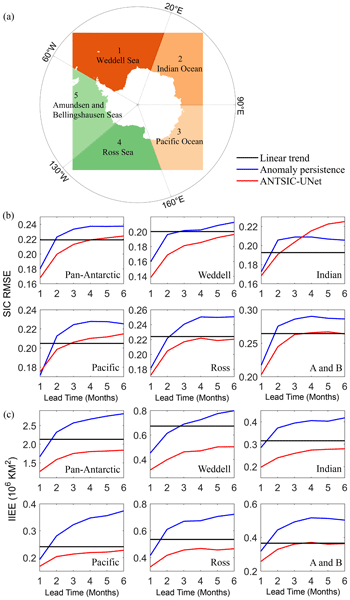
Antarctic sea ice has changed rapidly in recent years. Here we developed a deep learning model trained by multiple climate variables for extended seasonal Antarctic sea ice prediction. Our model shows high predictive skills up to 6 months in advance, particularly in predicting extreme events. It also shows skillful predictions at the sea ice edge and year-to-year sea ice changes. Variable importance analyses suggest what variables are more important for prediction at different lead times.
Hu Yang, Xiaoxu Shi, Xulong Wang, Qingsong Liu, Yi Zhong, Xiaodong Liu, Youbin Sun, Yanjun Cai, Fei Liu, Gerrit Lohmann, Martin Werner, Zhimin Jian, Tainã M. L. Pinho, Hai Cheng, Lijuan Lu, Jiping Liu, Chao-Yuan Yang, Qinghua Yang, Yongyun Hu, Xing Cheng, Jingyu Zhang, and Dake Chen
Clim. Past, 21, 1263–1279, https://doi.org/10.5194/cp-21-1263-2025, https://doi.org/10.5194/cp-21-1263-2025, 2025
Short summary
Short summary
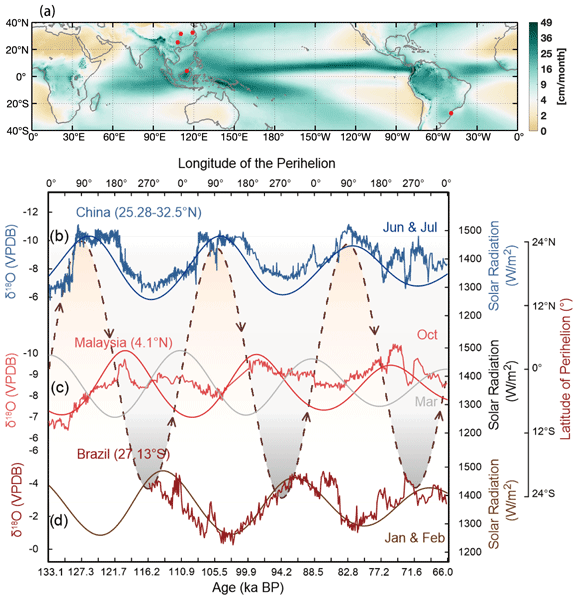
For 1 century, the hemispheric summer insolation is proposed as a key pacemaker of astronomical climate change. However, an increasing number of geologic records reveal that the low-latitude hydrological cycle shows asynchronous precessional evolutions that are very often out of phase with the summer insolation. Here, we propose that the astronomically driven low-latitude hydrological cycle is not paced by summer insolation but by shifting perihelion.
Anni Zhao, Ran Feng, Chris M. Brierley, Jian Zhang, and Yongyun Hu
Clim. Past, 20, 1195–1211, https://doi.org/10.5194/cp-20-1195-2024, https://doi.org/10.5194/cp-20-1195-2024, 2024
Short summary
Short summary
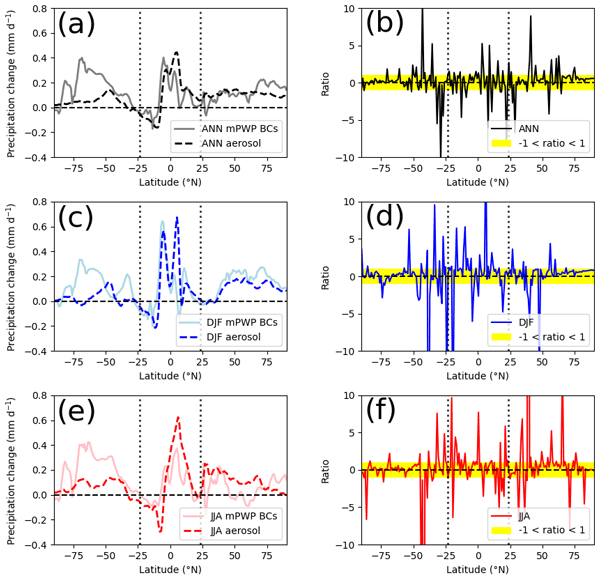
We analyse simulations with idealised aerosol scenarios to examine the importance of aerosol forcing on mPWP precipitation and how aerosol uncertainty could explain the data–model mismatch. We find further warming, a narrower and stronger ITCZ, and monsoon domain rainfall change after removal of industrial emissions. Aerosols have more impacts on tropical precipitation than the mPWP boundary conditions. This highlights the importance of prescribed aerosol scenarios in simulating mPWP climate.
Haoyue Zuo, Yonggang Liu, Gaojun Li, Zhifang Xu, Liang Zhao, Zhengtang Guo, and Yongyun Hu
Geosci. Model Dev., 17, 3949–3974, https://doi.org/10.5194/gmd-17-3949-2024, https://doi.org/10.5194/gmd-17-3949-2024, 2024
Short summary
Short summary
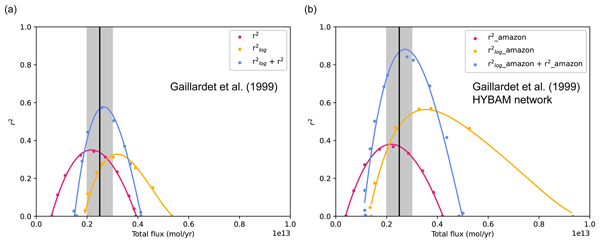
Compared to the silicate weathering fluxes measured at large river basins, the current models tend to systematically overestimate the fluxes over the tropical region, which leads to an overestimation of the global total weathering flux. The most possible cause of such bias is found to be the overestimation of tropical surface erosion, which indicates that the tropical vegetation likely slows down physical erosion significantly. We propose a way of taking this effect into account in models.
Cited articles
Amiotte Suchet, P., Probst, J., and Ludwig, W.: Worldwide distribution of continental rock lithology: Implications for the atmospheric/soil CO2 uptake by continental weathering and alkalinity river transport to the oceans, Global Biogeochem. Cy., 17, 2002GB001891, https://doi.org/10.1029/2002GB001891, 2003.
Anderson, R. S. and Anderson, S. P.: Geomorphology: The Mechanics and Chemistry of Landscapes, Cambridge University Press, https://doi.org/10.1017/CBO9780511794827, 2010.
Berner, R. A.: A model for atmospheric CO2 over Phanerozoic time, Am. J. Sci., 291, 339–376, https://doi.org/10.2475/ajs.291.4.339, 1991.
Berner, R. A. and Caldeira, K.: The need for mass balance and feedback in the geochemical carbon cycle, Geology, 25, 955–956, https://doi.org/10.1130/0091-7613(1997)025<0955:TNFMBA>2.3.CO;2, 1997.
Berner, R. A., Lasaga, A. C., and Garrels, R. M.: Carbonate-silicate geochemical cycle and its effect on atmospheric carbon dioxide over the past 100 million years, Am. J. Sci., 283, https://doi.org/10.2475/ajs.283.7.641, 1983.
Binnie, S. A., Phillips, W. M., Summerfield, M. A., and Fifield, L. K.: Tectonic uplift, threshold hillslopes, and denudation rates in a developing mountain range, Geology, 35, 743, https://doi.org/10.1130/G23641A.1, 2007.
Bluth, G. and Kump, L.: Lithologic and Climatologic Controls of River Chemistry, Geochim. Cosmochim. Ac., 58, 2341–2359, https://doi.org/10.1016/0016-7037(94)90015-9, 1994.
Brantley, S. L., Shaughnessy, A., Lebedeva, M. I., and Balashov, V. N.: How temperature-dependent silicate weathering acts as Earth's geological thermostat, Science, 379, 382–389, https://doi.org/10.1126/science.add2922, 2023.
Breiman, L.: Random Forests, Mach. Learn., 45, 5–32, https://doi.org/10.1023/A:1010933404324, 2001.
Carretier, S., Regard, V., Vassallo, R., Aguilar, G., Martinod, J., Riquelme, R., Pepin, E., Charrier, R., Hérail, G., Farías, M., Guyot, J.-L., Vargas, G., and Lagane, C.: Slope and climate variability control of erosion in the Andes of central Chile, Geology, 41, 195–198, https://doi.org/10.1130/G33735.1, 2013.
Codilean, A. T., Munack, H., Cohen, T. J., Saktura, W. M., Gray, A., and Mudd, S. M.: OCTOPUS: an open cosmogenic isotope and luminescence database, Earth Syst. Sci. Data, 10, 2123–2139, https://doi.org/10.5194/essd-10-2123-2018, 2018.
Coogan, L. A. and Caves Rugenstein, J. K.: Regulation of the carbon cycle on geological timescales, in: Treatise on Geochemistry, Elsevier, 419–465, https://doi.org/10.1016/B978-0-323-99762-1.00060-7, 2025.
Coogan, L. A. and Gillis, K. M.: Low-Temperature Alteration of the Seafloor: Impacts on Ocean Chemistry, Annu. Rev. Earth Planet. Sc., 46, 21–45, https://doi.org/10.1146/annurev-earth-082517-010027, 2018.
Danabasoglu, G., Lamarque, J.-F., Bacmeister, J., Bailey, D. A., DuVivier, A. K., Edwards, J., Emmons, L. K., Fasullo, J., Garcia, R., Gettelman, A., Hannay, C., Holland, M. M., Large, W. G., Lauritzen, P. H., Lawrence, D. M., Lenaerts, J. T. M., Lindsay, K., Lipscomb, W. H., Mills, M. J., Neale, R., Oleson, K. W., Otto-Bliesner, B., Phillips, A. S., Sacks, W., Tilmes, S., van Kampenhout, L., Vertenstein, M., Bertini, A., Dennis, J., Deser, C., Fischer, C., Fox-Kemper, B., Kay, J. E., Kinnison, D., Kushner, P. J., Larson, V. E., Long, M. C., Mickelson, S., Moore, J. K., Nienhouse, E., Polvani, L., Rasch, P. J., and Strand, W. G.: The Community Earth System Model Version 2 (CESM2), J. Adv. Model. Earth Sy., 12, https://doi.org/10.1029/2019MS001916, 2020.
Delunel, R., Van Der Beek, P. A., Carcaillet, J., Bourlès, D. L., and Valla, P. G.: Frost-cracking control on catchment denudation rates: Insights from in situ produced 10Be concentrations in stream sediments (Ecrins–Pelvoux massif, French Western Alps), Earth Planet. Sc. Lett., 293, 72–83, https://doi.org/10.1016/j.epsl.2010.02.020, 2010.
Dessert, C., Dupré, B., Gaillardet, J., François, L. M., and Allègre, C. J.: Basalt weathering laws and the impact of basalt weathering on the global carbon cycle, Chem. Geol., 202, 257–273, https://doi.org/10.1016/j.chemgeo.2002.10.001, 2003.
DiBiase, R. A. and Whipple, K. X.: The influence of erosion thresholds and runoff variability on the relationships among topography, climate, and erosion rate, J. Geophys. Res.-Ea. Surf., https://doi.org/10.1029/2011JF002095, 2011.
Donnadieu, Y., Goddéris, Y., Pierrehumbert, R., Dromart, G., Fluteau, F., and Jacob, R.: A GEOCLIM simulation of climatic and biogeochemical consequences of Pangea breakup, Geochem. Geophy. Geosy., 7, 2006GC001278, https://doi.org/10.1029/2006GC001278, 2006.
Farr, T. G., Rosen, P. A., Caro, E., Crippen, R., Duren, R., Hensley, S., Kobrick, M., Paller, M., Rodriguez, E., Roth, L., Seal, D., Shaffer, S., Shimada, J., Umland, J., Werner, M., Oskin, M., Burbank, D., and Alsdorf, D.: The Shuttle Radar Topography Mission, Rev. Geophys., 45, 2005RG000183, https://doi.org/10.1029/2005RG000183, 2007.
Fick, S. E. and Hijmans, R. J.: WorldClim 2: new 1-km spatial resolution climate surfaces for global land areas, Int. J. Climatol., 37, 4302–4315, https://doi.org/10.1002/joc.5086, 2017.
Gabet, E. J. and Mudd, S. M.: A theoretical model coupling chemical weathering rates with denudation rates, Geology, 37, 151–154, https://doi.org/10.1130/G25270A.1, 2009.
Gaillardet, J., Dupré, B., Louvat, P., and Allègre, C. J.: Global silicate weathering and CO2 consumption rates deduced from the chemistry of large rivers, Chem. Geol., 159, 3–30, https://doi.org/10.1016/S0009-2541(99)00031-5, 1999.
Hales, T. C. and Roering, J. J.: Climatic controls on frost cracking and implications for the evolution of bedrock landscapes, J. Geophys. Res., 112, 2006JF000616, https://doi.org/10.1029/2006JF000616, 2007.
Harris, I., Jones, P., Osborn, T., and Lister, D.: Updated high-resolution grids of monthly climatic observations – The CRU TS3.10 Dataset, Int. J. Climatol., 34, 623–642, https://doi.org/10.1002/joc.3711, 2014.
Hartmann, J. and Moosdorf, N.: The new global lithological map database GLiM: A representation of rock properties at the Earth surface, Geochem. Geophy. Geosy., 13, https://doi.org/10.1029/2012GC004370, 2012.
Hartmann, J., Jansen, N., Dürr, H. H., Kempe, S., and Köhler, P.: Global CO2-consumption by chemical weathering: What is the contribution of highly active weathering regions?, Global Planet. Change, 69, 185–194, https://doi.org/10.1016/j.gloplacha.2009.07.007, 2009.
Heimsath, A. M., Dietrich, W. E., Nishiizumi, K., and Finkel, R. C.: The soil production function and landscape equilibrium, Nature, 388, 358–361, https://doi.org/10.1038/41056, 1997.
Hilton, R. G. and West, A. J.: Mountains, erosion and the carbon cycle, Nat. Rev. Earth Environ., 1, 284–299, https://doi.org/10.1038/s43017-020-0058-6, 2020.
Kump, L. R., Brantley, S. L., and Arthur, M. A.: Chemical Weathering, Atmospheric CO2, and Climate, Annu. Rev. Earth Planet. Sc., 28, 611–667, https://doi.org/10.1146/annurev.earth.28.1.611, 2000.
Lague, D.: The stream power river incision model: evidence, theory and beyond, Earth Surf. Proc. Land., 39, 38–61, https://doi.org/10.1002/esp.3462, 2014.
Larsen, I. J. and Montgomery, D. R.: Landslide erosion coupled to tectonics and river incision, Nat. Geosci., 5, 468–473, https://doi.org/10.1038/ngeo1479, 2012.
Larsen, I. J., Montgomery, D. R., and Greenberg, H. M.: The contribution of mountains to global denudation, Geology, 42, 527–530, https://doi.org/10.1130/G35136.1, 2014.
Lawrence, P. and Chase, T.: Representing a new MODIS consistent land surface in the Community Land Model (CLM 3.0), J. Geophys. Res., 112, https://doi.org/10.1029/2006JG000168, 2007.
Li, G., Hartmann, J., Derry, L. A., West, A. J., You, C.-F., Long, X., Zhan, T., Li, L., Li, G., Qiu, W., Li, T., Liu, L., Chen, Y., Ji, J., Zhao, L., and Chen, J.: Temperature dependence of basalt weathering, Earth Planet. Sc. Lett., 443, 59–69, https://doi.org/10.1016/j.epsl.2016.03.015, 2016.
Li, X., Hu, Y., Guo, J., Lan, J., Lin, Q., Bao, X., Yuan, S., Wei, M., Li, Z., Man, K., Yin, Z., Han, J., Zhang, J., Zhu, C., Zhao, Z., Liu, Y., Yang, J., and Nie, J.: A high-resolution climate simulation dataset for the past 540 million years, Sci. Data, 9, 371, https://doi.org/10.1038/s41597-022-01490-4, 2022.
Lundberg, S. M. and Lee, S.-I.: A unified approach to interpreting model predictions, in: Proceedings of the 31st International Conference on Neural Information Processing Systems, Long Beach, California, USA, 4768–4777, 2017.
Maffre, P., Ladant, J.-B., Moquet, J.-S., Carretier, S., Labat, D., and Goddéris, Y.: Mountain ranges, climate and weathering. Do orogens strengthen or weaken the silicate weathering carbon sink?, Earth Planet. Sc. Lett., 493, 174–185, https://doi.org/10.1016/j.epsl.2018.04.034, 2018.
Maher, K. and Chamberlain, C. P.: Hydrologic Regulation of Chemical Weathering and the Geologic Carbon Cycle, Science, 343, 1502–1504, https://doi.org/10.1126/science.1250770, 2014.
Milliman, J. D. and Syvitski, J. P. M.: Geomorphic/tectonic control of sediment discharge to the ocean: the importance of small mountainous rivers, J. Geol., 100, 525–544, https://doi.org/10.1086/629606, 1992.
Mills, B. J. W., Donnadieu, Y., and Goddéris, Y.: Spatial continuous integration of Phanerozoic global biogeochemistry and climate, Gondwana Res., 100, 73–86, https://doi.org/10.1016/j.gr.2021.02.011, 2021.
Mishra, A. K., Placzek, C., and Jones, R.: Coupled influence of precipitation and vegetation on millennial-scale erosion rates derived from 10Be, PLoS One, 14, e0211325, https://doi.org/10.1371/journal.pone.0211325, 2019.
Moon, S., Chamberlain, C. P., and Hilley, G. E.: New estimates of silicate weathering rates and their uncertainties in global rivers, Geochim. Cosmochim. Ac., 134, 257–274, https://doi.org/10.1016/j.gca.2014.02.033, 2014.
Moquet, J.-S., Crave, A., Viers, J., Seyler, P., Armijos, E., Bourrel, L., Chavarri, E., Lagane, C., Laraque, A., Lavado Casimiro, W. S., Pombosa, R., Noriega, L., Vera, A., and Guyot, J.-L.: Chemical weathering and atmospheric/soil CO2 uptake in the Andean and Foreland Amazon basins, Chem. Geol., 287, 1–26, https://doi.org/10.1016/j.chemgeo.2011.01.005, 2011.
Moquet, J.-S., Guyot, J.-L., Crave, A., Viers, J., Filizola, N., Martinez, J.-M., Oliveira, T. C., Sánchez, L. S. H., Lagane, C., Casimiro, W. S. L., Noriega, L., and Pombosa, R.: Amazon River dissolved load: temporal dynamics and annual budget from the Andes to the ocean, Environ. Sci. Pollut. R., 23, 11405–11429, https://doi.org/10.1007/s11356-015-5503-6, 2016.
Mudd, S. M., Harel, M.-A., Hurst, M. D., Grieve, S. W. D., and Marrero, S. M.: The CAIRN method: automated, reproducible calculation of catchment-averaged denudation rates from cosmogenic nuclide concentrations, Earth Surf. Dynam., 4, 655–674, https://doi.org/10.5194/esurf-4-655-2016, 2016.
Müller, R. D., Mather, B., Dutkiewicz, A., Keller, T., Merdith, A., Gonzalez, C. M., Gorczyk, W., and Zahirovic, S.: Evolution of Earth's tectonic carbon conveyor belt, Nature, 605, 629–639, https://doi.org/10.1038/s41586-022-04420-x, 2022.
Ouimet, W. B., Whipple, K. X., and Granger, D. E.: Beyond threshold hillslopes: Channel adjustment to base-level fall in tectonically active mountain ranges, Geology, 37, 579–582, https://doi.org/10.1130/G30013A.1, 2009.
Park, Y., Maffre, P., Goddéris, Y., Macdonald, F. A., Anttila, E. S. C., and Swanson-Hysell, N. L.: Emergence of the Southeast Asian islands as a driver for Neogene cooling, P. Natl. Acad. Sci. USA, 117, 25319–25326, https://doi.org/10.1073/pnas.2011033117, 2020.
Perron, J. T.: Climate and the Pace of Erosional Landscape Evolution, Annu. Rev. Earth Planet. Sc., 45, 561–591, https://doi.org/10.1146/annurev-earth-060614-105405, 2017.
Portenga, E. W. and Bierman, P. R.: Understanding Earth's eroding surface with 10Be, GSAT, 21, 4–10, https://doi.org/10.1130/G111A.1, 2011.
Prosser, I. P., Dietrich, W. E., and Stevenson, J.: Flow resistance and sediment transport by concentrated overland flow in a grassland valley, Geomorphology, 13, 71–86, https://doi.org/10.1016/0169-555X(95)00020-6, 1995.
Raymo, M. E. and Ruddiman, W.: Cooling in the late Cenozoic [14], Nature, 361, 124, https://doi.org/10.1038/361124a0, 1993.
Riebe, C. S., Kirchner, J. W., Granger, D. E., and Finkel, R. C.: Strong tectonic and weak climatic control of long-term chemical weathering rates, Geology, 29, 511, https://doi.org/10.1130/0091-7613(2001)029<0511:STAWCC>2.0.CO;2, 2001.
Rugenstein, J. K. C., Ibarra, D. E., Zhang, S., Planavsky, N. J., and Von Blanckenburg, F.: Isotope mass-balance constraints preclude that mafic weathering drove Neogene cooling, P. Natl. Acad. Sci. USA, 118, e2026345118, https://doi.org/10.1073/pnas.2026345118, 2021.
Scotese, C. R.: An Atlas of Phanerozoic Paleogeographic Maps: The Seas Come In and the Seas Go Out, Annu. Rev. Earth Planet. Sci., 49, 679–728, https://doi.org/10.1146/annurev-earth-081320-064052, 2021.
Shapley, L. S.: 17. A Value for n-Person Games, in: Contributions to the Theory of Games (AM-28), Volume II, edited by: Kuhn, H. W. and Tucker, A. W., Princeton University Press, 307–318, https://doi.org/10.1515/9781400881970-018, 1953.
Snyder, N. P., Whipple, K. X., Tucker, G. E., and Merritts, D. J.: Importance of a stochastic distribution of floods and erosion thresholds in the bedrock river incision problem, J. Geophys. Res., 108, 2001JB001655, https://doi.org/10.1029/2001JB001655, 2003.
Trapp-Müller, G., Caves Rugenstein, J., Conley, D. J., Geilert, S., Hagens, M., Hong, W.-L., Jeandel, C., Longman, J., Mason, P. R. D., Middelburg, J. J., Milliken, K. L., Navarre-Sitchler, A., Planavsky, N. J., Reichart, G.-J., Slomp, C. P., Sluijs, A., Van Hinsbergen, D. J. J., and Zhang, X. Y.: Earth's silicate weathering continuum, Nat. Geosci., 18, 691–701, https://doi.org/10.1038/s41561-025-01743-y, 2025.
Tucker, G. E.: Drainage basin sensitivity to tectonic and climatic forcing: implications of a stochastic model for the role of entrainment and erosion thresholds, Earth Surf. Proc. Land., 29, 185–205, https://doi.org/10.1002/esp.1020, 2004.
Valdes, P. J., Scotese, C. R., and Lunt, D. J.: Deep ocean temperatures through time, Clim. Past, 17, 1483–1506, https://doi.org/10.5194/cp-17-1483-2021, 2021.
Walker, J. C. G., Hays, P. B., and Kasting, J. F.: A negative feedback mechanism for the long-term stabilization of Earth's surface temperature, J. Geophys. Res., 86, 9776–9782, https://doi.org/10.1029/JC086iC10p09776, 1981.
Wan, S., Clift, P. D., Li, A., Yu, Z., Li, T., and Hu, D.: Tectonic and climatic controls on long‐term silicate weathering in Asia since 5 Ma, Geophys. Res. Lett., 39, 2012GL052377, https://doi.org/10.1029/2012GL052377, 2012.
West, A., Galy, A., and Bickle, M.: Tectonic and climatic controls on silicate weathering, Earth Planet. Sc. Lett., 235, 211–228, https://doi.org/10.1016/j.epsl.2005.03.020, 2005.
White, A. F. and Blum, A. E.: Effects of climate on chemical_ weathering in watersheds, Geochim. Cosmochim. Ac., 59, 1729–1747, https://doi.org/10.1016/0016-7037(95)00078-E, 1995.
White, A. F. and Brantley, S. L.: The effect of time on the weathering of silicate minerals: Why do weathering rates differ in the laboratory and field?, Chem. Geol., 202, 479–506, https://doi.org/10.1016/j.chemgeo.2003.03.001, 2003.
Willenbring, J. K., Codilean, A. T., Ferrier, K. L., McElroy, B., and Kirchner, J. W.: Short Communication: Earth is (mostly) flat, but mountains dominate global denudation: apportionment of the continental mass flux over millennial time scales, revisited, Earth Surf. Dynam. Discuss., 2, 1–17, https://doi.org/10.5194/esurfd-2-1-2014, 2014.
Zhang, M., Liu, Y., Zhu, J., Wang, Z., and Liu, Z.: Impact of Dust on Climate and AMOC During the Last Glacial Maximum Simulated by CESM1.2, Geophys. Res. Lett., 49, e2021GL096672, https://doi.org/10.1029/2021GL096672, 2022.
Zhao, J., Liu, Y., and Hu, Y.: MErSiM v1.0: Machine learning derived Erosion and Silicate weathering Model; code and data of Zhao et al. (2026) GMD, Zenodo [code, data set], https://doi.org/10.5281/zenodo.18015309, 2025.
Zhao, J., Liu, Y., Li, G., and Zuo, H.: Thresholds in the controls of denudation rates: A global analysis of tectonic, climatic and biological factors based on machine learning, Earth Planet. Sc. Lett., 674, 119750, https://doi.org/10.1016/j.epsl.2025.119750, 2026.
Zuo, H., Liu, Y., Li, G., Xu, Z., Zhao, L., Guo, Z., and Hu, Y.: A revised model of global silicate weathering considering the influence of vegetation cover on erosion rate, Geosci. Model Dev., 17, 3949–3974, https://doi.org/10.5194/gmd-17-3949-2024, 2024.
Short summary
By using artificial intelligence and geological measurements, we built a machine learning model that accurately shows how landscapes erode. With this module included we developed a new silicate weatherig model, named MErSiM v1.0, which corrected a major overestimation of weathering flux in models simulating Earth’s long-term carbon cycle. This revealed that Earth's natural ability to remove atmospheric carbon dioxide is profoundly weaker under intense warming than previously understood.
By using artificial intelligence and geological measurements, we built a machine learning model...