Articles | Volume 19, issue 13
https://doi.org/10.5194/gmd-19-6207-2026
© Author(s) 2026. This work is distributed under
the Creative Commons Attribution 4.0 License.
https://doi.org/10.5194/gmd-19-6207-2026
© Author(s) 2026. This work is distributed under
the Creative Commons Attribution 4.0 License.
CarboKitten.jl – an open source toolkit for carbonate stratigraphic modeling
Johan Hidding
CORRESPONDING AUTHOR
Netherlands eScience Center, Science Park 402 (Matrix THREE), 1098 XH Amsterdam, the Netherlands
Utrecht University, Faculty of Geosciences, Princetonlaan 8a, 3584 CB Utrecht, the Netherlands
Niklas Hohmann
Utrecht University, Faculty of Geosciences, Princetonlaan 8a, 3584 CB Utrecht, the Netherlands
Xianyi Liu
Utrecht University, Faculty of Geosciences, Princetonlaan 8a, 3584 CB Utrecht, the Netherlands
Peter Burgess
University of Liverpool, School of Environmental Sciences, 4 Brownlow Street, Liverpool, L69 3GP, United Kingdom
Hanno Spreeuw
Netherlands eScience Center, Science Park 402 (Matrix THREE), 1098 XH Amsterdam, the Netherlands
Related authors
No articles found.
Niklas Hohmann, David De Vleeschouwer, Sietske Batenburg, and Emilia Jarochowska
Geochronology, 7, 427–448, https://doi.org/10.5194/gchron-7-427-2025, https://doi.org/10.5194/gchron-7-427-2025, 2025
Short summary
Short summary
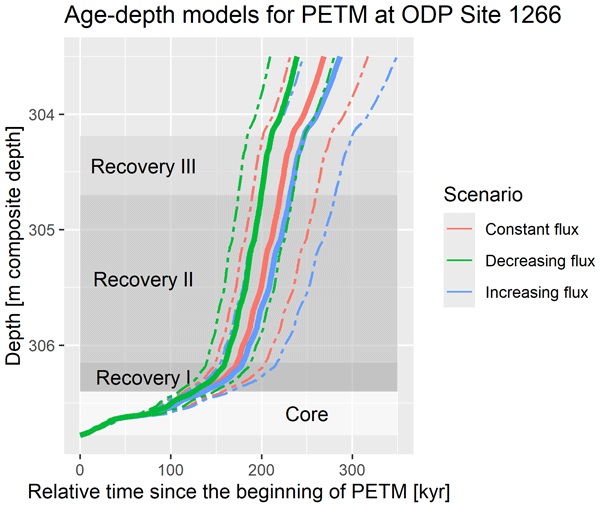
Age–depth models assign ages to sampling locations (e.g., in drill cores), making them crucial to the determined timing and pace of past changes. We present two methods to estimate age–depth models from sedimentological and stratigraphic information, resulting in richer and more empirically realistic age–depth models. As a use case, we (1) determine the timing of the Frasnian–Famennian extinction and (2) examine the duration of the Paleocene–Eocene Thermal Maximum (PETM), a potential deep-time analog for anthropogenic climate change.
Konstantina Agiadi, Niklas Hohmann, Elsa Gliozzi, Danae Thivaiou, Francesca R. Bosellini, Marco Taviani, Giovanni Bianucci, Alberto Collareta, Laurent Londeix, Costanza Faranda, Francesca Bulian, Efterpi Koskeridou, Francesca Lozar, Alan Maria Mancini, Stefano Dominici, Pierre Moissette, Ildefonso Bajo Campos, Enrico Borghi, George Iliopoulos, Assimina Antonarakou, George Kontakiotis, Evangelia Besiou, Stergios D. Zarkogiannis, Mathias Harzhauser, Francisco Javier Sierro, Angelo Camerlenghi, and Daniel García-Castellanos
Earth Syst. Sci. Data, 16, 4767–4775, https://doi.org/10.5194/essd-16-4767-2024, https://doi.org/10.5194/essd-16-4767-2024, 2024
Short summary
Short summary
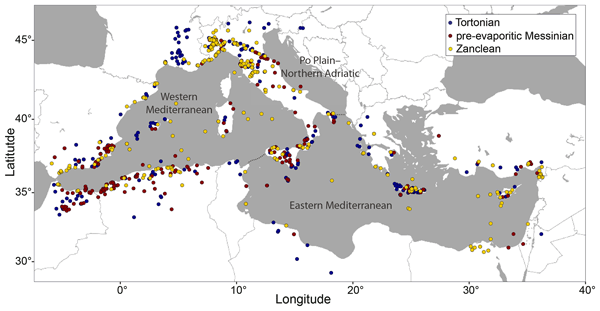
We present a dataset of 23032 fossil occurrences of marine organisms from the Late Miocene to the Early Pliocene (~11 to 3.6 million years ago) from the Mediterranean Sea. This dataset will allow us, for the first time, to quantify the biodiversity impact of the Messinian salinity crisis, a major geological event that possibly changed global and regional climate and biota.
Cited articles
Adams, E. W. and Schlager, W.: Basic Types of Submarine Slope Curvature, J. Sediment. Res., 70, 814–828, https://doi.org/10.1306/2DC4093A-0E47-11D7-8643000102C1865D, 2000. a, b
Barnhart, K. R., Hutton, E. W. H., Tucker, G. E., Gasparini, N. M., Istanbulluoglu, E., Hobley, D. E. J., Lyons, N. J., Mouchene, M., Nudurupati, S. S., Adams, J. M., and Bandaragoda, C.: Short communication: Landlab v2.0: a software package for Earth surface dynamics, Earth Surf. Dynam., 8, 379–397, https://doi.org/10.5194/esurf-8-379-2020, 2020. a
Barrett, S. J. and Webster, J. M.: Reef Sedimentary Accretion Model (ReefSAM): Understanding coral reef evolution on Holocene time scales using 3D stratigraphic forward modelling, Mar. Geol., 391, 108–126, https://doi.org/10.1016/j.margeo.2017.07.007, 2017. a
Bosence, D. W. J., Pomar, L., Waltham, D. A., and Lankester, T. H. G.: Computer Modeling a Miocene Carbonate Platform, Mallorca, Spain1, AAPG Bull., 78, 247–266, https://doi.org/10.1306/BDFF9078-1718-11D7-8645000102C1865D, 1994. a
Bosscher, H. and Southam, J.: CARBPLAT – A computer model to simulate the development of carbonate platforms, Geology, 20, 235–238, https://doi.org/10.1130/0091-7613(1992)020<0235:CACMTS>2.3.CO;2, 1992. a, b
Burgess, P. M.: The nature of shallow-water carbonate lithofacies thickness distributions, Geology, 36, 235–238, https://doi.org/10.1130/G243326A.1, 2008. a
Burgess, P. M.: Identifying Ordered Strata: Evidence, Methods, and Meaning, J. Sediment. Res., 86, 148–167, https://doi.org/10.2110/jsr.2016.10, 2016. a
Burgess, P. M. and Emery, D. J.: Sensitive dependence, divergence and unpredictable behaviour in a stratigraphic forward model of a carbonate system, in: Geological Prior Information: Informing Science and Engineering, vol. 239, edited by: Curtis, A. and Wood, R., Geological Society of London, ISBN 978-1-86239-171-0, https://doi.org/10.1144/GSL.SP.2004.239.01.06, 2004. a
Burgess, P. M., Wright, V. P., and Emery, D.: Numerical forward modelling of peritidal carbonate parasequence development: implications for outcrop interpretation, Basin Res., 13, 1–16, https://doi.org/10.1046/j.1365-2117.2001.00130.x, 2001. a
Burgess, P. M., Masiero, I., Toby, S. C., and Duller, R. A.: A big fan of signals? Exploring autogenic and allogenic process and product in a numerical stratigraphic forward model of submarine-fan development, J. Sediment. Res., 89, 1–12, https://doi.org/10.2110/jsr.2019.3, 2019. a, b
Crucifix, M.: palinsol: Insolation for Palaeoclimate Studies, CRAN, https://doi.org/10.32614/CRAN.package.palinsol, 2023. a
Curtis, A., Bloem, H., Wood, R., Bowyer, F., Shields, G. A., Zhou, Y., Yilales, M., and Tetzlaff, D.: Natural sampling and aliasing of marine geochemical signals, Sci. Rep., 15, 760, https://doi.org/10.1038/s41598-024-84871-6, 2025. a, b, c
Danisch, S. and Krumbiegel, J.: Makie.jl: Flexible high-performance data visualization for Julia, J. Open Source Softw., 6, 3349, https://doi.org/10.21105/joss.03349, 2021. a
Demicco, R. V.: CYCOPATH 2D – a two-dimensional, forward model of cyclic sedimentation on carbonate platforms, Comput. Geosci., 24, 405–423, https://doi.org/10.1016/S0098-3004(98)00024-7, 1998. a
Ding, X., Salles, T., Flament, N., and Rey, P.: Quantitative stratigraphic analysis in a source-to-sink numerical framework, Geosci. Model Dev., 12, 2571–2585, https://doi.org/10.5194/gmd-12-2571-2019, 2019. a
Dormann, S., Deutsch, A., and Lawniczak, A. T.: Fourier analysis of Turing-like pattern formation in cellular automaton models, Future Generat. Comput. Syst., 17, 901–909, https://doi.org/10.1016/S0167-739X(00)00068-6, 2001. a
Drummond, C. N. and Dugan, P. J.: Self-organizing models of shallow-water carbonate accumulation, J. Sediment. Res., 69, 939–946, https://doi.org/10.2110/jsr.69.939, 1999. a, b, c
Dyer, B., Maloof, A. C., Purkis, S. J., and Harris, P. M. M.: Quantifying the relationship between water depth and carbonate facies, Sediment. Geol., 373, 1–10, https://doi.org/10.1016/j.sedgeo.2018.05.011, 2018. a
Evans, K. M.: Larger than Life: it's so nonlinear, PhD thesis, Uniersity of Wisconsin-Madison, Madison, https://www.csun.edu/~kme52026/thesis.html (last access: 1 March 2026), 1996. a
Falivene, O., Frascati, A., Bolla Pittaluga, M., and Martin, J.: Three-dimensional Reduced-Complexity Simulation of Fluvio-Deltaic Clastic Stratigraphy, J. Sediment. Res., 89, 46–65, https://doi.org/10.2110/jsr.2018.73, 2019. a
Fathiyah Jamaludin, S. N.: Quantitative geo-history analysis of the Luconia-Balingian provinces, Malaysia with emphasis on the tectonic subsidence signatures, Mar. Petrol. Geol., 173, 107224, https://doi.org/10.1016/j.marpetgeo.2024.107224, 2025. a
Geyman, E. C., Maloof, A. C., and Dyer, B.: How is sea level change encoded in carbonate stratigraphy?, Earth Planet. Sc. Lett., 560, 116790, https://doi.org/10.1016/j.epsl.2021.116790, 2021. a
Granjeon, D. and Joseph, P.: Concepts and Applications of A 3-D Multiple Lithology, Diffusive Model in Stratigraphic Modeling, in: Numerical Experiments in Stratigraphy: Recent Advances in Stratigraphic and Sedimentologic Computer Simulations, vol. 62, edited by: Harbaugh, J. W., Watney, W. L., Rankey, E. C., Slingerland, R., Goldstein, R. H., and Franseen, E. K., SEPM – Society for Sedimentary Geology, 197–209, https://doi.org/10.2110/pec.99.62.0197, 1999. a, b, c
Hannisdal, B.: Phenotypic evolution in the fossil record: numerical experiments, J. Geol., 114, 133–153, https://doi.org/10.1086/499569, 2006. a, b
Henglai, P., Fongngern, R., and Saller, A.: The growth and demise of a Middle Miocene carbonate platform in Central Luconia, offshore Malaysia, Mar. Petrol. Geol., 163, 106763, https://doi.org/10.1016/j.marpetgeo.2024.106763, 2024. a, b, c
Hidding, J.: Entangled, a Bidirectional System for Sustainable Literate Programming, in: 2023 IEEE 19th International Conference on e-Science (e-Science), 1–9, https://doi.org/10.1109/e-Science58273.2023.10254816, 2023. a
Hidding, J., Jarochowska, E., Liu, X., Burgess, P., Hohmann, N., and Spreeuw, H.: CarboKitten.jl, Zenodo [code], https://doi.org/10.5281/zenodo.15742533, 2025.
Hidding, J., Jarochowska, E., Liu, X., Burgess, P., Hohmann, N., and Spreeuw, H.: CarboKitten.jl (v0.6.1), Zenodo [code], https://doi.org/10.5281/zenodo.20626229, 2026a (code also available at: https://github.com/MindTheGap-ERC/CarboKitten.jl, last access: 10 June 2026). a
Hidding, J., Jarochowska, E., Hohmann, N., Spreeuw, H., and xyl96: MindTheGap-ERC/CarboKitten-research-paper: Accepted Paper (v1.0), Zenodo [code], https://doi.org/10.5281/zenodo.20451169, 2026b. a, b
Hill, J., Tetzlaff, D., Curtis, A., and Wood, R.: Modeling shallow marine carbonate depositional systems, Comput. Geosci. 35, 1862–1874, https://doi.org/10.1016/j.cageo.2008.12.006, 2009. a
Hobley, D. E. J., Adams, J. M., Nudurupati, S. S., Hutton, E. W. H., Gasparini, N. M., Istanbulluoglu, E., and Tucker, G. E.: Creative computing with Landlab: an open-source toolkit for building, coupling, and exploring two-dimensional numerical models of Earth-surface dynamics, Earth Surf. Dynam., 5, 21–46, https://doi.org/10.5194/esurf-5-21-2017, 2017. a
Hohmann, N. and Jarochowska, E.: StratPal: An R package for creating stratigraphic paleobiology modelling pipelines, Meth. Ecol. Evol., 16, 678–686, https://doi.org/10.1111/2041-210X.14507, 2025. a
Hohmann, N., Koelewijn, J. R., Burgess, P., and Jarochowska, E.: Identification of the mode of evolution in incomplete carbonate successions, BMC Ecol. Evol., 24, 113, https://doi.org/10.1186/s12862-024-02287-2, 2024. a, b, c, d
Holland, S. M.: The quality of the fossil record: A sequence stratigraphic perspective, Paleobiology, 26, 148–168, https://doi.org/10.1017/S0094837300026919, 2000. a
Holland, S. M. and Patzkowsky, M. E.: Models for simulating the fossil record, Geology, 27, 491–494, https://doi.org/10.1130/0091-7613(1999)027<0491:MFSTFR>2.3.CO;2, 1999. a
Holland, S. M. and Patzkowsky, M. E.: Stratigraphic Variation in the Timing of First and Last Occurrences, PALAIOS, 17, 134–146, https://doi.org/10.1669/0883-1351(2002)017<0134:SVITTO>2.0.CO;2, 2002. a
Husinec, A., Read, J. F., and Kemp, D. B.: Orbital forcing of Upper Jurassic (Tithonian) shallow-water carbonates, Tethyan Adriatic Platform, Croatia evaluated using synthetic vs. real data sets, Palaeogeogr. Palaeocl. Palaeoecol., 622, 111617, https://doi.org/10.1016/j.palaeo.2023.111617, 2023. a
Hutton, E. W. H. and Syvitski, J. P. M.: Sedflux 2.0: An advanced process-response model that generates three-dimensional stratigraphy, Comput. Geosci., 34, 1319–1337, https://doi.org/10.1016/j.cageo.2008.02.013, 2008. a
James, S. C., Jones, C. A., Grace, M. D., and Roberts, J. D.: Advances in sediment transport modelling, J. Hydraul. Res., 48, 754–763, 2010. a
Jean Borgomano, C. L., Lanteaume, C., Léonide, P., Fournier, F., Montaggioni, L. F., and Masse, J.-P.: Quantitative carbonate sequence stratigraphy: Insights from stratigraphic forward models, AAPG Bull., 104, 1115–1142, https://doi.org/10.1306/11111917396, 2020. a
Kaufman, P., Grotzinger, J. P., and McCormick, D. S.: Depth-dependent diffusion algorithm for simulation of sedimentation in shallow marine depositional systems, Bulletin (Kansas Geological Survey), 233, 489–508, https://doi.org/10.17161/kgsbulletin.no.233.20474, 1991. a
Kemp, D. B. and Van Manen, S. M.: Metre-scale cycles in shallow water carbonate successions: Milankovitch and stochastic origins, Sedimentology, 66, 2590–2604, https://doi.org/10.1111/sed.12609, 2019. a, b
Kemp, D. B., Van Manen, S. M., Pollitt, D. A., and Burgess, P. M.: Investigating the preservation of orbital forcing in peritidal carbonates, Sedimentology, 63, 1701–1718, https://doi.org/10.1111/sed.12282, 2016. a, b, c
Kemp, D. B., Fraser, W. T., and Izumi, K.: Stratigraphic completeness and resolution in an ancient mudrock succession, Sedimentology, 65, 1875–1890, https://doi.org/10.1111/sed.12450, 2018. a
Kenter, J. A. M.: Carbonate platform flanks: slope angle and sediment fabric, Sedimentology, 37, 777–794, https://doi.org/10.1111/j.1365-3091.1990.tb01825.x, 1990. a, b, c
Knuth, D. E.: Literate Programming, Comput. J., 27, 97–111, https://doi.org/10.1093/comjnl/27.2.97, 1984. a
Laskar, J.: A long-term numerical solution for the insolation quantities of the Earth, Astron. Astrophys., 428, 261–285, https://doi.org/10.1051/0004-6361:20041335, 2004. a
Lisiecki, L. E. and Raymo, M. E.: A Pliocene-Pleistocene stack of 57 globally distributed benthic δ18O records, Paleoceanography, 20, https://doi.org/10.1029/2004PA001071, 2005. a, b, c
Liu, J. and Liu, K.: Estimating stratal completeness of carbonate deposition via process-based stratigraphic forward modeling, Sci. China Earth Sci., 64, 253–259, https://doi.org/10.1007/s11430-020-9660-8, 2021. a
Liu, J., Webster, J. M., Salles, T., Wang, S., Ma, Y., Xu, W., Li, G., and Yan, W.: The Formation of Atolls: New Insights From Numerical Simulations, J. Geophys. Res.-Earth, 127, e2022JF006812, https://doi.org/10.1029/2022JF006812, 2022. a
Lopez-Gamundi, C., Barnes, B. B., Betzler, C., Harris, P. M., Oehlert, A. M., Eberli, G. P., and Purkis, S. J.: The sediment budget of Great Bahama Bank–Earth's largest modern carbonate platform, Geology, 53, 748–752, https://doi.org/10.1130/G52850.1, 2025. a
Masiero, I., Kozlowski, E., Antonatos, G., Xi, H., and Burgess, P.: Numerical stratigraphic forward models as conceptual knowledge repositories and experimental tools: An example using a new enhanced version of CarboCAT, Comput. Geosci., 138, 104 453, https://doi.org/10.1016/j.cageo.2020.104453, 2020. a, b
Masiero, I., Burgess, P., Hollis, C., Manifold, L., Gawthorpe, R., Lecomte, I., Marshall, J., and Rotevatn, A.: Syn-rift carbonate platforms in space and time: testing and refining conceptual models using stratigraphic and seismic numerical forward modelling, in: Seismic Characterization of Carbonate Platforms and Reservoirs, edited by: Hendry, J., Burgess, P., Hunt, D., Janson, X., and Zampetti, V., Geological Society of London, ISBN 978-1-78620-539-1, https://doi.org/10.1144/SP509-2019-217, 2021. a
Miller, K. G., Kominz, M. A., Browning, J. V., Wright, J. D., Mountain, G. S., Katz, M. E., Sugarman, P. J., Cramer, B. S., Christie-Blick, N., and Pekar, S. F.: The Phanerozoic Record of Global Sea-Level Change, Science, 310, 1293–1298, https://doi.org/10.1126/science.1116412, 2005. a
Mitchell, S. F., Paul, C. R. C., and Gale, A. S.: Carbon isotopes and sequence stratigraphy, Geol. Soc. Lond. Spec. Publ., 104, 11–24, https://doi.org/10.1144/GSL.SP.1996.104.01.02, 1996. a
Myrow, P. M. and Grotzinger, J. P.: Chemostratigraphic Proxy Records: Forward Modeling the Effects of Unconformities, Variable Sediment Accumulation Rates, and Sampling-Interval Bias, in: Carbonate Sedimentation and Diagenesis in the Evolving Precambrian World, vol. 67, edited by: Grotzinger, J. P. and James, N. P., SEPM Society for Sedimentary Geology, ISBN 978-1-56576-189-6, https://doi.org/10.2110/pec.00.67, 2000. a
Pastier, A.-M., Husson, L., Pedoja, K., Bézos, A., Authemayou, C., Arias-Ruiz, C., and Cahyarini, S. Y.: Genesis and Architecture of Sequences of Quaternary Coral Reef Terraces: Insights From Numerical Models, Geochem. Geophy. Geosy., 20, 4248–4272, https://doi.org/10.1029/2019GC008239, 2019. a
Paterson, R. J., Whitaker, F. F., Jones, G. D., Smart, P. L., Waltham, D., and Felce, G.: Accommodation and Sedimentary Architecture of Isolated Icehouse Carbonate Platforms: Insights from Forward Modeling with CARB3D+, J. Sediment. Res., 76, 1162–1182, https://doi.org/10.2110/jsr.2006.113, 2006. a, b
Purkis, S. J., Koppel, J. v. d., and Burgess, P. M.: Spatial self-organization in carbonate depositional environments, SEPM Spec. Publ., 106, 53–66, https://doi.org/10.2110/sepmsp.106.02, 2016. a
Salles, T.: Badlands: A parallel basin and landscape dynamics model, SoftwareX, 5, 195–202, https://doi.org/10.1016/j.softx.2016.08.005, 2016. a
Salles, T., Ding, X., and Brocard, G.: pyBadlands: A framework to simulate sediment transport, landscape dynamics and basin stratigraphic evolution through space and time, PLOS ONE, 13, e0195557, https://doi.org/10.1371/journal.pone.0195557, 2018a. a
Salles, T., Pall, J., Webster, J. M., and Dechnik, B.: Exploring coral reef responses to millennial-scale climatic forcings: insights from the 1-D numerical tool pyReef-Core v1.0, Geosci. Model Dev., 11, 2093–2110, https://doi.org/10.5194/gmd-11-2093-2018, 2018b. a
Schlager, W. and Camber, O.: Submarine slope angles, drowning unconformities, and self-erosion of limestone escarpments, Geology, 14, 762–765, https://doi.org/10.1130/0091-7613(1986)14<762:SSADUA>2.0.CO;2, 1986. a
Schlager, W. and Warrlich, G.: Record of sea‐level fall in tropical carbonates, Basin Res., 21, 209–224, https://doi.org/10.1111/j.1365-2117.2008.00383.x, 2009. a
Strobel, J., Cannon, R., Christopher, G. S., Kendall, C. S., Biswas, G., and Bezdek, J.: Interactive (SEDPAK) simulation of clastic and carbonate sediments in shelf to basin settings, Comput. Geosci., 15, 1279–1290, https://doi.org/10.1016/0098-3004(89)90092-7, 1989. a
Sultana, D., Burgess, P., and Bosence, D.: How do carbonate factories influence carbonate platform morphology? Exploring production-transport interactions with numerical forward modelling, Sedimentology, 69, 372–393, https://doi.org/10.1111/sed.12943, 2022. a, b, c, d
Sylvester, Z., Straub, K. M., and Covault, J. A.: Stratigraphy in space and time: A reproducible approach to analysis and visualization, Earth-Sci. Rev., 250, 104706, https://doi.org/10.1016/j.earscirev.2024.104706, 2024. a
Tetzlaff, D.: Stratigraphic forward modeling software package for research and education, arXiv [preprint], https://doi.org/10.48550/arXiv.2302.05272, 2023. a
Warrlich, G., Bosence, D., Waltham, D., Wood, C., Boylan, A., and Badenas, B.: 3D stratigraphic forward modelling for analysis and prediction of carbonate platform stratigraphies in exploration and production, Mar. Petrol. Geol., 25, 35–58, https://doi.org/10.1016/j.marpetgeo.2007.04.005, 2008. a, b
Warrlich, G. M. D., Waltham, D. A., and Bosence, D. W. J.: Quantifying the sequence stratigraphy and drowning mechanisms of atolls using a new 3‐D forward stratigraphic modelling program (CARBONATE 3D), Basin Res., 14, 379–400, https://doi.org/10.1046/j.1365-2117.2002.00181.x, 2002. a
Weij, R., Reijmer, J. J. G., Eberli, G. P., and Swart, P. K.: The limited link between accommodation space, sediment thickness, and inner platform facies distribution (Holocene–Pleistocene, Bahamas), Deposit. Rec., 5, 400–420, https://doi.org/10.1002/dep2.50, 2019. a
Wild, T. B., Loucks, D. P., and Annandale, G. W.: SedSim: A River Basin Simulation Screening Model for Reservoir Management of Sediment, Water, and Hydropower, J. Open Res. Softw., 7, https://doi.org/10.5334/jors.261, 2019. a
Xi, H. and Burgess, P. M.: The stratigraphic significance of self-organization: Exploring how autogenic processes can generate cyclical carbonate platform strata, Sedimentology, 69, 1769–1788, https://doi.org/10.1111/sed.12974, 2022. a, b
Zimmt, J. B., Holland, S. M., Finnegan, S., and Marshall, C. R.: Recognizing pulses of extinction from clusters of last occurrences, Palaeontology, 64, 1–20, https://doi.org/10.1111/pala.12505, 2021. a
Short summary
Coral reefs and limestones hold crucial records of Earth's climate history, but scientists have lacked accessible tools to simulate how these systems form over thousands to millions of years. We developed CarboKitten, free software that models how tropical sediments and associated organisms grow under changing sea levels and environmental conditions. The program runs fast on standard computers and can test scientific theories about how these geological features preserve the Earth's history.
Coral reefs and limestones hold crucial records of Earth's climate history, but scientists have...