Articles | Volume 19, issue 13
https://doi.org/10.5194/gmd-19-6027-2026
© Author(s) 2026. This work is distributed under
the Creative Commons Attribution 4.0 License.
https://doi.org/10.5194/gmd-19-6027-2026
© Author(s) 2026. This work is distributed under
the Creative Commons Attribution 4.0 License.
A self-supervised precipitation forecast verification based on contrastive learning

College of Meteorology and Oceanography, National University of Defense Technology, Changsha, 410072, China
High Impact Weather Key Laboratory of CMA, Changsha, 410072, China
Shuwen Huang
College of Meteorology and Oceanography, National University of Defense Technology, Changsha, 410072, China
Qian Li
College of Meteorology and Oceanography, National University of Defense Technology, Changsha, 410072, China
High Impact Weather Key Laboratory of CMA, Changsha, 410072, China
Xuan Peng
College of Meteorology and Oceanography, National University of Defense Technology, Changsha, 410072, China
High Impact Weather Key Laboratory of CMA, Changsha, 410072, China
Haoming Chen
State Key Laboratory of Severe Weather Meteorological Science and Technology, Chinese Academy of Meteorological Sciences, Beijing, 100081, China
Kefeng Zhu
Nanjing Innovation Institute for Atmospheric Sciences, Chinese Academy of Meteorological Sciences-Jiangsu Meteorological Service, Nanjing, 210041, China
Liwen Wang
College of Meteorology and Oceanography, National University of Defense Technology, Changsha, 410072, China
Sheng Li
College of Meteorology and Oceanography, National University of Defense Technology, Changsha, 410072, China
Related authors
No articles found.
Jing Sun, Yunying Li, Hao Hu, Qian Li, Chengzhi Ye, Yining Shi, and Zitong Chen
Atmos. Chem. Phys., 25, 16347–16361, https://doi.org/10.5194/acp-25-16347-2025, https://doi.org/10.5194/acp-25-16347-2025, 2025
Short summary
Short summary
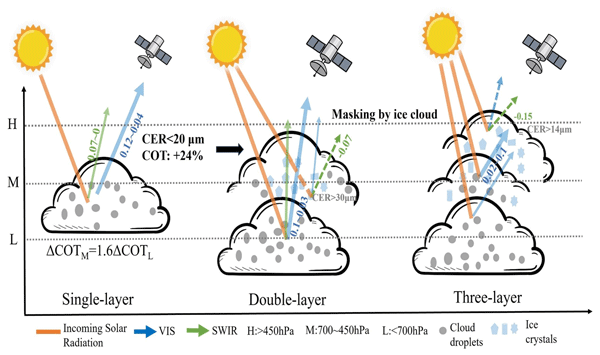
Clouds strongly affect how sunlight and heat move through the atmosphere, but their vertical layers make them hard to study. We examined how different cloud layers influence satellite estimates of cloud thickness and droplet size using observations and computer simulations over China. We found that high ice clouds can hide lower water clouds, causing large errors. This shows satellites need to consider cloud layers to improve accuracy.
Liwen Wang, Qian Li, Qi Lv, Xuan Peng, and Wei You
Geosci. Model Dev., 18, 2427–2442, https://doi.org/10.5194/gmd-18-2427-2025, https://doi.org/10.5194/gmd-18-2427-2025, 2025
Short summary
Short summary
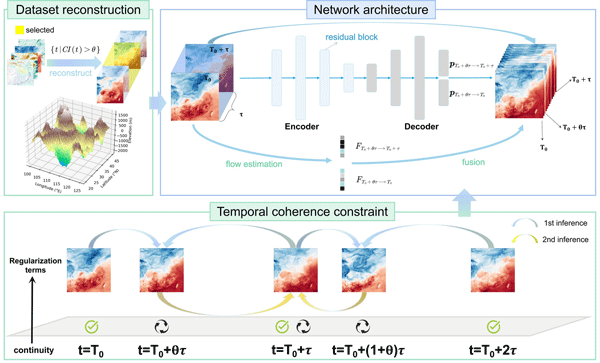
Our research presents a novel deep learning approach called "TemDeep" for downscaling atmospheric variables at arbitrary time resolutions based on temporal coherence. Results show that our method can accurately recover evolution details superior to other methods, reaching 53.7 % in the restoration rate. Our findings are important for advancing weather forecasting models and enabling more precise and reliable predictions to support disaster preparedness, agriculture, and sustainable development.
Bing Zhang, Mingjian Zeng, Anning Huang, Zhengkun Qin, Couhua Liu, Wenru Shi, Xin Li, Kefeng Zhu, Chunlei Gu, and Jialing Zhou
Geosci. Model Dev., 17, 4579–4601, https://doi.org/10.5194/gmd-17-4579-2024, https://doi.org/10.5194/gmd-17-4579-2024, 2024
Short summary
Short summary
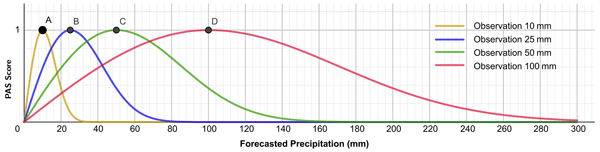
By directly analyzing the proximity of precipitation forecasts and observations, a precipitation accuracy score (PAS) method was constructed. This method does not utilize a traditional contingency-table-based classification verification; however, it can replace the threat score (TS), equitable threat score (ETS), and other skill score methods, and it can be used to calculate the accuracy of numerical models or quantitative precipitation forecasts.
Cited articles
Ayzel, G., Scheffer, T., and Heistermann, M.: RainNet v1.0: a convolutional neural network for radar-based precipitation nowcasting, Geosci. Model Dev., 13, 2631–2644, https://doi.org/10.5194/gmd-13-2631-2020, 2020.
Cassola, F., Ferrari, F., and Mazzino, A.: Numerical simulations of Mediterranean heavy precipitation events with the WRF model: a verification exercise using different approaches, Atmos. Res., 164, 210–225, https://doi.org/10.1016/j.atmosres.2015.05.010, 2015.
Chen, T., Kornblith, S., Norouzi, M., and Hinton, G.: A simple framework for contrastive learning of visual representations, in: Proceedings of the 8th International Conference on Learning Representations (ICLR), 26 April–1 May 2020, Addis Ababa, Ethiopia, 1597–1607, arXiv, https://doi.org/10.48550/arXiv.2002.05709 2020.
Chen, Y., Wang, Y., Huang, G., and Tian, Q.: Coupling physical factors for precipitation forecast in China with graph neural network, Geophys. Res. Lett., 51, e2023GL106676, https://doi.org/10.1029/2023GL106676, 2024.
Davis, C., Brown, B., and Bullock, R.: Object-based verification of precipitation forecasts, Mon. Weather Rev., 134, 1772–1784, https://doi.org/10.1175/MWR3145.1, 2006.
Dorninger, M., Gilleland, E., Casati, B., Mittermaier, M. P., Ebert, E. E., Brown, B. G., and Wilson, L. J.: The setup of the MesoVICT project, B. Am. Meteorol. Soc., 99, 1887–1906, https://doi.org/10.1175/BAMS-D-17-0164.1, 2018.
Dorninger, M., Ghelli, A., and Lerch, S.: Recent developments and application examples on forecast verification, Meteorol. Appl., 27, e1934, https://doi.org/10.1002/met.1934, 2020.
Ebert, E. E. and Gallus Jr., W. A.: Toward better understanding of the contiguous rain area (CRA) method for spatial forecast verification, Weather Forecast., 24, 1401–1414, https://doi.org/10.1175/2009WAF2222252.1, 2009.
Gidaris, S., Singh, P., and Komodakis, N.: Unsupervised representation learning by predicting image rotations, in: Proceedings of the 6th International Conference on Learning Representations (ICLR), 30 April–3 May 2018, Vancouver, Canada, arXiv, https://doi.org/10.48550/arXiv.1803.07728, 2018.
Gilleland, E., Ahijevych, D., Brown, B. G., Casati, B., and Ebert, E. E.: Intercomparison of spatial forecast verification methods, Weather Forecast., 24, 1416–1430, https://doi.org/10.1175/2009WAF2222269.1, 2009.
Gilleland, E., Ahijevych, D., Brown, B. G., and Ebert, E. E.: Verifying forecasts spatially, B. Am. Meteorol. Soc., 91, 1365–1376, https://doi.org/10.1175/2010BAMS2819.1, 2010.
Gofa, F., Boucouvala, D., Louka, P., and Flocas, H.: Spatial verification approaches as a tool to evaluate the performance of high resolution precipitation forecasts, Atmos. Res., 208, 78–87, https://doi.org/10.1016/j.atmosres.2017.09.021, 2018.
Gofa, F., Flocas, H., Louka, P., and Samos, I.: A coherent approach to evaluating precipitation forecasts over complex terrain, Atmosphere, 13, 1164, https://doi.org/10.3390/atmos13081164, 2022.
Grill, J. B., Strub, F., Altché, F., Tallec, C., Richemond, P., Buchatskaya, E., Doersch, C., Pires, B. A., Guo, Z., Azar, M. G., Piot, B., Kavukcuoglu, K., Munos, R., and Valko, M.: Bootstrap your own latent – a new approach to self-supervised learning, in: Advances in Neural Information Processing Systems 33 (NeurIPS 2020), 6–12 December 2020, online, 21271–21284, 2020.
He, K., Zhang, X., Ren, S., and Sun, J.: Deep residual learning for image recognition, in: Proceedings of the IEEE Conference on Computer Vision and Pattern Recognition(CVPR), 27–30 June 2016, Las Vegas, USA, 770–778, https://doi.org/10.1109/CVPR.2016.90, 2016.
Ilyas, I. F., Beskales, G., and Soliman, M. A.: A survey of top-k query processing techniques in relational database systems, ACM Comput. Surv., 40, 1–58, https://doi.org/10.1145/1391729.1391730, 2008.
Jain, S., Scaife, A. A., Shepherd, T. G., Deser, C., Dunstone, N., Schmidt, G. A., Trenberth, K. E., and Turkington, T.: Importance of internal variability for climate model assessment, npj Clim. Atmos. Sci., 6, 68, https://doi.org/10.1038/s41612-023-00389-0, 2023.
Lee, S.-H., Kim, S.-W., Angevine, W. M., Bianco, L., McKeen, S. A., Senff, C. J., Trainer, M., Tucker, S. C., and Zamora, R. J.: Evaluation of urban surface parameterizations in the WRF model using measurements during the Texas Air Quality Study 2006 field campaign, Atmos. Chem. Phys., 11, 2127–2143, https://doi.org/10.5194/acp-11-2127-2011, 2011.
Li, L., Shao, A., and Qiu, X.: Short-term forecast large-scale error characteristics and their relationship with precipitation forecast skill under two rainfall regimes, Atmos. Res., 298, 107152, https://doi.org/10.1016/j.atmosres.2023.107152, 2024.
Liu, X., Zhang, F., Hou, Z., Mian, L., Wang, Z., Zhang, J., and Tang, J.: Self-supervised learning: generative or contrastive, IEEE T. Knowl. Data En., 35, 857–876, https://doi.org/10.1109/TKDE.2021.3090866, 2021.
Mittermaier, M. P. and Roberts, N. M.: Intercomparison of spatial forecast verification methods: identifying skillful spatial scales using the fractions skill score, Weather Forecast., 25, 343–354, https://doi.org/10.1175/2009WAF2222260.1, 2010.
NUDT: CLPFV, Zenodo [code, data set], https://doi.org/10.5281/zenodo.16777790, 2025.
Oord, A., Li, Y., and Vinyals, O.: Representation learning with contrastive predictive coding, arXiv [preprint], https://doi.org/10.48550/arXiv.1807.03748, 11 July 2018.
Persson, A. and Grazzini, F.: User guide to ECMWF forecast products, ECMWF Meteorological Bulletins M3.2, ECMWF, Reading, UK, 115 pp., https://doi.org/10.21957/m1cs7h, 2007.
Roberts, N. M. and Lean, H. W.: Scale-selective verification of rainfall accumulations from high-resolution forecasts of convective events, Mon. Weather Rev., 136, 78–97, https://doi.org/10.1175/2007MWR2123.1, 2008.
Rossa, A., Nurmi, P., and Ebert, E.: Overview of methods for the verification of quantitative precipitation forecasts, in: Precipitation: Advances in Measurement, Estimation and Prediction, edited by: Michaelides, S., Springer, Berlin, Heidelberg, Germany, 419–452, https://doi.org/10.1007/978-3-540-77655-0_16, 2008.
Saavedra Valeriano, O. C., Koike, T., Yang, K., Graf, T., Li, X., Wang, L., and Han, X.: Decision support for dam release during floods using a distributed biosphere hydrological model driven by quantitative precipitation forecasts, Water Resour. Res., 46, W10544, https://doi.org/10.1029/2010WR009502, 2010.
Saunshi, N., Plevrakis, O., Arora, S., Khodak, M., and Khandeparkar, H.: A theoretical analysis of contrastive unsupervised representation learning, in: Proceedings of the 7th International Conference on Learning Representations (ICLR), New Orleans, LA, USA, 6–9 May 2019, arXiv [preprint], https://arxiv.org/abs/1902.09229, 2019.
Shen, Y., Hong, Z., Pan, Y., Yu, J., and Maguire, L.: China's 1 km merged gauge, radar and satellite experimental precipitation dataset, Remote Sens., 10, 264, https://doi.org/10.3390/rs10020264, 2018.
Qiu, Y., Feng, J., Zhang, Z., Zhao, X., Li, Z., Ma, Z., Liu, R., and Zhu, J.: Regional aerosol forecasts based on deep learning and numerical weather prediction, npj Clim. Atmos. Sci., 6, 71, https://doi.org/10.1038/s41612-023-00397-0, 2023.
van der Plas, E., Schmeits, M., Hooijman, N., and Kok, K.: A comparative verification of high-resolution precipitation forecasts using model output statistics, Mon. Weather Rev., 145, 4037–4054, https://doi.org/10.1175/MWR-D-16-0256.1, 2017.
Wernli, H., Paulat, M., Hagen, M., and Frei, C.: SAL – a novel quality measure for the verification of quantitative precipitation forecasts, Mon. Weather Rev., 136, 4470–4487, https://doi.org/10.1175/2008MWR2415.1, 2008.
Wernli, H., Hofmann, C., and Zimmer, M.: Spatial forecast verification methods intercomparison project: application of the SAL technique, Weather Forecast., 24, 1472–1484, https://doi.org/10.1175/2010BAMS2819.1, 2009.
Xu, L., Chen, N., Chen, Z., Zhang, C., and Yu, H.: Spatiotemporal forecasting in Earth system science: methods, uncertainties, predictability and future directions, Earth-Sci. Rev., 222, 103828, https://doi.org/10.1016/j.earscirev.2021.103828, 2021.
Xu, X., Sun, X., Han, W., Zhong, X., Chen, L., Gao, Z., and Li, H.: FuXi-DA: a generalized deep learning data assimilation framework for assimilating satellite observations, npj Clim. Atmos. Sci., 8, 156, https://doi.org/10.1038/s41612-025-01039-3, 2025.
Zhu, K., Zhang, C., Xue, M., and Yang, N.: Predictability and skill of convection-permitting ensemble forecast systems in predicting the record-breaking “21⋅7” extreme rainfall event in Henan Province, China, Sci. China Earth Sci., 65, 1879–1902, https://doi.org/10.1007/s11430-022-9961-7, 2022.
Short summary
We developed a contrastive learning method (CLPFV - contrastive learning-based precipitation forecast verification) to improve the accuracy of precipitation forecast verification. The proposed method uses precipitation augmentation to simulate real-world forecast errors with gradients and then employs an improved loss function to reflect these errors in the contrastive learning. Experimental results show that the proposed method outperforms traditional and spatial verification methods across different error types and aligns better with expert judgment.
We developed a contrastive learning method (CLPFV - contrastive learning-based precipitation...