
Articles | Volume 19, issue 13
https://doi.org/10.5194/gmd-19-5961-2026
© Author(s) 2026. This work is distributed under
the Creative Commons Attribution 4.0 License.
the Creative Commons Attribution 4.0 License.
https://doi.org/10.5194/gmd-19-5961-2026
© Author(s) 2026. This work is distributed under
the Creative Commons Attribution 4.0 License.
the Creative Commons Attribution 4.0 License.
Development and technical paper
| 
08 Jul 2026
Development and technical paper |
| 08 Jul 2026
| 08 Jul 2026
TRACE-Python: tracer-based rapid anthropogenic carbon estimation implemented in Python (version 1.0)

School of Oceanography, University of Washington, Seattle, WA, USA
Brendan R. Carter
Cooperative Institute for Climate, Ocean, and Ecosystem Studies, University of Washington, Seattle, WA, USA
Mark J. Warner
School of Oceanography, University of Washington, Seattle, WA, USA
Larissa M. Dias
Cooperative Institute for Climate, Ocean, and Ecosystem Studies, University of Washington, Seattle, WA, USA
NOAA Pacific Marine Environmental Laboratory, Seattle, WA, USA
Related authors
Brendan R. Carter, Jörg Schwinger, Rolf Sonnerup, Andrea J. Fassbender, Jonathan D. Sharp, Larissa M. Dias, and Daniel E. Sandborn
Earth Syst. Sci. Data, 17, 3073–3088, https://doi.org/10.5194/essd-17-3073-2025, https://doi.org/10.5194/essd-17-3073-2025, 2025
Short summary
Short summary
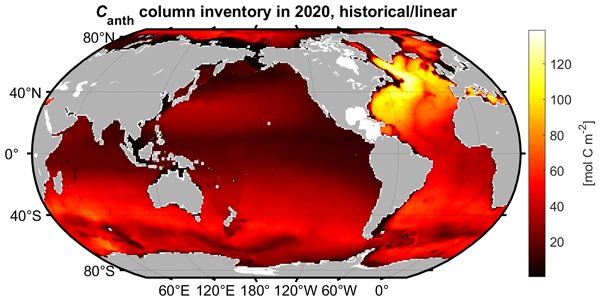
We infer ocean gas exchange and circulation from ocean tracer measurements and use this to create code to estimate the amount of carbon dioxide dissolved in the ocean that is there due to human emissions of CO2 into the atmosphere. The code works across the ocean depths for the past, present, or future from information about the location, temperature, and salinity of the seawater. We produce a data product with estimates throughout the ocean throughout the last ~300 and the next ~500 years.
Nico Lange, Siv K. Lauvset, Brendan R. Carter, Matthew P. Humphreys, Ryan J. Woosley, Are Olsen, Henry C. Bittig, Alex Kozyr, Marta Álvarez, Kumiko Azetsu-Scott, Susan Becker, Peter J. Brown, Leticia Cotrim da Cunha, Larissa Dias, Mario Hoppema, Masao Ishii, Emil Jeansson, Akihiko Murata, Jens Daniel Müller, Fiz F. Pérez, Carsten Schirnick, Reiner Steinfeldt, Adam Ulfsbo, Anton Velo, and Toste Tanhua
Earth Syst. Sci. Data Discuss., https://doi.org/10.5194/essd-2026-496, https://doi.org/10.5194/essd-2026-496, 2026
Revised manuscript under review for ESSD
Short summary
Short summary
GLODAP is a data product for ocean inorganic carbon and related biogeochemical variables measured by the chemical analysis of water bottle samples from scientific cruises. GLODAPv3 is the third version release of GLODAP. The data that are included have been subjected to extensive quality control, including systematic evaluation of systematic cruise differences. This version contains data from 1181 hydrographic cruises covering the world's oceans from 1972 to 2023.
Hyelim Yoo, Li-Qing Jiang, Chris Langdon, Alex Kozyr, Simone R. Alin, Jose Martin Hernandez Ayon, Kumiko Azetsu-Scott, Leticia Barbero, Nicole Besemer, Albert Boyd, Jean R. Brodeur, Wei-Jun Cai, Brendan R. Carter, Cecilia Chapa, Eugene Colbourne, Jessica N. Cross, Ian Enochs, Leticia Espinosa-Carreon, Richard A. Feely, Karina E. Giesbrecht, Helen Gurney-Smith, Burke Hales, Naomi Harada, James Hooper, Christopher W. Hunt, Debby Ianson, Mike Jankulak, Terrence M. Joyce, Esther G. Kennedy, Brian A. King, Arne Körtzinger, Matthias Lankhorst, Gary Maillet, Derek Manzello, Anna K. McLaskey, Viviane V. Menezes, Nicolas Metzl, Christine Michel, Natalie M. Monacci, Julio M. Morell, Akihiko Murata, Jan Newton, Emily O'Grady, Ana M. Palacio-Castro, Denis Pierrot, Marc Ringuette, Christopher Sabine, Joseph E. Salisbury, Akash R. Sastri, Ute Schuster, Uwe Send, Ryan Smith, Michel Starr, James H. Swift, Lynne D. Talley, Helmuth Thomas, Douglas W. R. Wallace, Zhaohui Aleck Wang, Rik Wanninkhof, Chi S. Wong, Patricia L. Yager, and Igor Yashayaev
Earth Syst. Sci. Data Discuss., https://doi.org/10.5194/essd-2026-516, https://doi.org/10.5194/essd-2026-516, 2026
Preprint under review for ESSD
Short summary
Short summary
The coastal Ocean Data Analysis Product in North America (CODAP-NA, Version 2026) substantially increased both the spatial and temporal coverage of coastal biogeochemical measurements across North American continental shelves. This version comprises 446 cruises, 31,864 hydrographic profiles, and 195,489 discrete data records covering continental shelf environments from Alaska to Mexico in the west and from Canada to the Caribbean in the east from 1981 to 2024.
Matthew P. Humphreys, Siv K. Lauvset, Nico Lange, Henry C. Bittig, Brendan R. Carter, Mario Hoppema, Akihiko Murata, Are Olsen, Toste Tanhua, Adam Ulfsbo, Antón Velo, Ryan J. Woosley, Kumiko Azetsu-Scott, Jens D. Müller, and Fiz F. Pérez
EGUsphere, https://doi.org/10.5194/egusphere-2026-3063, https://doi.org/10.5194/egusphere-2026-3063, 2026
Short summary
Short summary
The Global Ocean Data Analysis Project (GLODAP) collects oceanographic datasets from research cruises that are needed to study the marine carbon cycle. The datasets are quality controlled and adjusted where necessary to ensure consistency between cruises, and published as a global data product. Here, we present a new method for calculating the consistency adjustments called ‘furthest-first inversion’ which has been developed for the newest version of the data product.
Li-Qing Jiang, Amanda Fay, Jens Daniel Müller, Luke Gregor, Alizée Roobaert, Lydia Keppler, Dustin Carroll, Siv K. Lauvset, Tim DeVries, Judith Hauck, Christian Rödenbeck, Nicolas Metzl, Andrea J. Fassbender, Jean-Pierre Gattuso, Peter Landschützer, Rik Wanninkhof, Christopher Sabine, Simone R. Alin, Mario Hoppema, Are Olsen, Matthew P. Humphreys, Kunal Chakraborty, Ana C. Franco, Kumiko Azetsu-Scott, Dorothee C. E. Bakker, Leticia Barbero, Nicholas R. Bates, Nicole Besemer, Henry C. Bittig, Albert E. Boyd, Daniel Broullón, Wei-Jun Cai, Brendan R. Carter, Thi-Tuyet-Trang Chau, Chen-Tung Arthur Chen, Frédéric Cyr, John E. Dore, Ian Enochs, Richard A. Feely, Hernan E. Garcia, Marion Gehlen, Prasanna Kanti Ghoshal, Lucas Gloege, Melchor González-Dávila, Nicolas Gruber, Debby Ianson, Yosuke Iida, Masao Ishii, Apurva Padamnabh Joshi, Esther Kennedy, Alex Kozyr, Nico Lange, Claire Lo Monaco, Derek P. Manzello, Galen A. McKinley, Natalie M. Monacci, Xose A. Padin, Ana M. Palacio-Castro, Fiz F. Pérez, J. Magdalena Santana-Casiano, Jonathan Sharp, Adrienne Sutton, Jim Swift, Toste Tanhua, Maciej Telszewski, Jens Terhaar, Ruben van Hooidonk, Anton Velo, Andrew J. Watson, Angelicque E. White, Zelun Wu, Liang Xue, Hyelim Yoo, Jiye Zeng, and Guorong Zhong
Earth Syst. Sci. Data, 18, 1405–1462, https://doi.org/10.5194/essd-18-1405-2026, https://doi.org/10.5194/essd-18-1405-2026, 2026
Short summary
Short summary
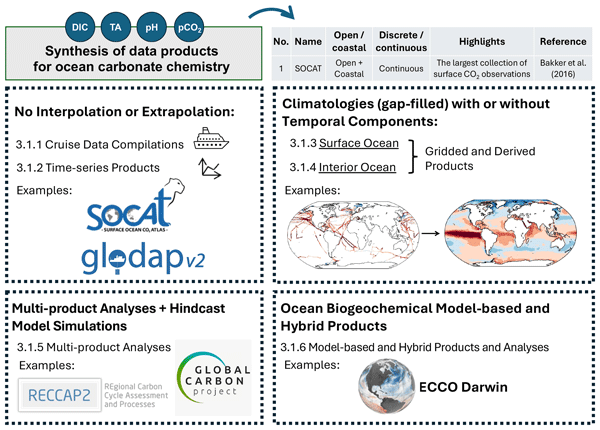
This review article provides an overview of 68 existing ocean carbonate chemistry data products and data product sets, encompassing a broad range of types, including compilations of cruise datasets, gap-filled observational products, model simulations, and more. It is designed to help researchers identify and access the data products that best support their scientific objectives, thereby facilitating progress in understanding the ocean's changing carbonate chemistry.
Larissa M. Dias and Brendan R. Carter
Geosci. Model Dev., 18, 7275–7295, https://doi.org/10.5194/gmd-18-7275-2025, https://doi.org/10.5194/gmd-18-7275-2025, 2025
Short summary
Short summary
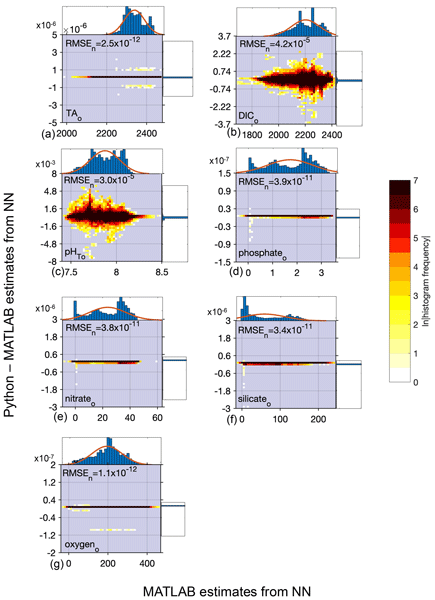
The increasing availability of oceanographic physical and chemical data necessitates accompanying methods for optimizing use of these data. This project produced algorithms (PyESPERs) for estimating biogeochemical seawater properties in Python, a freely available coding language. These algorithms were based on empirical seawater property estimation routines (ESPERs), which were originally written in the proprietary MATLAB coding language and can be used in studies of marine carbonate chemistry.
Brendan R. Carter, Jörg Schwinger, Rolf Sonnerup, Andrea J. Fassbender, Jonathan D. Sharp, Larissa M. Dias, and Daniel E. Sandborn
Earth Syst. Sci. Data, 17, 3073–3088, https://doi.org/10.5194/essd-17-3073-2025, https://doi.org/10.5194/essd-17-3073-2025, 2025
Short summary
Short summary
We infer ocean gas exchange and circulation from ocean tracer measurements and use this to create code to estimate the amount of carbon dioxide dissolved in the ocean that is there due to human emissions of CO2 into the atmosphere. The code works across the ocean depths for the past, present, or future from information about the location, temperature, and salinity of the seawater. We produce a data product with estimates throughout the ocean throughout the last ~300 and the next ~500 years.
Mallory C. Ringham, Nathan Hirtle, Cody Shaw, Xi Lu, Julian Herndon, Brendan R. Carter, and Matthew D. Eisaman
Biogeosciences, 21, 3551–3570, https://doi.org/10.5194/bg-21-3551-2024, https://doi.org/10.5194/bg-21-3551-2024, 2024
Short summary
Short summary
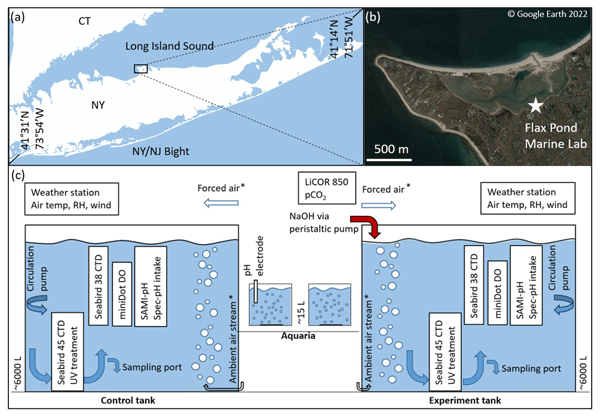
Ocean alkalinity enhancement leverages the large surface area and carbon storage capacity of the oceans to store atmospheric CO2 as dissolved bicarbonate. We monitored CO2 uptake in seawater treated with NaOH to establish operational boundaries for carbon removal experiments. Results show that CO2 equilibration occurred on the order of weeks to months, was consistent with values expected from equilibration calculations, and was limited by mineral precipitation at high pH and CaCO3 saturation.
Li-Qing Jiang, Tim P. Boyer, Christopher R. Paver, Hyelim Yoo, James R. Reagan, Simone R. Alin, Leticia Barbero, Brendan R. Carter, Richard A. Feely, and Rik Wanninkhof
Earth Syst. Sci. Data, 16, 3383–3390, https://doi.org/10.5194/essd-16-3383-2024, https://doi.org/10.5194/essd-16-3383-2024, 2024
Short summary
Short summary
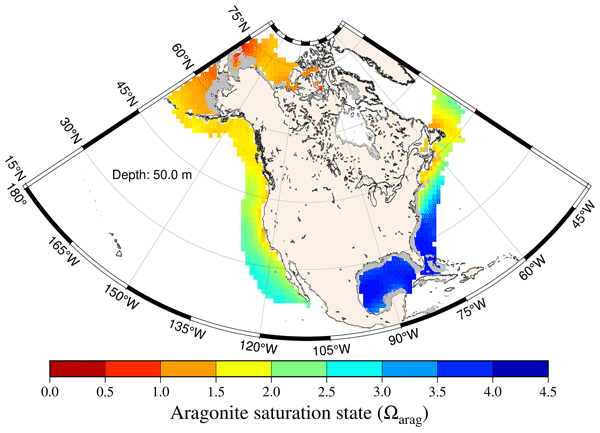
In this paper, we unveil a data product featuring ten coastal ocean acidification variables. These indicators are provided on 1°×1° spatial grids at 14 standardized depth levels, ranging from the surface to a depth of 500 m, along the North American ocean margins.

Siv K. Lauvset, Nico Lange, Toste Tanhua, Henry C. Bittig, Are Olsen, Alex Kozyr, Marta Álvarez, Kumiko Azetsu-Scott, Peter J. Brown, Brendan R. Carter, Leticia Cotrim da Cunha, Mario Hoppema, Matthew P. Humphreys, Masao Ishii, Emil Jeansson, Akihiko Murata, Jens Daniel Müller, Fiz F. Pérez, Carsten Schirnick, Reiner Steinfeldt, Toru Suzuki, Adam Ulfsbo, Anton Velo, Ryan J. Woosley, and Robert M. Key
Earth Syst. Sci. Data, 16, 2047–2072, https://doi.org/10.5194/essd-16-2047-2024, https://doi.org/10.5194/essd-16-2047-2024, 2024
Short summary
Short summary
GLODAP is a data product for ocean inorganic carbon and related biogeochemical variables measured by the chemical analysis of water bottle samples from scientific cruises. GLODAPv2.2023 is the fifth update of GLODAPv2 from 2016. The data that are included have been subjected to extensive quality controlling, including systematic evaluation of measurement biases. This version contains data from 1108 hydrographic cruises covering the world's oceans from 1972 to 2021.
Simone R. Alin, Jan A. Newton, Richard A. Feely, Dana Greeley, Beth Curry, Julian Herndon, and Mark Warner
Earth Syst. Sci. Data, 16, 837–865, https://doi.org/10.5194/essd-16-837-2024, https://doi.org/10.5194/essd-16-837-2024, 2024
Short summary
Short summary
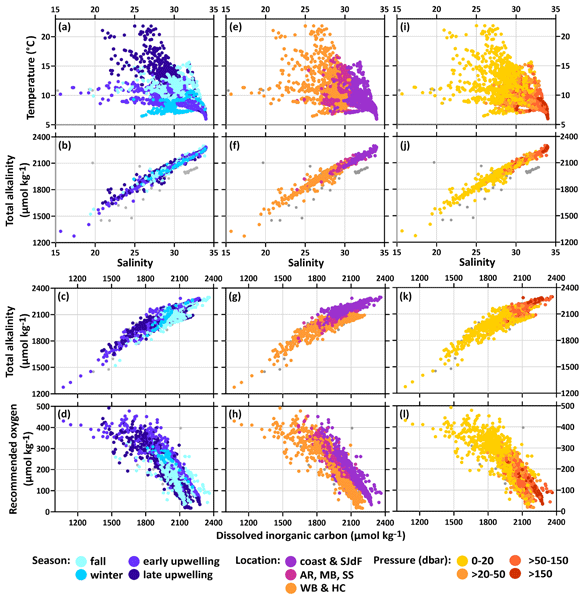
The Salish cruise data product provides 2008–2018 oceanographic data from the southern Salish Sea and nearby coastal sampling stations. Temperature, salinity, oxygen, nutrient, and dissolved inorganic carbon measurements from 715 oceanographic profiles will facilitate further study of ocean acidification, hypoxia, and marine heatwave impacts in this region. Three subsets of the compiled datasets from 35 cruises are available with consistent formatting and multiple commonly used units.
Katja Fennel, Matthew C. Long, Christopher Algar, Brendan Carter, David Keller, Arnaud Laurent, Jann Paul Mattern, Ruth Musgrave, Andreas Oschlies, Josiane Ostiguy, Jaime B. Palter, and Daniel B. Whitt
State Planet, 2-oae2023, 9, https://doi.org/10.5194/sp-2-oae2023-9-2023, https://doi.org/10.5194/sp-2-oae2023-9-2023, 2023
Short summary
Short summary
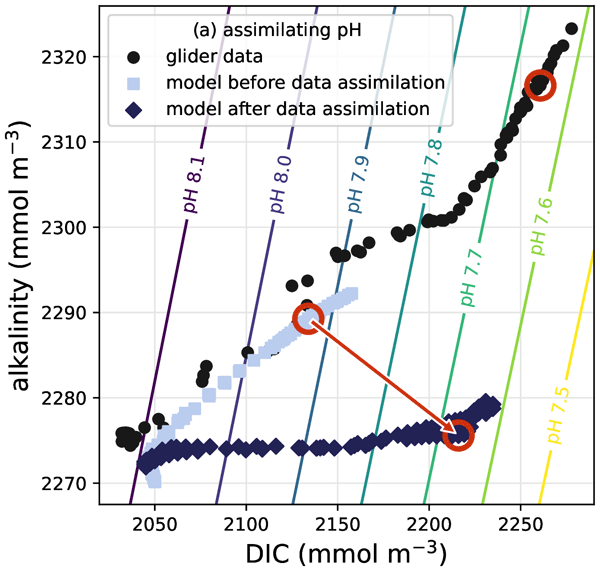
This paper describes biogeochemical models and modelling techniques for applications related to ocean alkalinity enhancement (OAE) research. Many of the most pressing OAE-related research questions cannot be addressed by observation alone but will require a combination of skilful models and observations. We present illustrative examples with references to further information; describe limitations, caveats, and future research needs; and provide practical recommendations.
Jonathan D. Sharp, Andrea J. Fassbender, Brendan R. Carter, Gregory C. Johnson, Cristina Schultz, and John P. Dunne
Earth Syst. Sci. Data, 15, 4481–4518, https://doi.org/10.5194/essd-15-4481-2023, https://doi.org/10.5194/essd-15-4481-2023, 2023
Short summary
Short summary
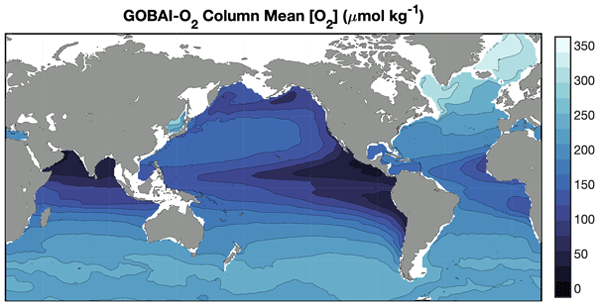
Dissolved oxygen content is a critical metric of ocean health. Recently, expanding fleets of autonomous platforms that measure oxygen in the ocean have produced a wealth of new data. We leverage machine learning to take advantage of this growing global dataset, producing a gridded data product of ocean interior dissolved oxygen at monthly resolution over nearly 2 decades. This work provides novel information for investigations of spatial, seasonal, and interannual variability in ocean oxygen.
Siv K. Lauvset, Nico Lange, Toste Tanhua, Henry C. Bittig, Are Olsen, Alex Kozyr, Simone Alin, Marta Álvarez, Kumiko Azetsu-Scott, Leticia Barbero, Susan Becker, Peter J. Brown, Brendan R. Carter, Leticia Cotrim da Cunha, Richard A. Feely, Mario Hoppema, Matthew P. Humphreys, Masao Ishii, Emil Jeansson, Li-Qing Jiang, Steve D. Jones, Claire Lo Monaco, Akihiko Murata, Jens Daniel Müller, Fiz F. Pérez, Benjamin Pfeil, Carsten Schirnick, Reiner Steinfeldt, Toru Suzuki, Bronte Tilbrook, Adam Ulfsbo, Anton Velo, Ryan J. Woosley, and Robert M. Key
Earth Syst. Sci. Data, 14, 5543–5572, https://doi.org/10.5194/essd-14-5543-2022, https://doi.org/10.5194/essd-14-5543-2022, 2022
Short summary
Short summary
GLODAP is a data product for ocean inorganic carbon and related biogeochemical variables measured by the chemical analysis of water bottle samples from scientific cruises. GLODAPv2.2022 is the fourth update of GLODAPv2 from 2016. The data that are included have been subjected to extensive quality controlling, including systematic evaluation of measurement biases. This version contains data from 1085 hydrographic cruises covering the world's oceans from 1972 to 2021.
Jonathan D. Sharp, Andrea J. Fassbender, Brendan R. Carter, Paige D. Lavin, and Adrienne J. Sutton
Earth Syst. Sci. Data, 14, 2081–2108, https://doi.org/10.5194/essd-14-2081-2022, https://doi.org/10.5194/essd-14-2081-2022, 2022
Short summary
Short summary
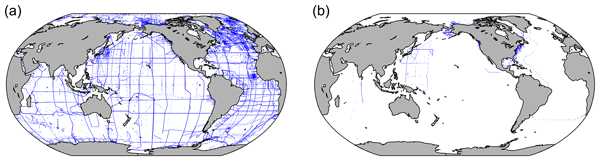
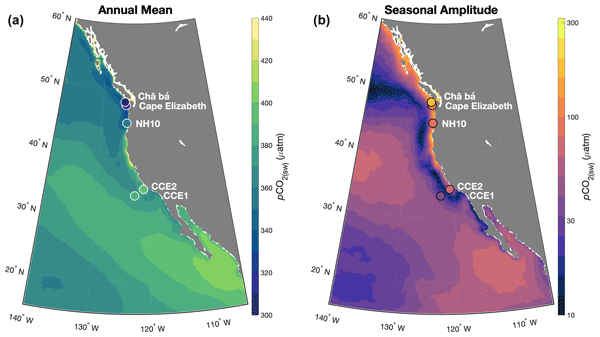
Oceanographers calculate the exchange of carbon between the ocean and atmosphere by comparing partial pressures of carbon dioxide (pCO2). Because seawater pCO2 is not measured everywhere at all times, interpolation schemes are required to fill observational gaps. We describe a monthly gap-filled dataset of pCO2 in the northeast Pacific Ocean off the west coast of North America created by machine-learning interpolation. This dataset is unique in its robust representation of coastal seasonality.
Siv K. Lauvset, Nico Lange, Toste Tanhua, Henry C. Bittig, Are Olsen, Alex Kozyr, Marta Álvarez, Susan Becker, Peter J. Brown, Brendan R. Carter, Leticia Cotrim da Cunha, Richard A. Feely, Steven van Heuven, Mario Hoppema, Masao Ishii, Emil Jeansson, Sara Jutterström, Steve D. Jones, Maren K. Karlsen, Claire Lo Monaco, Patrick Michaelis, Akihiko Murata, Fiz F. Pérez, Benjamin Pfeil, Carsten Schirnick, Reiner Steinfeldt, Toru Suzuki, Bronte Tilbrook, Anton Velo, Rik Wanninkhof, Ryan J. Woosley, and Robert M. Key
Earth Syst. Sci. Data, 13, 5565–5589, https://doi.org/10.5194/essd-13-5565-2021, https://doi.org/10.5194/essd-13-5565-2021, 2021
Short summary
Short summary
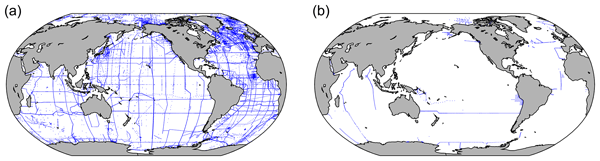
GLODAP is a data product for ocean inorganic carbon and related biogeochemical variables measured by the chemical analysis of water bottle samples from scientific cruises. GLODAPv2.2021 is the third update of GLODAPv2 from 2016. The data that are included have been subjected to extensive quality control, including systematic evaluation of measurement biases. This version contains data from 989 hydrographic cruises covering the world's oceans from 1972 to 2020.
Cited articles
Archer, D., Kheshgi, H., and Maier-Reimer, E.: Dynamics of Fossil Fuel CO2 Neutralization by Marine CaCO3, Global Biogeochem. Cy., 12, 259–276, https://doi.org/10.1029/98GB00744, 1998. a
Barker, P. M. and McDougall, T. J.: Two Interpolation Methods Using Multiply-Rotated Piecewise Cubic Hermite Interpolating Polynomials, J. Atmos. Ocean. Tech., 37, 605–619, https://doi.org/10.1175/JTECH-D-19-0211.1, 2020. a
Bronselaer, B., Winton, M., Russell, J., Sabine, C. L., and Khatiwala, S.: Agreement of CMIP5 Simulated and Observed Ocean Anthropogenic CO2 Uptake, Geophys. Res. Lett., 44, https://doi.org/10.1002/2017gl074435, 2017. a
Bullister, J. L. and Warner, M. J.: Atmospheric Histories (1765–2022) for CFC-11, CFC-12, CFC-113, CCl4, SF6 and N2O (NCEI Accession 0164584), https://doi.org/10.3334/CDIAC/OTG.CFC_ATM_HIST_2015, 2017. a
Carter, B. R.: Anthropogenic Carbon Distributions from Preindustrial to 2500 c.e. Estimated Using Tracer-based Rapid Anthropogenic Carbon Estimation (Version 1), Zenodo [data set], https://doi.org/10.5281/ZENODO.15003059, 2025a. a
Carter, B. R.: BRCScienceProducts/TRACEv1: TRACEv1_publication, Zenodo [code], https://doi.org/10.5281/ZENODO.15692788, 2025b. a, b
Carter, B. R., Feely, R. A., Williams, N. L., Dickson, A. G., Fong, M. B., and Takeshita, Y.: Updated Methods for Global Locally Interpolated Estimation of Alkalinity, pH, and Nitrate, Limnol. Ocean Meth., 16, 119–131, https://doi.org/10.1002/lom3.10232, 2017. a
Carter, B. R., Bittig, H. C., Fassbender, A. J., Sharp, J. D., Takeshita, Y., Xu, Y.-Y., Álvarez, M., Wanninkhof, R., Feely, R. A., and Barbero, L.: New and Updated Global Empirical Seawater Property Estimation Routines, Limnol. Oceanogr. Meth., lom3.10461, https://doi.org/10.1002/lom3.10461, 2021a. a, b, c
Carter, B. R., Feely, R. A., Lauvset, S. K., Olsen, A., DeVries, T., and Sonnerup, R.: Preformed Properties for Marine Organic Matter and Carbonate Mineral Cycling Quantification, Global Biogeochem. Cy., 35, https://doi.org/10.1029/2020GB006623, 2021b. a, b
CCHDO Hydrographic Data Office: CCHDO Hydrographic Data Archive, https://doi.org/10.6075/J0CCHAM8, 2023. a
Clement, D. and Gruber, N.: The eMLR(C*) Method to Determine Decadal Changes in the Global Ocean Storage of Anthropogenic CO2, Global Biogeochem. Cy., 32, 654–679, https://doi.org/10.1002/2017GB005819, 2018. a
Davila, X., Gebbie, G., Brakstad, A., Lauvset, S. K., McDonagh, E. L., Schwinger, J., and Olsen, A.: How Is the Ocean Anthropogenic Carbon Reservoir Filled?, Global Biogeochem. Cy., 36, e2021GB007055, https://doi.org/10.1029/2021GB007055, 2022. a, b, c
DeVries, T.: The Oceanic Anthropogenic CO2 Sink: Storage, Air-sea Fluxes, and Transports over the Industrial Era, Global Biogeochem. Cy., 28, 631–647, https://doi.org/10.1002/2013GB004739, 2014. a, b, c, d
DeVries, T., Yamamoto, K., Wanninkhof, R., Gruber, N., Hauck, J., Müller, J. D., Bopp, L., Carroll, D., Carter, B., Chau, T.-T.-T., Doney, S. C., Gehlen, M., Gloege, L., Gregor, L., Henson, S., Kim, J. H., Iida, Y., Ilyina, T., Landschützer, P., Le Quéré, C., Munro, D., Nissen, C., Patara, L., Pérez, F. F., Resplandy, L., Rodgers, K. B., Schwinger, J., Séférian, R., Sicardi, V., Terhaar, J., Triñanes, J., Tsujino, H., Watson, A., Yasunaka, S., and Zeng, J.: Magnitude, Trends, and Variability of the Global Ocean Carbon Sink From 1985 to 2018, Global Biogeochem. Cy., 37, e2023GB007780, https://doi.org/10.1029/2023GB007780, 2023. a, b
Dias, L. M. and Carter, B. R.: PyESPERv1.0.0: A Python Implementation of Empirical Seawater Property Estimation Routines (ESPERs), Geosci. Model Dev., 18, 7275–7295, https://doi.org/10.5194/gmd-18-7275-2025, 2025. a, b
Doney, S. C., Busch, D. S., Cooley, S. R., and Kroeker, K. J.: The Impacts of Ocean Acidification on Marine Ecosystems and Reliant Human Communities, Annu. Rev. Environ. Resour., 45, 83–112, https://doi.org/10.1146/annurev-environ-012320-083019, 2020. a
Fay, A. R. and McKinley, G. A.: Global Open-Ocean Biomes: Mean and Temporal Variability, Earth Syst. Sci. Data, 6, 273–284, https://doi.org/10.5194/essd-6-273-2014, 2014. a, b, c
Fay, A. R., Gregor, L., Landschützer, P., McKinley, G. A., Gruber, N., Gehlen, M., Iida, Y., Laruelle, G. G., Rödenbeck, C., Roobaert, A., and Zeng, J.: SeaFlux: Harmonization of Air–Sea CO2 Fluxes from Surface pCO2 data Products Using a Standardized Approach, Earth Syst. Sci. Data, 13, 4693–4710, https://doi.org/10.5194/essd-13-4693-2021, 2021. a
Firing, E., Filipe, Barna, A., and Abernathey, R.: TEOS-10/GSW-Python: V3.4.1, Zenodo [code], https://doi.org/10.5281/zenodo.4631364, 2021. a
Friedlingstein, P., O'Sullivan, M., Jones, M. W., Andrew, R. M., Bakker, D. C. E., Hauck, J., Landschützer, P., Le Quéré, C., Luijkx, I. T., Peters, G. P., Peters, W., Pongratz, J., Schwingshackl, C., Sitch, S., Canadell, J. G., Ciais, P., Jackson, R. B., Alin, S. R., Anthoni, P., Barbero, L., Bates, N. R., Becker, M., Bellouin, N., Decharme, B., Bopp, L., Brasika, I. B. M., Cadule, P., Chamberlain, M. A., Chandra, N., Chau, T.-T.-T., Chevallier, F., Chini, L. P., Cronin, M., Dou, X., Enyo, K., Evans, W., Falk, S., Feely, R. A., Feng, L., Ford, D. J., Gasser, T., Ghattas, J., Gkritzalis, T., Grassi, G., Gregor, L., Gruber, N., Gürses, Ö., Harris, I., Hefner, M., Heinke, J., Houghton, R. A., Hurtt, G. C., Iida, Y., Ilyina, T., Jacobson, A. R., Jain, A., Jarníková, T., Jersild, A., Jiang, F., Jin, Z., Joos, F., Kato, E., Keeling, R. F., Kennedy, D., Klein Goldewijk, K., Knauer, J., Korsbakken, J. I., Körtzinger, A., Lan, X., Lefèvre, N., Li, H., Liu, J., Liu, Z., Ma, L., Marland, G., Mayot, N., McGuire, P. C., McKinley, G. A., Meyer, G., Morgan, E. J., Munro, D. R., Nakaoka, S.-I., Niwa, Y., O'Brien, K. M., Olsen, A., Omar, A. M., Ono, T., Paulsen, M., Pierrot, D., Pocock, K., Poulter, B., Powis, C. M., Rehder, G., Resplandy, L., Robertson, E., Rödenbeck, C., Rosan, T. M., Schwinger, J., Séférian, R., Smallman, T. L., Smith, S. M., Sospedra-Alfonso, R., Sun, Q., Sutton, A. J., Sweeney, C., Takao, S., Tans, P. P., Tian, H., Tilbrook, B., Tsujino, H., Tubiello, F., Van Der Werf, G. R., Van Ooijen, E., Wanninkhof, R., Watanabe, M., Wimart-Rousseau, C., Yang, D., Yang, X., Yuan, W., Yue, X., Zaehle, S., Zeng, J., and Zheng, B.: Global Carbon Budget 2023, Earth Syst. Sci. Data, 15, 5301–5369, https://doi.org/10.5194/essd-15-5301-2023, 2023. a
Fritsch, F. N. and Carlson, R. E.: Monotone Piecewise Cubic Interpolation, SIAM J. Numer. Anal., 17, 238–246, https://doi.org/10.1137/0717021, 1980. a
Gregor, L. and Humphreys, M. P.: SeaFlux: Updated Continuous Integration and Docs, Zenodo [code], https://doi.org/10.5281/ZENODO.4659162, 2021. a
Gruber, N., Sarmiento, J. L., and Stocker, T. F.: An Improved Method for Detecting Anthropogenic CO2 in the Oceans, Global Biogeochem. Cy., 10, 809–837, https://doi.org/10.1029/96GB01608, 1996. a
Gruber, N., Clement, D., Carter, B. R., Feely, R. A., Van Heuven, S., Hoppema, M., Ishii, M., Key, R. M., Kozyr, A., Lauvset, S. K., Lo Monaco, C., Mathis, J. T., Murata, A., Olsen, A., Perez, F. F., Sabine, C. L., Tanhua, T., and Wanninkhof, R.: The Oceanic Sink for Anthropogenic CO2 from 1994 to 2007, Science, 363, 1193–1199, https://doi.org/10.1126/science.aau5153, 2019. a
Haine, T. W. N., Griffies, S. M., Gebbie, G., and Jiang, W.: A Review of Green's Function Methods for Tracer Timescales and Pathways in Ocean Models, J. Adv. Model. Earth Syst., 17, e2024MS004637, https://doi.org/10.1029/2024MS004637, 2025. a
Hall, T. M., Haine, T. W. N., and Waugh, D. W.: Inferring the Concentration of Anthropogenic Carbon in the Ocean from Tracers, Global Biogeochem. Cy., 16, https://doi.org/10.1029/2001GB001835, 2002. a, b
Hassell, D., Gregory, J., Blower, J., Lawrence, B. N., and Taylor, K. E.: A Data Model of the Climate and Forecast Metadata Conventions (CF-1.6) with a Software Implementation (Cf-Python v2.1), Geosci. Model Dev., 10, 4619–4646, https://doi.org/10.5194/gmd-10-4619-2017, 2017. a
He, Y.-C., Tjiputra, J., Langehaug, H. R., Jeansson, E., Gao, Y., Schwinger, J., and Olsen, A.: A Model-Based Evaluation of the Inverse Gaussian Transit-Time Distribution Method for Inferring Anthropogenic Carbon Storage in the Ocean, J. Geophys. Res.-Oceans, 123, 1777–1800, https://doi.org/10.1002/2017JC013504, 2018. a, b, c, d
Holzer, M. and Primeau, F. W.: Improved Constraints on Transit Time Distributions from Argon 39: A Maximum Entropy Approach, J. Geophys. Res., 115, 2010JC006410, https://doi.org/10.1029/2010JC006410, 2010. a
Humphreys, M. P., Sandborn, D. E., Gregor, L., Pierrot, D., van Heuven, S. S., Lewis, E., and Wallace, D.: PyCO2SYS: Marine Carbonate System Calculations in Python, Zenodo [code], https://doi.org/10.5281/zenodo.3744275, 2020. a
Humphreys, M. P., Lewis, E. R., Sharp, J. D., and Pierrot, D.: PyCO2SYS v1.8: marine carbonate system calculations in Python, Geosci. Model Dev., 15, 15–43, https://doi.org/10.5194/gmd-15-15-2022, 2022. a, b, c
Jiang, L.-Q., Dunne, J., Carter, B. R., Tjiputra, J. F., Terhaar, J., Sharp, J. D., Olsen, A., Alin, S., Bakker, D. C. E., Feely, R. A., Gattuso, J.-P., Hogan, P., Ilyina, T., Lange, N., Lauvset, S. K., Lewis, E. R., Lovato, T., Palmieri, J., Santana-Falcón, Y., Schwinger, J., Séférian, R., Strand, G., Swart, N., Tanhua, T., Tsujino, H., Wanninkhof, R., Watanabe, M., Yamamoto, A., and Ziehn, T.: Global Surface Ocean Acidification Indicators From 1750 to 2100, J. Adv. Model. Earth Syst., 15, e2022MS003563, https://doi.org/10.1029/2022MS003563, 2023. a
Keeling, R. F. and Keeling, C. D.: Atmospheric Monthly in Situ CO2 Data – Mauna Loa Observatory, Hawaii, UC San Diego [data set], https://doi.org/10.6075/J08W3BHW, 2017. a
Khatiwala, S., Primeau, F., and Hall, T.: Reconstruction of the History of Anthropogenic CO2 Concentrations in the Ocean, Nature, 462, 346–349, https://doi.org/10.1038/nature08526, 2009. a, b, c, d
Khatiwala, S., Tanhua, T., Mikaloff Fletcher, S., Gerber, M., Doney, S. C., Graven, H. D., Gruber, N., McKinley, G. A., Murata, A., Ríos, A. F., and Sabine, C. L.: Global Ocean Storage of Anthropogenic Carbon, Biogeosciences, 10, 2169–2191, https://doi.org/10.5194/bg-10-2169-2013, 2013. a
Lauvset, S. K., Key, R. M., Olsen, A., van Heuven, S., Velo, A., Lin, X., Schirnick, C., Kozyr, A., Tanhua, T., Hoppema, M., Jutterström, S., Steinfeldt, R., Jeansson, E., Ishii, M., Perez, F. F., Suzuki, T., and Watelet, S.: A new global interior ocean mapped climatology: the 1°×1° GLODAP version 2, Earth Syst. Sci. Data, 8, 325–340, https://doi.org/10.5194/essd-8-325-2016, 2016. a, b, c, d, e
Lauvset, S. K., Carter, B. R., Pèrez, F. F., Jiang, L.-Q., Feely, R. A., Velo, A., and Olsen, A.: Processes Driving Global Interior Ocean pH Distribution, Global Biogeochem. Cy., 34, e2019GB006229, https://doi.org/10.1029/2019GB006229, 2020. a
Lauvset, S. K., Lange, N., Tanhua, T., Bittig, H. C., Olsen, A., Kozyr, A., Álvarez, M., Azetsu-Scott, K., Brown, P. J., Carter, B. R., Cotrim Da Cunha, L., Hoppema, M., Humphreys, M. P., Ishii, M., Jeansson, E., Murata, A., Müller, J. D., Pérez, F. F., Schirnick, C., Steinfeldt, R., Suzuki, T., Ulfsbo, A., Velo, A., Woosley, R. J., and Key, R. M.: The Annual Update GLODAPv2.2023: The Global Interior Ocean Biogeochemical Data Product, Earth Syst. Sci. Data, 16, 2047–2072, https://doi.org/10.5194/essd-16-2047-2024, 2024. a, b
Lewis, E. and Wallace, D.: Program Developed for CO2 System Calculations, Tech. Rep. ORNL/CDIAC-105, Oak Ridge Natl. Lab., Oak Ridge, Tenn., https://www.ncei.noaa.gov/access/ocean-carbon-acidification-data-system/oceans/CO2SYS/co2rprt.html (last access: 4 June 2026), 1998. a
Meinshausen, M., Nicholls, Z. R. J., Lewis, J., Gidden, M. J., Vogel, E., Freund, M., Beyerle, U., Gessner, C., Nauels, A., Bauer, N., Canadell, J. G., Daniel, J. S., John, A., Krummel, P. B., Luderer, G., Meinshausen, N., Montzka, S. A., Rayner, P. J., Reimann, S., Smith, S. J., van den Berg, M., Velders, G. J. M., Vollmer, M. K., and Wang, R. H. J.: The Shared Socio-Economic Pathway (SSP) Greenhouse Gas Concentrations and Their Extensions to 2500, Geosci. Model Dev., 13, 3571–3605, https://doi.org/10.5194/gmd-13-3571-2020, 2020. a
Müller, J. D., Gruber, N., Carter, B., Feely, R., Ishii, M., Lange, N., Lauvset, S. K., Murata, A., Olsen, A., Pérez, F. F., Sabine, C., Tanhua, T., Wanninkhof, R., and Zhu, D.: Decadal Trends in the Oceanic Storage of Anthropogenic Carbon From 1994 to 2014, AGU Adv., 4, e2023AV000875, https://doi.org/10.1029/2023AV000875, 2023. a, b, c, d
Orr, J. C., Epitalon, J.-M., and Gattuso, J.-P.: Comparison of Ten Packages That Compute Ocean Carbonate Chemistry, Biogeosciences, 12, 1483–1510, https://doi.org/10.5194/bg-12-1483-2015, 2015. a
Raimondi, L., Wefing, A.-M., and Casacuberta, N.: Anthropogenic Carbon in the Arctic Ocean: Perspectives From Different Transient Tracers, J. Geophys. Res.-Oceans, 129, e2023JC019999, https://doi.org/10.1029/2023JC019999, 2024. a
Romberg, W.: Vereinfachte numerische Integration, Det Kongelige Norske Videnskabers Selskab Forhandlinger, 28, 30–36, 1955. a
Rubino, M., Etheridge, D., Thornton, D., Allison, C., Francey, R., Langenfelds, R., Steele, P., Trudinger, C., Spencer, D., Curran, M., Van Ommen, T., and Smith, A.: Law Dome Ice Core 2000-Year CO2, CH4, N2O and δ13C-CO2, CSIRO [data set], https://doi.org/10.25919/5BFE29FF807FB, 2019. a
Sabine, C. L., Feely, R. A., Gruber, N., Key, R. M., Lee, K., Bullister, J. L., Wanninkhof, R., Wong, C. S., Wallace, D. W. R., Tilbrook, B., Millero, F. J., Peng, T.-H., Kozyr, A., Ono, T., and Rios, A. F.: The Oceanic Sink for Anthropogenic CO2, Science, 305, 367–371, https://doi.org/10.1126/science.1097403, 2004. a, b
Sandborn, D. and Carter, B.: Tracer-Based Rapid Anthropogenic Carbon Estimation (TRACEv0.1.0-Python), Zenodo [code], https://doi.org/10.5281/ZENODO.15597123, 2025. a
Sandborn, D., Carter, B., Warner, M. J., Erickson, Z., and Dias, L.: Global Ocean Anthropogenic Carbon Concentrations from Preindustrial to 2500 c.e. Estimated Using TRACE-Python, Zenodo [data set], https://doi.org/10.5281/zenodo.17246805, 2025a. a, b, c
Sandborn, D., Barrett, R., and Carter, B.: d-sandborn/TRACE: Tracer-based Rapid Anthropogenic Carbon Estimation (TRACE) (v1.0.0), Zenodo [code], https://doi.org/10.5281/zenodo.17822675, 2025b a
Sharp, J. D., Pierrot, D., Humphreys, M. P., Epitalon, J.-M., Orr, J. C., Lewis, E. R., and Wallace, D. W.: CO2SYSv3 for MATLAB, Zenodo [code], https://doi.org/10.5281/ZENODO.3952803, 2020. a
Sonnerup, R. E., Mecking, S., Bullister, J. L., and Warner, M. J.: Transit Time Distributions and Oxygen Utilization Rates from Chlorofluorocarbons and Sulfur Hexafluoride in the Southeast Pacific Ocean, J. Geophys. Res.-Oceans, 120, 3761–3776, https://doi.org/10.1002/2015JC010781, 2015. a, b, c
Stöven, T., Tanhua, T., Hoppema, M., and Bullister, J. L.: Perspectives of Transient Tracer Applications and Limiting Cases, Ocean Sci., 11, 699–718, https://doi.org/10.5194/os-11-699-2015, 2015. a, b
Terhaar, J., Goris, N., Müller, J. D., DeVries, T., Gruber, N., Hauck, J., Perez, F. F., and Séférian, R.: Assessment of Global Ocean Biogeochemistry Models for Ocean Carbon Sink Estimates in RECCAP2 and Recommendations for Future Studies, J. Adv. Model. Earth Syst., 16, e2023MS003840, https://doi.org/10.1029/2023MS003840, 2024. a
van Heuven, S., Pierrot, D., Rae, J., Lewis, E., and Wallace, D.: CO2SYSv1.1, MATLAB Program Developed for CO2 System Calculations, ORNL/CDIAC-105b. Carbon Dioxide Information Analysis Center, Oak Ridge National Laboratory, US DoE, Oak Ridge, TN, https://www.ncei.noaa.gov/access/ocean-carbon-acidification-data-system/oceans/CO2SYS/co2rprt.html (last access: 4 June 2026), 2011. a
Waugh, D. W., Hall, T. M., and Haine, T. W. N.: Relationships among Tracer Ages, J. Geophys. Res., 108, 2002JC001325, https://doi.org/10.1029/2002JC001325, 2003. a, b
Waugh, D. W., Hall, T. M., McNeil, B. I., Key, R., and Matear, R. J.: Anthropogenic CO2 in the Oceans Estimated Using Transit Time Distributions, Tellus B, 58, 376, https://doi.org/10.1111/j.1600-0889.2006.00222.x, 2006. a, b
Short summary
We present a new implementation of our method for estimation of human-created carbon dioxide in the ocean.
Tracer-based Rapid Anthropogenic Carbon Estimationrelies on transient tracer measurements to infer gas exchange and circulation. Our work implements practical and fundamental improvements increasing accessibility, flexibility, and skill of the method. We provide an updated data product of global ocean carbon inventories spanning the industrial era and a range of future projections.
We present a new implementation of our method for estimation of human-created carbon dioxide in...


