
Articles | Volume 19, issue 12
https://doi.org/10.5194/gmd-19-5781-2026
© Author(s) 2026. This work is distributed under
the Creative Commons Attribution 4.0 License.
the Creative Commons Attribution 4.0 License.
https://doi.org/10.5194/gmd-19-5781-2026
© Author(s) 2026. This work is distributed under
the Creative Commons Attribution 4.0 License.
the Creative Commons Attribution 4.0 License.
Development and technical paper
| 
01 Jul 2026
Development and technical paper |
| 01 Jul 2026
| 01 Jul 2026
Pre-training for deep statistical climate downscaling: enhancing consistency and robustness across regional datasets
Jose González-Abad
CORRESPONDING AUTHOR
Instituto de Física de Cantabria (IFCA), CSIC-Universidad de Cantabria, Santander, Spain
Maialen Iturbide
Instituto de Física de Cantabria (IFCA), CSIC-Universidad de Cantabria, Santander, Spain
Alfonso Hernanz
Spanish Meteorological Agency (AEMET), Madrid, Spain
José Manuel Gutiérrez
Instituto de Física de Cantabria (IFCA), CSIC-Universidad de Cantabria, Santander, Spain
Related authors

Jorge Baño-Medina, Rodrigo Manzanas, Ezequiel Cimadevilla, Jesús Fernández, Jose González-Abad, Antonio S. Cofiño, and José Manuel Gutiérrez
Geosci. Model Dev., 15, 6747–6758, https://doi.org/10.5194/gmd-15-6747-2022, https://doi.org/10.5194/gmd-15-6747-2022, 2022
Short summary
Short summary
Deep neural networks are used to produce downscaled regional climate change projections over Europe for temperature and precipitation for the first time. The resulting dataset, DeepESD, is analyzed against state-of-the-art downscaling methodologies, reproducing more accurately the observed climate in the historical period and showing plausible future climate change signals with low computational requirements.
Carlos Correa, Alfonso Hernanz, Iván San-Felipe, and Esteban Rodríguez-Guisado
Hydrol. Earth Syst. Sci., 30, 4457–4480, https://doi.org/10.5194/hess-30-4457-2026, https://doi.org/10.5194/hess-30-4457-2026, 2026
Short summary
Short summary
Heavy rainfall over short periods can cause floods and damage in cities, yet rainfall is often only measured daily. We developed a new method to generate realistic hourly rainfall data from daily values, using information from many weather stations in Spain and the United States. Our approach reproduces extreme rainfall more accurately than existing methods, helping to improve flood risk studies, infrastructure design, and climate impact assessments.

Óscar Mirones, Joaquín Bedia, Sixto Herrera, Maialen Iturbide, and Jorge Baño Medina
Hydrol. Earth Syst. Sci., 29, 799–822, https://doi.org/10.5194/hess-29-799-2025, https://doi.org/10.5194/hess-29-799-2025, 2025
Short summary
Short summary
We devised an adaptive method for calibrating remote sensing precipitation in the South Pacific. By classifying data into weather types and applying varied techniques, we achieve improved calibration. Results showed enhanced accuracy in mean and extreme precipitation indices across locations. The method offers customization options and effectively addresses intense rainfall events. Its versatility allows for application in diverse scenarios, supporting a better understanding of climate impacts.
Jorge Tamayo, Ernesto Rodriguez-Camino, Alfonso Hernanz, and Sara Covaleda
Adv. Sci. Res., 19, 105–115, https://doi.org/10.5194/asr-19-105-2022, https://doi.org/10.5194/asr-19-105-2022, 2022
Short summary
Short summary
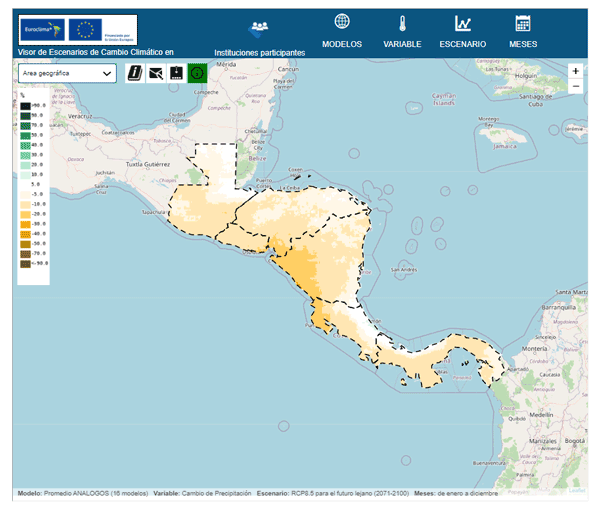
There has been developed for Central America downscaled climate change scenarios using the same methodology, that allows a joint analysis for the whole region. The high number of simulations improves the situation prior to the start of the action, where each country had a limited number of projections that differed in terms of background information, methodology and resolution. A web based viewer allows consultations and download on 37 different climatic variables and derived indices.
Jorge Baño-Medina, Rodrigo Manzanas, Ezequiel Cimadevilla, Jesús Fernández, Jose González-Abad, Antonio S. Cofiño, and José Manuel Gutiérrez
Geosci. Model Dev., 15, 6747–6758, https://doi.org/10.5194/gmd-15-6747-2022, https://doi.org/10.5194/gmd-15-6747-2022, 2022
Short summary
Short summary
Deep neural networks are used to produce downscaled regional climate change projections over Europe for temperature and precipitation for the first time. The resulting dataset, DeepESD, is analyzed against state-of-the-art downscaling methodologies, reproducing more accurately the observed climate in the historical period and showing plausible future climate change signals with low computational requirements.
Cited articles
Addison, H., Kendon, E., Ravuri, S., Aitchison, L., and Watson, P. A.: Machine learning emulation of precipitation from km-scale regional climate simulations using a diffusion model, arXiv [preprint], https://doi.org/10.48550/arXiv.2407.14158, 2024. a
Agrawal, P., Girshick, R., and Malik, J.: Analyzing the performance of multilayer neural networks for object recognition, in: Computer Vision–ECCV 2014: 13th European Conference, Zurich, Switzerland, 6–12 September 2014, Proceedings, Part VII 13, Springer, 329–344, https://doi.org/10.1007/978-3-319-10584-0_22, 2014. a
Amblar-Francés, M. P., Ramos-Calzado, P., Sanchis-Lladó, J., Hernanz-Lázaro, A., Peral-García, M. C., Navascués, B., Dominguez-Alonso, M., Pastor-Saavedra, M. A., and Rodríguez-Camino, E.: High resolution climate change projections for the Pyrenees region, Adv. Sci. Res., 17, 191–208, 2020. a
Arrieta, A. B., Díaz-Rodríguez, N., Del Ser, J., Bennetot, A., Tabik, S., Barbado, A., García, S., Gil-López, S., Molina, D., Benjamins, R., Chatila, R., and Herrera, F.: Explainable Artificial Intelligence (XAI): concepts, taxonomies, opportunities and challenges toward responsible AI, Inform. Fusion, 58, 82–115, 2020. a, b
Baño-Medina, J.: Understanding deep learning decisions in statistical downscaling models, in: Proceedings of the 10th International Conference on Climate Informatics, CI2020, Association for Computing Machinery, New York, NY, USA, https://doi.org/10.1145/3429309.3429321, 79–85, 2021. a, b
Baño-Medina, J., Manzanas, R., and Gutiérrez, J. M.: Configuration and intercomparison of deep learning neural models for statistical downscaling, Geosci. Model Dev., 13, 2109–2124, https://doi.org/10.5194/gmd-13-2109-2020, 2020. a, b, c
Baño-Medina, J., Manzanas, R., Cimadevilla, E., Fernández, J., González-Abad, J., Cofiño, A. S., and Gutiérrez, J. M.: Downscaling multi-model climate projection ensembles with deep learning (DeepESD): contribution to CORDEX EUR-44, Geosci. Model Dev., 15, 6747–6758, https://doi.org/10.5194/gmd-15-6747-2022, 2022. a, b, c, d
Baño-Medina, J., Iturbide, M., Fernández, J., and Gutiérrez, J. M.: Transferability and explainability of deep learning emulators for regional climate model projections: Perspectives for future applications, arXiv [preprint], https://doi.org/10.48550/arXiv.2311.03378, 2023. a, b, c
Basque Government: Klimatek: Downscaled Climate Change Scenarios for the Basque Autonomous Community, Technical report, Basque Government – Ihobe, https://www.euskadi.eus/contenidos/documentacion/escenarios_cc/es_def/adjuntos/Klimatek-2020.pdf (last access: 26 January 2026), 2020. a
Bengio, Y., Lamblin, P., Popovici, D., and Larochelle, H.: Greedy layer-wise training of deep networks, Adv. Neur. In., 19, 153–160, 2006. a
Bishop, C. M. and Nasrabadi, N. M.: Pattern Recognition and Machine Learning, Springer, ISBN 978-0-387-31073-2, 2006. a
Bodnar, C., Bruinsma, W. P., Lucic, A., Stanley, M., Allen, A., Brandstetter, J., Garvan, P., Riechert, M., Weyn, J. A., Dong, H., Gupta, J. K., Thambiratnam, K., Archibald, A. T., Wu, C.-C., Heider, E., Welling, M., Turner, R. E., and Perdikaris, P.: A foundation model for the Earth system, Nature 641, 1180–1187, https://doi.org/10.1038/s41586-025-09005-y, 2025. a, b
Bommasani, R., Hudson, D. A., Adeli, E., Altman, R., Arora, S., von Arx, S., Bernstein, M. S., Bohg, J., Bosselut, A., Brunskill, E., Brynjolfsson, E., Buch, S., Card, D., Castellon, R., Chatterji, N., Chen, A., Creel, K., Davis, J. Q., Demszky, D., Donahue, C., Doumbouya, M., Durmus, E., Ermon, S., Etchemendy, J., Ethayarajh, K., Fei-Fei, L., Finn, C., Gale, T., Gillespie, L., Goel, K., Goodman, N., Grossman, S., Guha, N., Hashimoto, T., Henderson, P., Hewitt, J., Ho, D. E., Hong, J., Hsu, K., Huang, J., Icard, T., Jain, S., Jurafsky, D., Kalluri, P., Karamcheti, S., Keeling, G., Khani, F., Khattab, O., Koh, P. W., Krass, M., Krishna, R., Kuditipudi, R., Kumar, A., Ladhak, F., Lee, M., Lee, T., Leskovec, J., Levent, I., Li, X. L., Li, X., Ma, T., Malik, A., Manning, C. D., Mirchandani, S., Mitchell, E., Munyikwa, Z., Nair, S., Narayan, A., Narayanan, D., Newman, B., Nie, A., Niebles, J. C., Nilforoshan, H., Nyarko, J., Ogut, G., Orr, L., Papadimitriou, I., Park, J. S., Piech, C., Portelance, E., Potts, C., Raghunathan, A., Reich, R., Ren, H., Rong, F., Roohani, Y., Ruiz, C., Ryan, J., Ré, C., Sadigh, D., Sagawa, S., Santhanam, K., Shih, A., Srinivasan, K., Tamkin, A., Taori, R., Thomas, A. W., Tramèr, F., Wang, R. E., Wang, W., Wu, B., Wu, J., Wu, Y., Xie, S. M., Yasunaga, M., You, J., Zaharia, M., Zhang, M., Zhang, T., Zhang, X., Zhang, Y., Zheng, L., Zhou, K., and Liang, P.: On the opportunities and risks of foundation models, arXiv [preprint], https://doi.org/10.48550/arXiv.2108.07258, 2021. a
Brown, T. B.: Language models are few-shot learners, arXiv [preprint], https://doi.org/10.48550/arXiv.2005.14165, 2020. a
Cariou, E., Cattiaux, J., Qasmi, S., Ribes, A., Cassou, C., and Doury, A.: Linking European temperature variations to atmospheric circulation with a neural network: a pilot study in a climate model, Geophys. Res. Lett., 52, e2024GL113540, https://doi.org/10.1029/2024GL113540, 2025. a
Caron, M., Touvron, H., Misra, I., Jégou, H., Mairal, J., Bojanowski, P., and Joulin, A.: Emerging properties in self-supervised vision transformers, in: Proceedings of the IEEE/CVF international conference on computer vision, 9650–9660, https://doi.org/10.1109/ICCV48922.2021.00951, 2021. a
Chen, D., Rojas, M., Samset, B., Cobb, K., Diongue Niang, A., Edwards, P., Emori, S., Faria, S., Hawkins, E., Hope, P., Huybrechts, P., Meinshausen, M., Mustafa, S., Plattner, G.-K., and Tréguier, A.-M.: Framing, context, and methods, in: Climate Change 2021: The Physical Science Basis. Contribution of Working Group I to the Sixth Assessment Report of the Intergovernmental Panel on Climate Change, edited by: Masson-Delmotte, V., Zhai, P., Pirani, A., Connors, S., Péan, C., Berger, S., Caud, N., Chen, Y., Goldfarb, L., Gomis, M., Huang, M., Leitzell, K., Lonnoy, E., Matthews, J., Maycock, T., Waterfield, T., Yelekçi, O., Yu, R., and Zhou, B., Cambridge University Press, Cambridge, UK and New York, NY, USA, 147–286, https://www.ipcc.ch/report/ar6/wg1/chapter/chapter-1 (last access: 10 November 2025), 2021. a
Chen, M., Radford, A., Child, R., Wu, J., Jun, H., Luan, D., and Sutskever, I.: Generative pretraining from pixels, in: International conference on machine learning, PMLR, 1691–1703, https://proceedings.mlr.press/v119/chen20s.html (last access: 30 June 2026), 2020. a
Cornes, R. C., van der Schrier, G., van den Besselaar, E. J., and Jones, P. D.: An ensemble version of the E-OBS temperature and precipitation data sets, J. Geophys. Res.-Atmos., 123, 9391–9409, 2018. a
Correa, C., Hernanz Lázaro, A., and Rodríguez Guisado, E.: Evaluación de métodos de regionalización estadística para la generación de proyecciones climáticas en el marco del PNACC-2 2021–2030, https://www.aemet.es/documentos/es/conocermas/recursos_en_linea/publicaciones_y_estudios/publicaciones/NT_41_AEMET/NT_41_AEMET.pdf (last access: 30 June 2026), 2023. a
Cos, J., Doblas-Reyes, F., Jury, M., Marcos, R., Bretonnière, P.-A., and Samsó, M.: The Mediterranean climate change hotspot in the CMIP5 and CMIP6 projections, Earth Syst. Dynam., 13, 321–340, https://doi.org/10.5194/esd-13-321-2022, 2022. a
Devlin, J., Chang, M.-W., Lee, K., and Toutanova, K.: BERT: Pre-training of Deep Bidirectional Transformers for Language Understanding, in: Proceedings of the 2019 Conference of the North American Chapter of the Association for Computational Linguistics: Human Language Technologies, Volume 1 (Long and Short Papers), Minneapolis, Minnesota. Association for Computational Linguistics, 4171–4186, https://doi.org/10.18653/v1/N19-1423, 2019. a, b
Döscher, R., Acosta, M., Alessandri, A., Anthoni, P., Arsouze, T., Bergman, T., Bernardello, R., Boussetta, S., Caron, L.-P., Carver, G., Castrillo, M., Catalano, F., Cvijanovic, I., Davini, P., Dekker, E., Doblas-Reyes, F. J., Docquier, D., Echevarria, P., Fladrich, U., Fuentes-Franco, R., Gröger, M., v. Hardenberg, J., Hieronymus, J., Karami, M. P., Keskinen, J.-P., Koenigk, T., Makkonen, R., Massonnet, F., Ménégoz, M., Miller, P. A., Moreno-Chamarro, E., Nieradzik, L., van Noije, T., Nolan, P., O'Donnell, D., Ollinaho, P., van den Oord, G., Ortega, P., Prims, O. T., Ramos, A., Reerink, T., Rousset, C., Ruprich-Robert, Y., Le Sager, P., Schmith, T., Schrödner, R., Serva, F., Sicardi, V., Sloth Madsen, M., Smith, B., Tian, T., Tourigny, E., Uotila, P., Vancoppenolle, M., Wang, S., Wårlind, D., Willén, U., Wyser, K., Yang, S., Yepes-Arbós, X., and Zhang, Q.: The EC-Earth3 Earth system model for the Coupled Model Intercomparison Project 6, Geosci. Model Dev., 15, 2973–3020, https://doi.org/10.5194/gmd-15-2973-2022, 2022. a
Dosovitskiy, A.: An image is worth 16×16 words: Transformers for image recognition at scale, arXiv [preprint], https://doi.org/10.48550/arXiv.2010.11929, 2020. a
Doury, A., Somot, S., Gadat, S., Ribes, A., and Corre, L.: Regional climate model emulator based on deep learning: concept and first evaluation of a novel hybrid downscaling approach, Clim. Dynam., 60, 1751–1779, 2023. a
Erhan, D., Courville, A., Bengio, Y., and Vincent, P.: Why does unsupervised pre-training help deep learning?, in: Proceedings of the thirteenth international conference on artificial intelligence and statistics, JMLR Workshop and Conference Proceedings, 201–208, https://proceedings.mlr.press/v9/erhan10a.html (last access: 30 June 2026), 2010. a, b
Eyring, V., Bony, S., Meehl, G. A., Senior, C. A., Stevens, B., Stouffer, R. J., and Taylor, K. E.: Overview of the Coupled Model Intercomparison Project Phase 6 (CMIP6) experimental design and organization, Geosci. Model Dev., 9, 1937–1958, https://doi.org/10.5194/gmd-9-1937-2016, 2016. a
Favà, V., Curto, J., and Llasat, M.: Regional differential behaviour of maximum temperatures in the Iberian Peninsula regarding the Summer NAO in the second half of the twentieth century, Atmos. Res., 182, 319–334, 2016. a
Favà, V., Curto, J. J., and Llasat, M. d. C.: Changes in summer pressure patterns across the late 1960s and their influence on temperature trends on the eastern coast of the Iberian Peninsula, Atmosphere-Basel, 9, 42, https://doi.org/10.3390/atmos9020042, 2018. a
François, B., Thao, S., and Vrac, M.: Adjusting spatial dependence of climate model outputs with cycle-consistent adversarial networks, Clim. Dynam., 57, 3323–3353, 2021. a
Glorot, X. and Bengio, Y.: Understanding the difficulty of training deep feedforward neural networks, in: Proceedings of the thirteenth international conference on artificial intelligence and statistics, JMLR Workshop and Conference Proceedings, 249–256, https://proceedings.mlr.press/v9/glorot10a.html (last access: 30 June 2026), 2010. a
González-Abad, J.: Deep learning models used in the manuscript “Pre-training for Deep Statistical Climate Downscaling: A case study within the Spanish National Adaptation Plan (PNACC)”, Zenodo [code], https://doi.org/10.5281/zenodo.18468086, 2025a. a, b
González-Abad, J.: Predictors for the manuscript “Pre-training for Deep Statistical Climate Downscaling: A case study within the Spanish National Adaptation Plan (PNACC)”, Zenodo [data set], https://doi.org/10.5281/zenodo.16687087, 2025b. a
González-Abad, J.: jgonzalezab/pretraining_PP_downscaling: v1.0, Zenodo [code], https://doi.org/10.5281/zenodo.18467873, 2026. a
González-Abad, J. and Gutiérrez, J. M.: Are deep learning methods suitable for downscaling global climate projections? An intercomparison for temperature and precipitation over Spain, Artificial Intelligence for the Earth Systems, 4, 240121, https://doi.org/10.1175/AIES-D-24-0121.1, 2025. a, b, c, d, e, f, g, h, i
González-Abad, J. and Spanish Meteorological Agency (AEMET): Predictands for the manuscript “Pre-training for Deep Statistical Climate Downscaling: A case study within the Spanish National Adaptation Plan (PNACC)”, Zenodo [data set], https://doi.org/10.5281/zenodo.17338348, 2025. a
Gutiérrez, J. M., San-Martín, D., Brands, S., Manzanas, R., and Herrera, S.: Reassessing statistical downscaling techniques for their robust application under climate change conditions, J. Climate, 26, 171–188, 2013. a
Gutiérrez, J. M., Maraun, D., Widmann, M., Huth, R., Hertig, E., Benestad, R., Rössler, O., Wibig, J., Wilcke, R., Kotlarski, S., San Martín, D., Herrera, S., Bedia, J., Casanueva, A., Manzanas, R., Iturbide, M., Vrac, M. ,Dubrovský, M., Ribalaygua, J., Pórtoles, J., Räty, O., Räisänen, J., Hingray, B., Raynaud, D., Casado, M. J., Ramos, P., Zerenner, T., Turco, M., Bosshard, T., Štěpánek, P., Bartholy, J., Pongracz, R., Keller, D. E., Fischer, A. M., Cardoso, R. M., Soares, P. M. M., Czernecki, B., and Pagé, C.: An intercomparison of a large ensemble of statistical downscaling methods over Europe: results from the VALUE perfect predictor cross-validation experiment, Int. J. Climatol., 39, 3750–3785, 2019. a
Hastie, T., Friedman, J., and Tibshirani, R.: The Elements of Statistical Learning, Springer Series in Statistics, Springer, New York, NY, https://doi.org/10.1007/978-0-387-21606-5, 2001. a
He, K., Chen, X., Xie, S., Li, Y., Dollár, P., and Girshick, R.: Masked autoencoders are scalable vision learners, in: Proceedings of the IEEE/CVF conference on computer vision and pattern recognition, 16000–16009, https://doi.org/10.1109/CVPR52688.2022.01553, 2022. a
Hernanz, A., García-Valero, J. A., Domínguez, M., Ramos-Calzado, P., Pastor-Saavedra, M. A., and Rodríguez-Camino, E.: Evaluation of statistical downscaling methods for climate change projections over Spain: present conditions with perfect predictors, Int. J. Climatol., 42, 762–776, 2022. a
Herrera, S., Cardoso, R. M., Soares, P. M., Espírito-Santo, F., Viterbo, P., and Gutiérrez, J. M.: Iberia01: a new gridded dataset of daily precipitation and temperatures over Iberia, Earth Syst. Sci. Data, 11, 1947–1956, https://doi.org/10.5194/essd-11-1947-2019, 2019. a, b
Hersbach, H., Bell, B., Berrisford, P., Hirahara, S., Horányi, A., Muñoz-Sabater, J., Nicolas, J., Peubey, C., Radu, R., Schepers, D., Simmons, A., Soci, C., Abdalla, S., Abellan, X., Balsamo, G., Bechtold, P., Biavati, G., Bidlot, J., Bonavita, M., De Chiara, G., Dahlgren, P., Dee, D., Diamantakis, M., Dragani, R., Flemming, J., Forbes, R., Fuentes, M., Geer, A., Haimberger, L., Healy, S., Hogan, R. J., Hólm, E., Janisková, M., Keeley, S., Laloyaux, P., Lopez, P., Lupu, C., Radnoti, G., de Rosnay, P., Rozum, I., Vamborg, F., Villaume, S., and Thépaut, J.-N.: The ERA5 global reanalysis, Q. J. Roy. Meteor. Soc., 146, 1999–2049, 2020. a
Hoerling, M., Eischeid, J., Perlwitz, J., Quan, X., Zhang, T., and Pegion, P.: On the increased frequency of Mediterranean drought, J. Climate, 25, 2146–2161, 2012. a
Kheir, A. M., Elnashar, A., Mosad, A., and Govind, A.: An improved deep learning procedure for statistical downscaling of climate data, Heliyon, 9, https://doi.org/10.1016/j.heliyon.2023.e18200, 2023. a
Kingma, D. P.: Adam: A method for stochastic optimization, arXiv [preprint], https://doi.org/10.48550/arXiv.1412.6980, 2014. a
Klein Tank, A. M. G., Wijngaard, J., Können, G., Böhm, R., Demarée, G., Gocheva, A., Mileta, M., Pashiardis, S., Hejkrlik, L., Kern-Hansen, C., Heino, R., Bessemoulin, P., Müller-Westermeier, G., Tzanakou, M., Szalai, S., Pálsdóttir, T., Fitzgerald, D., Rubin, S., Capaldo, M., Maugeri, M., Leitass, A., Bukantis, A., Aberfeld, R., van Engelen, A. F. V., Førland, E., Mietus, M., Coelho, F., Mares, C., Razuvaev, V., Nieplova, E., Cegnar, T., López, J. A., Dahlström, B., Moberg, A., Kirchhofer, W., Ceylan, A., Pachaliuk, O., Alexander, L. V., and Petrovic, P.: Daily dataset of 20th-century surface air temperature and precipitation series for the European Climate Assessment, Int. J. Climatol., 22, 1441–1453, 2002. a
Klok, E. and Klein Tank, A.: Updated and extended European dataset of daily climate observations, Int. J. Climatol., 29, 1182–1191, 2009. a
Krizhevsky, A., Sutskever, I., and Hinton, G. E.: Imagenet classification with deep convolutional neural networks, Commun. ACM, 25, 1097–1105, https://doi.org/10.1145/3065386, 2012. a
LeCun, Y. and Bengio, Y.: Convolutional networks for images, speech, and time series, in: The Handbook of Brain Theory and Neural Networks, MIT Press, https://doi.org/10.5555/303568.303704, 1995. a
Lessig, C., Luise, I., Gong, B., Langguth, M., Stadtler, S., and Schultz, M.: AtmoRep: A stochastic model of atmosphere dynamics using large scale representation learning, arXiv [preprint], https://doi.org/10.48550/arXiv.2308.13280, 2023. a, b
Maraun, D. and Widmann, M.: Statistical Downscaling and Bias Correction for Climate Research,, Cambridge University Press, ISBN 978-1-107-06605-2, 2018. a
Merino, A., Martín, M., Fernández-González, S., Sánchez, J., and Valero, F.: Extreme maximum temperature events and their relationships with large-scale modes: potential hazard on the Iberian Peninsula, Theor. Appl. Climatol., 133, 531–550, 2018. a
Minh, D., Wang, H. X., Li, Y. F., and Nguyen, T. N.: Explainable artificial intelligence: a comprehensive review, Artif. Intell. Rev., 55, 3503–3568, https://doi.org/10.1007/s10462-021-10088-y, 2022. a, b
Miró, J. J., Estrela, M. J., Olcina-Cantos, J., and Martin-Vide, J.: Future projection of precipitation changes in the Júcar and Segura river basins (Iberian Peninsula) by CMIP5 GCMs local downscaling, Atmosphere-Basel, 12, 879, https://doi.org/10.3390/atmos12070879, 2021. a
Monjo, R., Gaitán, E., Pórtoles, J., Ribalaygua, J., and Torres, L.: Changes in extreme precipitation over Spain using statistical downscaling of CMIP5 projections, Int. J. Climatol., 36, 757–769, 2016. a
Nguyen, T., Brandstetter, J., Kapoor, A., Gupta, J. K., and Grover, A.: ClimaX: A foundation model for weather and climate, arXiv [preprint], https://doi.org/10.48550/arXiv.2301.10343, 2023. a, b
Peral García, M. C., Navascués, B., and Ramos Calzado, P.: Serie de precipitación diaria en rejilla con fines climáticos, AEMET – Agencia Estatal de Meteorología, https://doi.org/10.31978/014-17-009-5, 2017. a, b, c
Pérez, I. A. and García, M. Á.: Climate change in the Iberian Peninsula by weather types and temperature, Atmos. Res., 284, 106596, https://doi.org/10.1016/j.atmosres.2022.106596, 2023. a
Prince, S. J.: Understanding Deep Learning, MIT Press, ISBN 13:978-0262048644, 2023. a
Quesada-Chacón, D., Barfus, K., and Bernhofer, C.: Repeatable high-resolution statistical downscaling through deep learning, Geosci. Model Dev., 15, 7353–7370, https://doi.org/10.5194/gmd-15-7353-2022, 2022. a
Radford, A.: Improving language understanding by generative pre-training, https://www.mikecaptain.com/resources/pdf/GPT-1.pdf (last access: 30 June 2026), 2018. a
Radford, A., Kim, J. W., Hallacy, C., Ramesh, A., Goh, G., Agarwal, S., Sastry, G., Askell, A., Mishkin, P., Clark, J., Krueger, G., and Sutskever, I.: Learning transferable visual models from natural language supervision, in: International conference on machine learning, PMLR, 8748–8763, https://proceedings.mlr.press/v139/radford21a.html (last access: 30 June 2026), 2021. a
Rampal, N., Gibson, P. B., Sood, A., Stuart, S., Fauchereau, N. C., Brandolino, C., Noll, B., and Meyers, T.: High-resolution downscaling with interpretable deep learning: rainfall extremes over New Zealand, Weather and Climate Extremes, 38, 100525, https://doi.org/10.1016/j.wace.2022.100525, 2022. a, b
Rampal, N., Hobeichi, S., Gibson, P. B., Baño-Medina, J., Abramowitz, G., Beucler, T., González-Abad, J., Chapman, W., Harder, P., and Gutiérrez, J. M.: Enhancing regional climate downscaling through advances in machine learning, Artificial Intelligence for the Earth Systems, 3, 230066, https://doi.org/10.1175/AIES-D-23-0066.1 2024. a, b, c
Schmude, J., Roy, S., Trojak, W., Jakubik, J., Civitarese, D. S., Singh, S., Kuehnert, J., Ankur, K., Gupta, A., Phillips, C. E., Kienzler, R., Szwarcman, D., Gaur, V., Shinde, R., Lal, R., Da Silva, A., Guevara Diaz, J. L., Jones, A., Pfreundschuh, S., Lin, A., Sheshadri, A., Nair, U., Anantharaj, V., Hamann, H., Watson, C., Maskey, M., Lee, T. J., Moreno, J. B., and Ramachandran, R.: Prithvi WxC: Foundation Model for Weather and Climate, arXiv [preprint], https://doi.org/10.48550/arXiv.2409.13598, 2024. a
Sha, Y., Gagne II, D. J., West, G., and Stull, R.: Deep-learning-based gridded downscaling of surface meteorological variables in complex terrain. Part I: Daily maximum and minimum 2-m temperature, J. Appl. Meteorol., 59, 2057–2073, 2020a. a
Sha, Y., Gagne II, D. J., West, G., and Stull, R.: Deep-learning-based gridded downscaling of surface meteorological variables in complex terrain. Part II: Daily precipitation, J. Appl. Meteorol., 59, 2075–2092, 2020b. a
Soares, P. M. M., Johannsen, F., Lima, D. C. A., Lemos, G., Bento, V. A., and Bushenkova, A.: High-resolution downscaling of CMIP6 Earth system and global climate models using deep learning for Iberia, Geosci. Model Dev., 17, 229–259, https://doi.org/10.5194/gmd-17-229-2024, 2024. a, b, c, d
Sobolowski, S., Somot, S., Fernandez, J., Evin, G., Maraun, D., Kotlarski, S., Jury, M., Benestad, R. E., Teichmann, C., Christensen, O. B., Katharina, B., Buonomo, E., Katragkou, E., Steger, C., Sorland, S., Nikulin, G., McSweeney, C., Dobler, A., Palmer, T., Wilke, R., Boé, J., Brunner, L., Ribes, A., Qasmi, S., Nabat, P., Sevault, F., Oudar, T., and Brands, S.: EURO-CORDEX CMIP6 GCM Selection & Ensemble Design: Best Practices and Recommendations, Zenodo [code], https://doi.org/10.5281/zenodo.7673400, 2023. a
Spanish Meteorological Agency: Archive of Regionalized Climate Scenarios, Spanish National Adaptation Plan (PNACC), https://archivo-proyecciones-climaticas.aemet.es/ (last access: 21 July 2025), 2021. a
Taboada, F., Herrera García, S., Anadón Álvarez, R., Álvarez García, M. A., Colina Vuelta, A., Gutiérrez San Millán, E., Fernández Iglesias, J. C., and Guardado Fernández, C.: Development of High Resolution Climate Change Scenarios for the Principality of Asturias, Technical report, CuCC-Climate Change Chair, University of Oviedo, https://cucc-uo.es/elaboracion-de-escenarios-de-cambio-climatico-de-alta-resolucion-sobre-el-principado-de-asturias/ (last access: 30 June 2026) 2024. a
Vandal, T., Kodra, E., Ganguly, S., Michaelis, A., Nemani, R., and Ganguly, A. R.: Deepsd: Generating high resolution climate change projections through single image super-resolution, in: Proceedings of the 23rd acm sigkdd international conference on knowledge discovery and data mining, 1663–1672, https://doi.org/10.1145/3097983.3098004, 2017. a
Vincent, P., Larochelle, H., Lajoie, I., Bengio, Y., Manzagol, P.-A., and Bottou, L.: Stacked denoising autoencoders: learning useful representations in a deep network with a local denoising criterion, J. Mach. Learn. Res., 11, 3371–3408, 2010. a
Yosinski, J., Clune, J., Bengio, Y., and Lipson, H.: How transferable are features in deep neural networks?, arXiv [preprint], https://doi.org/10.48550/arxiv.1411.1792, 2014. a
Zhu, H. and Zhou, Q.: Advancing satellite-derived precipitation downscaling in data-sparse area through deep transfer learning, IEEE T. Geosci. Remote, 62, 1–13, 2024. a
Short summary
We explore how deep learning can improve local climate projections by adapting a national model to regional data. By relying on a paradigm called pre-training, we show that models can produce more consistent and physically aligned results, even when data is limited. This helps make future climate projections more reliable and supports better planning at both national and local levels.
We explore how deep learning can improve local climate projections by adapting a national model...


