Articles | Volume 19, issue 12
https://doi.org/10.5194/gmd-19-5641-2026
© Author(s) 2026. This work is distributed under
the Creative Commons Attribution 4.0 License.
https://doi.org/10.5194/gmd-19-5641-2026
© Author(s) 2026. This work is distributed under
the Creative Commons Attribution 4.0 License.
ImpactETC1.0: impact-oriented tracking of extratropical cyclones with global optimisation and track reconciliation

Danish Meteorological Institute, Sankt Kjelds Plads 11, Copenhagen, 2100, Denmark
Jonas Wied Pedersen
Danish Meteorological Institute, Sankt Kjelds Plads 11, Copenhagen, 2100, Denmark
DTU Sustain, Technical University of Denmark, Bygningstorvet, Building 115, Kgs. Lyngby, 2800, Denmark
Ida Margrethe Ringgaard
Danish Meteorological Institute, Sankt Kjelds Plads 11, Copenhagen, 2100, Denmark
Morten Andreas Dahl Larsen
Danish Meteorological Institute, Sankt Kjelds Plads 11, Copenhagen, 2100, Denmark
Related authors
No articles found.
Molly Asher, Mark A. Trigg, Cathryn E. Birch, Rasmus Henriksen, Steven J. Böing, and Jonas Wied Pedersen
EGUsphere, https://doi.org/10.5194/egusphere-2025-4711, https://doi.org/10.5194/egusphere-2025-4711, 2025
Short summary
Short summary
How rainfall is distributed over the course of a storm can critically shape flooding, erosion, and water resource impacts. This study reviews nearly fifty metrics used to describe storm patterns and tests their performance when rainfall events are processed differently or are at different resolutions. Our results reveal which metrics are most robust, how they overlap or diverge, and introduce a unifying framework that clarifies storm structure for future research and applied use.
Kévin Dubois, Morten Andreas Dahl Larsen, Martin Drews, Erik Nilsson, and Anna Rutgersson
Nat. Hazards Earth Syst. Sci., 24, 3245–3265, https://doi.org/10.5194/nhess-24-3245-2024, https://doi.org/10.5194/nhess-24-3245-2024, 2024
Short summary
Short summary
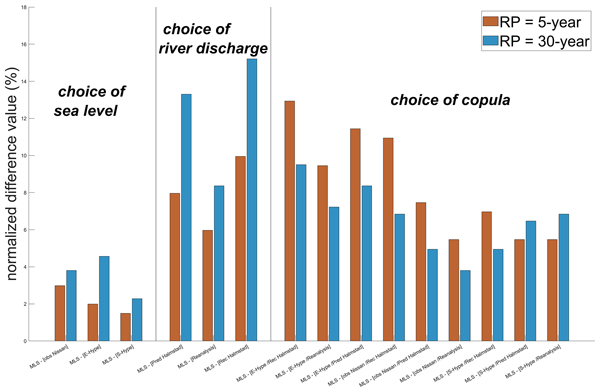
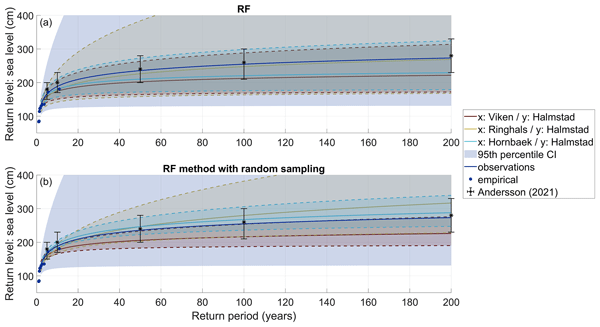
Both extreme river discharge and storm surges can interact at the coast and lead to flooding. However, it is difficult to predict flood levels during such compound events because they are rare and complex. Here, we focus on the quantification of uncertainties and investigate the sources of limitations while carrying out such analyses at Halmstad, Sweden. Based on a sensitivity analysis, we emphasize that both the choice of data source and statistical methodology influence the results.
Kévin Dubois, Morten Andreas Dahl Larsen, Martin Drews, Erik Nilsson, and Anna Rutgersson
Ocean Sci., 20, 21–30, https://doi.org/10.5194/os-20-21-2024, https://doi.org/10.5194/os-20-21-2024, 2024
Short summary
Short summary
Coastal floods occur due to extreme sea levels (ESLs) which are difficult to predict because of their rarity. Long records of accurate sea levels at the local scale increase ESL predictability. Here, we apply a machine learning technique to extend sea level observation data in the past based on a neighbouring tide gauge. We compared the results with a linear model. We conclude that both models give reasonable results with a better accuracy towards the extremes for the machine learning model.
Elin Andrée, Jian Su, Morten Andreas Dahl Larsen, Martin Drews, Martin Stendel, and Kristine Skovgaard Madsen
Nat. Hazards Earth Syst. Sci., 23, 1817–1834, https://doi.org/10.5194/nhess-23-1817-2023, https://doi.org/10.5194/nhess-23-1817-2023, 2023
Short summary
Short summary
When natural processes interact, they may compound each other. The combined effect can amplify extreme sea levels, such as when a storm occurs at a time when the water level is already higher than usual. We used numerical modelling of a record-breaking storm surge in 1872 to show that other prior sea-level conditions could have further worsened the outcome. Our research highlights the need to consider the physical context of extreme sea levels in measures to reduce coastal flood risk.
Matthias Gröger, Manja Placke, H. E. Markus Meier, Florian Börgel, Sandra-Esther Brunnabend, Cyril Dutheil, Ulf Gräwe, Magnus Hieronymus, Thomas Neumann, Hagen Radtke, Semjon Schimanke, Jian Su, and Germo Väli
Geosci. Model Dev., 15, 8613–8638, https://doi.org/10.5194/gmd-15-8613-2022, https://doi.org/10.5194/gmd-15-8613-2022, 2022
Short summary
Short summary
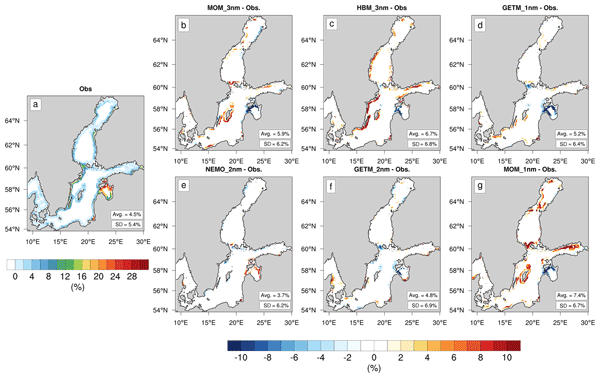
Comparisons of oceanographic climate data from different models often suffer from different model setups, forcing fields, and output of variables. This paper provides a protocol to harmonize these elements to set up multidecadal simulations for the Baltic Sea, a marginal sea in Europe. First results are shown from six different model simulations from four different model platforms. Topical studies for upwelling, marine heat waves, and stratification are also assessed.
Tuomas Kärnä, Patrik Ljungemyr, Saeed Falahat, Ida Ringgaard, Lars Axell, Vasily Korabel, Jens Murawski, Ilja Maljutenko, Anja Lindenthal, Simon Jandt-Scheelke, Svetlana Verjovkina, Ina Lorkowski, Priidik Lagemaa, Jun She, Laura Tuomi, Adam Nord, and Vibeke Huess
Geosci. Model Dev., 14, 5731–5749, https://doi.org/10.5194/gmd-14-5731-2021, https://doi.org/10.5194/gmd-14-5731-2021, 2021
Short summary
Short summary
We present Nemo-Nordic 2.0, a novel operational marine model for the Baltic Sea. The model covers the Baltic Sea and the North Sea with approximately 1 nmi resolution. We validate the model's performance against sea level, water temperature, and salinity observations, as well as sea ice charts. The skill analysis demonstrates that Nemo-Nordic 2.0 can reproduce the hydrographic features of the Baltic Sea.
Cited articles
Agertoft, N., Su, J., Pedersen, J. W., Ringgaard, I. M., and Larsen, M. A. D.: ImpactETC1.0 release, Zenodo [code], https://doi.org/10.5281/zenodo.20309449, 2026. a, b, c
Andrée, E., Su, J., Larsen, M. A. D., Drews, M., Stendel, M., and Skovgaard Madsen, K.: The role of preconditioning for extreme storm surges in the western Baltic Sea, Nat. Hazards Earth Syst. Sci., 23, 1817–1834, https://doi.org/10.5194/nhess-23-1817-2023, 2023. a
Andrée, E., Su, J., Larsen, M. A. D., Madsen, K. S., and Drews, M.: Simulating major storm surge events in a complex coastal region, Ocean Model., 162, 101 802, https://doi.org/10.1016/j.ocemod.2021.101802, 2021. a
Andrée, E., Drews, M., Su, J., Larsen, M. A. D., Drønen, N., and Madsen, K. S.: Simulating wind-driven extreme sea levels: Sensitivity to wind speed and direction, Weather and Climate Extremes, 36, 100422, https://doi.org/10.1016/j.wace.2022.100422, 2022. a
Bengtsson, L., Hodges, K. I., and Keenlyside, N.: Will Extratropical Storms Intensify in a Warmer Climate?, J. Climate, 22, 2276–2301, https://doi.org/10.1175/2008JCLI2678.1, 2009. a
Catto, J. L.: Extratropical cyclone classification and its use in climate studies, Rev. Geophys., 54, 486–520, https://doi.org/10.1002/2016RG000519, 2016. a
Feser, F., Barcikowska, M., Krueger, O., Schenk, F., Weisse, R., and Xia, L.: Storminess over the North Atlantic and northwestern Europe – A review, Q. J. Roy. Meteor. Soc., 141, 350–382, https://doi.org/10.1002/qj.2364, 2015. a, b
Flaounas, E., Kotroni, V., Lagouvardos, K., and Flaounas, I.: CycloTRACK (v1.0) – tracking winter extratropical cyclones based on relative vorticity: sensitivity to data filtering and other relevant parameters, Geosci. Model Dev., 7, 1841–1853, https://doi.org/10.5194/gmd-7-1841-2014, 2014. a, b, c, d
Flaounas, E., Aragão, L., Bernini, L., Dafis, S., Doiteau, B., Flocas, H., Gray, S. L., Karwat, A., Kouroutzoglou, J., Lionello, P., Miglietta, M. M., Pantillon, F., Pasquero, C., Patlakas, P., Picornell, M. Á., Porcù, F., Priestley, M. D. K., Reale, M., Roberts, M. J., Saaroni, H., Sandler, D., Scoccimarro, E., Sprenger, M., and Ziv, B.: A composite approach to produce reference datasets for extratropical cyclone tracks: application to Mediterranean cyclones, Weather Clim. Dynam., 4, 639–661, https://doi.org/10.5194/wcd-4-639-2023, 2023. a
Froude, L. S. R.: TIGGE: Comparison of the Prediction of Northern Hemisphere Extratropical Cyclones by Different Ensemble Prediction Systems, Weather Forecast., 25, 819–836, https://doi.org/10.1175/2010WAF2222326.1, 2010. a
Gonçalves, A., Liberato, M. L. R., and Nieto, R.: Wind Energy Assessment during High-Impact Winter Storms in Southwestern Europe, Atmosphere, 12, https://doi.org/10.3390/atmos12040509, 2021. a
Gramcianinov, C., Campos, R., de Camargo, R., Hodges, K., Guedes Soares, C., and da Silva Dias, P.: Analysis of Atlantic extratropical storm tracks characteristics in 41 years of ERA5 and CFSR/CFSv2 databases, Ocean Eng., 216, 108111, https://doi.org/10.1016/j.oceaneng.2020.108111, 2020. a
Grieger, J., Leckebusch, G. C., Raible, C. C., Rudeva, I., and and, I. S.: Subantarctic cyclones identified by 14 tracking methods, and their role for moisture transports into the continent, Tellus A, 70, 1–18, https://doi.org/10.1080/16000870.2018.1454808, 2018. a
Hodges, K. I.: Feature Tracking on the Unit Sphere, Mon. Weather Rev., 123, 3458–3465, https://doi.org/10.1175/1520-0493(1995)123<3458:FTOTUS>2.0.CO;2, 1995. a
Hodges, K. I., Hoskins, B. J., Boyle, J., and Thorncroft, C.: A Comparison of Recent Reanalysis Datasets Using Objective Feature Tracking: Storm Tracks and Tropical Easterly Waves, Mon. Weather Rev., 131, 2012–2037, https://doi.org/10.1175/1520-0493(2003)131<2012:ACORRD>2.0.CO;2, 2003. a
Hofstätter, M., Chimani, B., Lexer, A., and Blöschl, G.: A new classification scheme of European cyclone tracks with relevance to precipitation, Water Resour. Res., 52, 7086–7104, https://doi.org/10.1002/2016WR019146, 2016. a, b, c
Hoskins, B. J. and Hodges, K. I.: The annual cycle of Northern Hemisphere storm tracks. Part I: Seasons, J. Climate, 32, 1743–1760, https://doi.org/10.1175/JCLI-D-17-0870.s1, 2019. a, b
Hunter, A., Stephenson, D. B., Economou, T., Holland, M., and Cook, I.: New perspectives on the collective risk of extratropical cyclones, Q. J. Roy. Meteor. Soc., 142, 243–256, https://doi.org/10.1002/qj.2649, 2016. a
Kuhn, H. W.: The Hungarian method for the assignment problem, Nav. Res. Logist. Q., 2, 83–97, https://doi.org/10.1002/nav.3800020109, 1955. a
Lakkis, S. G., Canziani, P., Yuchechen, A., Rocamora, L., Caferri, A., Hodges, K., and O'Neill, A.: A 4D feature-tracking algorithm: A multidimensional view of cyclone systems, Q. J. Roy. Meteor. Soc., 145, 395–417, https://doi.org/10.1002/qj.3436, 2019. a, b
Lodise, J., Merrifield, S., Collins, C., Rogowski, P., Behrens, J., and Terrill, E.: Global climatology of extratropical cyclones from a new tracking approach and associated wave heights from satellite radar altimeter, J. Geophys. Res.-Oceans, 127, e2022JC018925, https://doi.org/10.1029/2022JC018925, 2022. a, b, c, d, e
Medina, S. and Houze Jr., R. A.: Kelvin–Helmholtz waves in extratropical cyclones passing over mountain ranges, Q. J. Roy. Meteor. Soc., 142, 1311–1319, https://doi.org/10.1002/qj.2734, 2016. a
Munkres, J.: Algorithms for the Assignment and Transportation Problems, J. Soc. Ind. Appl. Math., 5, 32–38, https://doi.org/10.1137/0105003, 1957. a
Neu, U., Akperov, M. G., Bellenbaum, N., Benestad, R., Blender, R., Caballero, R., Cocozza, A., Dacre, H. F., Feng, Y., Fraedrich, K., Grieger, J., Gulev, S., Hanley, J., Hewson, T., Inatsu, M., Keay, K., Kew, S. F., Kindem, I., Leckebusch, G. C., Liberato, M. L. R., Lionello, P., Mokhov, I. I., Pinto, J. G., Raible, C. C., Reale, M., Rudeva, I., Schuster, M., Simmonds, I., Sinclair, M., Sprenger, M., Tilinina, N. D., Trigo, I. F., Ulbrich, S., Ulbrich, U., Wang, X. L., and Wernli, H.: IMILAST: A Community Effort to Intercompare Extratropical Cyclone Detection and Tracking Algorithms, B. Am. Meteorol. Soc., 94, 529–547, https://doi.org/10.1175/BAMS-D-11-00154.1, 2013. a, b, c, d
Pauley, P. M.: An Example of Uncertainty in Sea Level Pressure Reduction, Weather Forecast., 13, 833–850, https://doi.org/10.1175/1520-0434(1998)013<0833:AEOUIS>2.0.CO;2, 1998. a
Priestley, M. D., Ackerley, D., Catto, J. L., Hodges, K. I., McDonald, R. E., and Lee, R. W.: An overview of the extratropical storm tracks in CMIP6 historical simulations, J. Climate, 33, 6315–6343, https://doi.org/10.1175/JCLI-D-19-0928.1, 2020. a, b
Ragone, F., Mariotti, M., Parodi, A., von Hardenberg, J., and Pasquero, C.: A climatological study of Western Mediterranean Medicanes in numerical simulations with explicit and parameterized convection, Atmosphere, 397, https://doi.org/10.3390/atmos9100397, 2018. a, b, c
Raible, C. C., Della-Marta, P. M., Schwierz, C., Wernli, H., and Blender, R.: Northern Hemisphere Extratropical Cyclones: A Comparison of Detection and Tracking Methods and Different Reanalyses, Mon. Weather Rev., 136, 880–897, https://doi.org/10.1175/2007MWR2143.1, 2008. a, b
Ridal, M., Bazile, E., Le Moigne, P., Randriamampianina, R., Schimanke, S., Andrae, U., Berggren, L., Brousseau, P., Dahlgren, P., Edvinsson, L., El-Said, A., Glinton, M., Hagelin, S., Hopsch, S., Isaksson, L., Medeiros, P., Olsson, E., Unden, P., and Wang, Z. Q.: CERRA, the Copernicus European Regional Reanalysis system, Q. J. Roy. Meteor. Soc., 150, 3385–3411, https://doi.org/10.1002/qj.4764, 2024. a, b
Sanchez-Gomez, E. and Somot, S.: Impact of the internal variability on the cyclone tracks simulated by a regional climate model over the Med-CORDEX domain, Clim. Dynam., 51, 1005–1021, https://doi.org/10.1007/s00382-016-3394-y, 2018. a, b, c, d
Schimanke, S., Ridal, M., Le Moigne, P., Berggren, L., Undén, P., Randriamampianina, R., Andrea, U., Bazile, E., Bertelsen, A., Brousseau, P., Dahlgren, P., Edvinsson, L., El Said, A., Glinton, M., Hopsch, S., Isaksson, L., Mladek, R., Olsson, E., Verrelle, A., and Wang, Z.: CERRA sub-daily regional reanalysis data for Europe on single levels from 1984 to present, Copernicus Climate Change Service (C3S) Climate Data Store (CDS) [data set], https://doi.org/10.24381/cds.622a565a, 2021. a
Seda, M.: The Assignment Problem and Its Relation to Logistics Problems, Algorithms, 15, https://doi.org/10.3390/a15100377, 2022. a
Ullrich, P. A., Zarzycki, C. M., McClenny, E. E., Pinheiro, M. C., Stansfield, A. M., and Reed, K. A.: TempestExtremes v2.1: a community framework for feature detection, tracking, and analysis in large datasets, Geosci. Model Dev., 14, 5023–5048, https://doi.org/10.5194/gmd-14-5023-2021, 2021. a, b, c, d, e, f, g
Zappa, G., Shaffrey, L. C., Hodges, K. I., Sansom, P. G., and Stephenson, D. B.: A Multimodel Assessment of Future Projections of North Atlantic and European Extratropical Cyclones in the CMIP5 Climate Models, J. Climate, 26, 5846–5862, https://doi.org/10.1175/JCLI-D-12-00573.1, 2013. a
Zhang, S., Xue, Y., Zhang, H., Zhou, X., Li, K., and Liu, R.: Improved Hungarian algorithm–based task scheduling optimization strategy for remote sensing big data processing, Geo-Spatial Information Science, 27, 1141–1154, https://doi.org/10.1080/10095020.2023.2178339, 2024. a
Short summary
Extratropical cyclones (ETCs) drive severe weather and cause significant socio-economic impacts. We present ImpactETC1.0, a framework that identifies ETC tracks and links them to local impacts, here storm surges. It uses global optimisation, BLOB analysis, and several post-processing options to improve tracking quality and identify impact-relevant tracks. Results show ImpactETC1.0 enables efficient, impact-focused ETC tracking.
Extratropical cyclones (ETCs) drive severe weather and cause significant socio-economic impacts....