
Articles | Volume 19, issue 12
https://doi.org/10.5194/gmd-19-5401-2026
© Author(s) 2026. This work is distributed under
the Creative Commons Attribution 4.0 License.
the Creative Commons Attribution 4.0 License.
https://doi.org/10.5194/gmd-19-5401-2026
© Author(s) 2026. This work is distributed under
the Creative Commons Attribution 4.0 License.
the Creative Commons Attribution 4.0 License.
Development and technical paper
| 
23 Jun 2026
Development and technical paper |
| 23 Jun 2026
| 23 Jun 2026
Interpolating station quantile biases for tropospheric ozone MDA8 bias correction
Department of Atmospheric Physics, Faculty of Mathematics and Physics, Charles University, V Holešovičkách 2, 180 00, Prague 8, Czech Republic
Modeling and Expertise Pool, Czech Hydrometeorological Institute, Na Šabatce 17, 143 00, Prague 4, Czech Republic
Jan Karlický
Department of Atmospheric Physics, Faculty of Mathematics and Physics, Charles University, V Holešovičkách 2, 180 00, Prague 8, Czech Republic
Peter Huszár
Department of Atmospheric Physics, Faculty of Mathematics and Physics, Charles University, V Holešovičkách 2, 180 00, Prague 8, Czech Republic
Related authors
Lukáš Bartík, Peter Huszár, Jan Peiker, Jan Karlický, Ondřej Vlček, and Petr Vodička
Atmos. Chem. Phys., 25, 15301–15328, https://doi.org/10.5194/acp-25-15301-2025, https://doi.org/10.5194/acp-25-15301-2025, 2025
Short summary
Short summary
This study investigates how to better understand and predict organic aerosols, which are tiny particles in the air that can affect our health and climate. By using advanced computer models, we examined the impact of different emissions and environmental conditions on these aerosols in Central Europe. Our findings show that including specific emissions significantly improved the accuracy of our predictions.
Peter Huszár, Lukáš Bartík, Jan Karlický, and Alvaro Patricio Prieto Perez
Atmos. Chem. Phys., 26, 4377–4403, https://doi.org/10.5194/acp-26-4377-2026, https://doi.org/10.5194/acp-26-4377-2026, 2026
Short summary
Short summary
This study evaluates the role of past emissions on the particulate matter pollution over Central Europe. It uses a chemical transport model along with a novel method of tagging emission according to the day they have been emitted. Our result showed that while the particulate matter pollution in cities is predominantly caused by actual day emissions, emission from day-1 to day-3 can also add a considerable fraction and under special circumstances even week old emissions can be important.
Lukáš Bartík, Peter Huszár, Jan Peiker, Jan Karlický, Ondřej Vlček, and Petr Vodička
Atmos. Chem. Phys., 25, 15301–15328, https://doi.org/10.5194/acp-25-15301-2025, https://doi.org/10.5194/acp-25-15301-2025, 2025
Short summary
Short summary
This study investigates how to better understand and predict organic aerosols, which are tiny particles in the air that can affect our health and climate. By using advanced computer models, we examined the impact of different emissions and environmental conditions on these aerosols in Central Europe. Our findings show that including specific emissions significantly improved the accuracy of our predictions.
Jan Karlický, Jáchym Bareš, and Peter Huszár
EGUsphere, https://doi.org/10.5194/egusphere-2025-388, https://doi.org/10.5194/egusphere-2025-388, 2025
Preprint archived
Short summary
Short summary
Our study includes results of WRF model simulations focused to evaluate sensitivity of local climate in cities on urban surface characteristics. Summer urban heat island is mostly impacted by changes in vegetation cover in city, albedo of roofs and irrigated green roofs. Results are usable also to reveal suitable mitigation strategies for reduction of negative aspects of local climate in cities.
Marina Liaskoni, Peter Huszár, Lukáš Bartík, Alvaro Patricio Prieto Perez, Jan Karlický, and Kateřina Šindelářová
Atmos. Chem. Phys., 24, 13541–13569, https://doi.org/10.5194/acp-24-13541-2024, https://doi.org/10.5194/acp-24-13541-2024, 2024
Short summary
Short summary
The impact of biogenic emissions of hydrocarbons from vegetation on ozone, as well as on overall oxidative capacity of air, is analyzed for central European cities for a present-day period using a chemistry transport model. Moreover, the analysis evaluates the partial role of urban vegetation in impacting all biogenic emissions. We found substantial increases in ozone due to these emissions, and about 10% of this increase is attributable to vegetation within urban areas.
Michal Belda, Nina Benešová, Jaroslav Resler, Peter Huszár, Ondřej Vlček, Pavel Krč, Jan Karlický, Pavel Juruš, and Kryštof Eben
Geosci. Model Dev., 17, 3867–3878, https://doi.org/10.5194/gmd-17-3867-2024, https://doi.org/10.5194/gmd-17-3867-2024, 2024
Short summary
Short summary
For modeling atmospheric chemistry, it is necessary to provide data on emissions of pollutants. These can come from various sources and in various forms, and preprocessing of the data to be ingestible by chemistry models can be quite challenging. We developed the FUME processor to use a database layer that internally transforms all input data into a rigid structure, facilitating further processing to allow for emission processing from the continental to the street scale.
Lukáš Bartík, Peter Huszár, Jan Karlický, Ondřej Vlček, and Kryštof Eben
Atmos. Chem. Phys., 24, 4347–4387, https://doi.org/10.5194/acp-24-4347-2024, https://doi.org/10.5194/acp-24-4347-2024, 2024
Short summary
Short summary
The presented study deals with the attribution of fine particulate matter (PM2.5) concentrations to anthropogenic emissions over Central Europe using regional-scale models. It calculates the present-day contributions of different emissions sectors to concentrations of PM2.5 and its secondary components. Moreover, the study investigates the effect of chemical nonlinearities by using multiple source attribution methods and secondary organic aerosol calculation methods.
Peter Huszar, Alvaro Patricio Prieto Perez, Lukáš Bartík, Jan Karlický, and Anahi Villalba-Pradas
Atmos. Chem. Phys., 24, 397–425, https://doi.org/10.5194/acp-24-397-2024, https://doi.org/10.5194/acp-24-397-2024, 2024
Short summary
Short summary
Urbanization transforms rural land into artificial land, while due to human activities, it also introduces a great quantity of emissions. We quantify the impact of urbanization on the final particulate matter pollutant levels by looking not only at these emissions, but also at the way urban land cover influences meteorological conditions, how the removal of pollutants changes due to urban land cover, and how biogenic emissions from vegetation change due to less vegetation in urban areas.
Marina Liaskoni, Peter Huszar, Lukáš Bartík, Alvaro Patricio Prieto Perez, Jan Karlický, and Ondřej Vlček
Atmos. Chem. Phys., 23, 3629–3654, https://doi.org/10.5194/acp-23-3629-2023, https://doi.org/10.5194/acp-23-3629-2023, 2023
Short summary
Short summary
Wind-blown dust (WBD) emissions emitted from European soils are estimated for the 2007–2016 period, and their impact on the total particulate matter (PM) concentration is calculated. We found a considerable increase in PM concentrations due to such emissions, especially on selected days (rather than on a seasonal average). We also found that WBD emissions are strongest over western Europe, and the highest impacts on PM are calculated for this region.
Peter Huszar, Jan Karlický, Lukáš Bartík, Marina Liaskoni, Alvaro Patricio Prieto Perez, and Kateřina Šindelářová
Atmos. Chem. Phys., 22, 12647–12674, https://doi.org/10.5194/acp-22-12647-2022, https://doi.org/10.5194/acp-22-12647-2022, 2022
Short summary
Short summary
Urbanization turns rural land cover into artificial land cover, while due to human activities, it introduces a great quantity of emissions. We attempt to quantify the impact of urbanization on the final air pollutant levels by looking not only at these emissions, but also the way urban land cover influences meteorological conditions, how the removal of pollutants changes due to urban land cover, and how biogenic emissions from vegetation change due to less vegetation in urban areas.
Katerina Sindelarova, Jana Markova, David Simpson, Peter Huszar, Jan Karlicky, Sabine Darras, and Claire Granier
Earth Syst. Sci. Data, 14, 251–270, https://doi.org/10.5194/essd-14-251-2022, https://doi.org/10.5194/essd-14-251-2022, 2022
Short summary
Short summary
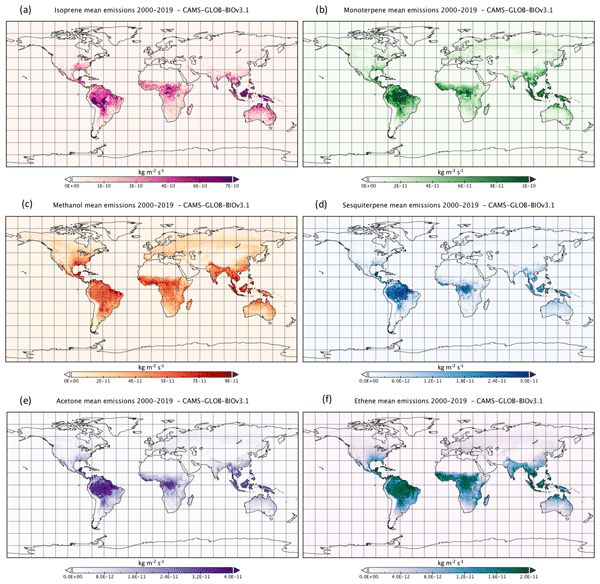
Three new datasets of global emissions of biogenic volatile organic compounds (BVOCs) emitted into the atmosphere from terrestrial vegetation were developed for air quality modelling using the Model of Emissions of Gases and Aerosols from Nature (MEGANv2.1) driven by European Centre for Medium-Range Weather Forecasts meteorological reanalyses for the years 2000–2019. The datasets include updates of the isoprene emission factors in Europe and study the impact of land cover change on emissions.
Peter Huszar, Jan Karlický, Jana Marková, Tereza Nováková, Marina Liaskoni, and Lukáš Bartík
Atmos. Chem. Phys., 21, 14309–14332, https://doi.org/10.5194/acp-21-14309-2021, https://doi.org/10.5194/acp-21-14309-2021, 2021
Short summary
Short summary
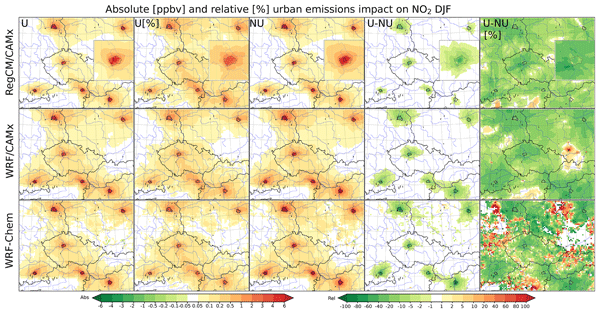
Urban areas are strong hot spots of emissions influencing local and regional air quality. Cities furthermore influence the meteorological conditions due to their characteristic surface properties and geometry. We found that if these latter effects are not included in the quantification of the impact of urban emissions on regional air quality, this impact will be overestimated, and this overestimation is mainly due to the enhanced turbulence that is present in cities compared to rural areas.
Jaroslav Resler, Kryštof Eben, Jan Geletič, Pavel Krč, Martin Rosecký, Matthias Sühring, Michal Belda, Vladimír Fuka, Tomáš Halenka, Peter Huszár, Jan Karlický, Nina Benešová, Jana Ďoubalová, Kateřina Honzáková, Josef Keder, Šárka Nápravníková, and Ondřej Vlček
Geosci. Model Dev., 14, 4797–4842, https://doi.org/10.5194/gmd-14-4797-2021, https://doi.org/10.5194/gmd-14-4797-2021, 2021
Short summary
Short summary
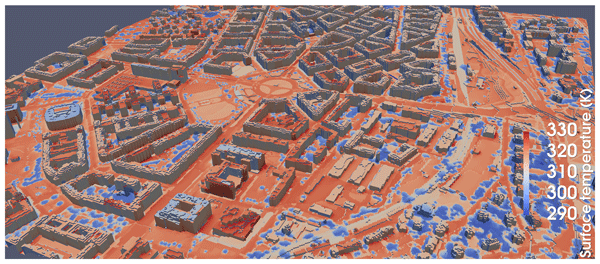
We describe validation of the PALM model v6.0 against measurements collected during two observational campaigns in Dejvice, Prague. The study focuses on the evaluation of the newly developed or improved radiative and energy balance modules in PALM related to urban modelling. In addition to the energy-related quantities, it also evaluates air flow and air quality under street canyon conditions.
Cited articles
Abdelmoaty, H. M., Rajulapati, C. R., Nerantzaki, S. D., and Papalexiou, S. M.: Bias-corrected high-resolution temperature and precipitation projections for Canada, Sci. Data, 12, 191, https://doi.org/10.1038/s41597-025-04396-z, 2025. a, b
Achilleos, G.: Errors within the Inverse Distance Weighted (IDW) interpolation procedure, Geocarto Int., 23, 429–449, https://doi.org/10.1080/10106040801966704, 2008. a
Archibald, A. T., Neu, J. L., Elshorbany, Y. F., Cooper, O. R., Young, P. J., Akiyoshi, H., Cox, R. A., Coyle, M., Derwent, R. G., Deushi, M., Finco, A., Frost, G. J., Galbally, I. E., Gerosa, G., Granier, C., Griffiths, P. T., Hossaini, R., Hu, L., Jöckel, P., Josse, B., Lin, M. Y., Mertens, M., Morgenstern, O., Naja, M., Naik, V., Oltmans, S., Plummer, D. A., Revell, L. E., Saiz-Lopez, A., Saxena, P., Shin, Y. M., Shahid, I., Shallcross, D., Tilmes, S., Trickl, T., Wallington, T. J., Wang, T., Worden, H. M., and Zeng, G.: Tropospheric Ozone Assessment Report: A critical review of changes in the tropospheric ozone burden and budget from 1850 to 2100, Elementa, 8, 034, https://doi.org/10.1525/elementa.2020.034, 2020. a
Colette, A., Andersson, C., Baklanov, A., Bessagnet, B., Brandt, J., Christensen, J. H., Doherty, R., Engardt, M., Geels, C., Giannakopoulos, C., Hedegaard, G. B., Katragkou, E., Langner, J., Lei, H., Manders, A., Melas, D., Meleux, F., Rouïl, L., Sofiev, M., Soares, J., Stevenson, D. S., Tombrou-Tzella, M., Varotsos, K. V., and Young, P.: Is the ozone climate penalty robust in Europe?, Environ. Res. Lett., 10, 084015, https://doi.org/10.1088/1748-9326/10/8/084015, 2015. a, b
Da, Y., Xu, Y., and McCarl, B.: Effects of Surface Ozone and Climate on Historical (1980–2015) Crop Yields in the United States: Implication for Mid-21st Century Projection, Environmental and Resource Economics, 81, 355–378, https://doi.org/10.1007/s10640-021-00629-y, 2022. a
Dee, D., Uppala, S., Simmons, A., Berrisford, P., Poli, P., Kobayashi, S., Andrae, U., Balmaseda, M., Balsamo, G., Bauer, P., Bechtold, P., Beljaars, A., van de Berg, L., Bidlot, J., Bormann, N., Delsol, C., Dragani, R., Fuentes, M., Geer, A., Haimberger, L., Healy, S., Hersbach, H., Hólm, E., Isaksen, L., Kållberg, P., Köhler, M., Matricardi, M., McNally, A., Monge-Sanz, B., Morcrette, J.-J., Park, B.-K., Peubey, C., de Rosnay, P., Tavolato, C., Thépaut, J.-N., and Vitart, F.: The ERA-Interim reanalysis: configuration and performance of the data assimilation system, Q. J. Roy. Meteor. Soc., 137, 553–597, https://doi.org/10.1002/qj.828, 2011. a
Doherty, R., Heal, M., and O'Connor, F.: Climate change impacts on human health over Europe through its effect on air quality, Environ. Health, 16, 118, https://doi.org/10.1186/s12940-017-0325-2, 2017. a
Emmons, L., Schwantes, R., Orlando, J., Tyndall, G., Kinnison, D., Lamarque, J.-F., Marsh, D., Mills, M., Tilmes, S., Bardeen, C., Buchholz, R., Conley, A., Gettelman, A., Garcia, R., Simpson, I., Blake, D., Meinardi, S., and Pétron, G.: The Chemistry Mechanism in the Community Earth System Model Version 2 (CESM2), J. Adv. Model. Earth Sy., 12, e2019MS001882, https://doi.org/10.1029/2019MS001882, 2020. a
EUR-Lex: Consolidated text: Directive 2008/50/EC of the European Parliament and of the Council of 21 May 2008 on ambient air quality and cleaner air for Europe, https://eur-lex.europa.eu/legal-content/EN/ALL/?uri=CELEX:02008L0050-20150918 (last access: 29 October 2025), 2015. a
Gentile, M., Courbin, F., and Meylan, G.: Interpolating point spread function anisotropy, Astron. Astrophys., 549, https://doi.org/10.1051/0004-6361/201219739, 2012. a
Grell, G. A., Peckham, S. E., Schmitz, R., McKeen, S. A., Frost, G., Skamarock, W. C., and Eder, B.: Fully coupled “online” chemistry within the WRF model, Atmos. Environ., 39, 6957–6975, https://doi.org/10.1016/j.atmosenv.2005.04.027, 2005. a, b, c, d
Gu, Y., Henze, D. K., Nawaz, M. O., and Wagner, U. J.: Response of the ozone-related health burden in Europe to changes in local anthropogenic emissions of ozone precursors, Environ. Res. Lett., 18, 114034, https://doi.org/10.1088/1748-9326/ad0167, 2023. a
Huszar, P., Miksovsky, J., Pisoft, P., Belda, M., and Halenka, T.: Interactive coupling of a regional climate model and a chemical transport model: evaluation and preliminary results on ozone and aerosol feedback, Clim. Res., 51, 59–88, https://doi.org/10.3354/cr01054, 2012. a, b
Im, U., Bianconi, R., Solazzo, E., Kioutsioukis, I., Badia, A., Balzarini, A., Baró, R., Bellasio, R., Brunner, D., Chemel, C., Curci, G., Flemming, J., Forkel, R., Giordano, L., Jiménez-Guerrero, P., Hirtl, M., Hodzic, A., Honzak, L., Jorba, O., Knote, C., Kuenen, J. J., Makar, P. A., Manders-Groot, A., Neal, L., Pérez, J. L., Pirovano, G., Pouliot, G., San Jose, R., Savage, N., Schroder, W., Sokhi, R. S., Syrakov, D., Torian, A., Tuccella, P., Werhahn, J., Wolke, R., Yahya, K., Zabkar, R., Zhang, Y., Zhang, J., Hogrefe, C., and Galmarini, S.: Evaluation of operational on-line-coupled regional air quality models over Europe and North America in the context of AQMEII phase 2. Part I: Ozone, Atmos. Environ., 115, 404–420, https://doi.org/10.1016/j.atmosenv.2014.09.042, 2015. a, b
Im, U., Ye, Z., Schuhen, N., Chowdhury, S., Christensen, J. H., Geels, C., Hänninen, Ristoand Hodnebrog, Ø., Marelle, L., Sofiev, M., Brandt, J., and Aunan, K.: Europe will struggle to meet the new WHO Air Quality Guidelines, npj Clean Air, 1, 13, https://doi.org/10.1038/s44407-025-00013-w, 2025. a
Jeffreys, H.: An invariant form for the prior probability in estimation problems, P. Roy. Soc. Lond. A Mat., 186, 453–461, https://doi.org/10.1098/rspa.1946.0056, 1946. a
Karlický, J.: WRF-Chem and CAMx ozone surface data from central-European simulations of period 2007–2016, Czech National Repository [data set], https://doi.org/10.48700/datst.ev7ej-gv255, 2022. a
Karlický, J., Rieder, H. E., Huszár, P., Peiker, J., and Sukhodolov, T.: A cautious note advocating the use of ensembles of models and driving data in modeling of regional ozone burdens, Air Qual. Atmos. Hlth., 17, 1415–1424, https://doi.org/10.1007/s11869-024-01516-3, 2024. a, b, c, d, e, f, g, h, i, j, k, l
Liu, Z., Doherty, R. M., Wild, O., O'Connor, F. M., and Turnock, S. T.: Correcting ozone biases in a global chemistry–climate model: implications for future ozone, Atmos. Chem. Phys., 22, 12543–12557, https://doi.org/10.5194/acp-22-12543-2022, 2022. a, b
Neal, L., Agnew, P., Moseley, S., Ordóñez, C., Savage, N., and Tilbee, M.: Application of a statistical post-processing technique to a gridded, operational, air quality forecast, Atmos. Environ., 98, 385–393, https://doi.org/10.1016/j.atmosenv.2014.09.004, 2014. a
Ohlert, P. L., Bach, M., and Breuer, L.: Accuracy assessment of inverse distance weighting interpolation of groundwater nitrate concentrations in Bavaria (Germany), Environ. Sci. Pollut. R., 30, 9445–9455, https://doi.org/10.1007/s11356-022-22670-0, 2023. a
Peiker, J.: Bias corrected ozone MDA8 in central Europe using various bias correction strategies, Zenodo [code, data set], https://doi.org/10.5281/zenodo.19630198, 2026. a
Pozzer, A., Anenberg, S. C., Dey, S., Haines, A., Lelieveld, J., and Chowdhury, S.: Mortality Attributable to Ambient Air Pollution: A Review of Global Estimates, GeoHealth, 7, e2022GH000711, https://doi.org/10.1029/2022GH000711, 2023. a
Prieto Perez, A. P., Huszár, P., and Karlický, J.: Validation of multi-model decadal simulations of present-day central European air-quality, Atmos. Environ., 349, 121077, https://doi.org/10.1016/j.atmosenv.2025.121077, 2025. a
Racherla, P. N. and Adams, P. J.: The response of surface ozone to climate change over the Eastern United States, Atmos. Chem. Phys., 8, 871–885, https://doi.org/10.5194/acp-8-871-2008, 2008. a, b
Rahmani, M., Mohammadi, A., and Azadi, M.: Comparison of Spatial Interpolation Methods for Gridded Bias Removal in Surface Temperature Forecasts, J. Meteorol. Res., 31, https://doi.org/10.1007/s13351-017-6135-1, 2017. a, b
Revell, L. E., Stenke, A., Tummon, F., Feinberg, A., Rozanov, E., Peter, T., Abraham, N. L., Akiyoshi, H., Archibald, A. T., Butchart, N., Deushi, M., Jöckel, P., Kinnison, D., Michou, M., Morgenstern, O., O'Connor, F. M., Oman, L. D., Pitari, G., Plummer, D. A., Schofield, R., Stone, K., Tilmes, S., Visioni, D., Yamashita, Y., and Zeng, G.: Tropospheric ozone in CCMI models and Gaussian process emulation to understand biases in the SOCOLv3 chemistry–climate model, Atmos. Chem. Phys., 18, 16155–16172, https://doi.org/10.5194/acp-18-16155-2018, 2018. a, b
Rieder, H. E., Fiore, A. M., Horowitz, L. W., and Naik, V.: Projecting policy-relevant metrics for high summertime ozone pollution events over the eastern United States due to climate and emission changes during the 21st century, J. Geophys. Res.-Atmos., 120, 784–800, https://doi.org/10.1002/2014JD022303, 2015. a, b, c, d, e, f
Schnell, J. L., Holmes, C. D., Jangam, A., and Prather, M. J.: Skill in forecasting extreme ozone pollution episodes with a global atmospheric chemistry model, Atmos. Chem. Phys., 14, 7721–7739, https://doi.org/10.5194/acp-14-7721-2014, 2014. a, b, c, d
Seinfeld, J. H. and Pandis, S. N.: Atmospheric Chemistry and Physics: From Air Pollution to Climate Change, Wiley, ISBN 9781118591505, 1998. a
Staehle, C., Rieder, H. E., Fiore, A. M., and Schnell, J. L.: Technical note: An assessment of the performance of statistical bias correction techniques for global chemistry–climate model surface ozone fields, Atmos. Chem. Phys., 24, 5953–5969, https://doi.org/10.5194/acp-24-5953-2024, 2024. a, b, c, d
Sukhodolov, T., Egorova, T., Stenke, A., Ball, W. T., Brodowsky, C., Chiodo, G., Feinberg, A., Friedel, M., Karagodin-Doyennel, A., Peter, T., Sedlacek, J., Vattioni, S., and Rozanov, E.: Atmosphere–ocean–aerosol–chemistry–climate model SOCOLv4.0: description and evaluation, Geosci. Model Dev., 14, 5525–5560, https://doi.org/10.5194/gmd-14-5525-2021, 2021. a, b
Ugolotti, A., Anders, T., Lanssens, B., Hickler, T., François, L., and Tölle, M. H.: Impact of bias correction on climate change signals over central Europe and the Iberian Peninsula, Front. Environ. Sci., 11, 2023, https://doi.org/10.3389/fenvs.2023.1116429, 2023. a
Short summary
We introduce a novel strategy for bias correction of tropospheric ozone maxima based on parametric interpolation of quantile biases (PIQB) from stations into the model grid. Its performance is evaluated and compared to other strategies found in literature. The results show that PIQB performs very well on simulations with a relatively high horizontal resolution, preserving model-resolved features yet mitigating model errors. We conclude that PIQB is suitable for correcting future projections.
We introduce a novel strategy for bias correction of tropospheric ozone maxima based on...


