Articles | Volume 19, issue 3
https://doi.org/10.5194/gmd-19-1387-2026
© Author(s) 2026. This work is distributed under
the Creative Commons Attribution 4.0 License.
https://doi.org/10.5194/gmd-19-1387-2026
© Author(s) 2026. This work is distributed under
the Creative Commons Attribution 4.0 License.
ConcentrationTracker: Landlab components for tracking material concentrations in sediment
Department of Earth & Environmental Sciences, Tulane University, New Orleans, 70118, USA
Nicole M. Gasparini
Department of Earth & Environmental Sciences, Tulane University, New Orleans, 70118, USA
Benjamin Campforts
Department of Earth Sciences, Vrije Universiteit Amsterdam, 1081 HV Amsterdam, the Netherlands
Gregory E. Tucker
Department of Geological Sciences, University of Colorado at Boulder, Boulder, 80309, USA
Cooperative Institute for Research in Environmental Sciences, University of Colorado at Boulder, Boulder, 80309, USA
Community Surface Dynamics Modeling System Integration Facility, University of Colorado at Boulder, Boulder, 80303, USA
Related authors
No articles found.
Coline Ariagno, Philippe Steer, Pierre G. Valla, and Benjamin Campforts
Earth Surf. Dynam., 13, 1109–1132, https://doi.org/10.5194/esurf-13-1109-2025, https://doi.org/10.5194/esurf-13-1109-2025, 2025
Short summary
Short summary
This study explore the impact of landslides on Alpine terrain using a landscape evolution model called
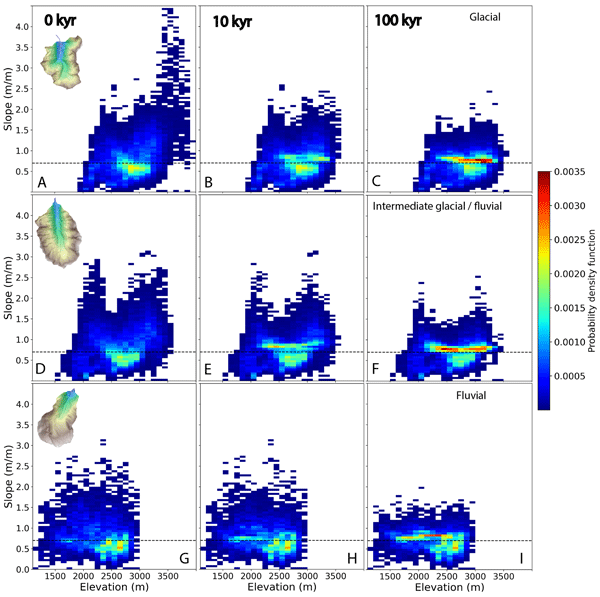
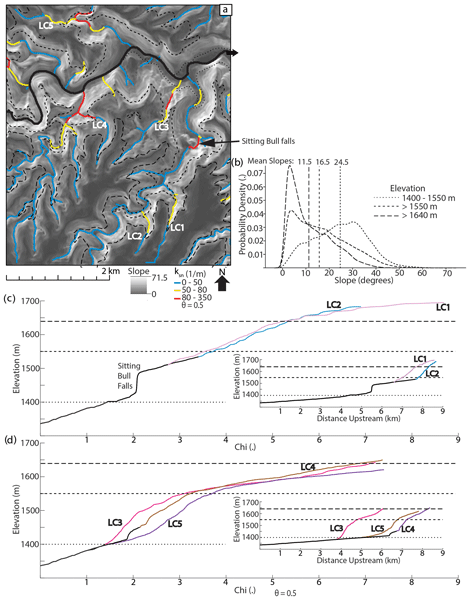
Hyland, which enables long-term topographical analysis. Our finding reveal that landslides are concentrated at two specific elevations over time and predominantly affect the highest and steepest slopes, particularly along ridges and crests. This study is part of a broader question concerning the origin of accelerated erosion during the Quaternary period.
Angel D. Monsalve, Samuel R. Anderson, Nicole M. Gasparini, and Elowyn M. Yager
Geosci. Model Dev., 18, 3427–3451, https://doi.org/10.5194/gmd-18-3427-2025, https://doi.org/10.5194/gmd-18-3427-2025, 2025
Short summary
Short summary
Rivers shape landscapes by moving sediments and changing their beds, but existing computer models oversimplify these processes by only considering erosion. We developed new software that simulates how rivers transport sediments and change over time through both erosion and deposition. This helps scientists and engineers better predict river behavior for water management, flood prevention, and ecosystem protection.
Nicole M. Gasparini, Adam M. Forte, and Katherine R. Barnhart
Earth Surf. Dynam., 12, 1227–1242, https://doi.org/10.5194/esurf-12-1227-2024, https://doi.org/10.5194/esurf-12-1227-2024, 2024
Short summary
Short summary
The time it takes for a landscape to adjust to new environmental conditions is critical for understanding the impacts of past and future environmental changes. We used different computational models and methods and found that predicted times for a landscape to reach a stable condition vary greatly. Our results illustrate that reporting how timescales are measured is important. Modelers should ensure that the measurement technique addresses the question.
Jeffrey Keck, Erkan Istanbulluoglu, Benjamin Campforts, Gregory Tucker, and Alexander Horner-Devine
Earth Surf. Dynam., 12, 1165–1191, https://doi.org/10.5194/esurf-12-1165-2024, https://doi.org/10.5194/esurf-12-1165-2024, 2024
Short summary
Short summary
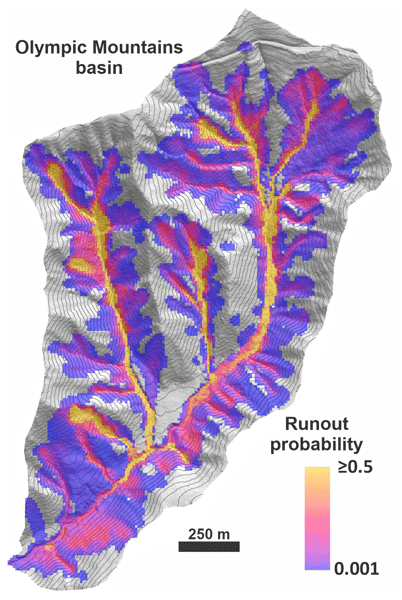
MassWastingRunout (MWR) is a new landslide runout model designed for sediment transport, landscape evolution, and hazard assessment applications. MWR is written in Python and includes a calibration utility that automatically determines best-fit parameters for a site and empirical probability density functions of each parameter for probabilistic model implementation. MWR and Jupyter Notebook tutorials are available as part of the Landlab package at https://github.com/landlab/landlab.
Daniel O'Hara, Liran Goren, Roos M. J. van Wees, Benjamin Campforts, Pablo Grosse, Pierre Lahitte, Gabor Kereszturi, and Matthieu Kervyn
Earth Surf. Dynam., 12, 709–726, https://doi.org/10.5194/esurf-12-709-2024, https://doi.org/10.5194/esurf-12-709-2024, 2024
Short summary
Short summary
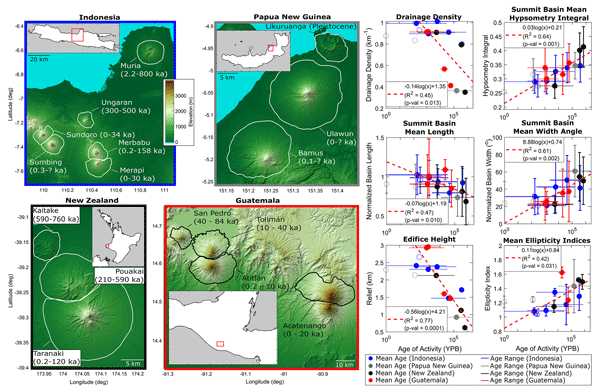
Understanding how volcanic edifices develop drainage basins remains unexplored in landscape evolution. Using digital evolution models of volcanoes with varying ages, we quantify the geometries of their edifices and associated drainage basins through time. We find that these metrics correlate with edifice age and are thus useful indicators of a volcano’s history. We then develop a generalized model for how volcano basins develop and compare our results to basin evolution in other settings.
Tian Gan, Gregory E. Tucker, Eric W. H. Hutton, Mark D. Piper, Irina Overeem, Albert J. Kettner, Benjamin Campforts, Julia M. Moriarty, Brianna Undzis, Ethan Pierce, and Lynn McCready
Geosci. Model Dev., 17, 2165–2185, https://doi.org/10.5194/gmd-17-2165-2024, https://doi.org/10.5194/gmd-17-2165-2024, 2024
Short summary
Short summary
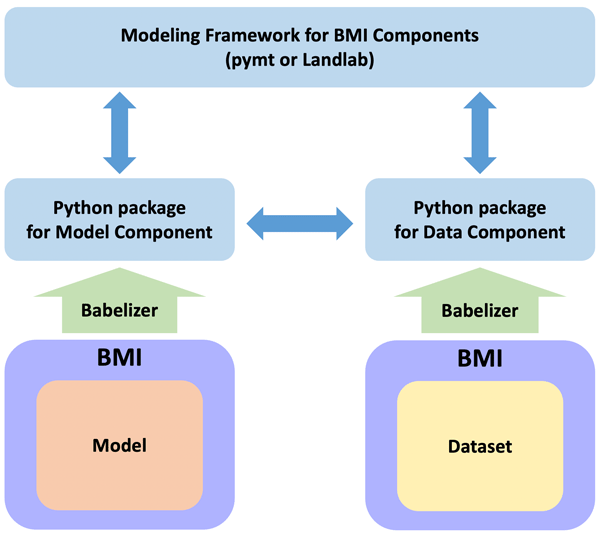
This study presents the design, implementation, and application of the CSDMS Data Components. The case studies demonstrate that the Data Components provide a consistent way to access heterogeneous datasets from multiple sources, and to seamlessly integrate them with various models for Earth surface process modeling. The Data Components support the creation of open data–model integration workflows to improve the research transparency and reproducibility.
Matthew C. Morriss, Benjamin Lehmann, Benjamin Campforts, George Brencher, Brianna Rick, Leif S. Anderson, Alexander L. Handwerger, Irina Overeem, and Jeffrey Moore
Earth Surf. Dynam., 11, 1251–1274, https://doi.org/10.5194/esurf-11-1251-2023, https://doi.org/10.5194/esurf-11-1251-2023, 2023
Short summary
Short summary
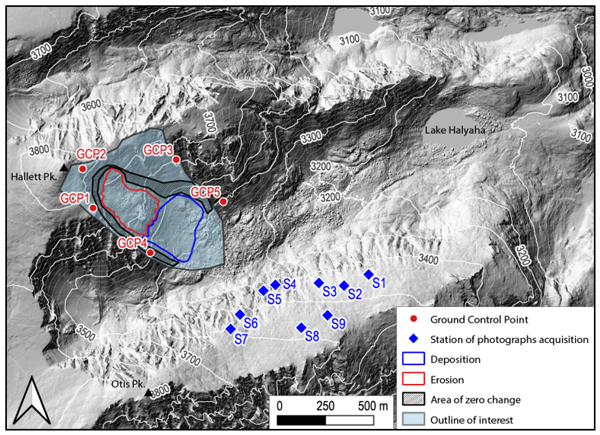
In this paper, we investigate the 28 June 2022 collapse of the Chaos Canyon landslide in Rocky Mountain National Park, Colorado, USA. We find that the landslide was moving prior to its collapse and took place at peak spring snowmelt; temperature modeling indicates the potential presence of permafrost. We hypothesize that this landslide could be part of the broader landscape evolution changes to alpine terrain caused by a warming climate, leading to thawing alpine permafrost.
Sam Anderson, Nicole Gasparini, and Joel Johnson
Earth Surf. Dynam., 11, 995–1011, https://doi.org/10.5194/esurf-11-995-2023, https://doi.org/10.5194/esurf-11-995-2023, 2023
Short summary
Short summary
We measured rock strength and amount of fracturing in the two different rock types, sandstones and carbonates, in Last Chance Canyon, New Mexico, USA. Where there is more carbonate bedrock, hills and channels steepen in Last Chance Canyon. This is because the carbonate-type bedrock tends to be more thickly bedded, is less fractured, and is stronger. The carbonate bedrock produces larger boulders than the sandstone bedrock, which can protect the more fractured sandstone bedrock from erosion.
Vao Fenotiana Razanamahandry, Marjolein Dewaele, Gerard Govers, Liesa Brosens, Benjamin Campforts, Liesbet Jacobs, Tantely Razafimbelo, Tovonarivo Rafolisy, and Steven Bouillon
Biogeosciences, 19, 3825–3841, https://doi.org/10.5194/bg-19-3825-2022, https://doi.org/10.5194/bg-19-3825-2022, 2022
Short summary
Short summary
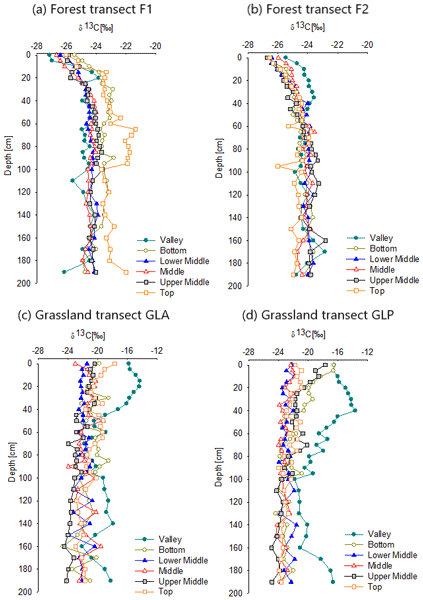
In order to shed light on possible past vegetation shifts in the Central Highlands of Madagascar, we measured stable isotope ratios of organic carbon in soil profiles along both forested and grassland hillslope transects in the Lake Alaotra region. Our results show that the landscape of this region was more forested in the past: soils in the C4-dominated grasslands contained a substantial fraction of C3-derived carbon, increasing with depth.
Liesa Brosens, Benjamin Campforts, Gerard Govers, Emilien Aldana-Jague, Vao Fenotiana Razanamahandry, Tantely Razafimbelo, Tovonarivo Rafolisy, and Liesbet Jacobs
Earth Surf. Dynam., 10, 209–227, https://doi.org/10.5194/esurf-10-209-2022, https://doi.org/10.5194/esurf-10-209-2022, 2022
Short summary
Short summary
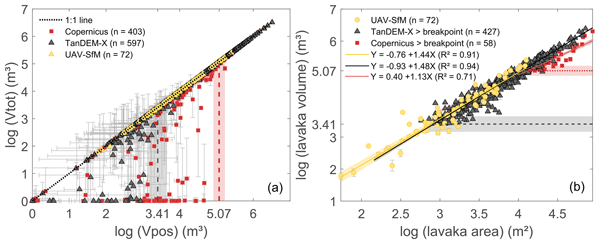
Obtaining accurate information on the volume of geomorphic features typically requires high-resolution topographic data, which are often not available. Here, we show that the globally available 12 m TanDEM-X DEM can be used to accurately estimate gully volumes and establish an area–volume relationship after applying a correction. This allowed us to get a first estimate of the amount of sediment that has been mobilized by large gullies (lavaka) in central Madagascar over the past 70 years.
Gregory E. Tucker, Eric W. H. Hutton, Mark D. Piper, Benjamin Campforts, Tian Gan, Katherine R. Barnhart, Albert J. Kettner, Irina Overeem, Scott D. Peckham, Lynn McCready, and Jaia Syvitski
Geosci. Model Dev., 15, 1413–1439, https://doi.org/10.5194/gmd-15-1413-2022, https://doi.org/10.5194/gmd-15-1413-2022, 2022
Short summary
Short summary
Scientists use computer simulation models to understand how Earth surface processes work, including floods, landslides, soil erosion, river channel migration, ocean sedimentation, and coastal change. Research benefits when the software for simulation modeling is open, shared, and coordinated. The Community Surface Dynamics Modeling System (CSDMS) is a US-based facility that supports research by providing community support, computing tools and guidelines, and educational resources.
Kelly Kochanski, Gregory Tucker, and Robert Anderson
The Cryosphere Discuss., https://doi.org/10.5194/tc-2021-205, https://doi.org/10.5194/tc-2021-205, 2021
Manuscript not accepted for further review
Short summary
Short summary
Falling snow does not life flat. When blown by the wind, it forms elaborate structures, like dunes. Where these dunes form, they change the way heat flows through the snow. This can accelerate sea ice melt and climate change. Here, we use both field observations obtained during blizzards in Colorado and simulations performed with a state-of-the-art model, to quantify the impact of snow dunes on Arctic heat flows.
Arthur Depicker, Gerard Govers, Liesbet Jacobs, Benjamin Campforts, Judith Uwihirwe, and Olivier Dewitte
Earth Surf. Dynam., 9, 445–462, https://doi.org/10.5194/esurf-9-445-2021, https://doi.org/10.5194/esurf-9-445-2021, 2021
Short summary
Short summary
We investigated how shallow landslide occurrence is impacted by deforestation and rifting in the North Tanganyika–Kivu rift region (Africa). We developed a new approach to calculate landslide erosion rates based on an inventory compiled in biased © Google Earth imagery. We find that deforestation increases landslide erosion by a factor of 2–8 and for a period of roughly 15 years. However, the exact impact of deforestation depends on the geomorphic context of the landscape (rejuvenated/relict).
Cited articles
Ahnert, F.: Brief Description of a Comprehensive Three-Dimensional Process-Response Model of Landform Development, Z. für Geomorfol., Supplementband 25, 29–49, 1976.
Anderson, R. S.: Particle trajectories on hillslopes: Implications for particle age and 10Be structure, J. Geophys. Res. Earth Surf., 120, 1626–1644, https://doi.org/10.1002/2015JF003479, 2015.
Barnhart, K. R., Glade, R. C., Shobe, C. M., and Tucker, G. E.: Terrainbento 1.0: a Python package for multi-model analysis in long-term drainage basin evolution, Geosci. Model Dev., 12, 1267–1297, https://doi.org/10.5194/gmd-12-1267-2019, 2019.
Barnhart, K. R., Hutton, E. W. H., Tucker, G. E., Gasparini, N. M., Istanbulluoglu, E., Hobley, D. E. J., Lyons, N. J., Mouchene, M., Nudurupati, S. S., Adams, J. M., and Bandaragoda, C.: Short communication: Landlab v2.0: a software package for Earth surface dynamics, Earth Surf. Dynam., 8, 379–397, https://doi.org/10.5194/esurf-8-379-2020, 2020.
Ben-Israel, M., Armon, M., Aster Team, and Matmon, A.: Sediment Residence Times in Large Rivers Quantified Using a Cosmogenic Nuclides Based Transport Model and Implications for Buffering of Continental Erosion Signals, J. Geophys. Res. Earth Surf., 127, e2021JF006417, https://doi.org/10.1029/2021JF006417, 2022.
Braun, J. and Willett, S. D.: A very efficient O(n), implicit and parallel method to solve the stream power equation governing fluvial incision and landscape evolution, Geomorphology, 180–181, 170–179, https://doi.org/10.1016/j.geomorph.2012.10.008, 2013.
Brimhall, G. H. and Dietrich, W. E.: Constitutive mass balance relations between chemical composition, volume, density, porosity, and strain in metasomatic hydrochemkai systems: Results on weathering and pedogenesis, Geochim. Cosmochim. Ac., 51, 567–587, https://doi.org/10.1016/0016-7037(87)90070-6, 1987.
Brosens, L., Campforts, B., Robinet, J., Vanacker, V., Opfergelt, S., Ameijeiras-Mariño, Y., Minella, J. P. G., and Govers, G.: Slope Gradient Controls Soil Thickness and Chemical Weathering in Subtropical Brazil: Understanding Rates and Timescales of Regional Soilscape Evolution Through a Combination of Field Data and Modeling, J. Geophys. Res. Earth Surf., 125, e2019JF005321, https://doi.org/10.1029/2019JF005321, 2020.
Brown, E. T., Stallard, R. F., Larsen, M. C., Raisbeck, G. M., and Yiou, F.: Denudation rates determined from the accumulation of in situ-produced 10Be in the Luquillo Experimental Forest, Puerto Rico, Earth Planet. Sci. Lett., 129, 193–202, 1995.
Campforts, B., Vanacker, V., Vanderborght, J., Baken, S., Smolders, E., and Govers, G.: Simulating the mobility of meteoric 10 Be in the landscape through a coupled soil-hillslope model (Be2D), Earth Planet. Sci. Lett., 439, 143–157, https://doi.org/10.1016/j.epsl.2016.01.017, 2016.
Campforts, B., Schwanghart, W., and Govers, G.: Accurate simulation of transient landscape evolution by eliminating numerical diffusion: the TTLEM 1.0 model, Earth Surf. Dynam., 5, 47–66, https://doi.org/10.5194/esurf-5-47-2017, 2017.
Carretier, S. and Regard, V.: Is it possible to quantify pebble abrasion and velocity in rivers using terrestrial cosmogenic nuclides?, J. Geophys. Res., 116, F04003, https://doi.org/10.1029/2011JF001968, 2011.
Carretier, S., Regard, V., and Soual, C.: Theoretical cosmogenic nuclide concentration in river bed load clasts: Does it depend on clast size?, Quat. Geochronol., 4, 108–123, https://doi.org/10.1016/j.quageo.2008.11.004, 2009.
Carretier, S., Martinod, P., Reich, M., and Godderis, Y.: Modelling sediment clasts transport during landscape evolution, Earth Surf. Dynam., 4, 237–251, https://doi.org/10.5194/esurf-4-237-2016, 2016.
Carretier, S., Regard, V., Leanni, L., and Farías, M.: Long-term dispersion of river gravel in a canyon in the Atacama Desert, Central Andes, deduced from their 10Be concentrations, Sci. Rep., 9, 17763, https://doi.org/10.1038/s41598-019-53806-x, 2019.
Carretier, S., Regard, V., Abdelhafiz, Y., and Plazolles, B.: Modelling detrital cosmogenic nuclide concentrations during landscape evolution in Cidre v2.0, Geosci. Model Dev., 16, 6741–6755, https://doi.org/10.5194/gmd-16-6741-2023, 2023.
Codilean, A. T., Bishop, P., Hoey, T. B., Stuart, F. M., and Fabel, D.: Cosmogenic 21Ne analysis of individual detrital grains: Opportunities and limitations, Earth Surf. Process. Landf., 35, 16–27, https://doi.org/10.1002/esp.1815, 2010.
Coulthard, T. J. and Macklin, M. G.: Modeling long-term contamination in river systems from historical metal mining, Geology, 31, 451, https://doi.org/10.1130/0091-7613(2003)031<0451:MLCIRS>2.0.CO;2, 2003.
Coulthard, T. J., Macklin, M. G., and Kirkby, M. J.: A cellular model of Holocene upland river basin and alluvial fan evolution, Earth Surf. Process. Landf., 27, 269–288, https://doi.org/10.1002/esp.318, 2002.
Coulthard, T. J., Neal, J. C., Bates, P. D., Ramirez, J., de Almeida, G. A. M., and Hancock, G. R.: Integrating the LISFLOOD-FP 2D hydrodynamic model with the CAESAR model: implications for modelling landscape evolution, Earth Surf. Process. Landf., 38, 1897–1906, https://doi.org/10.1002/esp.3478, 2013.
Davy, P. and Lague, D.: Fluvial erosion/transport equation of landscape evolution models revisited, J. Geophys. Res.-Earth, 114, F03007, https://doi.org/10.1029/2008JF001146, 2009.
Ferrier, K. L. and Kirchner, J. W.: Effects of physical erosion on chemical denudation rates: A numerical modeling study of soil-mantled hillslopes, Earth Planet. Sci. Lett., 272, 591–599, https://doi.org/10.1016/j.epsl.2008.05.024, 2008.
Ferrier, K. L., Kirchner, J. W., and Finkel, R. C.: Estimating millennial-scale rates of dust incorporation into eroding hillslope regolith using cosmogenic nuclides and immobile weathering tracers, J. Geophys. Res. Earth Surf., 116, https://doi.org/10.1029/2011JF001991, 2011.
Francis, O. R., Hales, T. C., Hobley, D. E. J., Fan, X., Horton, A. J., Scaringi, G., and Huang, R.: The impact of earthquakes on orogen-scale exhumation, Earth Surf. Dynam., 8, 579–593, https://doi.org/10.5194/esurf-8-579-2020, 2020.
Ganti, V., Passalacqua, P., and Foufoula-Georgiou, E.: A sub-grid scale closure for nonlinear hillslope sediment transport models, J. Geophys. Res. Earth Surf., 117, 2011JF002181, https://doi.org/10.1029/2011JF002181, 2012.
Gray, H. J., Tucker, G. E., Mahan, S. A., McGuire, C., and Rhodes, E. J.: On extracting sediment transport information from measurements of luminescence in river sediment, J. Geophys. Res. Earth Surf., 122, 654–677, https://doi.org/10.1002/2016JF003858, 2017.
Gray, H. J., Tucker, G. E., and Mahan, S. A.: Application of a Luminescence-Based Sediment Transport Model, Geophys. Res. Lett., 45, 6071–6080, https://doi.org/10.1029/2018GL078210, 2018.
Gray, H. J., Jain, M., Sawakuchi, A. O., Mahan, S. A., and Tucker, G. E.: Luminescence as a Sediment Tracer and Provenance Tool, Rev. Geophys., 57, 987–1017, https://doi.org/10.1029/2019RG000646, 2019.
Hanks, T. C., Bucknam, R. C., Lajoie, K. R., and Wallace, R. E.: Modification of wave-cut and faulting-controlled landforms, J. Geophys. Res. Solid Earth, 89, 5771–5790, https://doi.org/10.1029/JB089iB07p05771, 1984.
Heimsath, A. M.: Eroding the land: Steady-state and stochastic rates and processes through a cosmogenic lens, Spec. Pap. Geol. Soc. Am., 415, 111–129, https://doi.org/10.1130/2006.2415(07), 2006.
Hobley, D. E. J., Adams, J. M., Nudurupati, S. S., Hutton, E. W. H., Gasparini, N. M., Istanbulluoglu, E., and Tucker, G. E.: Creative computing with Landlab: an open-source toolkit for building, coupling, and exploring two-dimensional numerical models of Earth-surface dynamics, Earth Surf. Dynam., 5, 21–46, https://doi.org/10.5194/esurf-5-21-2017, 2017.
Johnstone, S. A. and Hilley, G. E.: Lithologic control on the form of soil-mantled hillslopes, Geology, 43, 83–86, https://doi.org/10.1130/G36052.1, 2015.
Kaste, J. M., Heimsath, A. M., and Bostick, B. C.: Short-term soil mixing quantified with fallout radionuclides, Geology, 35, 243, https://doi.org/10.1130/G23355A.1, 2007.
Lal, D.: Cosmic ray labeling of erosion surfaces: in situ nuclide production rates and erosion models, Earth Planet. Sci. Lett., 104, 424–439, https://doi.org/10.1016/0012-821X(91)90220-C, 1991.
Mudd, S. M.: Detection of transience in eroding landscapes, Earth Surf. Process. Landf., 42, 24–41, https://doi.org/10.1002/esp.3923, 2017.
Niemi, N. A., Oskin, M., Burbank, D. W., Heimsath, A. M., and Gabet, E. J.: Effects of bedrock landslides on cosmogenically determined erosion rates, Earth Planet. Sci. Lett., 237, 480–498, https://doi.org/10.1016/j.epsl.2005.07.009, 2005.
Petit, C., Salles, T., Godard, V., Rolland, Y., and Audin, L.: River incision, 10Be production and transport in a source-to-sink sediment system (Var catchment, SW Alps), Earth Surf. Dynam., 11, 183–201, https://doi.org/10.5194/esurf-11-183-2023, 2023.
Pierce, K. L. and Colman, S. M.: Effect of height and orientation (microclimate) on geomorphic degradation rates and processes, late-glacial terrace scarps in central Idaho, GSA Bull., 97, 869–885, https://doi.org/10.1130/0016-7606(1986)97<869:EOHAOM>2.0.CO;2, 1986.
Reed, M. M., Ferrier, K. L., and Perron, J. T.: Modeling Cosmogenic Nuclides in Transiently Evolving Topography and Chemically Weathering Soils, J. Geophys. Res. Earth Surf., 128, e2023JF007201, https://doi.org/10.1029/2023JF007201, 2023.
Reinhardt, L. J., Hoey, T. B., Barrows, T. T., Dempster, T. J., Bishop, P., and Fifield, L. K.: Interpreting erosion rates from cosmogenic radionuclide concentrations measured in rapidly eroding terrain, Earth Surf. Process. Landf., 32, 390–406, https://doi.org/10.1002/esp.1415, 2007.
Repka, J. L., Anderson, R. S., and Finkel, R. C.: Cosmogenic dating of fluvial terraces, Fremont River, Utah, Earth Planet. Sci. Lett., 152, 59–73, https://doi.org/10.1016/S0012-821X(97)00149-0, 1997.
Riebe, C. S., Hahm, W. J., and Brantley, S. L.: Controls on deep critical zone architecture: a historical review and four testable hypotheses, Earth Surf. Process. Landf., 42, 128–156, https://doi.org/10.1002/esp.4052, 2017.
Roberge, L.: ConcentrationTracker: Landlab components for tracking material concentrations in sediment – Figure scripts, Zenodo [data set], https://doi.org/10.5281/zenodo.15653060, 2025a.
Roberge, L.: ConcentrationTracker: Landlab components for tracking material concentrations in sediment – Source code, Zenodo [code], https://doi.org/10.5281/zenodo.15652866, 2025b (code also at: http://github.com/landlab/landlab, last access: 11 February 2026).
Roberge, L.: ConcentrationTracker: Landlab components for tracking material concentrations in sediment – User Manuals, Zenodo [interactive computing environment], https://doi.org/10.5281/zenodo.18603324, 2026 (interactive computing environment also at: https://github.com/loroberge/pub_Roberge_et_al_ConcentrationTracker_Manuals, last access: 11 February 2026).
Roering, J. J., Almond, P., Tonkin, P., and McKean, J.: Soil transport driven by biological processes over millennial time scales, Geology, 30, 1115–1118, https://doi.org/10.1130/0091-7613(2002)030<1115:STDBBP>2.0.CO;2, 2002.
Salles, T.: Badlands: A parallel basin and landscape dynamics model, SoftwareX, 5, 195–202, https://doi.org/10.1016/j.softx.2016.08.005, 2016.
Shobe, C. M., Tucker, G. E., and Barnhart, K. R.: The SPACE 1.0 model: a Landlab component for 2-D calculation of sediment transport, bedrock erosion, and landscape evolution, Geosci. Model Dev., 10, 4577–4604, https://doi.org/10.5194/gmd-10-4577-2017, 2017.
Small, E. E., Anderson, R. S., Repka, J. L., and Finkel, R. C.: Erosion rates of alpine bedrock summit surfaces deduced from in situ 10Be and 26Al, Earth Planet. Sci. Lett., 150, 413–425, 1997.
Small, E. E., Anderson, R. S., and Hancock, G. S.: Estimates of the rate of regolith production using 10Be and 26Al from an alpine hillslope, Geomorphology, 27, 131–150, https://doi.org/10.1016/S0169-555X(98)00094-4, 1999.
Tucker, G. E. and Slingerland, R.: Drainage basin responses to climate change, Water Resour. Res., 33, 2031–2047, https://doi.org/10.1029/97WR00409, 1997.
Tucker, G. E., Lancaster, S. T., Gasparini, N. M., and Bras, R. L.: The channel-hillslope integrated landscape development model (CHILD), in: Landscape Erosion and Evolution Modeling, edited by: Harmon, R. S. and Doe, W. W., Springer, New York, 349–388, https://doi.org/10.1007/978-1-4615-0575-4_12, 2001.
Van De Wiel, M. J., Coulthard, T. J., Macklin, M. G., and Lewin, J.: Embedding reach-scale fluvial dynamics within the CAESAR cellular automaton landscape evolution model, Geomorphology, 90, 283–301, https://doi.org/10.1016/j.geomorph.2006.10.024, 2007.
Willgoose, G., Bras, R. L., and Rodriguez-Iturbe, I.: A coupled channel network growth and hillslope evolution model: 1. Theory, Water Resour. Res., 27, 1671–1684, https://doi.org/10.1029/91WR00935, 1991.
Xie, J., Coulthard, T. J., Wang, M., and Wu, J.: Tracing seismic landslide-derived sediment dynamics in response to climate change, CATENA, 217, 106495, https://doi.org/10.1016/j.catena.2022.106495, 2022.
Yanites, B. J., Tucker, G. E., and Anderson, R. S.: Numerical and analytical models of cosmogenic radionuclide dynamics in landslide-dominated drainage basins, J. Geophys. Res. Earth Surf., 114, https://doi.org/10.1029/2008JF001088, 2009.
Yoo, K., Ji, J., Aufdenkampe, A., and Klaminder, J.: Rates of soil mixing and associated carbon fluxes in a forest versus tilled agricultural field: Implications for modeling the soil carbon cycle, J. Geophys. Res. Biogeosciences, 116, https://doi.org/10.1029/2010JG001304, 2011.

Short summary
Landscape evolution models compute the movement of sediment across landscapes. However, few account for the storage, fate, and transport of sediment properties, such as lithology or geochemistry. We present new Landlab model components that track such properties. Our unit-agnostic approach allows users to define the sediment properties for a wide range of applications (for example, mass of magnetite, volume of quartz, number of zircons, number of 10Be atoms,
equivalent doseof luminescence).
Landscape evolution models compute the movement of sediment across landscapes. However, few...