Articles | Volume 19, issue 3
https://doi.org/10.5194/gmd-19-1367-2026
© Author(s) 2026. This work is distributed under
the Creative Commons Attribution 4.0 License.
https://doi.org/10.5194/gmd-19-1367-2026
© Author(s) 2026. This work is distributed under
the Creative Commons Attribution 4.0 License.
Refining the Lagrangian approach for moisture source identification through sensitivity testing of assumptions using BTrIMS1.1

Climate Change Research Centre, University of New South Wales, Sydney, 2052, Australia
ARC Centre of Excellence for 21st Century Weather, Melbourne, Australia
Jason P. Evans
Climate Change Research Centre, University of New South Wales, Sydney, 2052, Australia
ARC Centre of Excellence for 21st Century Weather, Melbourne, Australia
Andréa S. Taschetto
Climate Change Research Centre, University of New South Wales, Sydney, 2052, Australia
ARC Centre of Excellence for 21st Century Weather, Melbourne, Australia
Chiara Holgate
ARC Centre of Excellence for 21st Century Weather, Melbourne, Australia
Research School of Earth Sciences, Australia National University, 0200, Canberra, Australia
Related authors
No articles found.
Rajesh Kumar Sahu, Hamza Kunhu Bangalath, Suleiman Mostamandi, Jason Evans, Paul A. Kucera, and Hylke E. Beck
Nat. Hazards Earth Syst. Sci., 26, 21–40, https://doi.org/10.5194/nhess-26-21-2026, https://doi.org/10.5194/nhess-26-21-2026, 2026
Short summary
Short summary
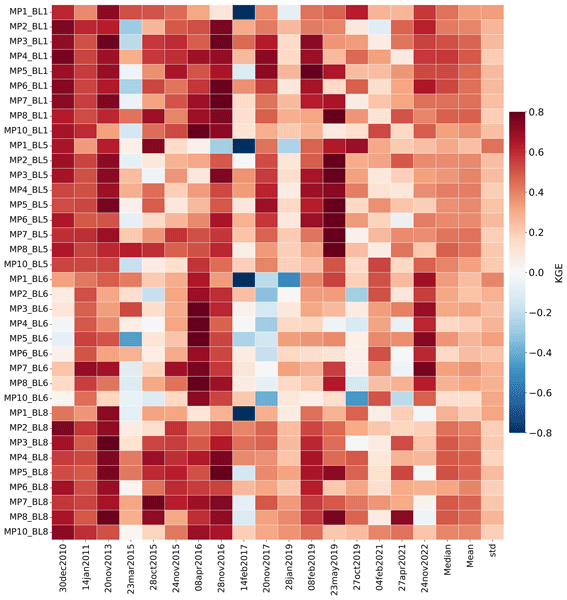
This study tests 36 combinations of microphysics and boundary layer schemes in the Weather Research and Forecasting model for extreme rainfall over Saudi Arabia. Using the Kling–Gupta Efficiency, the Yonsei University boundary layer with the Thompson microphysics performs best; the Morrison microphysics with the Mellor–Yamada–Nakanishi–Niino boundary layer ranks lowest. Mean temporal efficiency is 0.37, spatial efficiency is 0.26, revealing spatial prediction challenges in arid regions.
Youngil Kim and Jason Evans
EGUsphere, https://doi.org/10.5194/egusphere-2025-6411, https://doi.org/10.5194/egusphere-2025-6411, 2026
This preprint is open for discussion and under review for Geoscientific Model Development (GMD).
Short summary
Short summary
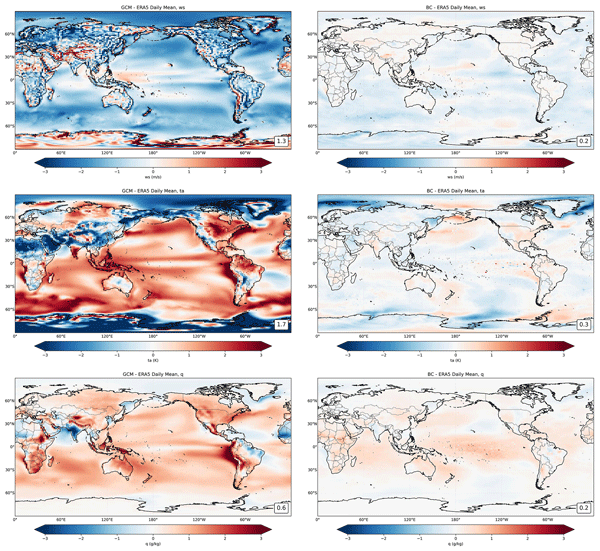
Climate models used to study future climate often contain systematic errors that affect high-resolution simulations. This study presents a new open-source tool that reduces these errors before regional climate simulations are run. By correcting multiple atmospheric variables together and at short time scales, the method improves realism and consistency in simulated climate patterns. This leads to more reliable regional projections, particularly for extreme weather events.
Wilma G. C. Huneke, Andrew McC. Hogg, Martin Dix, Daohua Bi, Arnold Sullivan, Shayne McGregor, Chiara M. Holgate, Siobhan P. O'Farrell, and Micael J. T. Oliveira
Geosci. Model Dev., 18, 9991–10015, https://doi.org/10.5194/gmd-18-9991-2025, https://doi.org/10.5194/gmd-18-9991-2025, 2025
Short summary
Short summary
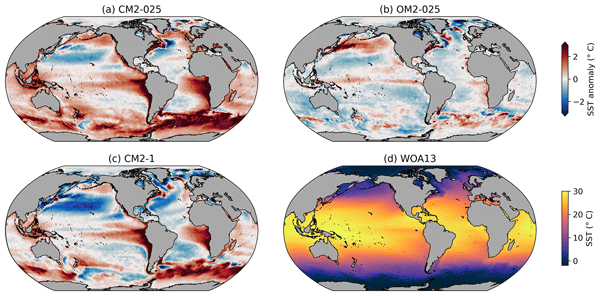
A new configuration of the Australian Community Climate and Earth System Simulator coupled model, ACCESS-CM2, with a higher resolution ocean-sea ice component is introduced. The new version of the coupled climate model was designed to better capture smaller-scale ocean motions. While this configuration improves the representation of many aspects of the climate system, some biases from the existing lower-resolution version persist.
Anjana Devanand, Jason P. Evans, Andy J. Pitman, Sujan Pal, David Gochis, and Kevin Sampson
Hydrol. Earth Syst. Sci., 29, 4491–4513, https://doi.org/10.5194/hess-29-4491-2025, https://doi.org/10.5194/hess-29-4491-2025, 2025
Short summary
Short summary
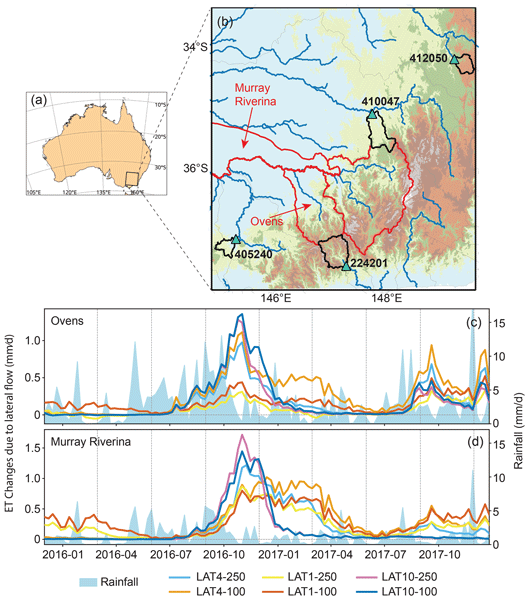
Including lateral flow increases evapotranspiration near major river channels in high-resolution land surface simulations in southeast Australia, consistent with observations. The 1-km resolution model shows a widespread pattern of dry ridges that does not exist at coarser resolutions. Our results have implications for improved simulations of droughts and future water availability.
Ingo Richter, Ping Chang, Ping-Gin Chiu, Gokhan Danabasoglu, Takeshi Doi, Dietmar Dommenget, Guillaume Gastineau, Zoe E. Gillett, Aixue Hu, Takahito Kataoka, Noel S. Keenlyside, Fred Kucharski, Yuko M. Okumura, Wonsun Park, Malte F. Stuecker, Andréa S. Taschetto, Chunzai Wang, Stephen G. Yeager, and Sang-Wook Yeh
Geosci. Model Dev., 18, 2587–2608, https://doi.org/10.5194/gmd-18-2587-2025, https://doi.org/10.5194/gmd-18-2587-2025, 2025
Short summary
Short summary
Tropical ocean basins influence each other through multiple pathways and mechanisms, referred to here as tropical basin interaction (TBI). Many researchers have examined TBI using comprehensive climate models but have obtained conflicting results. This may be partly due to differences in experiment protocols and partly due to systematic model errors. The Tropical Basin Interaction Model Intercomparison Project (TBIMIP) aims to address this problem by designing a set of TBI experiments that will be performed by multiple models.
Giovanni Di Virgilio, Fei Ji, Eugene Tam, Jason P. Evans, Jatin Kala, Julia Andrys, Christopher Thomas, Dipayan Choudhury, Carlos Rocha, Yue Li, and Matthew L. Riley
Geosci. Model Dev., 18, 703–724, https://doi.org/10.5194/gmd-18-703-2025, https://doi.org/10.5194/gmd-18-703-2025, 2025
Short summary
Short summary
We evaluate the skill in simulating the Australian climate of some of the latest generation of regional climate models. We show when and where the models simulate this climate with high skill versus model limitations. We show how new models perform relative to the previous-generation models, assessing how model design features may underlie key performance improvements. This work is of national and international relevance as it can help guide the use and interpretation of climate projections.
Giovanni Di Virgilio, Jason P. Evans, Fei Ji, Eugene Tam, Jatin Kala, Julia Andrys, Christopher Thomas, Dipayan Choudhury, Carlos Rocha, Stephen White, Yue Li, Moutassem El Rafei, Rishav Goyal, Matthew L. Riley, and Jyothi Lingala
Geosci. Model Dev., 18, 671–702, https://doi.org/10.5194/gmd-18-671-2025, https://doi.org/10.5194/gmd-18-671-2025, 2025
Short summary
Short summary
We introduce new climate models that simulate Australia’s future climate at regional scales, including at an unprecedented resolution of 4 km for 1950–2100. We describe the model design process used to create these new climate models. We show how the new models perform relative to previous-generation models and compare their climate projections. This work is of national and international relevance as it can help guide climate model design and the use and interpretation of climate projections.
Conrad Wasko, Seth Westra, Rory Nathan, Acacia Pepler, Timothy H. Raupach, Andrew Dowdy, Fiona Johnson, Michelle Ho, Kathleen L. McInnes, Doerte Jakob, Jason Evans, Gabriele Villarini, and Hayley J. Fowler
Hydrol. Earth Syst. Sci., 28, 1251–1285, https://doi.org/10.5194/hess-28-1251-2024, https://doi.org/10.5194/hess-28-1251-2024, 2024
Short summary
Short summary
In response to flood risk, design flood estimation is a cornerstone of infrastructure design and emergency response planning, but design flood estimation guidance under climate change is still in its infancy. We perform the first published systematic review of the impact of climate change on design flood estimation and conduct a meta-analysis to provide quantitative estimates of possible future changes in extreme rainfall.
Sanaa Hobeichi, Gab Abramowitz, and Jason P. Evans
Hydrol. Earth Syst. Sci., 25, 3855–3874, https://doi.org/10.5194/hess-25-3855-2021, https://doi.org/10.5194/hess-25-3855-2021, 2021
Short summary
Short summary
Evapotranspiration (ET) links the water, energy and carbon cycle on land. Reliable ET estimates are key to understand droughts and flooding. We develop a new ET dataset, DOLCE V3, by merging multiple global ET datasets, and we show that it matches ET observations better and hence is more reliable than its parent datasets. Next, we use DOLCE V3 to examine recent changes in ET and find that ET has increased over most of the land, decreased in some regions, and has not changed in some other regions
Max Kulinich, Yanan Fan, Spiridon Penev, Jason P. Evans, and Roman Olson
Geosci. Model Dev., 14, 3539–3551, https://doi.org/10.5194/gmd-14-3539-2021, https://doi.org/10.5194/gmd-14-3539-2021, 2021
Short summary
Short summary
We present a novel stochastic approach based on Markov chains to estimate climate model weights of multi-model ensemble means. This approach showed improved performance (better correlation with observations) over existing alternatives during cross-validation and model-as-truth tests. The results of this comparative analysis should serve to motivate further studies in applications of Markov chain and other nonlinear methods to find optimal model weights for constructing ensemble means.
Nicholas King-Hei Yeung, Laurie Menviel, Katrin J. Meissner, Andréa S. Taschetto, Tilo Ziehn, and Matthew Chamberlain
Clim. Past, 17, 869–885, https://doi.org/10.5194/cp-17-869-2021, https://doi.org/10.5194/cp-17-869-2021, 2021
Short summary
Short summary
The Last Interglacial period (LIG) is characterised by strong orbital forcing compared to the pre-industrial period (PI). This study compares the mean climate state of the LIG to the PI as simulated by the ACCESS-ESM1.5, with a focus on the southern hemispheric monsoons, which are shown to be consistently weakened. This is associated with cooler terrestrial conditions in austral summer due to decreased insolation, and greater pressure and subsidence over land from Hadley cell strengthening.
Cited articles
Barnes, M. A., King, M., Reeder, M., and Jakob, C.: The dynamics of slow-moving coherent cyclonic potential vorticity anomalies and their links to heavy rainfall over the eastern seaboard of Australia, Quarterly Journal of the Royal Meteorological Society, 149, 2233–2251, https://doi.org/10.1002/qj.4503, 2023.
Botsyun, S., Aemisegger, F., Villiger, L., Kirchner, I., and Pfahl, S.: Quantifying free tropospheric moisture sources over the western tropical Atlantic with numerical water tracers and isotopes, Atmospheric Science Letters, 25, e1274, https://doi.org/10.1002/asl.1274, 2024.
Brubaker, K. L., Entekhabi, D., and Eagleson, P. S.: Estimation of Continental Precipitation Recycling, Journal of Climate, 6, 1077–1089, https://doi.org/10.1175/1520-0442(1993)006<1077:EOCPR>2.0.CO;2, 1993.
Brunello, C. F., Gebhardt, F., Rinke, A., Dütsch, M., Bucci, S., Meyer, H., Mellat, M., and Werner, M.: Moisture Transformation in Warm Air Intrusions Into the Arctic: Process Attribution With Stable Water Isotopes, Geophysical Research Letters, 51, e2024GL111013, https://doi.org/10.1029/2024GL111013, 2024.
Budyko, M. I.: Climate and life, Academic Press, New York, 538 pp., ISBN 978-0-12-139450-1, 1974.
Catto, J. L., Jakob, C., Berry, G., and Nicholls, N.: Relating global precipitation to atmospheric fronts, Geophysical Research Letters, 39, https://doi.org/10.1029/2012GL051736, 2012.
Cloux, S., Garaboa-Paz, D., Insua-Costa, D., Miguez-Macho, G., and Pérez-Muñuzuri, V.: Extreme precipitation events in the Mediterranean area: contrasting two different models for moisture source identification, Hydrol. Earth Syst. Sci., 25, 6465–6477, https://doi.org/10.5194/hess-25-6465-2021, 2021.
Crespo-Otero, A., Insua-Costa, D., Hernández-García, E., López, C., and Míguez-Macho, G.: Simple physics-based adjustments reconcile the results of Eulerian and Lagrangian techniques for moisture tracking in atmospheric rivers, Earth Syst. Dynam., 16, 1483–1501, https://doi.org/10.5194/esd-16-1483-2025, 2025.
Dao, T. L., Vincent, C. L., and Lane, T. P.: Multiscale Influences on Rainfall in Northeast Australia, https://doi.org/10.1175/JCLI-D-22-0835.1, 2023.
de Vries, A. J.: A global climatological perspective on the importance of Rossby wave breaking and intense moisture transport for extreme precipitation events, Weather Clim. Dynam., 2, 129–161, https://doi.org/10.5194/wcd-2-129-2021, 2021.
De Vries, A. J., Casselman, J. W., Afargan-Gerstman, H., Nangombe, S. S., Pilon, R., Russo, E., Wicker, W., Yadav, P., and Domeisen, D. I. V.: Extreme weather in the Southern Hemisphere in early 2022: from Rossby waves to planetary-scale conditions, EGU General Assembly 2023, Vienna, Austria, 24–28 Apr 2023, EGU23-9918, https://doi.org/10.5194/egusphere-egu23-9918, 2023.
Dirmeyer, P. A. and Brubaker, K. L.: Contrasting evaporative moisture sources during the drought of 1988 and the flood of 1993, Journal of Geophysical Research: Atmospheres, 104, 19383–19397, https://doi.org/10.1029/1999JD900222, 1999.
Dominguez, F., Miguez-Macho, G., and Hu, H.: WRF with Water Vapor Tracers: A Study of Moisture Sources for the North American Monsoon, Journal of Hydrometeorology, 17, 1915–1927, https://doi.org/10.1175/JHM-D-15-0221.1, 2016.
Dominguez, F., Hu, H., and Martinez, J. A.: Two-Layer Dynamic Recycling Model (2L-DRM): Learning from Moisture Tracking Models of Different Complexity, Journal of Hydrometeorology, 21, 3–16, https://doi.org/10.1175/JHM-D-19-0101.1, 2020.
Draxler, R. and Hess, G.: Description of the HYSPLIT_4 modelling system, NOAA Tech. Mem. ERL ARL-224, https://www.arl.noaa.gov/documents/reports/hysplit_4.pdf (last access: 2 February 2026), 1997.
Eltahir, E. A. B. and Bras, R. L.: Precipitation recycling, Reviews of Geophysics, 34, 367–378, https://doi.org/10.1029/96RG01927, 1996.
Emanuel, K. A.: Atmospheric Convection, Oxford University Press, 598 pp., ISBN 978-0-19-506630-2, 1994.
Fernández-Alvarez, J. C., Pérez-Alarcón, A., Nieto, R., and Gimeno, L.: TROVA: TRansport Of water VApor, SoftwareX, 20, 101228, https://doi.org/10.1016/j.softx.2022.101228, 2022.
Forster, C., Stohl, A., and Seibert, P.: Parameterization of Convective Transport in a Lagrangian Particle Dispersion Model and Its Evaluation, https://doi.org/10.1175/JAM2470.1, 2007.
Fremme, A. and Sodemann, H.: The role of land and ocean evaporation on the variability of precipitation in the Yangtze River valley, Hydrol. Earth Syst. Sci., 23, 2525–2540, https://doi.org/10.5194/hess-23-2525-2019, 2019.
Gimeno, L., Stohl, A., Trigo, R. M., Dominguez, F., Yoshimura, K., Yu, L., Drumond, A., Durán-Quesada, A. M., and Nieto, R.: Oceanic and terrestrial sources of continental precipitation, Reviews of Geophysics, 50, https://doi.org/10.1029/2012RG000389, 2012.
Gimeno, L., Dominguez, F., Nieto, R., Trigo, R., Drumond, A., Reason, C. J. C., Taschetto, A. S., Ramos, A. M., Kumar, R., and Marengo, J.: Major Mechanisms of Atmospheric Moisture Transport and Their Role in Extreme Precipitation Events, Annual Review of Environment and Resources, 41, 117–141, https://doi.org/10.1146/annurev-environ-110615-085558, 2016.
Gimeno, L., Eiras-Barca, J., Durán-Quesada, A. M., Dominguez, F., van der Ent, R., Sodemann, H., Sánchez-Murillo, R., Nieto, R., and Kirchner, J. W.: The residence time of water vapour in the atmosphere, Nat. Rev. Earth Environ., 2, 558–569, https://doi.org/10.1038/s43017-021-00181-9, 2021.
Goessling, H. F. and Reick, C. H.: What do moisture recycling estimates tell us? Exploring the extreme case of non-evaporating continents, Hydrol. Earth Syst. Sci., 15, 3217–3235, https://doi.org/10.5194/hess-15-3217-2011, 2011.
Goessling, H. F. and Reick, C. H.: On the “well-mixed” assumption and numerical 2-D tracing of atmospheric moisture, Atmos. Chem. Phys., 13, 5567–5585, https://doi.org/10.5194/acp-13-5567-2013, 2013.
Graham, E., Smart, D., Lee, S. H., Harris, D., Sibley, A., and Holley, D.: An atmospheric river and a quasi-stationary front lead to heavy rainfall and flooding over Scotland, 6–8 October 2023, Weather, 78, 340–343, https://doi.org/10.1002/wea.4501, 2023.
Hersbach, H., Bell, B., Berrisford, P., Hirahara, S., Horányi, A., Muñoz-Sabater, J., Nicolas, J., Peubey, C., Radu, R., Schepers, D., Simmons, A., Soci, C., Abdalla, S., Abellan, X., Balsamo, G., Bechtold, P., Biavati, G., Bidlot, J., Bonavita, M., De Chiara, G., Dahlgren, P., Dee, D., Diamantakis, M., Dragani, R., Flemming, J., Forbes, R., Fuentes, M., Geer, A., Haimberger, L., Healy, S., Hogan, R. J., Hólm, E., Janisková, M., Keeley, S., Laloyaux, P., Lopez, P., Lupu, C., Radnoti, G., de Rosnay, P., Rozum, I., Vamborg, F., Villaume, S., and Thépaut, J.-N.: The ERA5 global reanalysis, Quarterly Journal of the Royal Meteorological Society, 146, 1999–2049, https://doi.org/10.1002/qj.3803, 2020.
Hersbach, H., Bell, B., Berrisford, P., Biavati, G., Horányi, A., Muñoz Sabater, J., Nicolas, J., Peubey, C., Radu, R., Schepers, D., Simmons, A., Soci, C., and Dee, D.: ERA5 hourly data on pressure levels from 1959 to present, Copernicus Climate Change Service (C3S) Climate Data Store (CDS) [data set], https://doi.org/10.24381/cds.bd0915c6, 2023a.
Hersbach, H., Bell, B., Berrisford, P., Biavati, G., Horányi, A., Muñoz Sabater, J., Nicolas, J., Peubey, C., Radu, R., Schepers, D., Simmons, A., Soci, C., and Dee, D.: ERA5 hourly data on single levels from 1979 to present, Copernicus Climate Change Service (C3S) Climate Data Store (CDS) [data set], https://doi.org/10.24381/cds.adbb2d47, 2023b.
Holgate, C., Evans, J. P., Taschetto, A. S., Gupta, A. S., and Santoso, A.: The Impact of Interacting Climate Modes on East Australian Precipitation Moisture Sources, Journal of Climate, 35, 3147–3159, https://doi.org/10.1175/JCLI-D-21-0750.1, 2022.
Holgate, C. M., Evans, J. P., van Dijk, A. I. J. M., Pitman, A. J., and Virgilio, G. D.: Australian Precipitation Recycling and Evaporative Source Regions, Journal of Climate, 33, 8721–8735, https://doi.org/10.1175/JCLI-D-19-0926.1, 2020.
Hong, C.-C., Huang, A.-Y., Hsu, H.-H., Tseng, W.-L., Lu, M.-M., and Chang, C.-C.: Causes of 2022 Pakistan flooding and its linkage with China and Europe heatwaves, npj Clim. Atmos. Sci., 6, 1–10, https://doi.org/10.1038/s41612-023-00492-2, 2023.
Hu, P., Yang, Z., Zhu, Q., Wang, W., and Yang, Q.: Quantifying suitable dynamic water levels in marsh wetlands based on hydrodynamic modelling, Hydrological Processes, 35, e14054, https://doi.org/10.1002/hyp.14054, 2021.
Hussain, A., Cao, J., Ali, S., Muhammad, S., Ullah, W., Hussain, I., Akhtar, M., Wu, X., Guan, Y., and Zhou, J.: Observed trends and variability of seasonal and annual precipitation in Pakistan during 1960–2016, Intl Journal of Climatology, 42, 8313–8332, https://doi.org/10.1002/joc.7709, 2022.
Insua-Costa, D. and Miguez-Macho, G.: A new moisture tagging capability in the Weather Research and Forecasting model: formulation, validation and application to the 2014 Great Lake-effect snowstorm, Earth Syst. Dynam., 9, 167–185, https://doi.org/10.5194/esd-9-167-2018, 2018.
Keune, J., Schumacher, D. L., and Miralles, D. G.: A unified framework to estimate the origins of atmospheric moisture and heat using Lagrangian models, Geosci. Model Dev., 15, 1875–1898, https://doi.org/10.5194/gmd-15-1875-2022, 2022.
Lavers, D., Prudhomme, C., and Hannah, D. M.: European precipitation connections with large-scale mean sea-level pressure (MSLP) fields, Hydrological Sciences Journal, 58, 310–327, https://doi.org/10.1080/02626667.2012.754545, 2013.
Lavers, D. A. and Villarini, G.: The contribution of atmospheric rivers to precipitation in Europe and the United States, Journal of Hydrology, 522, 382–390, https://doi.org/10.1016/j.jhydrol.2014.12.010, 2015.
Li, Y., Wang, C., Tang, Q., Yao, S., Sun, B., Peng, H., and Xiao, S.: Unraveling the discrepancies between Eulerian and Lagrangian moisture tracking models in monsoon- and westerly-dominated basins of the Tibetan Plateau, Atmos. Chem. Phys., 24, 10741–10758, https://doi.org/10.5194/acp-24-10741-2024, 2024.
Merrill, J. T., Bleck, R., and Boudra, D.: Techniques of Lagrangian Trajectory Analysis in Isentropic Coordinates, Monthly Weather Review, 114, 571–581, https://doi.org/10.1175/1520-0493(1986)114<0571:TOLTAI>2.0.CO;2, 1986.
Mu, Y.: YinglinMu/BTrIMSv1.1_original: v1.1, Zenodo [code], https://doi.org/10.5281/zenodo.15703767, 2025.
Nanditha, J. S., Kushwaha, A. P., Singh, R., Malik, I., Solanki, H., Chuphal, D. S., Dangar, S., Mahto, S. S., Vegad, U., and Mishra, V.: The Pakistan Flood of August 2022: Causes and Implications, Earth's Future, 11, e2022EF003230, https://doi.org/10.1029/2022EF003230, 2023.
Pepler, A., Dowdy, A., and Hope, P.: A global climatology of surface anticyclones, their variability, associated drivers and long-term trends, Clim. Dyn., 52, 5397–5412, https://doi.org/10.1007/s00382-018-4451-5, 2019.
Pérez-Alarcón, A., Fernández-Alvarez, J. C., Nieto, R., and Gimeno, L.: LATTIN: A Python-based tool for Lagrangian atmospheric moisture and heat tracking, Software Impacts, 20, 100638, https://doi.org/10.1016/j.simpa.2024.100638, 2024.
Pérez-Alarcón, A., Vázquez, M., Trigo, R. M., Nieto, R., and Gimeno, L.: Towards an understanding of uncertainties in the Lagrangian analysis of moisture sources for tropical cyclone precipitation through a study case, Atmospheric Research, 314, https://doi.org/10.1016/j.atmosres.2024.107822, 2025.
Pfahl, S., Madonna, E., Boettcher, M., Joos, H., and Wernli, H.: Warm Conveyor Belts in the ERA-Interim Dataset (1979–2010), Part II: Moisture Origin and Relevance for Precipitation, Journal of Climate, https://doi.org/10.1175/JCLI-D-13-00223.1, 2014.
Pisso, I., Sollum, E., Grythe, H., Kristiansen, N. I., Cassiani, M., Eckhardt, S., Arnold, D., Morton, D., Thompson, R. L., Groot Zwaaftink, C. D., Evangeliou, N., Sodemann, H., Haimberger, L., Henne, S., Brunner, D., Burkhart, J. F., Fouilloux, A., Brioude, J., Philipp, A., Seibert, P., and Stohl, A.: The Lagrangian particle dispersion model FLEXPART version 10.4, Geosci. Model Dev., 12, 4955–4997, https://doi.org/10.5194/gmd-12-4955-2019, 2019.
Reid, K. J., King, A. D., Lane, T. P., and Hudson, D.: Tropical, Subtropical, and Extratropical Atmospheric Rivers in the Australian Region, Journal of Climate, https://doi.org/10.1175/JCLI-D-21-0606.1, 2022.
Reid, K. J., Barnes, M. A., Gillett, Z. E., Parker, T., Udy, D. G., Ayat, H., Boschat, G., Bowden, A., Grosfeld, N. H., King, A. D., Richardson, D., Shao, Y., Teckentrup, L., Trewin, B., Hope, P., Zhou, L., Borowiak, A. R., Holgate, C. M., and Isphording, R. N.: A Multiscale Evaluation of the Wet 2022 in Eastern Australia, Journal of Climate, https://doi.org/10.1175/JCLI-D-24-0224.1, 2025.
Sekizawa, S., Nakamura, H., and Kosaka, Y.: Interannual Variability of the Australian Summer Monsoon Sustained through Internal Processes: Wind–Evaporation Feedback, Dynamical Air–Sea Interaction, and Soil Moisture Memory, Journal of Climate, https://doi.org/10.1175/JCLI-D-22-0116.1, 2023.
Sodemann, H., Schwierz, C., and Wernli, H.: Interannual variability of Greenland winter precipitation sources: Lagrangian moisture diagnostic and North Atlantic Oscillation influence, Journal of Geophysical Research: Atmospheres, 113, https://doi.org/10.1029/2007JD008503, 2008.
Sprenger, M. and Wernli, H.: The LAGRANTO Lagrangian analysis tool – version 2.0, Geosci. Model Dev., 8, 2569–2586, https://doi.org/10.5194/gmd-8-2569-2015, 2015.
Stohl, A. and James, P.: A Lagrangian Analysis of the Atmospheric Branch of the Global Water Cycle. Part I: Method Description, Validation, and Demonstration for the August 2002 Flooding in Central Europe, J. Hydrometeorol., 5, 656–678, https://doi.org/10.1175/1525-7541(2004)005<0656:ALAOTA>2.0.CO;2, 2004.
Stohl, A. and James, P.: A Lagrangian Analysis of the Atmospheric Branch of the Global Water Cycle, Part II: Moisture Transports between Earth's Ocean Basins and River Catchments, Journal of Hydrometeorology, 6, 961–984, https://doi.org/10.1175/JHM470.1, 2005.
Stohl, A., Wotawa, G., Seibert, P., and Kromp-Kolb, H.: Interpolation Errors in Wind Fields as a Function of Spatial and Temporal Resolution and Their Impact on Different Types of Kinematic Trajectories, J. Appl. Meteorol., 34(10), 2149–2165, https://doi.org/10.1175/1520%E2%80%910450(1995)034<2149:IEIWFA>2.0.CO;2, 1995.
Stohl, A., Haimberger, L., Scheele, M. P., and Wernli, H.: An intercomparison of results from three trajectory models, Meteorological Applications, 8, 127–135, https://doi.org/10.1017/S1350482701002018, 2001.
Terpstra, A., Gorodetskaya, I. V., and Sodemann, H.: Linking Sub-Tropical Evaporation and Extreme Precipitation Over East Antarctica: An Atmospheric River Case Study, Journal of Geophysical Research: Atmospheres, 126, e2020JD033617, https://doi.org/10.1029/2020JD033617, 2021.
Tuinenburg, O. A. and Staal, A.: Tracking the global flows of atmospheric moisture and associated uncertainties, Hydrol. Earth Syst. Sci., 24, 2419–2435, https://doi.org/10.5194/hess-24-2419-2020, 2020.
Ullah, W., Wang, G., Lou, D., Ullah, S., Bhatti, A. S., Ullah, S., Karim, A., Hagan, D. F. T., and Ali, G.: Large-scale atmospheric circulation patterns associated with extreme monsoon precipitation in Pakistan during 1981–2018, Atmospheric Research, 253, 105489, https://doi.org/10.1016/j.atmosres.2021.105489, 2021.
van der Ent, R. J. and Savenije, H. H. G.: Length and time scales of atmospheric moisture recycling, Atmos. Chem. Phys., 11, 1853–1863, https://doi.org/10.5194/acp-11-1853-2011, 2011.
van der Ent, R. J., Savenije, H. H. G., Schaefli, B., and Steele-Dunne, S. C.: Origin and fate of atmospheric moisture over continents, Water Resources Research, 46, https://doi.org/10.1029/2010WR009127, 2010.
van der Ent, R. J., Tuinenburg, O. A., Knoche, H.-R., Kunstmann, H., and Savenije, H. H. G.: Should we use a simple or complex model for moisture recycling and atmospheric moisture tracking?, Hydrol. Earth Syst. Sci., 17, 4869–4884, https://doi.org/10.5194/hess-17-4869-2013, 2013.
Wang, Z., Wilby, R. L., and Yu, D.: Spatial and temporal scaling of extreme rainfall in the United Kingdom, International Journal of Climatology, 44, 286–304, https://doi.org/10.1002/joc.8330, 2024.
Wei, J., Su, H., and Yang, Z.-L.: Impact of moisture flux convergence and soil moisture on precipitation: a case study for the southern United States with implications for the globe, Clim. Dyn., 46, 467–481, https://doi.org/10.1007/s00382-015-2593-2, 2016.
Winschall, A., Pfahl, S., Sodemann, H., and Wernli, H.: Comparison of Eulerian and Lagrangian moisture source diagnostics – the flood event in eastern Europe in May 2010, Atmos. Chem. Phys., 14, 6605–6619, https://doi.org/10.5194/acp-14-6605-2014, 2014.
Zhang, M., Zhong, D., Huang, W., Zhang, Y., Wang, G., Li, T., Tian, Y., and Xie, D.: Major moisture source patterns for extreme precipitation events over the Chinese Loess Plateau, International Journal of Climatology, 42, 7951–7967, https://doi.org/10.1002/joc.7686, 2022.
Zhao, Y., Chen, D., Li, J., Chen, D., Chang, Y., Li, J., and Qin, R.: Enhancement of the summer extreme precipitation over North China by interactions between moisture convergence and topographic settings, Clim. Dyn., 54, 2713–2730, https://doi.org/10.1007/s00382-020-05139-z, 2020.
Short summary
Lagrangian approaches have been increasingly employed due to their suitability for extreme events and climatological studies in finding moisture sources of precipitation. However, as these approaches track independent air parcels carrying moisture – rather than simulate processes based on governing physical equations – they rely on several underlying assumptions. This study tests these assumptions and refines the approaches to enhance their broader applicability.
Lagrangian approaches have been increasingly employed due to their suitability for extreme...