
the Creative Commons Attribution 4.0 License.
the Creative Commons Attribution 4.0 License.
 | 23 Nov 2026
Enhancing data-driven weather forecasting via gated relative position encoding and spatial-aware feed-forward network
Leyi Wang
Duo Zhang
Jerry Zhijian Yang

Baoxiang Pan
Dazhi Xi
Xiaoyu Huang
Transformer-based weather forecasting models often use static positional encodings, limiting their representation of flow-dependency and geographical heterogeneity. We introduce Gated Relative Position Encoding (GRPE) to address these limitations. Gating mechanism has recently been applied in data-driven weather forecasting, but its specific contribution remains insufficiently understood. We propose Spatial-Aware Feed-Forward Network (SAFN) to explore this question. GRPE constructs dynamic positional biases through a gated linear combination of learnable prototypes, allowing spatial relationships to vary with location and atmospheric state. SAFN combines depth-wise convolutions, multiplicative gating, and a learnable global positional bias to represent spatial feature interactions and persistent geographical influences. We integrate both components into the Neighborhood Attention Transformer for Atmospheric prediction (AtmoNAT), a global forecasting model with 43.4 million parameters trained on ERA5 reanalysis at 1.5° spatial resolution and 12 h temporal intervals. Evaluations using WeatherBench 2 metrics show that AtmoNAT's deterministic forecasts outperform the ensemble-mean forecasts of several other coarse-resolution models across most key variables at lead times up to 72 h. Over global land areas, AtmoNAT also outperforms several models trained at 0.25° resolution, including FuXi and GraphCast, for 10 m winds and 700 hPa specific humidity at lead times up to 120 h. Ablation experiments show that GRPE and SAFN each reduce root mean square errors by approximately 5 %–10 % across most evaluated variables, while individually increasing parameter counts and computational costs by only approximately 1 %–4 %. These results demonstrate that adaptive positional encoding and spatially aware feature gating can improve weather forecasting accuracy with modest computational overhead, highlighting the profound potential of GRPE and SAFN in advancing next-generation weather forecasting.
- Article
(8356 KB) - Full-text XML
-
Supplement
(4206 KB) - BibTeX
- EndNote


Weather forecasting is essential for saving lives and supporting emergency management during extreme events like hurricanes, while also mitigating economic losses in sectors like agriculture and transport. Numerical weather prediction works by treating the prediction as an initial value problem, pinning down current conditions through data assimilation and then integrating nonlinear partial differential equations across a global grid of enormous points (Bauer et al., 2015). Numerical weather prediction is considered to have a high degree of accuracy up to approximately 7 d (Haiden et al., 2025). However, its wide range accessibility is limited by immense computational costs.
To address the immense computational costs, data-driven weather models have emerged, training deep neural network to learn atmospheric patterns directly from decades of historical reanalysis data (Bi et al., 2023; Bodnar et al., 2025; Chen et al., 2023b, 2025; Couairon et al., 2024; Du et al., 2025; Esteves et al., 2023; Keisler, 2022; Lam et al., 2023; Nguyen et al., 2024; Niu et al., 2025). These models can yield global forecasts in seconds, orders of magnitude faster than numerical weather prediction, while demonstrating comparable statistical accuracy in medium-range forecasts (Rasp et al., 2024).
Over the past decade, the Transformer (Vaswani et al., 2017) has emerged as a powerful architecture for modeling long-range spatial and temporal dependencies. TimeSformer applies self-attention separately along the spatial and temporal dimensions of video sequences (Bertasius et al., 2021), while ViViT constructs spatiotemporal tokens and explores factorized spatial and temporal attention (Arnab et al., 2021). For Earth-system applications, Earthformer further develops a dedicated space–time Transformer for forecasting geophysical fields (Gao et al., 2022). Benefiting from their strong capacity for spatiotemporal representation, Transformers have also become a common backbone of data-driven weather models and have achieved state-of-the-art forecast skill (Bi et al., 2023; Bodnar et al., 2025; Chen et al., 2023b, 2025; Couairon et al., 2024; Du et al., 2025; Nguyen et al., 2024; Niu et al., 2025).
Because self-attention itself does not preserve token order or spatial arrangement, positional information must be explicitly introduced. FuXi (Chen et al., 2023b) adopts the continuous relative position bias of Swin Transformer (Liu et al., 2021), where attention scores are adjusted according to the relative displacement between tokens. FengWu uses rotary position embedding (RoPE), which applies position-dependent rotations to query and key vectors before computing their dot-product attention (Chen et al., 2025; Su et al., 2024). Both approaches impose geometry-based positional priors that are independent of the instantaneous atmospheric state: identical spatial configurations in attention windows across locations and forecast times receive the same relative bias or rotation rule. Such static representations may be restrictive for Earth-system forecasting, where interactions among atmospheric variables are spatially heterogeneous and dynamically modulated by geographical setting, circulation regime, season, and evolving weather conditions.
Several recent models have introduced additional spatial or temporal information to address this issue. Aurora (Bodnar et al., 2025), for example, uses additive embeddings derived from latitude, longitude, patch area, and absolute time, while Baguan (Niu et al., 2025) incorporates forecast lead time into its token representations. These approaches provide additional context but still represent only a limited subset of the factors governing the spatial and temporal variability of atmospheric dynamics. Pangu-Weather (Bi et al., 2023) instead introduces an Earth-Specific Positional Bias (ESPB) into its 3D Transformer, assigning attention biases according to absolute spatial coordinates to account for the spherical geometry and vertical structure of the atmosphere. However, To et al. (2024) showed that ESPB can be replaced by relative positional bias without degrading validation loss while reducing model size by nearly 40 %, suggesting that its large coordinate-dependent parameterization is not an efficient representation of location-dependent atmospheric interactions. These findings motivate the development of positional encodings that can represent atmospheric dynamics more efficiently while adapting to both location and flow state.
In this work, we introduce Gated Relative Position Encoding (GRPE) to improve the Neighborhood Attention Transformer in weather forecasting (NAT; Hassani et al., 2023). Rather than prescribing a fixed positional relationship, GRPE dynamically adjusts relative positional biases according to the evolving atmospheric state. Specifically, GRPE represents the positional bias as a gated linear combination of learnable prototypes, providing a compact yet flexible representation of flow-dependent spatial relationships. It further retains coordinate-dependent biases to capture persistent geographical heterogeneity, analogous to the role of ESPB, but with only a negligible increase in model size. When integrated into NAT, GRPE produces substantial improvements on WeatherBench 2 (Rasp et al., 2024) compared with otherwise identical models without GRPE, demonstrating the benefit of combining geographical dependence with dynamically varying flow state.
A gating mechanism regulates information flow through learned functions that determine which features to retain, suppress, or update. Starting from Long Short-Term Memory and Gate Recurrent Unit (Hochreiter and Schmidhuber, 1997; Chung et al., 2014), gating has been adopted across diverse neural architectures (e.g., Chen et al., 2022; Munir et al., 2025; Yang et al., 2024b; Zamir et al., 2022). Shazeer (2020) explored gated variants of Transformer feed-forward layers, which are now common in many open-source large language models (Grattafiori et al., 2024; Qiu et al., 2025; Yang et al., 2024a).
Interactions among atmospheric variables are central to weather evolution, motivating the use of gating to represent these dependencies in feature space. For example, FengWu-Adas incorporates gated convolution and gated cross-attention into its assimilation system (Chen et al., 2023a), while AtmosMJ uses gated residual fusion to mitigate long-term error accumulation (Cheon, 2025). However, the specific contribution of gating to data-driven weather forecasting remains insufficiently understood.
We introduce a Spatial-Aware Feed-Forward Network (SAFN) to enhance NAT in weather forecasting. Inspired by the Gated-Dconv Feed-Forward Network in Restormer (Zamir et al., 2022), SAFN combines channel expansion, parallel branches, and depth wise convolution with multiplicative gating to model feature interactions. We further introduce a global positional bias to capture spatial context associated with terrain. Extensive ablation experiments demonstrate that SAFN improves AtmoNAT's forecasting performance.
In this study, we choose NAT as the backbone Transformer block of our data-driven weather model to test GRPE and SAFN performance. GRPE and SAFN are incorporated into NAT as described in Sect. 2.2. We name our model as AtmoNAT, Neighborhood Attention Transformer for Atmospheric prediction. Neighborhood attention bridges the gap between the powerful modeling capabilities of Transformers and the efficient, localized characteristics of convolutional neural networks. It significantly reduces the computational complexity of global self-attention operation and has already been successfully applied to data-driven weather forecasting (e.g., Du et al., 2025; Pathak et al., 2026).
The remainder of this paper is organized as follows. Section 2 details the data, training procedures, and the architectural design of AtmoNAT, specifically focusing on GRPE and SAFN. Section 3 first compares AtmoNAT's performance with other data-driven weather models. Section 3 then presents an ablation study to isolate each module's contribution to AtmoNAT's performance, especially GRPE and SAFN. Section 4 provides a visualization of the GRPE and SAFN components to further understand the function of these two structures. Finally, Sect. 5 concludes the study and offers perspectives for future research.
2.1 Data and training
AtmoNAT is trained and validated on ERA5 reanalysis data (Hersbach et al., 2020). AtmoNAT predicts the evolution of both upper-air and surface fields. The upper-air components comprise five variables across 13 pressure levels: geopotential (Z), specific humidity (Q), temperature (T), and zonal and meridional wind speeds (U,V). Surface fields include 10 m wind speeds (U10 m, V10 m), 2 m temperature (T2 m), and mean sea-level pressure (MSLP). Additionally, static geographic inputs, are incorporated to provide spatial context, including altitude, latitude, longitude, the cosine of the solar zenith angle, and a land-sea mask. We utilize ERA5 data at a 1.5° spatial resolution with a 12 h temporal resolution (00:00 and 12:00 UTC). The dataset is chronologically partitioned into training (1979–2018; 29 200 samples), validation (2019; 730 samples), and testing (2020; 730 samples) sets.
The dataset is chronologically partitioned into training (1979–2018; 29 200 samples), validation (2019; 730 samples), and testing (2020; 730 samples) sets. All variables are standardized using statistics computed from the most recent 20 years (2000–2019) to better reflect the recent climate state, and no test data are used.
Implemented in PyTorch (Paszke et al., 2019), AtmoNAT is trained with a weighted Charbonnier loss (Charbonnier et al., 1994) to improve training stability, as defined in Eq. (1):
where is the Charbonnier penalty (Charbonnier et al., 1994) with a small constant ϵ, and λ=0.1 balances the contributions of the surface and upper-air terms. CA, CS, H, W, and L denote the number of upper-air variables, surface variables, and grid points in the latitudinal, longitudinal, and vertical directions, respectively, and c, i, j, and k are the corresponding indices. and denote the upper-air and surface variables predicted by AtmoNAT at a 12 h lead time (t+1) from the current state (t), and and are the corresponding ERA5 ground truth values. Following GraphCast (Lam et al., 2023), Pangu-Weather (Bi et al., 2023), and ArchesWeather (Couairon et al., 2024), the latitude weight ai is proportional to the grid-cell area (i.e., cosine-latitude weighting), the pressure-level weight bk is approximately proportional to pressure and thus decreases from the lowest to the highest level, and the variable-specific weight wc accounts for the varying physical importance and training difficulty of different variables.
Training utilizes the AdamW optimizer (Loshchilov and Hutter, 2017), beginning with a 5000-step linear warmup followed by a cosine annealing schedule with a peak learning rate of 2 × 10⁻⁴. We employ gradient accumulation to achieve an effective batch size of 8. The pretraining phase spans 280 000 iterations, followed by 20 000 iterations of multi-step autoregressive fine-tuning. Consistent with other models, AtmoNAT generates long-lead-time predictions autoregressively. During multi-step autoregressive fine-tuning (Couairon et al., 2024; Keisler, 2022; Lam et al., 2023; Nguyen et al., 2024; Niu et al., 2025), the model is rolled out K times, and the loss function in Eq. (1) is averaged across all K steps. During fine-tuning, the rollout steps are progressively increased: K=2 for the first 8000 steps, K=3 for the next 8000, and K=4 for the final 4000 steps. Due to GPU memory constraints, fine-tuning is capped at K=4 (representing a 48 h lead time).
2.2 Model architecture
2.2.1 Backbone network
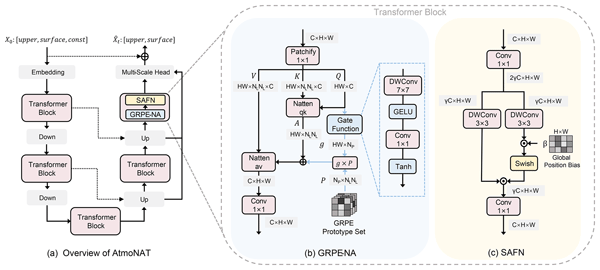
Inspired by feature pyramid network (Lin et al., 2017), The architecture of AtmoNAT (Fig. 1a) employs a backbone comprising five Transformer blocks. The input data X0 consists of the current time-step upper-air and surface variables outlined in Sect. 2.1, alongside static geographic inputs. The output data represents the predicted upper-air and surface variables 12 h later. In the encoder pathway, the spatial resolution of the feature maps is halved at each downsampling block (“Down” in Fig. 1a) while the feature dimension doubles. The decoder pathway performs the inverse operations. Spatial downsampling is achieved using patch merging (Liu et al., 2021), whereas upsampling and feature alignment across varying resolutions (“Up” in Fig. 1a) are accomplished via frequency fusion (Fig. S1 in the Supplement; Chen et al., 2024). A multi-scale-head block (Fig. S1) fuses features from three distinct resolutions.

Figure 1Architecture of the proposed AtmoNAT. (a) Overview of AtmoNAT. Each Transformer Block contains two submodules, enlarged on the right: (b) GRPE-NA, Neighborhood Attention with Gated Relative Position Encoding; (c) SAFN, a Spatial Aware Feed-forward Network. Arrows denote data flow and dashed lines denote zoom-in relations.
Following an initial embedding layer, extracted features pass through the five Transformer blocks. Each block contains several submodules, each of which consists of two functional components: Neighborhood Attention with GRPE (GRPE-NA) and SAFN. For illustration, the fifth Transformer block in Fig. 1a displays a single submodule of GRPE-NA and SAFN. Similar to other models (Nguyen et al., 2024; Niu et al., 2025), AtmoNAT employs adaptive layer normalization to modulate the inputs and outputs of both the GRPE-NA and SAFN within each submodule. The required scale and shift parameters are regressed from the embeddings of the lead time and forecast initialization time. The detailed version of AtmoNAT's structure with time-embedding input, the structure of embedding block, and the structure of adaptive layer normalization are illustrated in Fig. S2.
2.2.2 Neighborhood Attention with Gated Relative Position Encoding (GRPE-NA)
The GRPE-NA is detailed in Fig. 1b. Given an input feature map (where C, H, and W denote the channel, height, and width dimensions, respectively), a 1 × 1 convolution generates the query (Q), key (K), and value (V) tensors, all preserving the spatial dimensions of x.
Following Hassani et al. (2023), neighborhood attention is computed by first defining a query vector at spatial location (x,y) in Q. The corresponding key and value vectors within a local NL×NL neighborhood of K and V centered at (x,y) are denoted as and . For any point (i,j) within this neighborhood, the scaled dot-product prod(i,j) is calculated as:
The attention score at (i,j), is then derived via a SoftMax operation over the neighborhood:
Finally, the neighborhood attention's output vector at (x,y), ox,y, is the weighted sum of the value vectors :
In Fig. 1b, Eqs. (2) and (3) correspond to the operations in the “Natten-qk” module, while Eq. (4) characterizes the “Natten-av” module. Applying Eqs. (2) and (3) across all H×W spatial locations yields the final attention map A is reshaped into a two-dimensional tensor for convenience.
To compute the GRPE (E), we define NP learnable prototypes, collectively denoted as . The query tensor Q is processed through a gating function, comprising a 7 × 7 depth wise separable convolution, a GeLU activation (Hendrycks and Gimpel, 2016), a 1 × 1 convolution, and a Tanh activation:
Equation (5) yields the partition variable . The GRPE is then calculated as:
The resulting is added directly the attention map A. The calculations of GRPE through Eqs. (5) and (6) are illustrated by the blue arrows in Fig. 1b. Consequently, the scaled dot-product in Eq. (2) is updated to incorporate this spatial encoding:
This updated product in Eq. (7) generates the final neighborhood attention output, which subsequently passes through a 1 × 1 convolution to produce the input features for the SAFN.
Atmospheric motions are inherently directional; for instance, substance transport follows wind direction, which is driven by pressure gradients. To account for this directionality, the GRPE calculation must aggregate information across a large neighborhood. Therefore, the 7 × 7 depth-wise separable convolution in Eq. (5) analyzes features in query tensor Q over an extended receptive field to determine the partition variable g.
Let the GRPE and partition variable g at coordinate (x,y) be and , respectively, where gx,y(k) is the kth partition variable. If is the kth prototype in P, Eq. (6) yields:
In Eq. (8), GRPE is represented as a linear combination of learnable prototypes Pk, weighted by gx,y, which generalizes across all spatial coordinates. In summary, g provides the weighting coefficients for the prototypes, independently determining the GRPE at each location to capture the location-dependency of atmospheric motions. Furthermore, GRPE's reliance on Q introduces essential temporal variations, accounting for the dynamic nature of the atmosphere. The location-dependency, and time variations of GRPE are further discussed in Sect. 4.
2.2.3 Spatial Aware Feed-Forward Network (SAFN)
The SAFN architecture, shown in Fig. 1c, consists of parallel input and gating branches. For an input feature map , a 1 × 1 convolution projects the features into a 2γC-dimensional space. This projection is split evenly along the channel dimension and processed by two parallel 3 × 3 depth-wise separable convolutions. This yields the input features and the gating features .
The gating branch spatially modulates the information flowing from the input branch. To ensure precise spatial control, the gating features G are multiplied element-wise by a global positional bias for each channel. The product passes through a Swish activation function (Ramachandran et al., 2017) to produce the gating coefficients. The final output O is calculated as:
where ⊙ denotes element-wise multiplication.
SAFN builds on the Gated-Dconv Feed-Forward Network in Restormer (Zamir et al., 2022). To account for terrain's persistent, location-dependent influence on atmospheric motion, we introduce a global positional bias β when computing the gating coefficients. Multiplicative interactions between the input features I and gating features G provide a way to represent interaction among atmospheric variables. These interactions also extend across space: for example, local transport is influenced by the surrounding wind field. Parallel 3 × 3 depth wise separable convolutions capture this spatial context by incorporating information from neighboring locations. The ablation studies in Sect. 3.2 assess SAFN's contribution to AtmoNAT's forecasting performance.

Figure 2Relative RMSE of data-driven weather models trained on coarse resolution on key variables. Relative RMSE is calculated based on HRES performances.

Figure 3ACC of different data-driven weather models trained on coarse resolution on key variables till 72 h lead time.
3.1 Comparisons with other data-driven weather models
In this section, we compare the root mean square error (RMSE) and anomaly correlation coefficient (ACC) of AtmoNAT against several state-of-the-art data-driven weather models, including Pangu-Weather (Bi et al., 2023), NeuralGCM (Kochkov et al., 2024), GraphCast (Lam et al., 2023), FuXi (Chen et al., 2023b), Aurora (Bodnar et al., 2025), FengWu (Chen et al., 2025), Baguan (Niu et al., 2025), ArchesWeather (Couairon et al., 2024), and Stormer (Nguyen et al., 2024). For NeuralGCM, Stormer, and ArchesWeather, we evaluate the mean of its ensemble predictions. Ensemble prediction can substantially improve their performances. Regarding training resolutions, AtmoNAT and ArchesWeather are trained at 1.5°, NeuralGCM and Stormer at 1.4°, and all other models at 0.25°. Both the RMSE and ACC metrics incorporate area weighting, consistent with Rasp et al. (2024). Furthermore, RMSEs are normalized against the High-Resolution Ensemble Forecast (HRES) system from the ECMWF.
As detailed in Sect. 2.2.1, we define the combination of GRPE-NA and SAFN as a single feature extraction submodule. The five Transformer blocks in AtmoNAT (Fig. 1a) contain 10, 8, 4, 8, and 10 of these submodules, respectively. Due to GPU memory constraints, AtmoNAT's embedding dimension is restricted to 128, resulting in a total of 43.4 million parameters. The model was trained on two NVIDIA RTX 4090 GPUs for 28 d and is utilized for all subsequent performance comparisons.
Figure 2 illustrates the relative RMSE across different models. For a fair evaluation, we restrict this comparison to models trained at coarse resolutions: AtmoNAT and the ensemble forecasts of ArchesWeather, Stormer and NeuralGCM. AtmoNAT significantly outperforms the other models on 850 hPa zonal (U850) and meridional (V850) winds up to a 72 h lead time. It also demonstrates distinctly lower RMSEs for 10 m winds (U10 m, V10 m) and 850 hPa temperature (T850) up to an 84 h lead time. Furthermore, its lower prediction error for 700 hPa specific humidity (Q700) is sustained through a 60 h lead time. For 500 hPa geopotential (Z500) and 2 m temperature (T2 m), AtmoNAT surpasses Stormer, and is only outperformed by NeuralGCM on Z500 at lead times exceeding 48 h. Notably, AtmoNAT remains nearly the most accurate model for MSLP up to a 120 h lead time. In summary, single AtmoNAT's deterministic forecasts achieve superior performance across most key variables up to 72 h when compared with the ensemble forecasts of other coarse-resolution models.

Figure 4Relative RMSE of data-driven weather models in global land area on key variables. Relative RMSE is calculated based on HRES performances.
The relative RMSEs for specific geographical regions (Figs. S4–S9) align with the global findings in Fig. 2. Additionally, Fig. S3 compares AtmoNAT's RMSE against all evaluated data-driven weather models, including those trained at 0.25° resolution. While AtmoNAT performs significantly better than Pangu-Weather, it trails behind FuXi and GraphCast. On certain variables, AtmoNAT's performance degrades beyond a 72 h lead time; this is expected, as resource limitations restricted multi-step fine-tuning to a maximum 48 h lead time.
Figure 3 presents the ACC of the coarse-resolution models for key variables up to a 72 h lead time. These ACC trends are highly consistent with the RMSE results in Fig. 2. AtmoNAT achieves the highest ACC for MSLP, T850, U850, V850, U10 m, and V10 m. Notably, its ACC for wind velocities (U850, V850, U10 m, V10 m) is visually higher than that of the competing models. It outperforms Stormer on T2 m, while ACC values for Q700 and Z500 are nearly identical across all models. Extended ACC results up to a 120 h lead time (Fig. S10) reveal a performance degradation at day 5, again attributable to the 48 h fine-tuning limit imposed by computational constraints.
Figure 4 depicts the relative RMSE evaluated specifically over global land areas, incorporating state-of-the-art models trained at 0.25° resolution. Notably, AtmoNAT significantly outperforms all other models, including FuXi and GraphCast, on U10 m, V10 m, and Q700 up to a 120 h lead time. It also achieves the lowest RMSE for U850 and V850 between 48 and 108 h. For Z500, T850, and MSLP, AtmoNAT's performance remains comparable to other coarse-resolution models and distinctly superior to Pangu-Weather. Figure S3 shows the relative RMSE evaluated over global land areas, including ocean areas. AtmoNAT still cannot beat GraphCast and FuXi on all variables. Its superior performances on Q700, U850, V850, U10 m, and V10 m indicates that it cannot perform equally well in ocean areas. RMSE analyses on different geographical regions including those only on land area are presented in Figs. S11–S22.
Figure 5 compares forecast errors of key variables over Eurasia by AtmoNAT, HRES, Pangu-Weather, NeuralGCM, FuXi, and GraphCast. Error field analysis indicates that AtmoNAT consistently maintains lower prediction errors across the middle-to-high latitudes of Eurasia. For example, while other models exhibit distinct Z500 errors over northern Eurasia, AtmoNAT mitigates these inaccuracies. Similarly, pronounced positive MSLP errors are visible for other models over northwestern Eurasia, whereas AtmoNAT achieves a significantly lower RMSE. For Q700 and wind velocities (U850, V850, U10 m, V10 m), AtmoNAT's error fields are uniformly near zero, corroborating the state-of-the-art performance demonstrated in Fig. 4, even compared with the first-class models including FuXi and GraphCast. Forecasts initialized at two alternative times (Figs. S23 and S24) display consistent results.
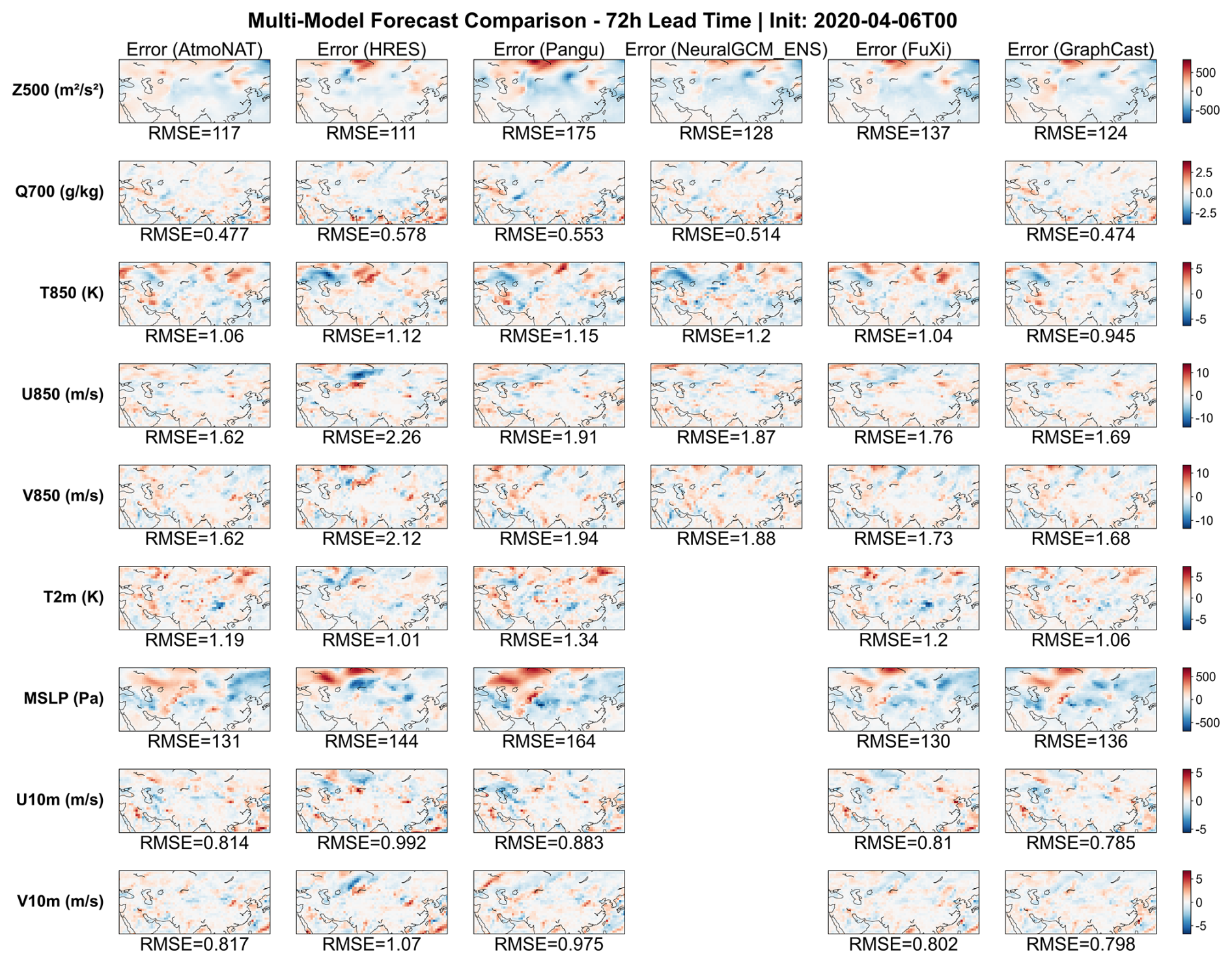
Figure 5Forecast error comparisons between different models on Eurasia at 72 h lead time initialized at 6 April 2020, 00:00:00 UTC. From left to right columns are error fields from AtmoNAT, HRES, Pangu-Weather, NeuralGCM, FuXi, and GraphCast. RMSE of each error field is located at the bottom of each subplot. Some error fields are not provided by NeuralGCM and FuXi, because those results are not included in WeatherBench 2.
3.2 Ablation study
To evaluate the relative contributions of AtmoNAT's architectural components, especially GRPE and SAFN, we conducted a step-by-step ablation study, comparing the 24 h lead time RMSEs of seven model variants (Table 1). We established a baseline model, denoted as “Swin Attention”. The latent dimension of this model is 96. It only uses Swin Transformer blocks (Liu et al., 2021). Multi-Scale Head is removed. Multi-step autoregressive fine-tuning is not applied. The remaining six models were constructed by sequentially integrating our proposed modifications: (1) replacing Shifted Window Self-Attention of Swin Transformer with Neighborhood Attention, (2) adding the Multi-Scale Head, (3) incorporating GRPE into the Neighborhood Attention, (4) substituting the standard Transformer feed-forward network (FFN; Vaswani et al., 2017) with SAFN, (5) increasing the latent dimension to 128, and finally, (6) applying multi-step autoregressive fine-tuning.
Except for the fine-tuned variant, all models in this section were trained for 110 000 iterations with a batch size of 8. Table 1 also reports the parameter counts and floating-point operations (FLOPs) during inference. The results indicate that standard Neighborhood Attention performs similarly to Swin Attention. It means that the performance of AtmoNAT is not due to the backbone choice. While the Multi-Scale Head reduces RMSE, its impact is less pronounced than that of GRPE and SAFN. Scaling the model capacity and applying autoregressive fine-tuning also yield substantial performance gains.
Table 1RMSE, parameter counts, and FLOPs of AtmoNATs for ablation study.

Note: Numbers in the parentheses are the parameter count or FLOPs change compared to the model in the former row. The lowest RMSEs are bolded. The performances of different models are validated at 24 h lead time on testing data.

Figure 6Relative RMSE of AtmoNATs for ablation study in Table 1 on key variables. Relative RMSE is calculated based on HRES performances.


Figure 6 extends the analysis in Table 1 up to a 120 h lead time. Consistent with Table 1, forecasting accuracy steadily improves with the progressive addition of new components, increased capacity, and fine-tuning. Neighborhood Attention and the Multi-Scale Head offer marginal improvements. The integration of GRPE yields a significant 5 % to 10 % RMSE reduction across most variables (excluding T2 m and Q700) at all lead times. Similarly, replacing the standard FFN with SAFN provides a stable 5 % to 10 % RMSE reduction across all variables. GRPE and SAFN achieve these substantial error reductions while increasing model size and FLOPs by only 1 % to 4 % (Table 1). Although increasing the latent dimension from 96 to 128 enhances performance, it nearly doubles the parameter count and FLOPs without yielding obvious improvements at longer lead times. Finally, consistent with previous studies (Nguyen et al., 2024), multi-step autoregressive fine-tuning is vital for long-range forecasting stability, delivering an approximately 10 % RMSE reduction across all key variables, particularly at 96 to 120 h lead times.
Figures 7 and 8 present scorecards detailing the relative RMSE improvements following the respective additions of GRPE and SAFN. Incorporating GRPE consistently reduces the RMSE of U,V, MSLP, U10 m, and V10 m by 5 % to 7.5 % across all vertical levels up to day 5. The most substantial improvement occurs for Z, which sees an overall RMSE reduction exceeding 7.5 %. Forecast accuracy also noticeably improves for T at pressure levels above 850 hPa, though gains are marginal for Q and T2 m. Notably, both Q and Z exhibit large RMSE reductions at altitudes above 150 hPa. The addition of SAFN produces a similar, but generally more pronounced, pattern of improvement (Fig. 8). SAFN enhances the predictions of U,V, and T by more than 7.5 % at levels above 400 hPa up to a 24 h lead time, while driving RMSE reductions of over 10 % for Z across all vertical levels up to day 3. Consistent with Fig. 6, both GRPE and SAFN are critical to AtmoNAT's high predictive accuracy.
Table 2RMSE, parameter counts, and FLOPs of AtmoNATs with different position encodings.

Note: The lowest RMSEs are bolded. The performances of different models are validated at 24 h lead time on testing data.
Table 2 isolates the impact of various position encodings on model RMSE. For these experiments, SAFN was replaced by a standard Transformer FFN, fine-tuning was disabled, and all models utilized a latent dimension of 96 and were trained for 1 825 000 iterations. We compared variants completely lacking position encodings against those utilizing standard relative position encodings (Liu et al., 2021), GRPE, and RoPE-Mixed (Heo et al., 2024) – a 2D adaptation of Rotary Positional Embeddings (Su et al., 2024) tailored for Vision Transformers. Because RoPE-Mixed is incompatible with Neighborhood Attention, it is evaluated exclusively within a Swin Transformer-based AtmoNAT backbone. Introducing any position encoding dramatically reduces AtmoNAT's RMSE compared to the baseline without encodings. Notably, GRPE achieves the lowest RMSE of all tested encodings.
Table 3 evaluates AtmoNAT variants equipped with different feed-forward networks, maintaining the training protocols and latent dimensions used in Table 2. The baseline model employs a standard Transformer FFN. The second variant replaces SAFN with a standard gating mechanism, the Swish-Gated Linear Unit (SwiGLU; Shazeer, 2020). SwiGLU resembles SAFN but applies uniform linear projections across all spatial locations of the global feature map. The results demonstrate that SwiGLU outperforms the standard FFN, affirming the effectiveness of gating mechanisms in data-driven weather forecasting. However, SAFN achieves distinctly lower RMSEs than SwiGLU. We attribute this superior performance to SAFN's use of parallel depth-wise separable convolutions, which extract non-local spatial context. This extended receptive field explicitly enables non-local feature interactions, a critical requirement for accurately predicting atmospheric dynamics.
Table 3RMSE, parameter counts, and FLOPs of AtmoNATs with different feed-forward networks.

Note: The lowest RMSEs are bolded. The performances of different models are validated at 24 h lead time on testing data.

Figure 9Scatter plot of RMSE improvement over HRES versus training cost (a), model size (b), and floating-point operations (FLOPs) per inference (c). Training costs are normalized to GPU days of NVIDIA V100.
Figure 9 illustrates the relative RMSE improvement over HRES for various data-driven weather models, aggregated across Z500, T850, Q700, and 850 hPa wind vectors following Rasp et al. (2024). To ensure fairness, this comparison is restricted to the first three forecast days, matching AtmoNAT's maximum 48-hour fine-tuning lead time. Baseline models' RMSEs are sourced from the WeatherBench 2 website, while training costs, model sizes, and FLOPs are drawn from published works. Training costs were normalized to NVIDIA V100 GPU days.
As shown in Fig. 9a, AtmoNAT, ArchesWeather, and FuXi are the most efficient models regarding RMSE improvement divided by training cost. When evaluating RMSE improvement divided by parameter count (Fig. 9b), AtmoNAT ranks second only to GraphCast; notably, competing models contain 7.5 to 75 times more parameters. Furthermore, AtmoNAT stands out as the most computationally efficient model, demonstrating the highest RMSE improvement divided by FLOPs per inference (Fig. 9c). Other models outperform AtmoNAT at the expense of requiring 5 to 30 times more FLOPs. Overall, AtmoNAT achieves the lowest RMSE among coarse-resolution models and Pangu-Weather, proving to be the most efficient model when taking training cost, model size, and computational cost all into account. From results shown previously, GRPE and SAFN achieve substantial error reductions with omittable model size and FLOPs increase, which contributes a lot to AtmoNAT's high efficiency.
To understand the efficacy of GRPE, Fig. 10 visualizes the learned GRPE prototypes, the corresponding partition variables (g), and the resulting aggregated GRPEs at two distinct geographic locations and forecast initialization times. For this analysis, we extracted four representative prototypes and their partition variables from the second GRPE-NA module within the final Transformer block.
As shown, the prototypes capture distinct spatial patterns learned dynamically during training: Prototype 1 divides positive and negative areas along a diagonal, Prototypes 2 and 4 feature a horizontal division across the center, and Prototype 3 centers a large negative bias at its core. The final GRPE is a linear combination of the prototypes.
Furthermore, the partition variable g independently determines the prototype weights at each spatial location, enabling the encoding to adapt to localized weather phenomena and successfully preserving the location-dependency of the atmosphere. Additionally, g exhibits clear temporal variations (Fig. 10a), inducing dynamic changes in the resulting GRPE over South America (Fig. 10b). This demonstrates GRPE's capacity to adjust to the temporal variability of atmospheric systems. Ultimately, GRPE's success in data-driven weather prediction stems from its comprehensive integration of temporal variability and location-dependency of atmospheric motions.

Figure 10Subplot (a) presents GRPE prototypes and corresponding gating variables g at each spatial coordinate. GRPEs in subplot (b) are the weighted sum of prototypes with weighting coefficients defined by g. The spatial locations of GRPEs are also presented in the world map at upper-right region. g and GRPEs are shown at prediction starting time 7 July 2020, 00:00:00 UTC and 14 December 2020, 12:00:00 UTC.
To understand the function of the global position bias β, Fig. 11 illustrates β of the final four SAFNs within the last Transformer block. These biases correlate with global terrain, exhibiting absolute values that are generally proportional to altitude. By accounting for the permanent influence of topography, the global positional bias provides the SAFN with an additional degree of freedom to generate more accurate gating coefficients [G⊙β in Eq. 9]. Consequently, this mechanism likely contributes to AtmoNAT's superior forecasting performance over global land areas.

Figure 11The visualization of global positional bias β of the last four SAFNs in the last Transformer block.
In this study, we propose GRPE and SAFN to enhance NAT-based data-driven weather forecasting. GRPE dynamically adjusts relative positional relationships according to the evolving atmospheric state, enabling the model to represent flow-dependent and time-varying features while retaining location-specific positional information with negligible increases in model size and computational cost. In parallel, SAFN introduces a spatially aware gating mechanism modulated by a global positional bias, allowing direct feature interactions to account for persistent geographical influences such as terrain and other location-dependent surface effects.
The performance of the GRPE- and SAFN-enhanced model is first evaluated in deterministic forecasting experiments. AtmoNAT achieves competitive performance across most key variables at lead times of up to 72 h, outperforming Pangu-Weather (Bi et al., 2023) and the ensemble forecasts of several coarse-resolution models (Kochkov et al., 2024; Couairon et al., 2024; Nguyen et al., 2024). Over global land areas, AtmoNAT also attains favorable accuracy for U10 m, V10 m, U850, V850, and Q700, surpassing several high-resolution models, including FuXi (Chen et al., 2023b) and GraphCast (Lam et al., 2023). In addition to forecast skill, AtmoNAT demonstrates strong computational efficiency, ranking among the most efficient models in terms of RMSE improvement relative to training cost and FLOPs, and second in RMSE improvement relative to parameter count.
Ablation experiments further confirm the effectiveness of both proposed components. GRPE and SAFN consistently improve predictive accuracy while introducing only negligible increases in parameter count and FLOPs, which contributes a lot to AtmoNAT's high efficiency. Comparisons with alternative positional encoding schemes and feed-forward network designs show that the NAT architecture equipped with GRPE and SAFN produces the lowest overall forecasting errors, indicating that explicitly modeling both flow-dependent spatial relationships and direct feature interactions is beneficial for data-driven weather prediction.
Building on this proof of concept, future work should evaluate GRPE and SAFN in larger AtmoNAT configurations with increased latent dimensions and extended fine-tuning lead times. Because Neighborhood Attention substantially reduces computational and memory requirements compared with standard global self-attention, it has become increasingly attractive for recent data-driven weather forecasting systems (e.g., Du et al., 2025; Pathak et al., 2026). Incorporating GRPE and SAFN into such architectures may provide an efficient route toward Earth-system-aware Transformer models that better represent both the evolving dynamics and spatial heterogeneity of the atmosphere, offering a promising foundation for the next generation of data-driven weather forecasting systems.
Source code of AtmoNAT can be accessed at https://doi.org/10.5281/zenodo.20537815 (Huang and Wang, 2026). ERA5 data for training, validation, and testing AtmoNAT can be accessed at https://doi.org/10.24381/cds.bd0915c6 (Hersbach et al., 2023). A 10 d test dataset for quick evaluation, a pretrained checkpoint, and data preprocessing scripts that regrid the raw ERA5 onto a 1.5° equiangular grid are also included in Huang and Wang (2026).
The supplement related to this article is available online at https://doi.org/10.5194/gmd-19-11149-2026-supplement.
Conceptualization: XH; Formal analysis: LW; Funding acquisition: JZY; Methodology: XH; Project administration: JZY; Writing (original draft preparation): LW; Writing (review and editing): LW, DZ, JZY, BP, DX, XH.
The contact author has declared that none of the authors has any competing interests.
Publisher's note: Copernicus Publications remains neutral with regard to jurisdictional claims made in the text, published maps, institutional affiliations, or any other geographical representation in this paper. The authors bear the ultimate responsibility for providing appropriate place names. Views expressed in the text are those of the authors and do not necessarily reflect the views of the publisher.
The authors thank P. Zhang for his guidance on formulating the idea. The authors thank the insights from the anonymous reviewers to improve the quality of this work. During the preparation of this manuscript, the authors used Gemini 3 and ChatGPT 5 for the purposes of language polishing.
This work is funded by Smart-Grid National Science and Technology Major Project (grant no. 2025ZD0805500).
This paper was edited by Stefan Rahimi-Esfarjani and reviewed by two anonymous referees.
Arnab, A., Dehghani, M., Heigold, G., Sun, C., Lučić, M., and Schmid, C.: ViViT: A video vision transformer, in: Proceedings of the IEEE/CVF International Conference on Computer Vision (ICCV 2021), Online Meeting, 11–17 October 2021, 6836–6846, https://doi.org/10.1109/ICCV48922.2021.00676, 2021.
Bauer, P., Thorpe, A., and Brunet, G.: The quiet revolution of numerical weather prediction, Nature, 525, 47–55, https://doi.org/10.1038/nature14956, 2015.
Bertasius, G., Wang, H., and Torresani, L.: Is Space-time attention all you need for video understanding?, in: Proceedings of the 38th International Conference on Machine Learning (ICML 2021), Online Meeting, 18–24 July 2021, 139, 813–824, https://proceedings.mlr.press/v139/bertasius21a.html (last access: 20 November 2026), 2021.
Bi, K., Xie, L., Zhang, H., Chen, X., Gu, X., and Tian, Q.: Accurate medium-range global weather forecasting with 3D neural networks, Nature, 619, 533–538, https://doi.org/10.1038/s41586-023-06185-3, 2023.
Bodnar, C., Bruinsma, W. P., Lucic, A., Stanley, M., Allen, A., Brandstetter, J., Garvan, P., Riechert, M., Weyn, J. A., Dong, H., Gupta, J. K., Thambiratnam, K., Archibald, A. T., Wu, C.-C., Heider, E., Welling, M., Turner, R. E., and Perdikaris, P.: A foundation model for the Earth system, Nature, 641, 1180–1187, https://doi.org/10.1038/s41586-025-09005-y, 2025.
Charbonnier, P., Blanc-Feraud, L., Aubert, G., and Barlaud, M.: Two deterministic half-quadratic regularization algorithms for computed imaging, in: Proceedings of 1st International Conference on Image Processing, Austin, Texas, USA, 13–16 November 1994, 2, 168–172, https://doi.org/10.1109/ICIP.1994.413553, 1994.
Cheon, M.: AtmosMJ: Revisiting gating mechanism for ai weather forecasting beyond the year scale, arXiv [preprint], https://doi.org/10.48550/arXiv.2506.09733, 11 June 2025.
Chen, K., Bai, L., Ling, F., Ye, P., Chen, T., Luo, J.-J., Chen, H., Xiao, Y., Chen, K., Han, T., and Ouyang, W.: Towards an end-to-end artificial intelligence driven global weather forecasting system, arXiv [preprint], https://doi.org/10.48550/arXiv.2312.12462, 18 December 2023a.
Chen, K., Han, T., Ling, F., Gong, J., Bai, L., Wang, X., Luo, J.-J., Fei, B., Zhang, W., Chen, X., Ma, L., Zhang, T., Su, R., Ci, Y., Li, B., Yang, X., and Ouyang, W.: The operational medium-range deterministic weather forecasting can be extended beyond a 10-day lead time, Communications Earth & Environment, 6, 518, https://doi.org/10.1038/s43247-025-02502-y, 2025.
Chen, L., Chu, X., Zhang, X., and Sun, J.: Simple baselines for image restoration, in: European Conference on Computer Vision (ECCV 2022), Tel Aviv, Israel, 23–27 October 2022, 17–33, https://doi.org/10.1007/978-3-031-20071-7_2, 2022.
Chen, L., Fu, Y., Gu, L., Yan, C., Harada, T., and Huang, G.: Frequency-aware feature fusion for dense image prediction, IEEE T. Pattern Anal., 46, 10763–10780, https://doi.org/10.1109/TPAMI.2024.3449959, 2024.
Chen, L., Zhong, X., Zhang, F., Cheng, Y., Xu, Y., Qi, Y., and Li, H.: FuXi: A cascade machine learning forecasting system for 15-day global weather forecast, npj Clim. Atmos. Sci., 6, 190, https://doi.org/10.1038/s41612-023-00512-1, 2023b.
Chung, J., Gulcehre, C., Cho, K., and Bengio, Y.: Empirical evaluation of gated recurrent neural networks on sequence modeling, arXiv [preprint], https://doi.org/10.48550/arXiv.1412.3555, 11 December 2014.
Couairon, G., Lessig, C., Charantonis, A., and Monteleoni, C.: ArchesWeather: An efficient AI weather forecasting model at 1.5° resolution, arXiv [preprint], https://doi.org/10.48550/arXiv.2405.14527, 23 May 2024.
Du, H., Kim, L., Creus-Costa, J., Michaels, J., Shetty, A., Hutchinson, T., Riedel, C., and Dean, J.: WeatherMesh-3: Fast and accurate operational global weather forecasting, arXiv [preprint], https://doi.org/10.48550/arXiv.2503.22235, 28 March 2025.
Esteves, C., Slotine, J. J., and Makadia, A.: Scaling spherical CNNs, in: Proceedings of the 40th International Conference on Machine Learning (ICML 2023), Honolulu, Hawaii, USA, 23–29 July 2023, 202, 9396–9411, https://proceedings.mlr.press/v202/esteves23a.html (last access: 20 November 2026), 2023.
Gao, Z., Shi, X., Wang, H., Zhu, Y., Wang, Y., Li, M., and Yeung, D.-Y.: Earthformer: exploring space-time transformers for earth system forecasting, in: Advances in Neural Information Processing Systems 35 (NeurIPS 2022), New Orleans, Louisiana, USA, 28 November–9 December 2022, 35, 25390–25403, https://doi.org/10.52202/068431-1841, 2022.
Grattafiori, A., Dubey, A., Jauhri, A., et al.: The Llama 3 herd of models, arXiv [preprint], https://doi.org/10.48550/arXiv.2407.21783, 31 July 2024.
Haiden, T., Janousek, M., Vitart, F., Prates, F., Maier-Gerber, M., Li, C. W. Y., and Chevallier, M.: Evaluation of ECMWF forecasts, ECMWF Tech. Memo. 931, European Centre for Medium-Range Weather Forecasts, Reading, UK, https://doi.org/10.21957/51e665e5c8, 2025.
Hassani, A., Walton, S., Li, J., Li, S., and Shi, H.: Neighborhood attention transformer, in: Proceedings of the IEEE/CVF Conference on Computer Vision and Pattern Recognition (CVPR 2023), Vancouver, Canada, 18–22 June 2023, 6185–6194, https://doi.org/10.1109/CVPR52729.2023.00599, 2023.
Hendrycks, D. and Gimpel, K.: Gaussian error linear units (GELUs), arXiv [preprint], https://doi.org/10.48550/arXiv.1606.08415, 27 June 2016.
Heo, B., Park, S., Han, D., and Yun, S.: Rotary position embedding for vision transformer, in: Proceedings of the European Conference on Computer Vision (ECCV 2024), Milan, Italy, 29 September–4 October 2024, 289–305, https://doi.org/10.1007/978-3-031-72684-2_17, 2024.
Hersbach, H., Bell, B., Berrisford, P., Hirahara, S., Horányi, A., Muñoz-Sabater, J., Nicolas, J., Peubey, C., Radu, R., Schepers, D., Simmons, A., Soci, C., Abdalla, S., Abellan, X., Balsamo, G., Bechtold, P., Biavati, G., Bidlot, J., Bonavita, M., De Chiara, G., Dahlgren, P., Dee, D., Diamantakis, M., Dragani, R., Flemming, J., Forbes, R., Fuentes, M., Geer, A., Haimberger, L., Healy, S., Hogan, R. J., Hólm, E., Janisková, M., Keeley, S., Laloyaux, P., Lopez, P., Lupu, C., Radnoti, G., de Rosnay, P., Rozum, I., Vamborg, F., Villaume, S., and Thépaut, J. N.: The ERA5 global reanalysis, Q. J. Roy. Meteor. Soc., 146, 1999–2049, https://doi.org/10.1002/qj.3803, 2020.
Hersbach, H., Bell, B., Berrisford, P., Biavati, G., Horányi, A., Muñoz Sabater, J., Nicolas, J., Peubey, C., Radu, R., Rozum, I., Schepers, D., Simmons, A., Soci, C., Dee, D., and Thépaut, J.-N.: ERA5 hourly data on pressure levels from 1940 to present, Copernicus Climate Change Service (C3S) Climate Data Store (CDS) [data set], https://doi.org/10.24381/cds.bd0915c6, 2023.
Hochreiter, S. and Schmidhuber, J.: Long short-term memory, Neural Comput., 9, 1735–1780, https://doi.org/10.1162/neco.1997.9.8.1735, 1997.
Huang, X. and Wang, L.: Neighborhood Attention Transformer for Atmospheric prediction (AtmoNAT), Zenodo [code], https://doi.org/10.5281/zenodo.20537815, 2026.
Keisler, R.: Forecasting global weather with graph neural networks, arXiv [preprint], https://doi.org/10.48550/arXiv.2202.07575, 15 February 2022.
Kochkov, D., Yuval, J., Langmore, I., Norgaard, P., Smith, J., Mooers, G., Klöwer, M., Lottes, J., Rasp, S., Düben, P., Hatfield, S., Battaglia, P., Sanchez-Gonzalez, A., Willson, M., Brenner, M. P., and Hoyer, S.: Neural general circulation models for weather and climate, Nature, 632, 1060–1066, https://doi.org/10.1038/s41586-024-07744-y, 2024.
Lam, R., Sanchez-Gonzalez, A., Willson, M., Wirnsberger, P., Fortunato, M., Alet, F., Ravuri, S., Ewalds, T., Eaton-Rosen, Z., Hu, W., Merose, A., Hoyer, S., Holland, G., Vinyals, O., Stott, J., Pritzel, A., Mohamed, S., and Battaglia, P.: Learning skillful medium-range global weather forecasting, Science, 382, 1416–1421, https://doi.org/10.1126/science.adi2336, 2023.
Lin, T. Y., Dollár, P., Girshick, R., He, K., Hariharan, B., and Belongie, S.: Feature pyramid networks for object detection, in: Proceedings of the IEEE Conference on Computer Vision and Pattern Recognition (CVPR 2017), Honolulu, Hawaii, USA, 21–26 July 2017, 2117–2125, https://doi.org/10.1109/CVPR.2017.106, 2017.
Liu, Z., Lin, Y., Cao, Y., Hu, H., Wei, Y., Zhang, Z., Lin, S., and Guo, B.: Swin transformer: Hierarchical vision transformer using shifted windows, in: Proceedings of the IEEE/CVF International Conference on Computer Vision (ICCV 2021), Montreal, Canada, 11–17 October 2021, 10012–10022, https://doi.ieeecomputersociety.org/10.1109/ICCV48922.2021.00986 (last access: 20 November 2026), 2021.
Loshchilov, I. and Hutter, F.: Decoupled weight decay regularization, arXiv [preprint], https://doi.org/10.48550/arXiv.1711.05101, 14 November 2017.
Munir, M., Rahman, M. M., and Marculescu, R.: AdaptViG: Adaptive Vision GNN with exponential decay gating, arXiv [preprint], https://doi.org/10.48550/arXiv.2511.09942, 15 November 2025.
Nguyen, T., Shah, R., Bansal, H., Arcomano, T., Maulik, R., Kotamarthi, V., Foster, I., Madireddy, S., and Grover, A.: Scaling transformer neural networks for skillful and reliable medium-range weather forecasting, in: Proceedings of the 38th International Conference on Neural Information Processing Systems (NeurIPS 2024), Vancouver, Canada, 10–15 December 2024, 68740–68771, https://doi.org/10.52202/079017-2196, 2024.
Niu, P., Ma, Z., Zhou, T., Chen, W., Shen, L., Jin, R., and Sun, L.: Utilizing strategic pre-training to reduce overfitting: Baguan – a pre-trained weather forecasting model, in: Proceedings of the 31st ACM SIGKDD Conference on Knowledge Discovery and Data Mining, Toronto, Canada, 3–7 August 2025, 2186–2197, https://doi.org/10.1145/3711896.3737178, 2025.
Paszke, A., Gross, S., Massa, F., Lerer, A., Bradbury, J., Chanan, G., Killeen, T., Lin, Z., Gimelshein, N., Antiga, L., Desmaison, A., Köpf, A., Yang, E., DeVito, Z., Raison, M., Tejani, A., Chilamkurthy, S., Steiner, B., Fang, L., Bai, J., and Chintala, S.: PyTorch: An imperative style, high-performance deep learning library, in: Proceedings of the 33rd International Conference on Neural Information Processing Systems (NeurIPS 2019), Vancouver, Canada, 8–14 December 2019, 8026–8037, https://dl.acm.org/doi/10.5555/3454287.3455008 (last access: 20 November 2026), 2019.
Pathak, J., Abbas, M. S., Harrington, P., Hu, Z., Brenowitz, N., Ravuri, S., Carpentieri, A., Leinonen, J., Adams, C., Hennigh, O., Geneva, N., Durran, D., and Pritchard, M.: Skillful Thunderstorm Forecasts Learned Directly from Observations, arXiv [preprint], https://doi.org/10.48550/arXiv.2601.17268, 24 January 2026.
Qiu, Z., Wang, Z., Zheng, B., Huang, Z., Wen, K., Yang, S., Men, R., Yu, L., Huang, F., Huang, S., Liu, D., Zhou, J., and Lin, J.: Gated attention for large language models: Non-linearity, sparsity, and attention-sink-free, in: Proceedings of the 39th Annual Conference on Neural Information Processing Systems (NeurIPS 2025), San Diego, USA, 2–7 December 2025, 38, 110931–110957, https://doi.org/10.52202/085713-3345, 2025.
Ramachandran, P., Zoph, B., and Le, Q. V.: Searching for activation functions, arXiv [preprint], https://doi.org/10.48550/arXiv.1710.05941, 16 October 2017.
Rasp, S., Hoyer, S., Merose, A., Langmore, I., Battaglia, P., Russell, T., Sanchez-Gonzalez, A., Yang, V., Carver, R., Agrawal, S., Chantry, M., Ben Bouallegue, Z., Dueben, P., Bromberg, C., Sisk, J., Barrington, L., Bell, A., and Sha, F.: WeatherBench 2: A benchmark for the next generation of data-driven global weather models, J. Adv. Model. Earth Sy., 16, e2023MS004019, https://doi.org/10.1029/2023MS004019, 2024.
Shazeer, N.: GLU variants improve transformer, arXiv [preprint], https://doi.org/10.48550/arXiv.2002.05202, 12 February 2020.
Su, J., Ahmed, M., Lu, Y., Pan, S., Bo, W., and Liu, Y.: RoFormer: Enhanced transformer with rotary position embedding, Neurocomputing, 568, 127063, https://doi.org/10.1016/j.neucom.2023.127063, 2024.
To, D., Quinting, J., Hoshyaripour, G. A., Götz, M., Streit, A., and Debus, C.: Architectural insights into and training methodology optimization of Pangu-Weather, Geosci. Model Dev., 17, 8873–8884, https://doi.org/10.5194/gmd-17-8873-2024, 2024.
Vaswani, A., Shazeer, N., Parmar, N., Uszkoreit, J., Jones, L., Gomez, A. N., Kaiser, Ł., and Polosukhin, I.: Attention is all you need, in: Proceedings of the 31st Annual Conference on Neural Information Processing Systems (NeurIPS 2017), Long Beach, USA, 4–9 December 2017, 5998–6008, https://dl.acm.org/doi/10.5555/3295222.3295349 (last access: 20 November 2026), 2017.
Yang, A., Yang, B., Zhang, B., Hui, B., Zheng, B., Yu, B., Li, C., Liu, D., Huang, F., Wei, H., Lin, H., Yang, J., Tu, J., Zhang, J., Yang, J., Yang, J., Zhou, J., Lin, J., Dang, K., Lu, K., Bao, K., Yang, K., Yu, L., Li, M., Xue, M., Zhang, P., Zhu, Q., Men, R., Lin, R., Li, T., Tang, T., Xia, T., Ren, X., Ren, X., Fan, Y., Su, Y., Zhang, Y., Wan, Y., Liu, Y., Cui, Z., Zhang, Z., and Qiu, Z.: Qwen2.5 technical report, arXiv [preprint], https://doi.org/10.48550/arXiv.2412.15115, 19 December 2024a.
Yang, S., Kautz, J., and Hatamizadeh, A.: Gated delta networks: Improving Mamba2 with delta rule, arXiv [preprint], https://doi.org/10.48550/arXiv.2412.06464, 9 December 2024b.
Zamir, S. W., Arora, A., Khan, S., Hayat, M., Khan, F. S., and Yang, M. H.: Restormer: Efficient transformer for high-resolution image restoration, in: Proceedings of the IEEE/CVF Conference on Computer Vision and Pattern Recognition (CVPR 2022), New Orleans, USA, 19–24 June 2022, 5718–5729, https://doi.org/10.1109/CVPR52688.2022.00564, 2022.