
Articles | Volume 19, issue 22
https://doi.org/10.5194/gmd-19-10933-2026
© Author(s) 2026. This work is distributed under
the Creative Commons Attribution 4.0 License.
the Creative Commons Attribution 4.0 License.
https://doi.org/10.5194/gmd-19-10933-2026
© Author(s) 2026. This work is distributed under
the Creative Commons Attribution 4.0 License.
the Creative Commons Attribution 4.0 License.
Model evaluation paper
| 
17 Nov 2026
Model evaluation paper |
| 17 Nov 2026
| 17 Nov 2026
Evaluation of precipitation variability over complex terrain based on observations and high resolution WRF v4.2.2 modelling

Faculty of Physics, Complutense University of Madrid, Madrid, Spain
Agencia Estatal de Meteorología (AEMET), Madrid, Spain
Geosciences Institute, IGEO (CSIC-UCM), Madrid, Spain
Jorge Navarro-Montesinos
Research Center for Energy, Environment and Technology (CIEMAT), Madrid, Spain
Cristina Vegas-Cañas
Geosciences Institute, IGEO (CSIC-UCM), Madrid, Spain
Félix García-Pereira
Departamento de Producción Agraria, Escuela Técnica Superior de Ingeniería Agronómica, Alimentaria y de Biosistemas (ETSIAAB), Universidad Politécnica de Madrid (UPM), Madrid, Spain
Elena García-Bustamante
Research Center for Energy, Environment and Technology (CIEMAT), Madrid, Spain
Esteban Rodríguez-Guisado
Agencia Estatal de Meteorología (AEMET), Madrid, Spain
Ernesto Rodríguez-Camino
Spanish Meteorological Society (AME), Madrid, Spain
Juan Carlos Sánchez-Perrino
Agencia Estatal de Meteorología (AEMET), Madrid, Spain
Rita M. Cardoso
Institute Dom Luís (IDL), Faculty of Sciences, University of Lisbon, Lisbon, Portugal
Sara Madera-Sánchez
Faculty of Physics, Complutense University of Madrid, Madrid, Spain
Research Center for Energy, Environment and Technology (CIEMAT), Madrid, Spain
Almudena García-García
Department of Remote Sensing, Helmholtz Centre for Environmental Research–UFZ, Leipzig, Germany
Francisco José Cuesta-Valero
Department of Remote Sensing, Helmholtz Centre for Environmental Research–UFZ, Leipzig, Germany
Hugo Beltrami
Climate & Atmospheric Sciences Institute, St. Francis Xavier University, Antigonish, Canada
Department of Earth and Atmospheric Sciences, University of Quebec at Montreal (UQAM), Montreal, Canada
Freddy Pinochet-Erazo
Climate & Atmospheric Sciences Institute, St. Francis Xavier University, Antigonish, Canada
Department of Earth and Atmospheric Sciences, University of Quebec at Montreal (UQAM), Montreal, Canada
Related authors
No articles found.
Carlos Correa, Alfonso Hernanz, Iván San-Felipe, and Esteban Rodríguez-Guisado
Hydrol. Earth Syst. Sci., 30, 4457–4480, https://doi.org/10.5194/hess-30-4457-2026, https://doi.org/10.5194/hess-30-4457-2026, 2026
Short summary
Short summary
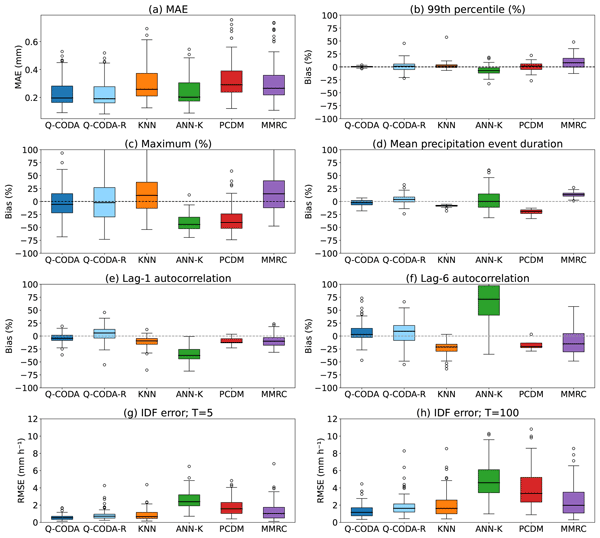
Heavy rainfall over short periods can cause floods and damage in cities, yet rainfall is often only measured daily. We developed a new method to generate realistic hourly rainfall data from daily values, using information from many weather stations in Spain and the United States. Our approach reproduces extreme rainfall more accurately than existing methods, helping to improve flood risk studies, infrastructure design, and climate impact assessments.
Ehsan Modiri, Oldrich Rakovec, Pallav Kumar Shrestha, Almudena García-García, Leandro Avila, Katie Blackford, Elizabeth Cooper, Bram Droppers, Paolo Filippucci, Milan Fischer, Matěj Orság, Pietro Stradiotti, Luca Brocca, Douglas B. Clark, Wouter Dorigo, Stefan Kollet, Jian Peng, Niko Wanders, and Luis Samaniego
EGUsphere, https://doi.org/10.5194/egusphere-2026-1012, https://doi.org/10.5194/egusphere-2026-1012, 2026
Short summary
Short summary
Drought impacts water supply, agriculture, and ecosystems, yet hydrological models often disagree on when and where drought occurs. This study tested whether satellite observations can improve how models represent soil moisture drought in the Rhine River basin. Using several models and major drought events, we show that satellite data improve spatial realism and reveal important differences among models, helping to better understand uncertainty in drought monitoring and early warning.
Félix García-Pereira, Jesús Fidel González-Rouco, Nagore Meabe-Yanguas, Philipp de Vrese, Norman Julius Steinert, Johann Jungclaus, and Stephan Lorenz
The Cryosphere, 19, 5959–5981, https://doi.org/10.5194/tc-19-5959-2025, https://doi.org/10.5194/tc-19-5959-2025, 2025
Short summary
Short summary
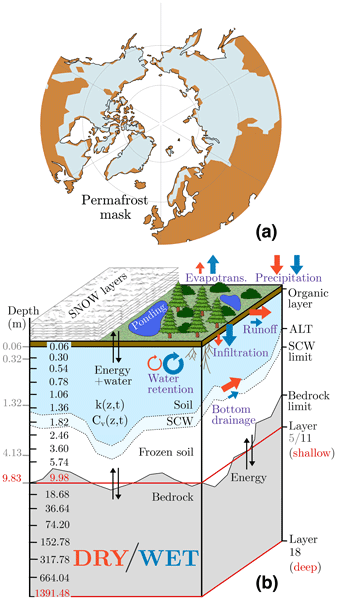
This work shows that changing the hydrological state of permafrost produces differences of up to 3 °C in the annual ground temperature, 1–2 m in the active layer thickness, and 5 million km2 in the permafrost extent. Including a deeper vertical thermal scheme reduces the extent decline by more than 2 million km2 in the highest radiative emission scenario. This is shown for the first time in fully-coupled experiments with an Earth System Model.
Clementine Dalelane, Andreas Paxian, Martín Senande, Sabela Sanfiz, Estéban Rodríguez Guisado, Jan Wandel, and Abhinav Tyagi
EGUsphere, https://doi.org/10.5194/egusphere-2025-3664, https://doi.org/10.5194/egusphere-2025-3664, 2025
Preprint archived
Short summary
Short summary
We propose a statistical technique for the construction of targeted teleconnection patterns, which maximizes the predictability of a user-selected impact variable in terms of large-scale atmospheric circulation. The implementation of targeted teleconnections into the statistical postprocessing of climate predictions can considerably increase the forecast skill compared to postprocessing based on EOF modes of variability.
João António Martins Careto, Rita Margarida Cardoso, Ana Russo, Daniela Catarina André Lima, and Pedro Miguel Matos Soares
Geosci. Model Dev., 17, 8115–8139, https://doi.org/10.5194/gmd-17-8115-2024, https://doi.org/10.5194/gmd-17-8115-2024, 2024
Short summary
Short summary
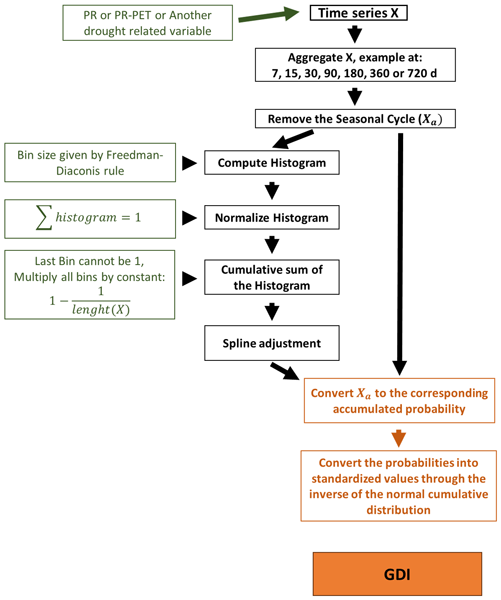
This study proposes a new daily drought index, the generalised drought index (GDI). The GDI not only identifies the same events as established indices but is also capable of improving their results. The index is empirically based and easy to compute, not requiring fitting the data to a probability distribution. The GDI can detect flash droughts and longer-term events, making it a versatile tool for drought monitoring.
Félix García-Pereira, Jesús Fidel González-Rouco, Camilo Melo-Aguilar, Norman Julius Steinert, Elena García-Bustamante, Philip de Vrese, Johann Jungclaus, Stephan Lorenz, Stefan Hagemann, Francisco José Cuesta-Valero, Almudena García-García, and Hugo Beltrami
Earth Syst. Dynam., 15, 547–564, https://doi.org/10.5194/esd-15-547-2024, https://doi.org/10.5194/esd-15-547-2024, 2024
Short summary
Short summary
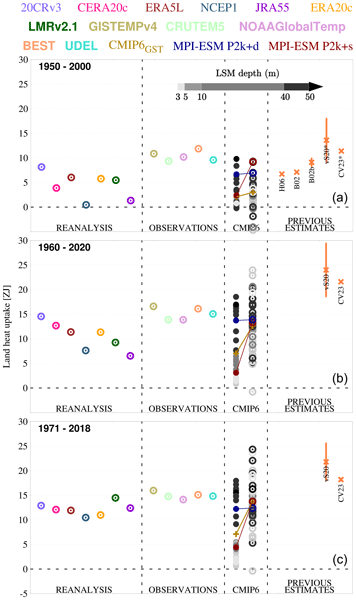
According to climate model estimates, the land stored 2 % of the system's heat excess in the last decades, while observational studies show it was around 6 %. This difference stems from these models using land components that are too shallow to constrain land heat uptake. Deepening the land component does not affect the surface temperature. This result can be used to derive land heat uptake estimates from different sources, which are much closer to previous observational reports.

João P. A. Martins, Sara Caetano, Carlos Pereira, Emanuel Dutra, and Rita M. Cardoso
Nat. Hazards Earth Syst. Sci., 24, 1501–1520, https://doi.org/10.5194/nhess-24-1501-2024, https://doi.org/10.5194/nhess-24-1501-2024, 2024
Short summary
Short summary
Over Europe, 2022 was truly exceptional in terms of extreme heat conditions, both in terms of temperature anomalies and their temporal and spatial extent. The satellite all-sky land surface temperature (LST) is used to provide a climatological context to extreme heat events. Where drought conditions prevail, LST anomalies are higher than 2 m air temperature anomalies. ERA5-Land does not represent this effect correctly due to a misrepresentation of vegetation anomalies.
Félix García-Pereira, Jesús Fidel González-Rouco, Thomas Schmid, Camilo Melo-Aguilar, Cristina Vegas-Cañas, Norman Julius Steinert, Pedro José Roldán-Gómez, Francisco José Cuesta-Valero, Almudena García-García, Hugo Beltrami, and Philipp de Vrese
SOIL, 10, 1–21, https://doi.org/10.5194/soil-10-1-2024, https://doi.org/10.5194/soil-10-1-2024, 2024
Short summary
Short summary
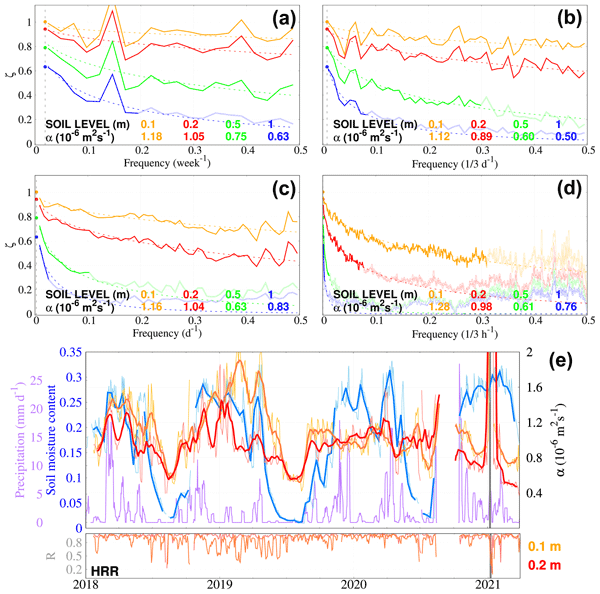
This work addresses air–ground temperature coupling and propagation into the subsurface in a mountainous area in central Spain using surface and subsurface data from six meteorological stations. Heat transfer of temperature changes at the ground surface occurs mainly by conduction controlled by thermal diffusivity of the subsurface, which varies with depth and time. A new methodology shows that near-surface diffusivity and soil moisture content changes with time are closely related.

Pedro José Roldán-Gómez, Jesús Fidel González-Rouco, Jason E. Smerdon, and Félix García-Pereira
Clim. Past, 19, 2361–2387, https://doi.org/10.5194/cp-19-2361-2023, https://doi.org/10.5194/cp-19-2361-2023, 2023
Short summary
Short summary
Analyses of reconstructed data suggest that the precipitation and availability of water have evolved in a similar way during the Last Millennium in different regions of the world, including areas of North America, Europe, the Middle East, southern Asia, northern South America, East Africa and the Indo-Pacific. To confirm this link between distant regions and to understand the reasons behind it, the information from different reconstructed and simulated products has been compiled and analyzed.
Philipp de Vrese, Goran Georgievski, Jesus Fidel Gonzalez Rouco, Dirk Notz, Tobias Stacke, Norman Julius Steinert, Stiig Wilkenskjeld, and Victor Brovkin
The Cryosphere, 17, 2095–2118, https://doi.org/10.5194/tc-17-2095-2023, https://doi.org/10.5194/tc-17-2095-2023, 2023
Short summary
Short summary
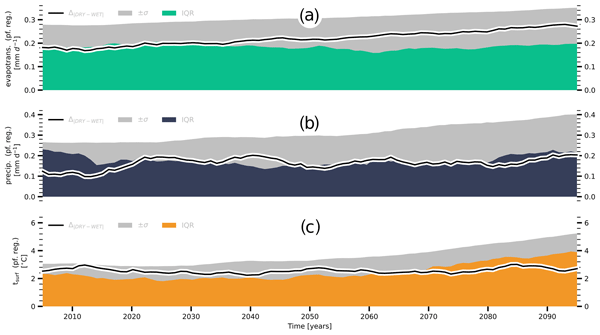
The current generation of Earth system models exhibits large inter-model differences in the simulated climate of the Arctic and subarctic zone. We used an adapted version of the Max Planck Institute (MPI) Earth System Model to show that differences in the representation of the soil hydrology in permafrost-affected regions could help explain a large part of this inter-model spread and have pronounced impacts on important elements of Earth systems as far to the south as the tropics.
Francisco José Cuesta-Valero, Hugo Beltrami, Almudena García-García, Gerhard Krinner, Moritz Langer, Andrew H. MacDougall, Jan Nitzbon, Jian Peng, Karina von Schuckmann, Sonia I. Seneviratne, Wim Thiery, Inne Vanderkelen, and Tonghua Wu
Earth Syst. Dynam., 14, 609–627, https://doi.org/10.5194/esd-14-609-2023, https://doi.org/10.5194/esd-14-609-2023, 2023
Short summary
Short summary
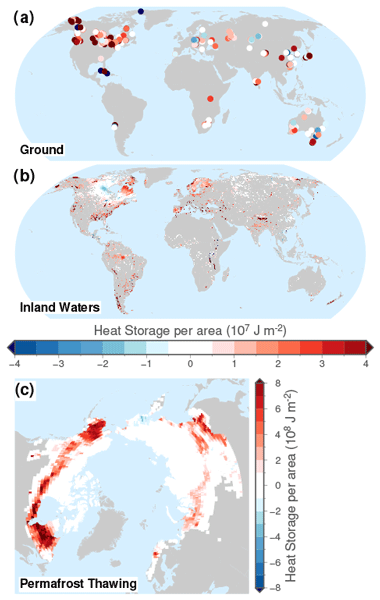
Climate change is caused by the accumulated heat in the Earth system, with the land storing the second largest amount of this extra heat. Here, new estimates of continental heat storage are obtained, including changes in inland-water heat storage and permafrost heat storage in addition to changes in ground heat storage. We also argue that heat gains in all three components should be monitored independently of their magnitude due to heat-dependent processes affecting society and ecosystems.
Karina von Schuckmann, Audrey Minière, Flora Gues, Francisco José Cuesta-Valero, Gottfried Kirchengast, Susheel Adusumilli, Fiammetta Straneo, Michaël Ablain, Richard P. Allan, Paul M. Barker, Hugo Beltrami, Alejandro Blazquez, Tim Boyer, Lijing Cheng, John Church, Damien Desbruyeres, Han Dolman, Catia M. Domingues, Almudena García-García, Donata Giglio, John E. Gilson, Maximilian Gorfer, Leopold Haimberger, Maria Z. Hakuba, Stefan Hendricks, Shigeki Hosoda, Gregory C. Johnson, Rachel Killick, Brian King, Nicolas Kolodziejczyk, Anton Korosov, Gerhard Krinner, Mikael Kuusela, Felix W. Landerer, Moritz Langer, Thomas Lavergne, Isobel Lawrence, Yuehua Li, John Lyman, Florence Marti, Ben Marzeion, Michael Mayer, Andrew H. MacDougall, Trevor McDougall, Didier Paolo Monselesan, Jan Nitzbon, Inès Otosaka, Jian Peng, Sarah Purkey, Dean Roemmich, Kanako Sato, Katsunari Sato, Abhishek Savita, Axel Schweiger, Andrew Shepherd, Sonia I. Seneviratne, Leon Simons, Donald A. Slater, Thomas Slater, Andrea K. Steiner, Toshio Suga, Tanguy Szekely, Wim Thiery, Mary-Louise Timmermans, Inne Vanderkelen, Susan E. Wjiffels, Tonghua Wu, and Michael Zemp
Earth Syst. Sci. Data, 15, 1675–1709, https://doi.org/10.5194/essd-15-1675-2023, https://doi.org/10.5194/essd-15-1675-2023, 2023
Short summary
Short summary
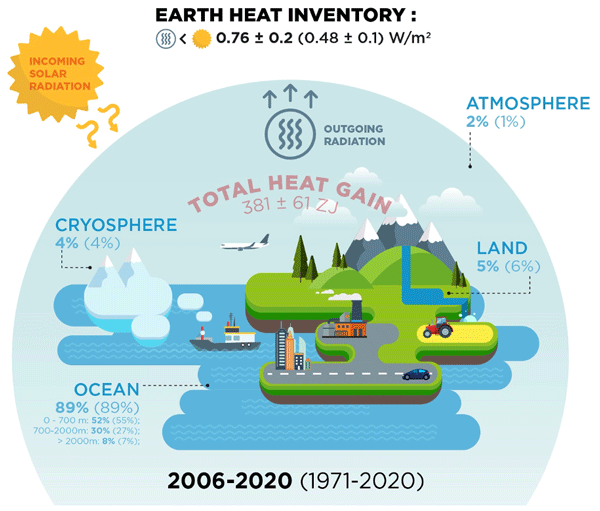
Earth's climate is out of energy balance, and this study quantifies how much heat has consequently accumulated over the past decades (ocean: 89 %, land: 6 %, cryosphere: 4 %, atmosphere: 1 %). Since 1971, this accumulated heat reached record values at an increasing pace. The Earth heat inventory provides a comprehensive view on the status and expectation of global warming, and we call for an implementation of this global climate indicator into the Paris Agreement’s Global Stocktake.
Francisco José Cuesta-Valero, Hugo Beltrami, Stephan Gruber, Almudena García-García, and J. Fidel González-Rouco
Geosci. Model Dev., 15, 7913–7932, https://doi.org/10.5194/gmd-15-7913-2022, https://doi.org/10.5194/gmd-15-7913-2022, 2022
Short summary
Short summary
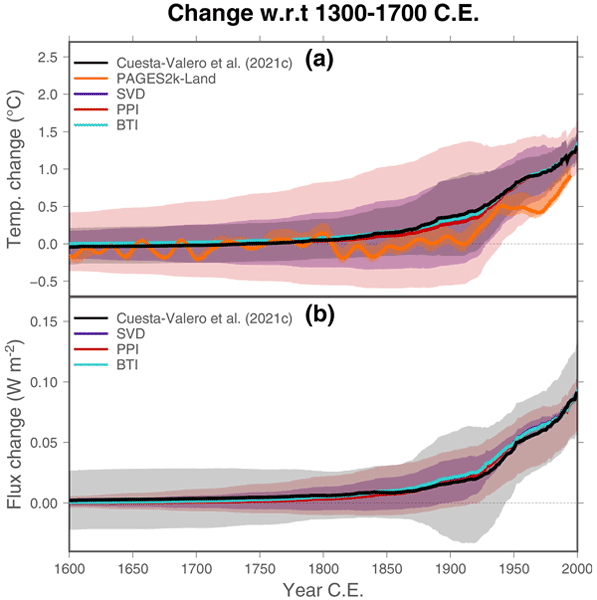
Inversions of subsurface temperature profiles provide past long-term estimates of ground surface temperature histories and ground heat flux histories at timescales of decades to millennia. Theses estimates complement high-frequency proxy temperature reconstructions and are the basis for studying continental heat storage. We develop and release a new bootstrap method to derive meaningful confidence intervals for the average surface temperature and heat flux histories from any number of profiles.
Jorge Tamayo, Ernesto Rodriguez-Camino, Alfonso Hernanz, and Sara Covaleda
Adv. Sci. Res., 19, 105–115, https://doi.org/10.5194/asr-19-105-2022, https://doi.org/10.5194/asr-19-105-2022, 2022
Short summary
Short summary
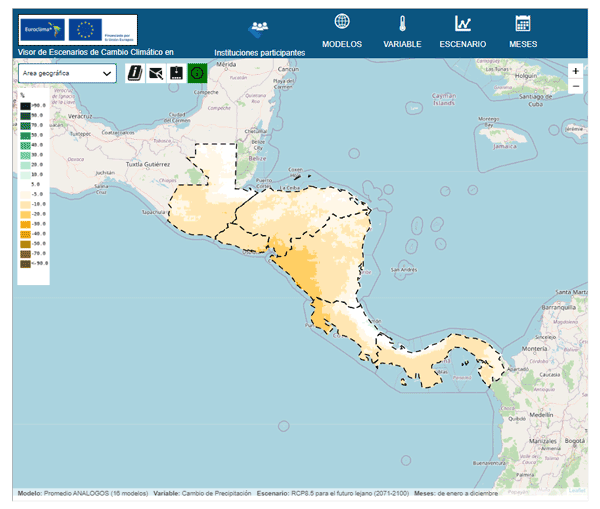
There has been developed for Central America downscaled climate change scenarios using the same methodology, that allows a joint analysis for the whole region. The high number of simulations improves the situation prior to the start of the action, where each country had a limited number of projections that differed in terms of background information, methodology and resolution. A web based viewer allows consultations and download on 37 different climatic variables and derived indices.

Almudena García-García, Francisco José Cuesta-Valero, Hugo Beltrami, J. Fidel González-Rouco, and Elena García-Bustamante
Geosci. Model Dev., 15, 413–428, https://doi.org/10.5194/gmd-15-413-2022, https://doi.org/10.5194/gmd-15-413-2022, 2022
Short summary
Short summary
We study the sensitivity of a regional climate model to resolution and soil scheme changes. Our results show that the use of finer resolutions mainly affects precipitation outputs, particularly in summer due to changes in convective processes. Finer resolutions are associated with larger biases compared with observations. Changing the land surface model scheme affects the simulation of near-surface temperatures, yielding the lowest biases in mean temperature with the most complex soil scheme.
Cited articles
Adler, C., Wester, P., Bhatt, I., Huggel, C., Insarov, G., Morecroft, M., Muccione, V., and Prakash, A.: Cross-Chapter Paper 5: Mountains, in: Climate Change 2022: Impacts, Adaptation and Vulnerability. Contribution of Working Group II to the Sixth Assessment Report of the Intergovernmental Panel on Climate Change, edited by: Pörtner, H.-O., Roberts, D. C., Tignor, M., Poloczanska, E. S., Mintenbeck, K., Alegría, A., Craig, M., Langsdorf, S., Löschke, S., Möller, V., Okem, A., and Rama, B., Cambridge University Press, Cambridge, UK and New York, NY, USA, 2273–2318, https://doi.org/10.1017/9781009325844.022, 2022. a
AEMET and IPMA: Atlas climático ibérico: temperatura del aire y precipitación (1971–2000), 1st Edn., Agencia Estatal de Meteorología, Instituto Português do Mar e da Atmosfera, ISBN 978-84-7837-079-5, 2011. a
Ali, E., Cramer, W., Carnicer, J., Georgopoulou, E., Hilmi, N. J. M., Le Cozannet, G., and Lionello, P.: Cross-Chapter Paper 4: Mediterranean Region, in: Climate Change 2022: Impacts, Adaptation and Vulnerability. Contribution of Working Group II to the Sixth Assessment Report of the Intergovernmental Panel on Climate Change, edited by: Pörtner, H.-O., Roberts, D. C., Tignor, M., Poloczanska, E. S., Mintenbeck, K., Alegría, A., Craig, M., Langsdorf, S., Löschke, S., Möller, V., Okem, A., and Rama, B., Cambridge University Press, Cambridge, UK and New York, NY, USA, 2233–2272, https://doi.org/10.1017/9781009325844.021, 2022. a
Ban, N., Caillaud, C., Coppola, E., Pichelli, E., Sobolowski, S., Adinolfi, M., Ahrens, B., Alias, A., Anders, I., Bastin, S., Belušić, D., Berthou, S., Brisson, E., Cardoso, R. M., Chan, S. C., Christensen, O. B., Fernández, J., Fumière, J., Gorodetskaya, I. V., Giorgi, F., Hodnebrog, Ø., Kerschner, M., Kjellström, E., Lenderink, G., Lung, T., and Milovac, J.: The first multi-model ensemble of regional climate simulations at kilometer-scale resolution, part I: evaluation of precipitation, Clim. Dynam., 57, 275–302, https://doi.org/10.1007/S00382-021-05708-W, 2021. a
Barry, R.: Mountain weather and climate, 3rd Edn., Cambridge University Press, New York, USA, ISBN 978-0-521-68158-2, 2008. a
Bello-Millán, F. J., Palacios, J., Gutierrez-Castillo, P., and Parras, L.: Simulations of a tornadic supercell event in the south of Spain: Sensitivity to initial and boundary conditions and microphysics parameterizations, Atmos. Res., 300, https://doi.org/10.1016/j.atmosres.2024.107262, 2024. a
Belušić, D., de Vries, H., Dobler, A., Landgren, O., Lind, P., Lindstedt, D., Pedersen, R. A., Sánchez-Perrino, J. C., Toivonen, E., van Ulft, B., Wang, F., Andrae, U., Batrak, Y., Kjellström, E., Lenderink, G., Nikulin, G., Pietikäinen, J.-P., Rodríguez-Camino, E., Samuelsson, P., van Meijgaard, E., and Wu, M.: HCLIM38: a flexible regional climate model applicable for different climate zones from coarse to convection-permitting scales, Geosci. Model Dev., 13, 1311–1333, https://doi.org/10.5194/gmd-13-1311-2020, 2020. a
Bi-Yun, S. and Xun-Qiang, B.: Validation for a tropical belt version of WRF: sensitivity tests on radiation and cumulus convection parameterizations, Atmos. Sci. Lett., 12, 192–200, https://doi.org/10.1080/16742834.2019.1590118, 2019. a
Bindoff, N., Stott, P., AchutaRao, K., Allen, M., Gillett, N., Gutzler, D., Hansingo, K., Hegerl, G., Hu, Y., Jain, S., Mokhov, I., Overland, J., Perlwitz, J., Sebbari, R., and Zhang, X.: Detection and Attribution of Climate Change: from Global to Regional, in: Climate Change 2013: The Physical Science Basis. Contribution of Working Group I to the Fifth Assessment Report of the Intergovernmental Panel on Climate Change, edited by: Stocker, T. F., Qin, D., Plattner, G.-K., Tignor, M., Allen, S. K., Boschung, J., Nauels, A., Xia, Y., Bex, V., and Midgley, P. M., Cambridge University Press, Cambridge, UK and New York, NY, USA, https://doi.org/10.1017/CBO9781107415324, 2013. a
Bopape, M.-J. M., Cardoso, H., Plant, R. S., Phaduli, E., Chikoore, H., Ndarana, T., Khalau, L., and Rakate, E.: Sensitivity of tropical cyclone Idai simulations to cumulus parametrization schemes, Atmosphere, 12, 932, https://doi.org/10.3390/atmos12080932, 2021. a
Cano Espadas, D., Palacio, J. I., Téllez, B., and Arias, P.: Estudio de las zonas más favorables para el desarrollo de tormentas en la Meseta Meridional, in: El Tiempo del Clima, edited by: Pérez Cueva, A. J., López Baeza, E., and Tamayo Carmona, J., Asociación Española de Climatología, Valencia, Spain, 313–324, 2001. a
Caretta, M., Mukherji, A., Arfanuzzaman, M., Betts, R., Gelfan, A., Hirabayashi, Y., Lissner, T., Liu, J., Gunn, E. L., Morgan, R., Mwanga, S., and Supratid, S.: Water, in: Climate Change 2022: Impacts, Adaptation, and Vulnerability. Contribution of Working Group II to the Sixth Assessment Report of the Intergovernmental Panel on Climate Change, edited by: Pörtner, H.-O., Roberts, D. C., Tignor, M., Poloczanska, E. S., Mintenbeck, K., Alegrí, A., a, Craig, M., Langsdorf, S., Löschke, S., Möller, V., Okem, A., Rama, B., Cambridge University Press, https://doi.org/10.1017/9781009325844.006, 2022. a
Casado, M. J. and Pastor, M. A.: Circulation types and winter precipitation in Spain, Int. J. Climatol., 36, 2727–2742, https://doi.org/10.1002/joc.3860, 2016. a
Collins, M., Knutti, R., Arblaster, J., Dufresne, J.-L., Fichefet, T., Friedlingstein, P., Gao, X., Gutowski, W., Johns, T., Krinner, G., Shongwe, M., Tebaldi, C., Weaver, A., and Wehner, M.: Long-term Climate Change: Projections, Commitments and Irreversibility, in: Climate Change 2013: The Physical Science Basis. Contribution of Working Group I to the Fifth Assessment Report of the Intergovernmental Panel on Climate Change, edited by: Stocker, T. F., Qin, D., Plattner, G.-K., Tignor, M., Allen, S. K., Boschung, J., Nauels, A., Xia, Y., Bex, V., and Midgley, P. M., Cambridge University Press, Cambridge, UK and New York, NY, USA, https://doi.org/10.1017/CBO9781107415324.024, 2013. a
Cos, J., Doblas-Reyes, F., Jury, M., Marcos, R., Bretonnière, P.-A., and Samsó, M.: The Mediterranean climate change hotspot in the CMIP5 and CMIP6 projections, Earth Syst. Dynam., 13, 321–340, https://doi.org/10.5194/esd-13-321-2022, 2022. a
Danielson, J. J. and Gesch, D. B.: Global multi-resolution terrain elevation data 2010 (GMTED2010), U. S. Department of the Interior, U. S. Geological Survey Washington, DC, USA, 2011–1073, 26 pp., https://doi.org/10.3133/ofr20111073, 2011. a, b
Durán, L., Sánchez, E., and Yagüe, C.: Climatology of precipitation over the Iberian Central System mountain range, Int. J. Climatol., 33, 2260–2273, https://doi.org/10.1002/joc.3602, 2013. a
Durán, L., Rodríguez-Fonseca, B., Yagüe, C., and Sánchez, E.: Water vapour flux patterns and precipitation at Sierra de Guadarrama mountain range (Spain), Int. J. Climatol., 35, 1593–1610, https://doi.org/10.1002/joc.4079, 2015. a
Fernández-Castillo, P., Román-Cascón, C., and Yagüe, C.: Impact of snow cover on the surface energy balance and its contribution to the extreme cold wave in Spain after snowstorm Filomena, Atmos. Res., 320, 108015, https://doi.org/10.1016/j.atmosres.2025.108015, 2025. a
Font Tullot, I.: Climatología de España y Portugal, 2nd edn., Universidad de Salamanca, Salamanca, Spain, ISBN 978-84-7800-944-2, 2000. a
Fox-Kemper, B., Hewitt, H., Xiao, C., Aðalgeirsdóttir, G., Drijfhout, S., Edwards, T., Golledge, N., Hemer, M., Kopp, R., Krinner, G., Mix, A., Notz, D., Nowicki, S., Nurhati, I., Ruiz, L., Sallée, J.-B., Slangen, A., and Yu, Y.: Ocean, Cryosphere and Sea Level Change, in: Climate Change 2021: The Physical Science Basis. Contribution of Working Group I to the Sixth Assessment Report of the Intergovernmental Panel on Climate Change, edited by: Masson-Delmotte, V., Zhai, P., Pirani, A., Connors, S. L., Péan, C., Berger, S., Caud, N., Chen, Y., Goldfarb, L., Gomis, M. I., Huang, M., Leitzell, K., Lonnoy, E., Matthews, J. B. R., Maycock, T. K., Waterfield, T., Yelekçi, O., Yu, R., and Zhou, B., Cambridge University Press, Cambridge, UK and New York, NY, USA, https://doi.org/10.1017/9781009157896.011, 2021. a
García-Pereira, F., González-Rouco, J. F., Melo-Aguilar, C., Steinert, N. J., García-Bustamante, E., de Vrese, P., Jungclaus, J., Lorenz, S., Hagemann, S., Cuesta-Valero, F. J., García-García, A., and Beltrami, H.: First comprehensive assessment of industrial-era land heat uptake from multiple sources, Earth Syst. Dynam., 15, 547–564, https://doi.org/10.5194/esd-15-547-2024, 2024a. a
García-Pereira, F., González-Rouco, J. F., Schmid, T., Melo-Aguilar, C., Vegas-Cañas, C., Steinert, N. J., Roldán-Gómez, P. J., Cuesta-Valero, F. J., García-García, A., Beltrami, H., and de Vrese, P.: Thermodynamic and hydrological drivers of the soil and bedrock thermal regimes in central Spain, SOIL, 10, 1–21, https://doi.org/10.5194/soil-10-1-2024, 2024b. a
Giorgi, F.: Climate change hot-spots, Geophys. Res. Lett., 33, L08707, https://doi.org/10.1029/2006GL025734, 2006. a
Gitay, H., Suárez, A., Watson, R. T., and Dokken, D. J.: Climate change and biodiversity, IPCC Technical Paper V, IPCC Working Group II, Technical Support Unit, ISBN 92-9169-104-7, 2002. a
Gómez-Navarro, J., Montávez, J., Jerez, S., Jiménez-Guerrero, P., and Zorita, E.: What is the role of the observational dataset in the evaluation and scoring of climate models?, Geophys. Res. Lett., 39, https://doi.org/10.1029/2012GL054206, 2012. a
González-Rouco, J. F., Steinert, N. J., García-Bustamante, E., Hagemann, S., de Vresse, P., Jungclaus, J. J., Lorenz, S. J., Melo-Aguilar, C., García-Pereira, F., and Navarro, J.: Increasing the depth of a Land Surface Model. Part I: Impacts on the soil thermal regime and energy storage, J. Hidro. Met., 22, 3211–3230, https://doi.org/10.1175/JHM-D-21-0024.1, 2021. a
Greciano-Zamorano, E., González-Rouco, J. F., Navarro-Montesinos, J., Vegas-Cañas, C., Rodríguez-Guisado, E., Rodríguez-Camino, E., García-Pereira, F., García-Bustamante, E., and Madera-Sánchez, S.: Evaluation of precipitation variability over complex terrain based on observations and high resolution WRF v4.2.2 modelling: open data (1.1), Zenodo [data set], https://doi.org/10.5281/zenodo.19712267, 2026. a
Grell, G. A. and Freitas, S. R.: A scale and aerosol aware stochastic convective parameterization for weather and air quality modeling, Atmos. Chem. Phys., 14, 5233–5250, https://doi.org/10.5194/acp-14-5233-2014, 2014. a
Haeberli, W. and Beniston, M.: Climate change and its impacts on glaciers and permafrost in the Alps, Ambio, 27, 258–265, 1998. a
Hahmann, A. N., Sīle, T., Witha, B., Davis, N. N., Dörenkämper, M., Ezber, Y., García-Bustamante, E., González-Rouco, J. F., Navarro, J., Olsen, B. T., and Söderberg, S.: The making of the New European Wind Atlas – Part 1: Model sensitivity, Geosci. Model Dev., 13, 5053–5078, https://doi.org/10.5194/gmd-13-5053-2020, 2020. a
Hartmann, D. L.: Global Physical Climatology, 2nd edn., Elsevier Academic Press, Amsterdam, Netherlands, ISBN 978-0-12-328531-7, 2015. a
Hersbach, H., Bell, B., Berrisford, P., Hirahara, S., Horányi, A., Muñoz-Sabater, J., Nicolas, J., Peubey, C., Radu, R., Schepers, D., Simmons, A., Soci, C., Abdalla, S., Abellan, X., Balsamo, G., and Dee, D.: The ERA5 global reanalysis, Q. J. Roy. Meteor. Soc., 146, 1999–2049, https://doi.org/10.1002/qj.3803, 2020. a, b, c
Huang, B., Liu, C., Banzon, V., Freeman, E., Graham, G., Hankins, B., Smith, T., and Zhang, H.-M.: Improvements of the daily optimum interpolation sea surface temperature (DOISST) version 2.1, J. Climate, 34, 2923–2939, https://doi.org/10.1175/JCLI-D-20-0166.1 (V2.1), 2021. a, b
Iacono, M. J., Delamere, J. S., Mlawer, E. J., Shephard, M. W., Clough, S. A., and Collins, W. D.: Radiative forcing by long-lived greenhouse gases: calculations with the AER radiative transfer models, J. Geophys. Res., 113, D13, https://doi.org/10.1029/2008JD009944, 2008. a, b, c
IPCC: Climate Change 2021: The Physical Science Basis. Contribution of Working Group I to the Sixth Assessment Report of the Intergovernmental Panel on Climate Change, edited by: Masson-Delmotte, V., Zhai, P., Pirani, A., Connors, S. L., Péan, C., Berger, S., Caud, N., Chen, Y., Goldfarb, L., Gomis, M. I., Huang, M., Leitzell, K., Lonnoy, E., Matthews, J. B. R., Maycock, T. K., Waterfield, T., Yelekçi, O., Yu, R., and Zhou, B., Cambridge University Press, Cambridge, UK and New York, NY, USA, 2391 pp., https://doi.org/10.1017/9781009157896, 2021. a, b
Jiménez, P. A., Dudhia, J., González-Rouco, J. F., Montávez, J., García-Bustamante, E., Navarro, J., Vilà-Guerau de Arellano, J., and Muñoz-Roldán, A.: An evaluation of WRF's ability to reproduce the surface wind over complex terrain based on typical circulation patterns, J. Geophys. Res., 118, 7651–7669, https://doi.org/10.1002/jgrd.50585, 2013a. a
Jiménez, P. A., González-Rouco, J. F., Montávez, J. P., García-Bustamante, E., Navarro, J., and Dudhia, J.: Analysis of the long-term surface wind variability over complex terrain using a high spatial resolution WRF simulation, Clim. Dyan., 40, 1643–1656, https://doi.org/10.1007/s00382-012-1326-z, 2013b. a
Lind, P., Belušić, D., Christensen, O. B., Dobler, A., Kjellström, E., Landgren, O., Lindstedt, D., Matte, D., Pedersen, R. A., Toivonen, E., Wang, F., Wu, M., and Zorita, E.: Benefits and added value of convection-permitting climate modeling over Fenno-Scandinavia, Clim. Dynam., 55, 1893–1912, https://doi.org/10.1007/s00382-020-05359-3, 2020. a, b
Mansell, E. R., Ziegler, C. L., and Bruning, E. C.: Simulated electrification of a small thunderstorm with two-moment bulk microphysics, J. Atmos. Sci., 67, 171–194, https://doi.org/10.1175/2009JAS2965.1, 2010. a
Mejías Moreno, M., Pozo Tejado, J. d., Albacete Carreño, L., and Villarroya, F.: El agua en la Sierra de Guadarrama, Bol. R. Soc. Esp. Hist. Nat. Sec. Geol, 110, 65–88, 2016. a
Morán-Tejeda, E., Llorente-Pinto, J. M., Ceballos-Barbancho, A., Tomás-Burguera, M., A.-M., C., E., A.-G., Revuelto, J., J., H., and J. I., L.-M.: The significance of monitoring high mountain environments to detect heavy precipitation hotspots: a case study in Gredos, Central Spain, Theor. Appl. Climatol., 146, 1174–1118, https://doi.org/10.1007/s00704-021-03791-x, 2021. a
Nakanishi, M. and Niino, H.: An improved Mellor–Yamada level-3 model: Its numerical stability and application to a regional prediction of advection fog, Bound.-Lay Meteorol., 119, 397–407, https://doi.org/10.1007/s10546-005-9030-8, 2006. a, b, c, d
Navarro-Montesinos, J., Greciano-Zamorano, E., González-Rouco, J., Vegas-Cañas, C., Rodríguez-Guisado, E., Rodríguez-Camino, E., García-Pereira, F., García-Bustamante, E., and Madera-Sánchez, S.: Evaluation of precipitation variability over complex terrain based on observations and high resolution WRF v4.2.2 modelling: source code (1.0) [Software], Zenodo, https://doi.org/10.5281/zenodo.19663814, 2026. a
Niu, G.-Y., Yang, Z.-L., Mitchell, K. E., Chen, F., Ek, M. B., Barlage, M., Kumar, A., Manning, K., Niyogi, D., Rosero, E., Tewari, M., and You, X.: The community Noah land surface model with multiparameterization options (Noah-MP): 1. Model description and evaluation with local-scale measurements, J. Geophys. Res.-Atmos., 116, D12109, https://doi.org/10.1029/2010JD015139, 2011. a, b
Nuñez, S., Arets, E., Alkemade, R., Verwer, C., and Leemans, R.: Assessing the impacts of climate change on biodiversity: is below 2 °C enough?, Climatic Change, 154, 351–365, https://doi.org/10.1007/s10584-019-02420-x, 2019. a
Prein, A., Langhans, W., Fosser, G., Ferrone, A., Ban, N., Goergen, K., Keller, M., Tolle, M., Gutjahr, O., Feser, F., and Brisson, E.: A review on regional convection-permitting climate modeling: Demonstrations, prospects, and challenges, Rev. Geophys., 53, 323–361, https://doi.org/10.1002/2014RG000475, 2015. a, b
Pörtner, H.-O., Roberts, D., Poloczanska, E., Mintenbeck, K., Tignor, M., Alegría, A., Craig, M., S. Langsdorf, S. L., Möller, V., and Okem, A.: Summary for Policymakers, in: Climate Change 2022: Impacts, Adaptation, and Vulnerability. Contribution of Working Group II to the Sixth Assessment Report of the Intergovernmental Panel on Climate Change, edited by: Pörtner, H.-O., Roberts, D. C., Tignor, M., Poloczanska, E. S., Mintenbeck, K., Alegría, A., Craig, M., Langsdorf, S., Löschke, S., Möller, V., Okem, A., Rama, B., Cambridge University Press, 3–33, https://doi.org/10.1017/9781009325844.001, 2022. a, b
Reynolds, R. W., Smith, T. M., Liu, C., Chelton, D. B., Casey, K. S., and Schlax, M. G.: Daily high-resolution-blended analyses for sea surface temperature, J. Climate, 20, 5473–5496, https://doi.org/10.1175/2007JCLI1824.1, 2007. a, b
Solano-Farias, F., Ojeda, M. G.-V., Donaire-Montaño, D., Rosa-Cánovas, J. J., Castro-Díez, Y., Esteban-Parra, M. J., and Gámiz-Fortis, S. R.: Assessment of physical schemes for WRF model in convection-permitting mode over southern Iberian Peninsula, Atmos. Res., 299, 107175, https://doi.org/10.1016/j.atmosres.2023.107175, 2024. a, b, c, d
Thompson, G., Field, P. R., Rasmussen, R. M., and Hall, W. D.: Explicit forecasts of winter precipitation using an improved bulk microphysics scheme. Part II: Implementation of a new snow parameterization, Mon. Weather Rev., 136, 5095–5115, https://doi.org/10.1175/2008MWR2387.1, 2008. a, b
Tomassini, L., Willett, M., Sellar, A., Lock, A., Walters, D., Whitall, M., Sanchez, C., Heming, J., Earnshaw, P., Rodriguez, J. M., Roff, G., Edwards, J., Williams, K., Bodas-Salcedo, A., Hill, P., and Milton, S.: Confronting the convective gray zone in the global configuration of the Met Office Unified Model, J. Adv. Model. Earth Sy., 15, e2022MS003418, https://doi.org/10.1029/2022MS003418, 2023. a
Torres-Vázquez, M. Á., Halifa-Marín, A., Montávez, J. P., and Turco, M.: High resolution monitoring and probabilistic prediction of meteorological drought in a Mediterranean environment, Weather and Climate Extremes, 40, 100558, https://doi.org/10.1016/j.wace.2023.100558, 2023. a
Van der Plas, E., Schmeits, M., Hooijman, N., and Kok, K.: A comparative verification of high-resolution precipitation forecasts using model output statistics, Mon. Weather Rev., 145, 4037–4054, https://doi.org/10.1175/MWR-D-16-0256.1, 2017. a
Vegas-Cañas, C., González-Rouco, J. F., Navarro-Montesinos, J., García-Bustamante, E., Lucio-Eceiza, E. E., García-Pereira, F., Rodríguez-Camino, E., Chazarra-Bernabé, A., and Álvarez Arévalo, I.: An Assessment of Observed and Simulated Temperature Variability in Sierra de Guadarrama, Atmosphere, 11, 1–25, https://doi.org/10.3390/atmos11090985, 2020. a, b, c, d, e
Vergara-Temprado, J., Ban, N., Panosetti, D., Schlemmer, L., and Schär, C.: Climate models permit convection at much coarser resolutions than previously considered, J. Climate, 33, 1915–1933, https://doi.org/10.1175/JCLI-D-19-0286.1, 2020. a
Vicente-Serrano, S. M., Tramblay, Y., Reig, F., González-Hidalgo, J. C., Beguería, S., Brunetti, M., Kalin, K. C., Patalen, L., Kržič, A., Lionello, P., Scoccimarro, E., Schubert, S., Toreti, A., and Xoplaki, E.: High temporal variability not trend dominates Mediterranean precipitation, Nature, 639, 658–666, https://doi.org/10.1038/s41586-024-08576-6, 2025. a
Viceto, C., Cardoso Pereira, S., and Rocha, A.: Climate Change Projections of Extreme Temperatures for the Iberian Peninsula, Atmosphere, 10, 2073–4433, https://doi.org/10.3390/atmos10050229, 2019. a
Von Storch, H. and Zwiers, F. W.: Statistical analysis in climate research, Cambridge University Press, ISBN 978-0-521-45071-3, 1999. a
Wang, W.: Forecasting Convection with a “Scale-Aware” Tiedtke Cumulus Parameterization Scheme at Kilometer Scales, Weather Forecast., 37, 1491–1507, https://doi.org/10.1175/WAF-D-21-0179.1, 2022. a
Wang, W., Dudhia, J., and Chen, M.: Application of WRF–How to get better performance, National Center for Atmos. Res., Boulder, CO, USA, January 2018, 2019. a
Wang, W., Bruyère, C., Duda, M., Dudhia, J., Gill, D., Kavulich, M., Keene, K., Lin, H.-C., Michalakes, J., Rizvi, S., and Zhang, X.: User’s Guide for the Advanced Research WRF (ARW) Modeling System, Version 4.2, NCAR Technical Report, National Center for Atmospheric Research, Boulder, CO, USA, 2020. a, b, c, d
Yao, T., Thompson, L., Chen, D., Zhang, Y., Wang, N., Zhao, L., Che, T., Xu, B., Wu, G., Zhang, F., Yu, W., Zhao, H., and Kang, S.: Third Pole climate warming and cryosphere system changes, World Meteorol. Orga. Bull., 69, 38–44, 2020. a
Short summary
This study compares observed and simulated rainfall in a mountainous area in central Spain from 1991 to 2020. It uses data from high and low elevations, along with long-term simulations and tests at very fine detail. While the finest detail tends to overestimate rainy days, it better captures heavy rainfall events. Overall, the results improve understanding of rainfall patterns and the benefits of higher detail.
This study compares observed and simulated rainfall in a mountainous area in central Spain from...


Altmetrics
Final-revised paper
Preprint