
Articles | Volume 18, issue 22
https://doi.org/10.5194/gmd-18-9219-2025
© Author(s) 2025. This work is distributed under
the Creative Commons Attribution 4.0 License.
the Creative Commons Attribution 4.0 License.
Special issue:
https://doi.org/10.5194/gmd-18-9219-2025
© Author(s) 2025. This work is distributed under
the Creative Commons Attribution 4.0 License.
the Creative Commons Attribution 4.0 License.
Development and technical paper
| 
28 Nov 2025
Development and technical paper |
| 28 Nov 2025
| 28 Nov 2025
Exploiting physics-based machine learning to quantify geodynamic effects – insights from the Alpine region

Institute of Applied Geosciences, TU Darmstadt, Schnittspahnstraße 9, 64287 Darmstadt, Germany
GFZ Helmholtz Centre for Geosciences, Telegrafenberg, 14473 Potsdam, Germany
Ajay Kumar
GFZ Helmholtz Centre for Geosciences, Telegrafenberg, 14473 Potsdam, Germany
Department of Earth and Climate Science, IISER Pune, Pune, India
Magdalena Scheck-Wenderoth
Sediment Basins and Georesources, TU Berlin, Ernst-Reuter-Platz 1, 10587 Berlin, Germany
GFZ Helmholtz Centre for Geosciences, Telegrafenberg, 14473 Potsdam, Germany
Mauro Cacace
GFZ Helmholtz Centre for Geosciences, Telegrafenberg, 14473 Potsdam, Germany
Related authors
Denise Degen, Moritz Ziegler, Oliver Heidbach, Andreas Henk, Karsten Reiter, and Florian Wellmann
Solid Earth, 16, 477–502, https://doi.org/10.5194/se-16-477-2025, https://doi.org/10.5194/se-16-477-2025, 2025
Short summary
Short summary
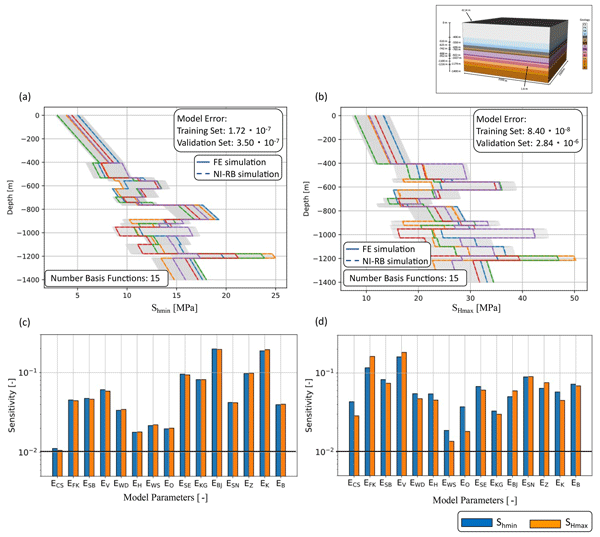
Obtaining reliable estimates of the subsurface state distributions is essential to determine the location of, e.g., potential nuclear waste disposal sites. However, providing these is challenging since it requires solving the problem numerous times, yielding high computational cost. To overcome this, we use a physics-based machine learning method to construct surrogate models. We demonstrate how it produces physics-preserving predictions, which differentiates it from purely data-driven approaches.
Denise Degen, Daniel Caviedes Voullième, Susanne Buiter, Harrie-Jan Hendricks Franssen, Harry Vereecken, Ana González-Nicolás, and Florian Wellmann
Geosci. Model Dev., 16, 7375–7409, https://doi.org/10.5194/gmd-16-7375-2023, https://doi.org/10.5194/gmd-16-7375-2023, 2023
Short summary
Short summary
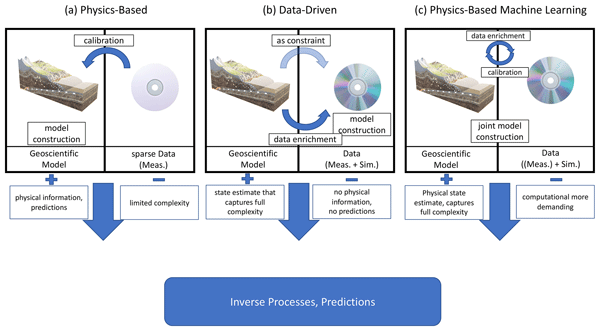
In geosciences, we often use simulations based on physical laws. These simulations can be computationally expensive, which is a problem if simulations must be performed many times (e.g., to add error bounds). We show how a novel machine learning method helps to reduce simulation time. In comparison to other approaches, which typically only look at the output of a simulation, the method considers physical laws in the simulation itself. The method provides reliable results faster than standard.
Denise Degen, Cameron Spooner, Magdalena Scheck-Wenderoth, and Mauro Cacace
Geosci. Model Dev., 14, 7133–7153, https://doi.org/10.5194/gmd-14-7133-2021, https://doi.org/10.5194/gmd-14-7133-2021, 2021
Short summary
Short summary
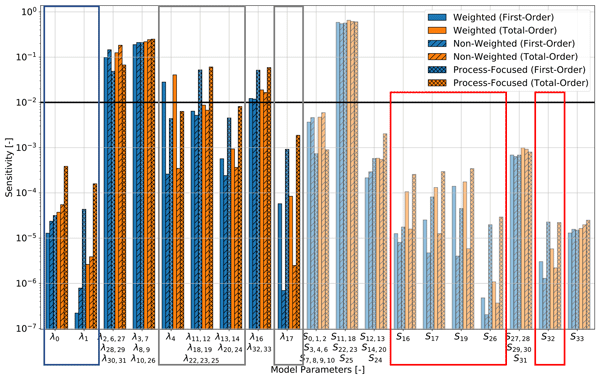
In times of worldwide energy transitions, an understanding of the subsurface is increasingly important to provide renewable energy sources such as geothermal energy. To validate our understanding of the subsurface we require data. However, the data are usually not distributed equally and introduce a potential misinterpretation of the subsurface. Therefore, in this study we investigate the influence of measurements on temperature distribution in the European Alps.
Waqas Hussain, Mauro Cacace, Andrea Bistacchi, and Riccardo Monti
EGUsphere, https://doi.org/10.5194/egusphere-2026-4815, https://doi.org/10.5194/egusphere-2026-4815, 2026
This preprint is open for discussion and under review for Solid Earth (SE).
Short summary
Short summary
PyMeshIt provides an automated way to turn complex three-dimensional geological surfaces into consistent volume models. Its main advance is the ability to handle folded surfaces, concave boundaries, and intersecting structures that are difficult for conventional meshing approaches. Tests on synthetic and real geological examples show that it extends the earlier MeshIt method to more complex geometries while preserving important geological boundaries and labels.
Mohammad Sabah, Mauro Cacace, Inga Berre, Iman R. Kivi, and Hannes Hofmann
EGUsphere, https://doi.org/10.5194/egusphere-2026-1658, https://doi.org/10.5194/egusphere-2026-1658, 2026
Short summary
Short summary
We developed a new way to simulate earthquakes triggered by fluid injection deep underground. These events involve both slow pressure build-up and rapid fault movement, which are difficult to capture together. Our method combines two calculation approaches and switches between them when needed. It reproduces earthquake behavior accurately while reducing computing time by up to seventy percent, making it more practical for assessing risks in energy and storage projects.
Denise Degen, Moritz Ziegler, Oliver Heidbach, Andreas Henk, Karsten Reiter, and Florian Wellmann
Solid Earth, 16, 477–502, https://doi.org/10.5194/se-16-477-2025, https://doi.org/10.5194/se-16-477-2025, 2025
Short summary
Short summary
Obtaining reliable estimates of the subsurface state distributions is essential to determine the location of, e.g., potential nuclear waste disposal sites. However, providing these is challenging since it requires solving the problem numerous times, yielding high computational cost. To overcome this, we use a physics-based machine learning method to construct surrogate models. We demonstrate how it produces physics-preserving predictions, which differentiates it from purely data-driven approaches.
Javier Abreu-Torres, Gergő Hutka, Guido Blöcher, Mauro Cacace, Vincent Magnenet, and Jean Schmittbuhl
Adv. Geosci., 65, 117–125, https://doi.org/10.5194/adgeo-65-117-2025, https://doi.org/10.5194/adgeo-65-117-2025, 2025
Short summary
Short summary
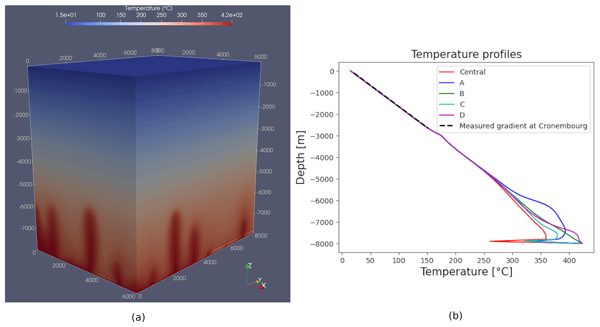
We develop a simplified model which describes the geological geometry of the Vendenheim site, the solid and fluid properties were adapted from studies in the area. We implement compute the hydrothermal flow with a temperature dependent density and viscosity in a porous medium, in order to verify if a hydrothermal convective system is compatible with known observations at the Vendenheim site, and to get a better idea of the initial conditions of a model for an induced seismicity model.
Kalliopi Tzoufka, Guido Blöcher, Mauro Cacace, Daniela Pfrang, and Kai Zosseder
Adv. Geosci., 65, 103–111, https://doi.org/10.5194/adgeo-65-103-2024, https://doi.org/10.5194/adgeo-65-103-2024, 2024
Short summary
Short summary
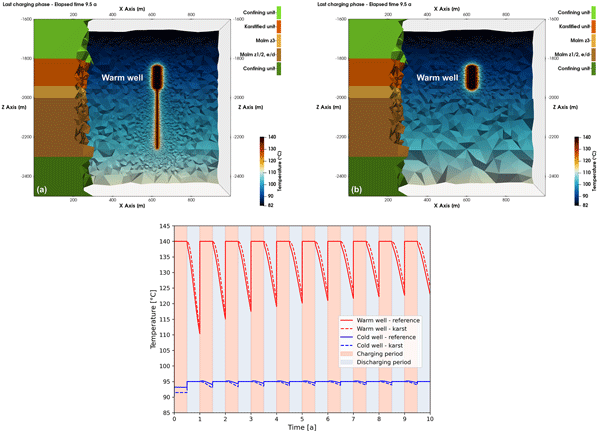
Concepts of High-Temperature Aquifer Thermal Energy Storage (HT-ATES) are investigated for system application in the German Molasse Basin. We quantify via physics-based numerical modelling the system performance with respect to HT-ATES concept development and provide a predictive analysis of HT-ATES application in the Upper Jurassic reservoir. Results demonstrate a non-uniform layer-specific distribution of the thermal front propagation, while promising heat recovery efficiencies are predicted.
Ángela María Gómez-García, Álvaro González, Mauro Cacace, Magdalena Scheck-Wenderoth, and Gaspar Monsalve
Solid Earth, 15, 281–303, https://doi.org/10.5194/se-15-281-2024, https://doi.org/10.5194/se-15-281-2024, 2024
Short summary
Short summary
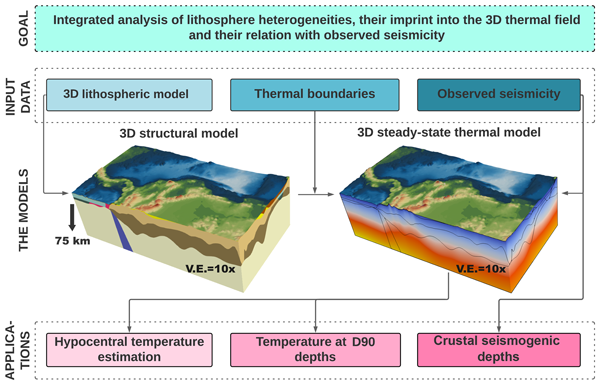
We compute a realistic three-dimensional model of the temperatures down to 75 km deep within the Earth, below the Caribbean Sea and northwestern South America. Using this, we estimate at which rock temperatures past earthquakes nucleated in the region and find that they agree with those derived from laboratory experiments of rock friction. We also analyse how the thermal state of the system affects the spatial distribution of seismicity in this region.
Denise Degen, Daniel Caviedes Voullième, Susanne Buiter, Harrie-Jan Hendricks Franssen, Harry Vereecken, Ana González-Nicolás, and Florian Wellmann
Geosci. Model Dev., 16, 7375–7409, https://doi.org/10.5194/gmd-16-7375-2023, https://doi.org/10.5194/gmd-16-7375-2023, 2023
Short summary
Short summary
In geosciences, we often use simulations based on physical laws. These simulations can be computationally expensive, which is a problem if simulations must be performed many times (e.g., to add error bounds). We show how a novel machine learning method helps to reduce simulation time. In comparison to other approaches, which typically only look at the output of a simulation, the method considers physical laws in the simulation itself. The method provides reliable results faster than standard.
Denise Degen, Cameron Spooner, Magdalena Scheck-Wenderoth, and Mauro Cacace
Geosci. Model Dev., 14, 7133–7153, https://doi.org/10.5194/gmd-14-7133-2021, https://doi.org/10.5194/gmd-14-7133-2021, 2021
Short summary
Short summary
In times of worldwide energy transitions, an understanding of the subsurface is increasingly important to provide renewable energy sources such as geothermal energy. To validate our understanding of the subsurface we require data. However, the data are usually not distributed equally and introduce a potential misinterpretation of the subsurface. Therefore, in this study we investigate the influence of measurements on temperature distribution in the European Alps.
Cited articles
Balay, S., Abhyankar, S., Adams, M. F., Brown, J., Brune, P., Buschelman, K., Dalcin, L., Eijkhout, V., Gropp, W. D., Kaushik, D., Knepley, M. G., May, D. A., McInnes, L. C., Rupp, K., Smith, B. F., Zampini, S., Zhang, H., and Zhang, H.: PETSc Web page, http://www.mcs.anl.gov/petsc (last access: 4 September 2025), 2017. a
Bangerth, W., Dannberg, J., Fraters, M., Gassmoeller, R., Glerum, A., Heister, T., Myhill, R., and Naliboff, J.: geodynamics/aspect: ASPECT 2.5.0 (v2.5.0), Zenodo [code], https://doi.org/10.5281/zenodo.8200213, 2023. a
Brisson, S., Degen, D., Nathan, D., Wellmann, F., and von Hagke, C.: Combining 3‐D probabilistic kinematic modeling with thermal resetting measurements: An approach to reduce uncertainty in exhumation histories. Geochemistry, Geophysics, Geosystems, 26, e2024GC011815, https://doi.org/10.1029/2024GC011815, 2025. a
Chuang, P.-Y. and Barba, L. A.: Experience report of physics-informed neural networks in fluid simulations: pitfalls and frustration, arXiv [preprint], arXiv:2205.14249, https://doi.org/10.48550/arXiv.2205.14249, 2022. a, b
Chuang, P.-Y. and Barba, L. A.: Predictive Limitations of Physics-Informed Neural Networks in Vortex Shedding, arXiv [preprint], arXiv:2306.00230, https://doi.org/10.48550/arXiv.2306.00230, 2023. a
Crameri, F., Schmeling, H., Golabek, G., Duretz, T., Orendt, R., Buiter, S., May, D., Kaus, B., Gerya, T., and Tackley, P.: A comparison of numerical surface topography calculations in geodynamic modelling: an evaluation of the `sticky air' method, Geophys. J. Int., 189, 38–54, 2012. a
Degen, D. and Cacace, M.: Effects of transient processes for thermal simulations of the Central European Basin, Geosci. Model Dev., 14, 1699–1719, https://doi.org/10.5194/gmd-14-1699-2021, 2021. a, b, c
Degen, D., Spooner, C., Scheck-Wenderoth, M., and Cacace, M.: How biased are our models? – a case study of the alpine region, Geosci. Model Dev., 14, 7133–7153, https://doi.org/10.5194/gmd-14-7133-2021, 2021a. a, b, c
Degen, D., Veroy, K., Freymark, J., Scheck-Wenderoth, M., Poulet, T., and Wellmann, F.: Global sensitivity analysis to optimize basin-scale conductive model calibration – A case study from the Upper Rhine Graben, Geothermics, 95, 102143, https://doi.org/10.1016/j.geothermics.2021.102143, 2021b. a, b
Degen, D., Cacace, M., and Wellmann, F.: 3D multi-physics uncertainty quantification using physics-based machine learning, Scientific Reports, 12, 17491, https://doi.org/10.1038/s41598-022-21739-7, 2022a. a, b, c
Degen, D., Veroy, K., and Wellmann, F.: Uncertainty quantification for basin-scale geothermal conduction models, Sci. Rep., 12, 4246, https://doi.org/10.1038/s41598-022-08017-2, 2022b. a
Degen, D., Caviedes Voullième, D., Buiter, S., Hendricks Franssen, H.-J., Vereecken, H., González-Nicolás, A., and Wellmann, F.: Perspectives of physics-based machine learning strategies for geoscientific applications governed by partial differential equations, Geosci. Model Dev., 16, 7375–7409, https://doi.org/10.5194/gmd-16-7375-2023, 2023. a, b, c, d, e, f
Degen, D., Kumar, A., Scheck-Wenderoth, M., and Cacace, M.: Non-Intrusive Reduced Basis Method – Case Study of the Alpine Region, Zenodo [code and data set], https://doi.org/10.5281/zenodo.14755256, 2025. a, b
El-Sharkawy, A., Meier, T., Lebedev, S., Behrmann, J. H., Hamada, M., Cristiano, L., Weidle, C., and Köhn, D.: The Slab Puzzle of the Alpine-Mediterranean Region: Insights From a New, High-Resolution, Shear Wave Velocity Model of the Upper Mantle, Geochem. Geophy. Geosy., 21, https://doi.org/10.1029/2020GC008993, 2020. a
Falkner, S., Klein, A., and Hutter, F.: BOHB: Robust and efficient hyperparameter optimization at scale, in: International Conference on Machine Learning, PMLR, 1437–1446, https://proceedings.mlr.press/v80/falkner18a.html (last access: 27 November 2025), 2018. a
Fichtner, A., Trampert, J., Cupillard, P., Saygin, E., Taymaz, T., Capdeville, Y., and Villaseñor, A.: Multiscale full waveform inversion, Geophys. J. Int., 194, 534–556, https://doi.org/10.1093/gji/ggt118, 2013. a
Fox, M., Herman, F., Kissling, E., and Willett, S. D.: Rapid exhumation in the Western Alps driven by slab detachment and glacial erosion, Geology, 43, 379–382, https://doi.org/10.1130/G36411.1, 2015. a
Guo, M. and Hesthaven, J. S.: Data-driven reduced order modeling for time-dependent problems, Comput. Meth. Appl. Mech. Eng., 345, 75–99, 2019. a
Handy, M. R., Schmid, S. M., Paffrath, M., and Friederich, W.: Orogenic lithosphere and slabs in the greater Alpine area – Interpretations based on teleseismic P-wave tomography, Solid Earth, 12, 2633–2669, https://doi.org/10.5194/se-12-2633-2021, 2021. a
Heister, T., Dannberg, J., Gassmöller, R., and Bangerth, W.: High Accuracy Mantle Convection Simulation through Modern Numerical Methods. II: Realistic Models and Problems, Geophys. J. Int., 210, 833–851, https://doi.org/10.1093/gji/ggx195, 2017. a, b
Hesthaven, J. S., Rozza, G., and Stamm, B. E.: Certified reduced basis methods for parametrized partial differential equations, in: Springer Briefs in Mathematics, Springer, https://doi.org/10.1007/978-3-319-22470-1, 2016. a, b
Kästle, E. D., Rosenberg, C., Boschi, L., Bellahsen, N., Meier, T., and El-Sharkawy, A.: Slab break-offs in the Alpine subduction zone, Int. J. Earth Sci., 109, 587–603, https://doi.org/10.1007/s00531-020-01821-z, 2020. a
Kaus, B. J., Mühlhaus, H., and May, D. A.: A stabilization algorithm for geodynamic numerical simulations with a free surface, Phys. Earth Planet. Inter., 181, 12–20, 2010. a
Kaus, B. J., Popov, A. A., Baumann, T., Pusok, A., Bauville, A., Fernandez, N., and Collignon, M.: Forward and inverse modelling of lithospheric deformation on geological timescales, in: Proceedings of nic symposium, vol. 48, NIC Series, NIC – John von Neumann Institute for Computing, 978–983, https://juser.fz-juelich.de/record/280633 (last access: 27 November 2025), 2016. a, b
Kronbichler, M., Heister, T., and Bangerth, W.: High Accuracy Mantle Convection Simulation through Modern Numerical Methods, Geophys. J. Int., 191, 12–29, https://doi.org/10.1111/j.1365-246X.2012.05609.x, 2012. a, b
Kumar, A.: LaMEM and ASPECT input and data files corresponding to Exploiting Physics-Based Machine Learning to Quantify Geodynamic Effects – Insights from the Alpine Region, Zenodo [data set], https://doi.org/10.5281/zenodo.17051562, 2025a. a
Kumar, A.: Pre-post process scripts and LaMEM input files to generate data for Surrogate Models, Zenodo [code and data set], https://doi.org/10.5281/zenodo.16640814, 2025b. a
Lourenço, D. L., Rozel, A. B., Ballmer, M. D., and Tackley, P. J.: Plutonic-squishy lid: A new global tectonic regime generated by intrusive magmatism on Earth-like planets, Geochem. Geophy. Geosy., 21, e2019GC008756, https://doi.org/10.1029/2019GC008756, 2020. a
Manassero, M. C., Afonso, J. C., Zyserman, F. I., Jones, A., Zlotnik, S., and Fomin, I.: A reduced order approach for probabilistic inversions of 3D magnetotelluric data II: joint inversion of MT and surface-wave data, J. Geophys. Res.-Solid, 126, e2021JB021962, https://doi.org/10.1029/2021JB021962, 2021. a
Mey, J., Scherler, D., Wickert, A. D., Egholm, D. L., Tesauro, M., Schildgen, T. F., and Strecker, M. R.: Glacial isostatic uplift of the European Alps, Nat. Commun., 7, 13382, https://doi.org/10.1038/ncomms13382, 2016. a, b
Paffrath, M., Friederich, W., Schmid, S. M., Handy, M. R., and the AlpArray and AlpArray-Swath D Working Group: Imaging structure and geometry of slabs in the greater Alpine area – a P-wave travel-time tomography using AlpArray Seismic Network data, Solid Earth, 12, 2671–2702, https://doi.org/10.5194/se-12-2671-2021, 2021. a
Rekoske, J. M., Gabriel, A. A., and May, D. A.: Instantaneous physics‐based ground motion maps using reduced‐order modeling. Journal of Geophysical Research: Solid Earth, 128, e2023JB026975, https://doi.org/10.1029/2023JB026975, 2023. a
Santoso, R., Degen, D., Cacace, M., and Wellmann, F.: State-of-the-art physics-based machine learning for hydro-mechanical simulation in geothermal applications, in: European Geothermal Congress, 1–10, https://www.researchgate.net/profile/Ryan-Santoso-2/publication/ (last access: 4 September 2025), 2022. a
Spada, M., Bianchi, I., Kissling, E., Agostinetti, N. P., and Wiemer, S.: Combining controlled-source seismology and receiver function information to derive 3-D Moho topography for Italy, Geophys. J. Int., 194, 1050–1068, https://doi.org/10.1093/gji/ggt148, 2013. a
Spooner, C., Scheck-Wenderoth, M., Götze, H.-J., Ebbing, J., Hetényi, G., and the AlpArray Working Group: Density distribution across the Alpine lithosphere constrained by 3-D gravity modelling and relation to seismicity and deformation, Solid Earth, 10, 2073–2088, https://doi.org/10.5194/se-10-2073-2019, 2019. a, b
Spooner, C., Scheck-Wenderoth, M., Cacace, M., and Anikiev, D.: How Alpine seismicity relates to lithospheric strength, Int. J. Earth Sci., 111, 1201–1221, 2022. a
Sternai, P., Sue, C., Husson, L., Serpelloni, E., Becker, T. W., Willett, S. D., Faccenna, C., Di Giulio, A., Spada, G., Jolivet, L., Valla, P., Petit, C., Nocquet, J.-M., Walpersdorf, A., and Castelltort, S.: Present-day uplift of the European Alps: Evaluating mechanisms and models of their relative contributions, Earth-Sci. Rev., 190, 589–604, 2019. a
Swischuk, R., Mainini, L., Peherstorfer, B., and Willcox, K.: Projection-based model reduction: Formulations for physics-based machine learning, Comput. Fluids, 179, 704–717, https://doi.org/10.1016/j.compfluid.2018.07.021, 2019. a, b, c
Tesauro, M., Kaban, M. K., and Cloetingh, S. A.: EuCRUST-07: A new reference model for the European crust, Geophys. Res. Lett., 35, L05313, https://doi.org/10.1029/2007GL032244, 2008. a, b
van Zelst, I., Crameri, F., Pusok, A. E., Glerum, A., Dannberg, J., and Thieulot, C.: 101 geodynamic modelling: how to design, interpret, and communicate numerical studies of the solid Earth, Solid Earth, 13, 583–637, https://doi.org/10.5194/se-13-583-2022, 2022. a
Wang, Q., Hesthaven, J. S., and Ray, D.: Non-intrusive reduced order modeling of unsteady flows using artificial neural networks with application to a combustion problem, J. Comput. Phys., 384, 289–307, https://doi.org/10.1016/j.jcp.2019.01.031, 2019. a, b
Zhu, H., Bozdăg, E., and Tromp, J.: Seismic structure of the European upper mantle based on adjoint tomography, Geophys. J. Int., 201, 18–52, https://doi.org/10.1093/gji/ggu492, 2015. a
Short summary
Geodynamical simulations cover a wide spatial and temporal range and are crucial to understand and assess the evolution of the Earth system. To enable computationally efficient modeling approaches that can account for potentially unknown subsurface properties, we present a surrogate modeling technique. This technique combines physics-based and machine-learning techniques to enable reliable predictions of geodynamical applications, as we illustrate for the case study of the Alpine Region.
Geodynamical simulations cover a wide spatial and temporal range and are crucial to understand...


Special issue