
Modelling tipping points in the Earth system (GMD/ESD) (GMD/ESD)
Modelling tipping points in the Earth system (GMD/ESD) (GMD/ESD)
Tipping dynamics are triggered when a change in part of the Earth system becomes self-perpetuating beyond a critical threshold (tipping point). This can lead to substantial, widespread, often abrupt and/or irreversible physical, biophysical and/or biogeochemical impacts, which in turn can induce far-reaching socioeconomic impacts. This collection includes papers investigating the risk, likelihood and impacts of crossing tipping points through a variety of approaches and model types, from offline standalone models of individual Earth system components to fully coupled Earth system models. The collection was initiated through TIPMIP, an international initiative that aims to systematically advance our understanding of tipping dynamics in various Earth system components and assess the associated uncertainties.
29 Jul 2026
The TIPMIP Earth system model experiment protocol: phase 1
Colin Jones, Isaline Bossert, Donovan P. Dennis, Hazel A. Jeffery, Chris D. Jones, Torben Koenigk, Sina Loriani, Benjamin Sanderson, Roland Séférian, Klaus Wyser, Shuting Yang, Manabu Abe, Sebastian Bathiany, Pascale Braconnot, Victor Brovkin, Friedrich A. Burger, Patrica Cadule, Frederic S. Castruccio, Gokhan Danabasoglu, Andrea Dittus, Jonathan F. Donges, Friederike Fröb, Thomas L. Frölicher, Goran Georgievski, Chuncheng Guo, Aixue Hu, Peter Lawrence, Paul Lerner, José Licón-Saláiz, Bette Otto-Bliesner, Anastasia Romanou, Elena Shevliakova, Yona Silvy, Didier Swingedouw, Jerry Tjiputra, Jeremy Walton, Andy Wiltshire, Ricarda Winkelmann, Richard Wood, Tokuta Yokohata, and Tilo Ziehn
Geosci. Model Dev., 19, 6941–6966, https://doi.org/10.5194/gmd-19-6941-2026, https://doi.org/10.5194/gmd-19-6941-2026, 2026
Short summary
Short summary
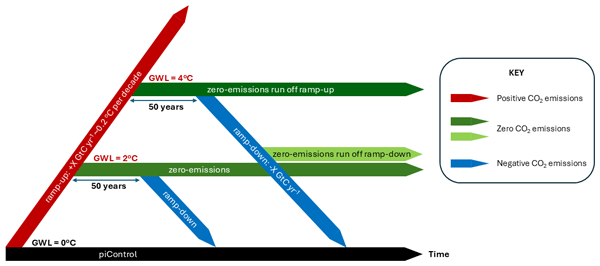
We introduce a new Earth system model experiment protocol to help researchers understand how Earth might respond to positive, zero, and negative carbon emissions. This protocol enables different models to be compared following similar warming and cooling rates. Researchers use the models to explore how the Earth reacts to different climate futures, including the risk of tipping points being exceeded and whether changes can be reversed. The results will support improved long-term climate policy.