Articles | Volume 18, issue 10
https://doi.org/10.5194/gmd-18-3157-2025
Model description paper
 | 
28 May 2025
Model description paper |  | 28 May 2025

NMH-CS 3.0: a C# programming language and Windows-system-based ecohydrological model derived from Noah-MP

Yong-He Liu and Zong-Liang Yang

Related authors

Tropical forest responses to climate extremes: an analysis using an individual-based demographic vegetation model
Mazen Nakad, Mahmoud Mbarak, Jihad Karaki, Tehreem Qureshi, Matteo Detto, Benjamin I. Cook, Marcos Longo, Géraldine Derroire, Xiangtao Xu, Jeremy Lichstein, Zong-Liang Yang, Pierre Gentine, and Ensheng Weng
EGUsphere, https://doi.org/10.5194/egusphere-2026-145,https://doi.org/10.5194/egusphere-2026-145, 2026
This preprint is open for discussion and under review for Biogeosciences (BG).
Short summary
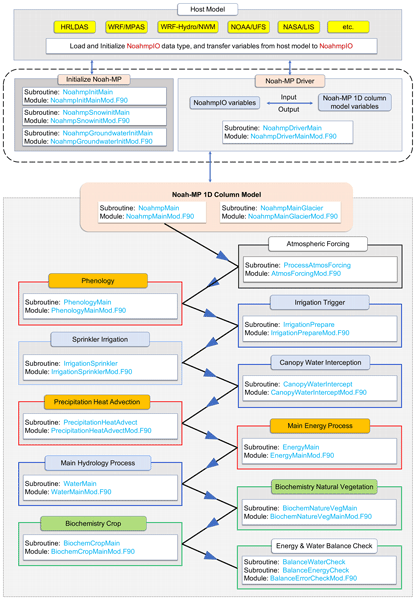
Modernizing the open-source community Noah with multi-parameterization options (Noah-MP) land surface model (version 5.0) with enhanced modularity, interoperability, and applicability
Cenlin He, Prasanth Valayamkunnath, Michael Barlage, Fei Chen, David Gochis, Ryan Cabell, Tim Schneider, Roy Rasmussen, Guo-Yue Niu, Zong-Liang Yang, Dev Niyogi, and Michael Ek
Geosci. Model Dev., 16, 5131–5151, https://doi.org/10.5194/gmd-16-5131-2023,https://doi.org/10.5194/gmd-16-5131-2023, 2023
Short summary
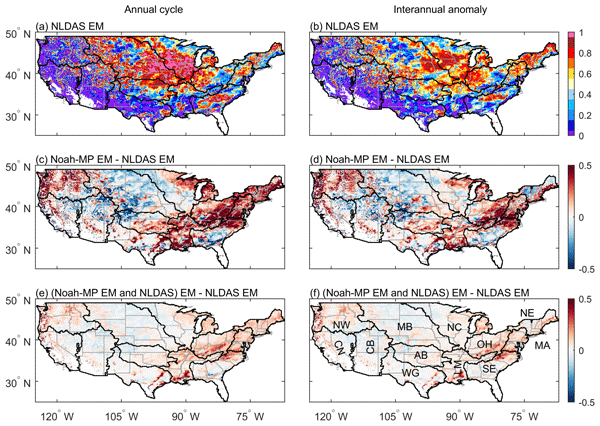
An ensemble of 48 physically perturbed model estimates of the 1∕8° terrestrial water budget over the conterminous United States, 1980–2015
Hui Zheng, Wenli Fei, Zong-Liang Yang, Jiangfeng Wei, Long Zhao, Lingcheng Li, and Shu Wang
Earth Syst. Sci. Data, 15, 2755–2780, https://doi.org/10.5194/essd-15-2755-2023,https://doi.org/10.5194/essd-15-2755-2023, 2023
Short summary
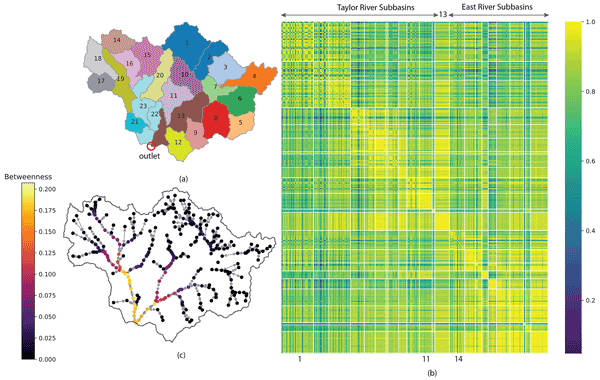
A graph neural network (GNN) approach to basin-scale river network learning: the role of physics-based connectivity and data fusion
Alexander Y. Sun, Peishi Jiang, Zong-Liang Yang, Yangxinyu Xie, and Xingyuan Chen
Hydrol. Earth Syst. Sci., 26, 5163–5184, https://doi.org/10.5194/hess-26-5163-2022,https://doi.org/10.5194/hess-26-5163-2022, 2022
Short summary

Cited articles

Bales, J.: Featured Collection Introduction: National Water Model II, J. Am. Water Resour. As., 55, 938–939, https://doi.org/10.1111/1752-1688.12786, 2019. 
Chang, M., Liao, W., Wang, X., Zhang, Q., Chen, W., Wu, Z., and Hu, Z.: An optimal ensemble of the Noah-MP land surface model for simulating surface heat fluxes over a typical subtropical forest in South China, Agr. Forest Meteorol., 281, 107815, https://doi.org/10.1016/j.agrformet.2019.107815, 2020. 
Chen, F., Manning, K. W., LeMone, M. A., Trier, S. B., Alfieri, J. G., Roberts, R., Tewari, M., Niyogi, D., Horst, T. W., Oncley, S. P., Basara, J. B., and Blanken, P. D.: Description and evaluation of the characteristics of the NCAR high-resolution land data assimilation system, J. Appl. Meteorol. Clim., 46, 694–713, https://doi.org/10.1175/JAM2463.1, 2007. 
Cunge, J. A.: On The Subject Of A Flood Propagation Computation Method (Musklngum Method), J. Hydraul. Res., 7, 205–230, https://doi.org/10.1080/00221686909500264, 1969. 
David, C. H., Yang, Z., and Famiglietti, J. S.: Quantification of the upstream-to-downstream influence in the Muskingum method and implications for speedup in parallel computations of river flow, Water Resour. Res., 49, 2783–2800, https://doi.org/10.1002/wrcr.20250, 2013. 
Download
Short summary
NMH-CS 3.0 is a C#-based ecohydrological model reconstructed from the WRF-Hydro/Noah-MP model by translating the Fortran code of WRF-Hydro 3.0 and integrating a parallel river routing module. It enables efficient execution on multi-core personal computers. Simulations in the Yellow River basin demonstrate its consistency with WRF-Hydro outputs, providing a reliable alternative to the original Noah-MP model.
Share